Feeds:
Posts
Comments

Archive for the ‘Classic Rock’ Category

TRACKLISTING (2005  edition):
Disc 1:
1. Dark Side Of The Moog (6:17)
2. Down To You (9:05)
3. Gemini And Leo (4:48)
4. Secret Places (3:59)
5. On Second Thoughts (7:30)
6. Winds (10:23)
7. Castles Version 1. (previously unreleased demo – 1975)(11:09)
8. Gary’s Lament (previously unreleased demo – 1975) (7:00)
9. Walking The Park (previously unreleased demo – 1975) (7:05)

Disc 2:
1. Night Creeper (previously unreleased demo – 1976) (3:46)
2. The Awakening (previously unreleased demo – 1976) (11:43)
3. Siren Song (previously unreleased demo – 1976) (6:55)
4. Castles Version 2. (previously unreleased demo – 1976) (5:00)
5. The Scorch (previously unreleased demo – 1976) (4:39)
6. Rivers (previously unreleased demo – 1976) (4:27)
7. Interplanetary Slut (previously unreleased demo – 1976) (5:32)
8. Dark Side Of The Moog (BBC session, In Concert – June 1976) (9:00)
9. Siren Song (BBC session, In Concert- June 1976) (12:13)
10. The Awakening (BBC session, In Concert – June 1976) (15:46)

LINEUP:
Don Airey – keyboards, synthesizers
Jon Hiseman – drums, tympani, gongs
Gary Moore – guitars, vocals
Neil Murray – bass
Mike Starrs – lead vocals

Although I had been thinking for a while of posting a review of this album for my ‘vault’ series, the sad events of today have made it almost mandatory for me to do so.  And what better way to celebrate the life and work of Irish guitar legend Gary Moore – who passed away last night at the still young age of 58 – than posting a review of an album that sees some of his finest contributions to the history of rock music?

In spite of the name, the only connection between Colosseum II and the original Colosseum is the presence of monster skinsman Jon Hiseman (so conveniently forgotten in those boring “best drummer” polls, where everybody seems to think that Portnoy and his ilk are God’s gift to drumming).  The new band also showcased the considerable talents of keyboard maestro Don Airey (who went on to replace Jon Lord in Deep Purple) and bassist Neil Murray, nowadays better known for his stints in Whitesnake and Black Sabbath. Murray tends to be given less credit than other four-stringers – in spite of having previously played with such Canterbury legends as Gilgamesh and  National Health, where he took the place left vacant by Richard Sinclair after Hatfield and the North’s demise. The musical proficiency of somebody who can keep up with both Jon Hiseman and Pip Pyle cannot be so easily disregarded, and Murray’s playing on Strange New Flesh is immaculate.

However, Colosseum II’s ace in the hole was the fiery fretboard prowess of then 24-year-old Gary Moore, formerly with Dublin-based band Skid Row. Moore’s stunning guitar work gave  Colosseum II a definitely harder edge  than the band’s former incarnation – straddling the line between Colosseum’s blues-based, sax-laden jazz-rock and Deep Purple-style hard rock. Unlike other jazz-rock bands, Colosseum II did not start out as a purely instrumental outfit. For Strange New Flesh, their debut album, Hiseman and Moore enlisted the talents of  vocalist Mike Starrs  (later with German-based band Lucifer’s Friend). For some, the sometimes overpowering presence of Starrs’s otherwise excellent vocals – a powerful tenor that, at times, oddly reminds me of a richer, more restrained version of James LaBrie – detracts from the overall brilliance of the album. Personally, though I quite like Starrs’s singing (Moore’s backing vocals being quite abrasive most of the time, though he developed quite a respectable voice in later years), I must also admit to having a slight preference for the instrumental tracks.  As Starrs (together with Murray) was subsequently fired by the band’s record label, Colosseum II’s next two albums were almost completely instrumental.

Most of the songs on the album were penned by Moore, with the exception of the Joni Mitchell cover “Down to You” – apparently an odd choice, yet rather successful, mainly thanks to Starrs’ passionate vocal performance and Moore’s beautifully melodic guitar. The album, however, opens in a completely different vein, with the blistering keyboard and guitar tour de force of the aptly-titled “Dark Side of the Moog”. “Gemini and Leo” is a funkier, jazzier track, with Starrs sounding a bit like Glenn Hughes in his Trapeze years. The following songs, “Secret Place” and On Second Thoughts” continue in much the same vein, all featuring superb interplay between the four virtuoso musicians, as well as soaring, powerful vocals. Hiseman and Murray’s propulsive rhythm section is masterful throughout, but Moore and Airey are the ones who really steal the show, Airey’s majestic keyboard sweeps duelling with Moore’s fluid yet searing lead. Original album closer “Winds” , a 10-minute-plus epic, summarizes all that is great about this record, at the same time jazzy and edgy, with plenty of tempo changes and that magnificent guitar sound.

The 2005 edition contains some real treats for fans of the band, including a number of live tracks (such as a killer version of “Dark Side of the Moog”) and quite a few unreleased demos of songs, part of which would end up on the band’s following albums, Electric Savage and War Dance – notably the original versions of blistering, intricate “Intergalactic Strut” (here bearing the amusing title of “Interplanetary Slut”),  the self-explanatory “The Scorch”  and romantic ballad “Castles”.

The highlight of those bonus tracks, though, is  the utterly beautiful Moore showcase “Gary’s Lament”, a wistful slow burner that  sounds particularly poignant in the light of today’s news. Gary was the anti-shredder, a down-to-earth guy who could really make his instrument speak and sing with an almost human voice. This review is dedicated to him, one of the many great musicians who left us way too soon. On any account, Strange New Flesh is a superb album, highly recommended to all lovers of great musicianship combined with heart and soul.
Read Full Post »

TRACKLISTING:
1. Bodhisattva  (5:19)
2. Razor Boy  (3:11)
3. The Boston Rag  (5:40)
4. Your Gold Teeth  (7:02)
5. Show Biz Kids  (5:25)
6. My Old School  (5:47)
7. Pearl of the Quarter  (3:50)
8. King of the World  (5:04)

LINEUP:
Donald Fagen – piano, electric piano, synthesizer, vocals
Walter Becker – electric bass, harmonica, vocals
Ray Brown – string bass on Razor Boy
Denny Dias – guitar, Stereo Mixmaster General
Jeff “Skunk” Baxter – guitar, pedal steel guitar
Jim Hodder – drums, percussion, vocals

With:
Ben Benay – acoustic guitar
Ray Brown – string bass (2)
Rick Derringer – slide guitar (5)
Victor Feldman – vibes, marimba, percussion
Ernie Watts – saxophone
Johnny Rotella – saxophone
Lanny Morgan – saxophone
Bill Perkins – saxophone
Sherlie Matthews, Myrna Matthews, Patricia Hall, David Palmer, Royce Jones, James Rolleston, Michael Fennelly – background vocals

Steely Dan are one of those bands that are loved passionately by a great many progressive rock fans, but whose legitimacy as a genuinely progressive outfit can spark some really heated debate. Now, while their music has definitely little in common with ‘traditional’ prog (as in 30-minute epics, head-spinning time signature changes, and all that jazz), its sheer complexity, sophistication and technical brilliance – not to mention Donald Fagen’s literate, sarcastic lyrics –  deserves a place in any self-respecting, comprehensive account of progressive music.

Though I was already vaguely familiar with the band, it was only in the past few years that I really got to know them in depth – thanks to the man who is now my husband. Having listened to all of their albums, I can safely state that I consider Countdown to Ecstasy (the band’s sophomore effort) their masterpiece, superior even to the much-praised Aja. Almost every track on it is a gem, a perfectly crafted example of music that is at the same time accessible and demanding, intricate and smoothly flowing. Steely Dan can do great hooks with the same ease as any seasoned pop band, and stun you with  complex instrumental interplay that would do any ‘classic’ prog band proud. Their choruses are infectiously memorable, but a dark, often seedy reality is hidden beneath those apparently carefree melodies.

Coundown to Ecstasy opens in upbeat mode with “Bodhisattva”, which targets the hippie fad for Eastern philosophies (the pun in ‘the sparkle of your China’ is quite priceless). Rich with horns, guitar and piano, the song has a brisk, almost danceable rhythm, but (unlike other songs on the album) no recognizable verse-chorus-verse structure. “Razor Boy” follows with its melancholy, laid-back vibe underlying one of Steely Dan’s many seedy tales of lost lives: “Will you still have a song to sing/When the razor boy comes and takes your fancy things away….”  The presence of an unusual instrument like the vibraphone lends a haunting quality to the song. The initial triple-whammy is closed by my favourite number, the moody, somewhat menacing “The Boston Rag”, another tale hinting at crime and punishment with one of the best choruses ever known to man (“Bring back the Boston rag/ Tell all your buddies that it ain’t no drag”), and the closest Steely Dan get to guitar power chords.

Out of the remaining songs, the hit “My Old School” and the romantic, French-flavoured “Pearl of the Quarter” lean more towards the more commercial side of things. The former is a real delight for lovers of brass rock, but as a whole leaves me somewhat cold; while I agree with those who think the latter is the weakest track on the album. “Your Gold Teeth”, the longest song at over 7 minutes, is instead an exercise in slinky elegance, deceptively lazy and effortlessly sophisticated. That leaves us with another couple of crackers – the venomous “Showbiz Kids”, punctuated by relentless background chants of ‘outrageous’, and featuring some killer slide guitar courtesy of Rick Derringer; and album closer “King of the World”, another lyrically intriguing tour-de-force enhanced by distinctive, slightly cheesy synth sounds.

Even though at a superficial listen the Dan may sound like an entertaining, yet ultimately hollow pop/jazz band, if you bother to peel away the layers you will find a lot to keep even the most demanding prog fan on their toes. Everything is there – the technical proficiency, the sterling production values, the intelligent lyrics, the expressive singing, the flawless songwriting. So, forget any labels and preconceptions, and get hold of a copy of this gem. You will not regret it.

Read Full Post »

TRACKLISTING:
1. I Am The One You Warned Me Of  (5:04)
2. Les Invisibles (5:33)
3. In The Presence Of Another World  (6:26)
4. Del Rio’s Song  (5:31)
5. The Siege And Investiture Of Baron Von Frankenstein’s Castle At Weisseria (6:43)
6. Astronomy  (6:47)
7. Magna Of Illusion  (5:53)
8. Blue Öyster Cult  (7:18)
9. Imaginos  (5:46)

LINEUP:
Eric Bloom –  vocals
Albert Bouchard –  guitar, percussion, vocals
Joe Bouchard –  keyboard, vocals
Allen Lanier –  keyboards
Donald “Buck Dharma” Roeser –  guitars, vocals

With:
Kenny Aaronson – bass
Thommy Price –  drums
Jack Secret –  additional vocals
Tommy Moringiello –  guitars
Jack Rigg –  guitars
Tommy Zvoncheck –  keyboards
Shocking U – backing vocals (3)
Joey Cerisano – additional lead vocal (5)
Jon Rogers – additional lead vocal (9)
Daniel Levitin –  additional backing vocals
Marc Biederman –  guitar
Kevin Carlson –  guitar
Robby Krieger – lead guitar (7,8)
Daniel Levitin –  guitar
Aldo Nova – guitar
Joe Satriani –  lead guitar (5)

Back from my well-deserved vacation, I am quite ready to resume my reviewing duties as regards both new and older material.  Though I have a couple of reviews of recent releases in the works, I would like to devote the first slot of the new year to what is possibly the most intriguing album by the band that brought us the original Fire of Unknown Origin (pun unintended).

Just before Imaginos was released, the mighty Blue Oyster Cult had been in disarray, a shadow of their former powerful selves. With the departure of some key members, the spark seemed gone forever – as witnessed by their previous, rather lacklustre release, 1986’s Club Ninja, held by many as their weakest recording effort. However, the completion of this 20-year-long project (originally conceived by drummer Albert Bouchard and mastermind Sandy Pearlman) brought the original members of the band together for what was destined to be their last great album (in some ways, even their masterpiece), and certainly one of their most progressive offerings.

The very elaborate concept behind Imaginos was at least partly inspired by HP Lovecraft’s Cthulhu Mythos, and crafted in order to provide an ‘alternative’ explanation for the onset of World War One.  The titular character is a ‘modified child’ with supernatural abilities, whose story is told (though not in chronological order) in the nine songs on the album, and foreshadowed on two songs featured on 1974’s Secret Treaties – “Subhuman” and “Astronomy”. Both appear on Imaginos, the latter with a different musical arrangement (in my view inferior to the original, and way too ‘Eighties’ for my tastes), the former rewritten as “Blue Oyster Cult”.

Such an intriguing, grandiose concept needed to be implemented accordingly. Therefore, the five members of the band brought on board a number of other musicians, including the ‘Guitar Orchestra of the State of Imaginos’, an impressive array of lead guitarists that included The Doors’ Robbie Krieger (who had already guested on BOC’s “ET Live”), and six-string wizard Joe Satriani. The result is a rich, majestic sound that fits the storyline like a glove, immediately noticeable from the first strains of opener “I Am the One You Warned Me Of,” which sets things off with a bang. In comparison to the somewhat limp-wristed nature of the band’s previous two efforts, The Revolution by Night and Club Ninja,  an exhilarating sense of energy can be  clearly perceived here. Even the more accessible numbers, like the sax-driven title-track, which closes the album on a somewhat cheerful note, in spite of its rather disturbing lyrics, or the even more upbeat “Del Rio’s Song” (possibly the album’s weakest link) seem to barge in with an assertiveness approached by none of the compositions appearing on either of the above-mentioned releases.

Vocalist Eric Bloom – one of the most distinctive (and underrated) voices in rock – is at the top of his game, belting out the obscure lyrics with self-assured forcefulness. On the rousing “The Siege and Investiture of Baron von Frankenstein’s Castle at Weisseria”, though, Bloom is replaced by guest singer Joey Cerisano; the song climaxes with a haunting chorus of “World without end”, and Joe Satriani’s blistering solo makes it even more memorable. Buck Dharma’s well-mannered voice does the honours on “Les Invisibles” – though the song itself is anything but reassuring, with its sinister synth effects and guitar work, and its insistent, almost obsessive repetition of the word ‘seven’; while “In the Presence of Another World” is a dark-hued mid-tempo, almost ballady at times, with a thundering, yet oddly catchy chorus stating that “Your master is a monster”.

The true highpoint of the album, however, comes  in the second half, with the double whammy of “Magna of Illusion” and “Blue Oyster Cult”. The former, named after the mysterious obsidian mirror that Desdinova (the new name given to Imaginos by his rescuers, the human servants of ‘the Invisible Ones’) finds in a jungle in the Yucatan, and which, kept for twenty years in his attic, poisons the minds of European leaders before the outbreak of WWI, is a triumphal, keyboard- and guitar-laden march related from the point of view of the protagonist’s granddaughter. “Blue Oyster Cult”, on the other hand, is as creepily addictive as its earlier version, “Subhuman”, with an anthemic close celebrating the occult nature of the band’s name as originally conceived by Sandy Pearlman.

Many BOC albums boast outstanding cover artwork, and Imaginos is no exception – the über-Gothic Victorian mansion (a San Francisco landmark burned to the ground in 1907)  poised on a cliff on the background of a stormy sky aptly conveying the sense of mystery and menace implicit in the whole story.  At any rate, despite its Eighties-style production (rather evident, for instance, in the drum sound), this is an album of epic proportions that will appeal to both hard rock and progressive rock fans – a much-needed reminder of the greatness and unique approach of this seminal band.

Read Full Post »

TRACKLISTING:
1. Three Score And Ten, Amen (5:36)
2. Time Lament (6:04)
3. Take Me Back To Doomsday (4:26)
4. The Daughter Of Time (3:30)
5. Theme For An Imaginary Western (4:05)
6. Bring Out Your Dead (4:25)
7. Downhill And Shadows (6:11)
8. The Time Machine (8:12)

LINEUP:
Jon Hiseman – drums
Dick-Heckstall-Smith – saxes
Dave Greenslade – organ, piano, vibes
Clem Clempson – guitar, vocals
Mark Clarke  – bass
Chris Farlowe – vocals

With:
Barbara Thompson – flute, saxes
Louis Cennamo – bass

Colosseum’s first studio album since the departure of singer/guitarist James Litherland (who went on to form the short-lived Mogul Thrash, known for having been John Wetton’s first band) sounds at the same time similar and unlike its illustrious predecessor, Valentyne Suite.  In comparison with the latter, it is a bluesier, jazzier effort, somewhat ‘bigger’-sounding, and with a harder, more guitar-oriented edge.

While progressive rock  fans will find a lot to enjoy in Daughter of Time, at least as regards the instrumental performances, new singer Chris Farlowe’s powerful, blues-tinged vocals do not fit with many people’s expectations of what a prog singer should sound like, and for some they may even be an acquired taste. To these ears, though, his voice is simply stunning, and complements perfectly the epic sweep and overall uplifting mood of the album.

I set great store by the opening track of an album, and “Three Score and Ten, Amen” does not disappoint, with Farlowe’s commanding vocals fitting perfectly into the lush texture of Colosseum’s music. Saxophonist  Dick Heckstall-Smith is joined by Barbara Thompson (Jon Hiseman’s wife) on flute, so that the presence of a mini brass section boosts the band’s already dramatic sound, providing a foil for Hiseman’s textbook-perfect drumming. Clem Clempson’s brilliant guitar work shines throughout the album,  and the instrumental section of “Time Lament” showcases his sadly underrated skills as a six-stringer. “Take Me Back to Doomsday”, my own personal favourite, is an exhilarating ride dominated by an awesome vocal performance by Farlowe and Greenslade’s scintillating piano, as well as a soothing, tasteful flute section.

While the title-track may sound slightly too bombastic for comfort, “Theme for an Imaginary Western” is another vocal tour-de-force for Farlowe, though of a somewhat more understated nature than his trademark, over-the-top style. Originally written by legendary bassist Jack Bruce for his 1969 album, Songs for a Tailor, it is a melancholy ballad vaguely reminiscent of Procol Harum’s best efforts. The intricate instrumental “Bring Out Your Dead” “, featuring sterling organ work by Dave Greenslade, comes closest to the band’s sound on Valentyne Suite; while the powerful, bluesy “Downhill and Shadows” introduces the live recording of “The Time Machine”, mainly an extended solo by master drummer Jon Hiseman. Even if drum solos have the reputation of being all too often terminally boring, this one is eminently listenable even for non-musicians.

The release of Daughter of Time was followed in 1971 by the legendary  Colosseum Live!, and then by the rather unexpected demise of the band.  The same line-up got back together in 1994 for a tour, which led to a permanent reformation of Colosseum.  Barbara Thompson, who had often guested in the band’s live performances, eventually replaced Dick Heckstall-Smith after his untimely passing in 2004.  On any account, though not as ground-breaking as Valentyne Suite, and slightly less cohesive, Daughter of Time is an excellent offering, blending jazz, blues, classic rock and progressive stylings in a single package – as well as lashings of genuine emotion. A highly recommended release from one of the landmark years in the history of rock.

Read Full Post »

TRACKLISTING:
1. Clear Air Turbulence  (7:35)
2. Five Moons  (7:30)
3. Money Lender  (5:38)
4. Over the Hill (7:14)
5. Goodhand Liza  (5:24)
7. Angel Manchenio  (5:17)

LINEUP:
Ian Gillan – lead vocals
Colin Towns – keyboards, flutes
John Gustafson – bass, vocals
Ray Fenwick – guitars, vocals
Mark Nauseef – drums, percussion
Martin Firth – baritone saxophone
John Huckridge – trumpets
Derek Healey – trumpets
Malcolm Griffiths – trombone
Phil Kersie – tenor saxophone (2)

It would not be too much of an exaggeration to call  Clear Air Turbulence, the second album released by the sadly short-lived Ian Gillan Band, one of the forgotten masterpieces of Seventies progressive rock. For those who think of Ian Gillan as little more than a hirsute hard rock screamer,  even a casual listen to this record may definitely bring somewhat of a shock – and not just because of the vocals.

Following his return to the world of music after a series of unsuccessful business ventures, Ian surrounded himself with a bunch of seasoned musicians (including bassist John Gustafson, of Quatermass and Roxy Music fame), and proceeded to surprise his fans by slowly but inexorably detaching himself from his Deep Purple past. Unfortunately, though, rock fans are not always as open-minded as we would wish them to be, and the project folded after releasing a total of three studio albums, plus a posthumous live one.

When listening to Clear Air Turbulence,  we cannot but regret the demise of such an exciting outfit, offering an incredibly high level of musicianship as well as  creativity. The six tracks on the album, which all exceed the five-minute mark, feature complex, multi-layered structures, enhanced by the discreet presence of a horn section, and distinguished by an overall sense of  sophistication, a lightness of touch seldom associated with Gillan’s mother band. Even Ian’s vocals, while easily recognizable, never really sound like the original ‘air raid siren’ unleashed on the likes of  Machine Head and  Made in Japan.

However, the ace in the hole on Clear Air Turbulence is undoubtedly keyboardist Colin Towns.  Another of the many unsung heroes of the rock world, now a composer of jazz and soundtrack music, Towns joined the band for the recording of this album (replacing original member Mike Moran), and immediately stamped his mark on their music, as well as on the band’s later incarnation – simply called Gillan, and much more akin to Deep Purple in sound, with excursions into outright heavy metal.

Weird, spaced-out keyboard sounds introduce the title-track, surging into a crescendo that soon gives way to a manic, bass- and drum-driven riff, and a wildly exhilarating, 7-minute-plus ride, powered by Towns’ sweeping synthesizers. In the middle section of the song, guitarist Ray Fenwick (a veteran of the British rock scene, formerly with the Spencer Davis Group) demonstrates his skills with a slow-burning, emotional solo. Towns is  also responsible for the delicate flutes on the dreamy, soulful ballad “Five Moons”; while on the funky “Money Lender” horns take pride of place, with Gillan’s  commanding, even aggressive vocal performance somewhat reminiscent of his hard-rockin’ past.

“Over the Hill” (my personal favourite, together with the title-track) showcases drummer Mark Nauseef’s impressive skills, as well as brilliant piano and synth in the bridge, and more understated yet distinctive guitar work. The atmospheric “Good Hand Liza” follows, punctuated by Latin-style percussion and spacey synths, and driven along by John Gustafson’s meaty, dynamic bass lines. The album ends in style with another intricate, highly structured number, the romantic “Angel Manchenio”, dedicated to a Gypsy who became Gillan’s blood brother (an intriguing tale, as told by both the lyrics and the liner notes). The song, which alternates slower, almost Latin-flavoured moments with full-fledged jazzy flights of instrumental and vocal prowess, is probably the furthest Gillan ever strayed away from his hard rock roots, and a perfect closer for such a distinctive album.

At the time of its release, Clear Air Turbulence was not considered rock enough by Deep Purple fans, and probably not jazzy enough by fusion devotees; moreover,  the competition of the fledgling punk scene did it no favours. Over thirty years later, however, it is high time it was recognized as an adventurous, stimulating effort, at times bordering on masterpiece status. It is a sad fact of the music world that, all too often, musicians are much more ready to try new avenues than their fans…  I would encourage my readers not to make the same mistake:  if you love sophisticated, complex jazz-rock/fusion, do not be put off by the name, and get hold of this album.

Read Full Post »

TRACKLISTING:
1. Cannonball (7:40)
2. Still in Love (4:28)
3. No Inbetween (4:41)
4. Better Days (6:12)
5. Brother Where You Bound (16:34)
6. Every Open Door (3:05)

LINEUP:
Rick Davies – keyboards, vocals
John Helliwell – saxophone, vocals
Bob Siebenberg – drums
Dougie Thompson – bass, Cha Cha, background vocals (2)

With:
David Gilmour – guitar solos (5)
Scott Gorham –  guitar (5)
Scott Page – flute (4, 5)
Marty Walsh – guitar (1, 2, 4, 5)
Doug Wintz – trombone (1)

When Roger Hodgson left the band in 1983, many were ready to write Supertramp off for good. After all, the interplay between his distinctive high-pitched vocals and Rick Davies’ gruff, bluesy tones, as well as their differing songwriting styles, had always been one of the main points of attraction for the many fans of the band. It was therefore quite a shock for the sceptics to be confronted with such a strong release as 1985’s Brother Where You Bound – a still relatively underappreciated album that, however, can easily be put on a par with the band’s renowned Seventies output.

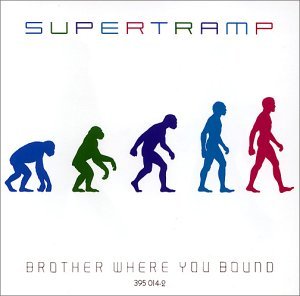
Starting from the elegantly minimalistic cover, depicting the stages of man’s evolution in five different colours on a pristine white background, Brother Where You Bound simply oozes class. Supertramp always had the uncanny knack of marrying catchy hooks with interesting, thought-provoking lyrics, and this album is no exception. Rick Davies, left alone to cope with vocal duties, unleashes a performance that is nothing short of awesome, especially on the album’s pièce de resistance, the 16-minute title-track. Add a couple of prestigious guest musicians to the mix, and you have a near-masterpiece on your hands.

In the best tradition of a band known for strong opening tracks, “Cannonball” does not disappoint the listener. Backed by a steady, almost danceable beat, and introduced by Davies’ scintillating piano, it is one of the vocalist/keyboardist’s many songs about a broken relationship, where you can positively hear the anger in his voice, belying the mock-cheerfulness of the sudden bursts of horns and the almost singalong coda. However, while the horn-heavy “Still in Love” seems to reprise the apparently carefree mood of Breakfast in America, on the whole the songs come across as definitely more somber and less accessible. Both the slow, understated “No Inbetween” (featuring great keyboards and sax) and the relentless “Better Days”, with its frantic pace and splendid flute solo, convey an aura of almost claustrophobic pessimism and disillusion

Interestingly, it is mainly Davies’ voice that makes Brother Where You Bound a markedly darker, less upbeat offering than Supertramp’s 1979 mega-hit, Breakfast in America.The title-track, in particular, is anything but an easy, radio-friendly listen, made up as it is of various parts interspersed by recorded voices, odd noises and sudden silences, underpinning the oppressive atmosphere conjured up by lyrics imbued with all the paranoia of the Cold War years. Davies’ stunning, highly dramatic vocal performance and David Gilmour’s trademark, crystal-clear guitar tones link all the pieces together to create what is possibly the band’s best epic. In comparison with such a wild, exhilarating ride, album closer “Every Open Door”, a slow, moody piece, is a tad anticlimactic, also on account of its decidedly more optimistic message.

If you only know Supertramp for the likes of “Dreamer” and “The Logical Song” (which is as perfect a pop song as they come), you will probably be inclined to dismiss them as little more than ‘prog-lite’ for those who hesitate to delve into the more demanding examples of the genre. Although it is true that the band possess a great feel for melody and memorable hooks, they are also outstanding musicians, and purveyors of above-average lyrics.  While they may represent the ‘easier’ side of prog, they do so with inimitable style and class, displaying songwriting skills that are far from average. Brother Where You Bound is a prime example of ‘crossover’  prog at its very best, and as such highly recommended to anyone but those prog fans who think that ‘pop’ is inevitably a bad word.

Read Full Post »

Tracklisting:
1. Let There Be More Light (5:38)
2. Remember a Day (4:33)
3. Set the Controls for the Heart of the Sun (5:28)
4. Corporal Clegg (4:12)
5. A Saucerful of Secrets (11:57)
6. See-Saw (4:36)
7. Jugband Blues (2:59)

Lineup:
Syd Barrett – guitar, vocals
David Gilmour – guitar, vocals
Nick Mason – drums
Roger Waters – bass, vocals
Richard Wright – organ, piano, vocals

Needless to say,  Pink Floyd do not belong to the contingent of lower-profile or just plain obscure bands that are often featured in blogs like mine. On the contrary, their fame is such that, outside the restricted circles of progressive rock fans, they are considered as mainstream an act as the likes of Madonna or Michael Jackson. However, with A Saucerful of Secrets we are as far removed as possible from the stadium-filling phenomenon the band would become just a few years later. This a disc of whose existence most fans of the band’s best-selling albums are barely aware, and that gets unfairly overshadowed by the cult status achieved by The Piper at the Gates of Dawn.

Pink Floyd’s sophomore effort is undoubtedly an album that can polarize listeners’ opinions. Some see it as dated, or lacking in cohesion, since it was released at a turning point for the band, when Syd Barrett, who was slowly descending into mental illness, was being gradually replaced by his friend David Gilmour – which involved a significant shift in the band’s overall sound. In my personal opinion, though, it is one of the great unsung masterpieces of  progressive rock.

No mean feat for a band specialized in killer openers, A Saucerful of Secrets can boast of one of the strongest opening tracks ever committed to record.  “Let There Be More Light” is the archetypal psych/prog composition, with weird, mesmerizing, Eastern-influenced sound effects, and vocals alternating between chant-like whispers and shouts. Together with the album’s best-known song, the equally iconic and hypnotic “Set the Controls for the Heart of the Sun” (whose definitive version appears on the “Live at Pompeii” movie), the track was written by Roger Waters, who was well on his way to becoming the band’s true driving force. Those who maintain that Waters was a less gifted composer than Gilmour should probably take a careful listen to both songs.

The mood changes almost abruptly with the following number, the Richard Wright-penned “Remember a Day”. With soothing, wistful vocals that match the nostalgia-filled lyrics (which seem to foreshadow Wright’s untimely passing), it is a delicate, charming piece that is definitely easier on the ear in a musical sense. In a similar key, the lullaby-like “See Saw” (also written by the late keyboardist) is not, however, equally successful, and is, in my view, the weakest track on the album. On the other hand  “Corporal Clegg” and “Jugband Blues”  hark back to the whimsy of much of the Floyd’s debut album, with endearingly zany vocals, odd noises and ironic, nonsense-filled lyrics. “Jugband Blues”, which closes the album in stark contrast to the eerie soundscapes of the opener, can be seen as Barrett’s testament, and feels particularly poignant nowadays, four years after Syd’s demise.

An album’s title-track often acts as its focal point, and this is particularly true of the schizophrenic masterpiece that is “A Saucerful of Secrets”. Over 12 minutes long, the track is introduced by an uncontrolled chaos of weird noises and hypnotic percussive patterns, a sonic storm that suddenly abates to be replaced by a solemn, organ-driven section, featuring wordless singing somewhat suggestive of a church choir. In a way, the song reflects the nature of the album itself, and the circumstances in which it came into being.

For those who have come to know Pink Floyd through their milestone albums of the Seventies, this record may well turn out to be a disappointment, since it is in no way as accomplished, let alone as polished as regards production values. A Saucerful of Secrets is a child of the late Sixties – raw, experimental, slightly incoherent – and as such captures the essence of an era in which creativity and envelope-pushing were rife. It also captures Pink Floyd’s full potential just a few years before the quantum leap that would lead them to conquer the world. An essential listen, and – incidentally – my own favourite  release by the band.

Read Full Post »

Tracklisting: 1. Fire Of Unknown Origin (4:11) 2. Burnin’ For You (4:30) 3. Veteran Of The Psychic Wars (4:50) 4. Sole Survivor (4:04) 5. Heavy Metal: The Black And Silver (3:19) 6. Vengeance (The Pact) (4:41) 7. After Dark (4:25) 8. Joan Crawford (4:54) 9. Don’t Turn Your Back (4:02) Lineup: Eric Bloom – lead vocals, bass (5) Donald “Buck Dharma” Roeser –  lead guitar, vocals, bass (8) Joseph Bouchard – bass, vocals Allen Lanier-  keyboards Albert Bouchard – drums, synthesizer, vocals Though it may not be the peak of originality, I would like to inaugurate my blog by posting a review of the album from which it takes its name. Released almost 30 years ago, the wonderfully-titled Fire of Unknown Origin counts as a firm favourite of mine – strange as it may sound to those who may not find it anything special, or even think it borders too much on AOR territory for comfort. However, it also contains a few songs that I would not hesitate to call masterpieces, as well as superb artwork, and a genuinely progressive vibe (though you should not expect anything resembling Yes or Genesis, of course). Fire of Unknown Origin features a major hit in “Burnin’ for You”, written and interpreted by criminally underrated guitarist Donald “Buck Dharma” Roeser – a catchy little number that got the band a lot of airplay at the time of the album’s release. Though a more straightforward (and also more openly commercial) composition than the legendary  “Don’t Fear the Reaper”,  it is still AOR with a bite, unlike some of the band’s later output. The other songs, however, are a different story – starting with the title-track, its  typically cryptic lyrics penned by punk muse Patti Smith (who was in a long-term relationship with keyboardist Allen Lanier). A fine showcase for Lanier’s skills,  it straddles the line between sophistication and commercial potential. The album’s standout track, however, is the magnificent  “Veteran of the Psychic Wars”, written by vocalist Eric Bloom together with English fantasy writer Michael Moorcock (also known for his collaboration with Hawkwind), who in the previous couple of years had provided lyrics for two other BOC  songs, “Black Blade” and “The Great Sun Jester”.   As good as those two tracks are, “Veteran” is in a different league – definitely one of the band’s classics, and one of those songs that, right from day one, have held a constant appeal for me, especially in some difficult moments of my life: “My energy is spent at last/And my armour is destroyed/And I’ve used up all my weapons/And I’m helpless and bereaved….” A slowly but powerfully surging composition, it features a killer guitar solo by Roeser, and a haunting drum pattern that was probably inspired by Peter Gabriel’s equally riveting “Intruder”. Like most of the album, the song was originally written for the soundtrack of the animated film Heavy Metal, but was the only one to eventually feature in its final version. While “Sole Survivor”, featuring former Meat Loaf vocalist Karla DeVito, and the upbeat but somewhat weak  “After Dark”  follow the AOR-inclined path of “Burning for You”, the eerie, ominous “Vengeance (The Pact)”, and the dramatic “Joan Crawford” present the listener with frequent time changes, lush musical textures and intense, forceful vocals. The album closes with the soothing vocal harmonies, layered bass and keyboard lines of the deceptively catchy “Don’t Turn Your Back”,  whose lyrics  (not surprisingly for the band) deal with the subject of death. Like its predecessor, the excellent Cultosaurus ErectusFire of Unknown Origin was produced by hard-rock icon Martin Birch, who in those years would also revive Black Sabbath’s flagging career – and then proceed to make stars out of Iron Maiden. With great clarity of sound, sterling performances from all the band members, powerfully emotional vocals, and intriguing  lyrics, it ranks undoubtedly as one of BOC’s best offerings. Though not as strongly cohesive as their third release, the stunning Secret Treaties, it is nevertheless highly recommended to all fans of vintage classic rock with a progressive bent.

Read Full Post »

« Newer Posts