Feeds:
Posts
Comments

Archive for the ‘Festival’ Category

TRACKLISTING:
1. Irreducible Complexity (3:39)
2. Manifest Density (3:45)
3. Save the Yuppie Breeding Grounds (4:07)
4. Disillusioned Avatar/Dub Interlude/Ephebus Amoebus (10:25)
5.  Disoriental Suite (11:46):
a) Bagua
b) Kan Hai De Re Zi
c) Views from Chicheng Precipice
6. Kuru (4:31)
7. The Okanogan Lobe (7:36)
8. Uncle Tang’s Cabinet of Dr. Caligari (3:44)
9. Blues for a Bruised Planet (4:35)
10. Waylaid (5:31)
11.  Middlebräu (9:09)

LINEUP:
Dennis Rea – guitar
Alicia DeJoie – violin
James DeJoie – baritone sax, flute, percussion
Kevin Millard – NS/Stick (8-string extended-range bass)
Stephen Cavit – drums, percussion

Two years after the release of their debut album, Manifest Density, Seattle-based quintet Moraine enjoy an impressive reputation as one of the most eclectic outfits on the modern progressive rock scene, purveyors of music that, while constantly dynamic and challenging, is never devoid of atmosphere and melody. In the months between the release of the album and their career-defining performance at NEARfest 2010, the band, led by veteran guitarist and composer Dennis Rea, underwent a lineup change, with the departure of cellist Ruth Davidson and drummer Jay Jaskot that determined a distinct shift in their sound.

For their sophomore effort – bearing the brilliant name of Metamorphic Rock, which, like the band’s own, reflects Dennis Rea’s passion for geology and mountaineering, as well as referring to the metamorphosis undergone by the band – Moraine have chosen a rather unconventional format. Though it is a live album, capturing their NEARfest set in crystal-clear detail, it focuses on new, unreleased material as much as on compositions originally featured on Manifest Density. The latter have been rearranged to accommodate the obvious differences in sound due to the presence of a baritone saxophone instead of a cello, their running time often extended as if to indulge the average prog fan’s preference for longer tracks.

With five members coming from very different musical backgrounds, Moraine are quite unlike conventional prog bands in being much less prone to reproduce their compositions verbatim when on stage, and thrive on freedom of improvisation. This diversity results in a headily eclectic direction, blending rock with jazz, funk, blues, world music and avant-garde, which however never descends into the sprawling “kitchen sink” approach adopted by many acts, with often debatable outcomes. Since its very beginning, Moraine has been a collaborative effort, with every member getting an opportunity to contribute to the songwriting – even if Dennis Rea gets the most credit on this album as a composer. As much as he is the band’s mouthpiece and most experienced member, even a cursory listen to either of Moraine’s albums will reveal a dense, tightly woven structure in which all instruments bring their own distinctive voice, and no one overwhelms the other.

The 11 tracks chosen for the band’s NEARfest set highlight their unique dynamics and the wide range of influences and ideas that characterize their compositional approach. Traces of their beginnings as a “chamber rock” outfit (or, as Rea puts it, a string quartet with drums) emerge occasionally throughout the set, but the definite rock turn taken by the band is hard to miss. In its three minutes, opener “Irreducible Complexity” effectively sums up the “new” Moraine: written by James DeJoie, it emphasizes how seamlessly the saxophone has become part of the whole, replacing the solemn drone of the cello with its more forceful tone, acting both as foundation (together with Stephen Cavit’s understated but subtly propulsive drumming and Kevin Millard’s versatile 8-string bass) and as a protagonist, in combination with the flowing, melodic strains of Alicia DeJoie’s violin and Rea’s clear, almost tinkling guitar.

Interestingly, the majority of Moraine’s compositions seem to make use of a leitmotiv device, a main theme, generally introduced right from the beginning, which crops up in different parts of a song, rendering it more memorable as well as more cohesive. This device is also explored by “Manifest Density”, with its catchy guitar-sax-violin riff, and the more angular “Kuru” – as well as newer material like the hauntingly majestic “The Okanogan Lobe”, and the forceful, slightly chaotic “Waylaid”. Like many of those RIO/Avant bands they have often been compared with, Moraine balance beautifully melodic, lyrical sections, dominated by Alicia DeJoie’s soaring violin, with others where a carefully controlled chaos seems to reign. “Uncle Tang’s Cabinet of Dr. Caligari” represents the band’s noisier side; while in the 10-minute medley of “Disillusioned Avatar/Dub Interlude/ Ephebus Amoebus”, all the different souls of Moraine are given a voice – from the gorgeously melancholy, violin-driven beginning – a masterpiece of careful atmosphere-building with its loose, rarefied texture – to the lazy reggae pace of the “dub interlude” (which allows the rhythm section to step into the limelight), finally climaxing with an effects-drenched, free-jazz workout.

Running at almost 12 minutes, the amusingly-named “Disoriental Suite”, based on Dennis Rea’s solo album Views from Chicheng Precipice illustrates Moraine’s more meditative side, opening with a gentle, lilting melody enhanced by James DeJoie’s flute, and culminating with a sparser, more experimental, violin-led section. As its title implies, the somber mood of “Blues for a Bruised Planet” – a fresh take on the old warhorse of the blues ballad – expressed by the mournful voice of the sax and reinforced by violin and guitar, stems from Dennis Rea’s deep concern with the sorry state of Planet Earth. My personal favourite from the band, the towering “Middlebräu”, closes the album with a bang, its funky intro followed by a short, snappy drum solo, and then culminating with the gorgeous, slow-motion coda in which the interplay between guitar and violin reaches unparalleled heights.

The sheer quality of the recording (mixed by legendary Seattle-based engineer Steve Fisk) and the brilliance of the individual performances more than compensates for the editing of Rea’s unassumingly witty on-stage banter – my only quibble about an otherwise outstanding album. As I pointed out in my review of the 2010 edition of NEARfest, Moraine were by far the most authentically progressive band on the bill. Moreover, their particular brand of “East-meets-West” is quite far removed from cheesy attempts at exoticism for its own sake, but rather motivated by genuine love and interest for different musical modes than ours. Needless to say, Metamorphic Rock is unlikely to be fully appreciated by symphonic prog traditionalists, especially those who object to the absence of keyboards, but it is otherwise highly recommended to all open-minded prog fans. Another contender for my personal Top 10 of 2011 – hoping for a third album some time in 2012.

Links:
http://www.moraineband.com

http://www.moonjune.com

Read Full Post »

You cannot get lucky all the time, as this year’s edition of ProgDay abundantly proved. Indeed, while last year the weather had been  as perfect for early September as anyone could have wished – sunny yet cool, breezy and dry, which made spending two days outdoors a real delight – this time, especially on the festival’s first day, we got a nice taste of typical Southern US summer weather, with relatively high temperatures made much worse by humidity close to 80% . Every time I checked the weather forecast in the days before the event, my heart sank lower and lower, and I have to admit that – as a staunch hot-weather-hater – I was more than a bit worried. Thankfully, nothing bad happened, at least to me (one of my fellow attendees suffered heatstroke and had to be taken to hospital), though most people’s enjoyment was somewhat marred by the unrelenting onslaught of the heat and humidity.

Despite the lack of cooperation on the part of the weather (which, considering the recent hurricane threats on the US East Coast, might have been far worse), ProgDay 2011 was an unqualified success. With a top-notch lineup representing the very best of modern-day prog, plenty of variety to satisfy even the most jaded fan, and – most important of all – lashings of humour and pure fun (two words that are not often associated with the prog scene), the festival managed to wipe out the bad taste still lingering months after the traumatic cancellation of NEARfest (whose future, at the time of writing, still hangs in the balance), and restore at least in part my faith in the future of progressive rock. No event can survive for 16 uninterrupted years without good reason – in this particular case, a healthy mix of humility, dedication and open-mindedness. Even if ProgDay has never aspired to the grandeur of other events, with their state-of-the-art theatres and “prestigious” lineups, it has acted as a showcase for a wide range of subgenres within the prog spectrum, and provided a springboard for up-and-coming bands, both domestic and international. And then, last but not least, the festival has been able to create – much more so than its higher-end cousins – an authentic community spirit, where everyone brings something to the table, avoiding the cliquish atmosphere that has often spoiled the experience of other events for those who are in some ways outsiders.

This year we set out on Friday morning, in order to avoid the Labour Day weekend traffic later in the afternoon, so were able to spend some quality time with friends at the renovated Comfort Inn Hotel – and eat way too much food, as often happens in such happy occasions. The anticipation for the event ran high, and attendance was noticeably up from last year, when the festival had been penalized by the lack of the coveted “international” bands, in spite of a superb lineup showcasing some of the finest acts on the North American scene. This year, the NEARfest cancellation had encouraged more people to head South, and – even if still far from the record highs reached on previous editions – the increase was noticeable as soon as we reached the festival grounds on Saturday morning. In spite of their constant fight with financial strictures, the organizers had managed to put together an incredibly tight lineup, catering to all progressive tastes. Even the two cancellations – first Czech band Uz Jsme Doma, then Sunday headliners Quantum Fantay  – did not undermine the strength of the musical offer.

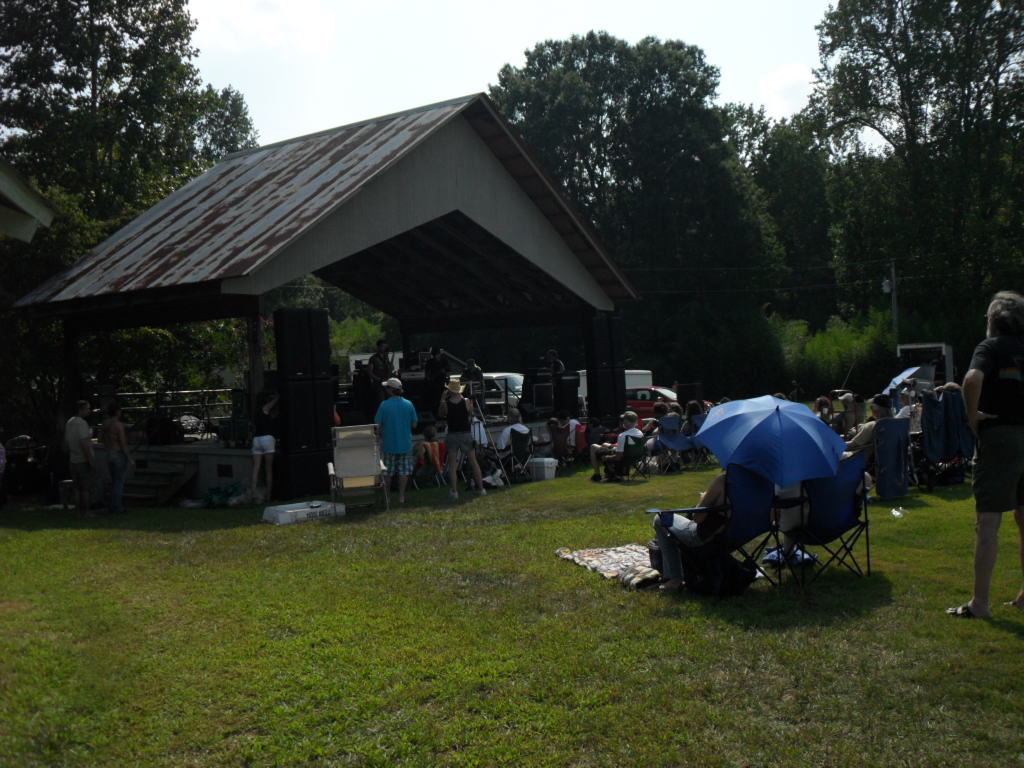
The heat building up on Friday afternoon did not show any promise of abating the following day, though when we reached the beautiful festival location at Storybook Farm things were still relatively pleasant. Photographs do not do full  justice to the beauty of the surroundings, the green field ringed by woods where you can hear the echo of the music if you walk far enough from the stage area. The lack of rain in the summer months was made particularly evident by the clouds of dust raised by the cars approaching the festival premises (hence the title of my review), and the dry, prickly feel of the grass. Thankfully, in the morning and early evening a breeze blowing from the trees made things bearable, and my lightweight folding chair allowed me to move around in order to catch it. There was no respite from the sun, however, and leaving the shelter of the covered pavilion meant being hit by the full force of its rays, especially in the early hours of the afternoon.

Half of the bands on this year’s lineup were instrumental, and Milwaukee-based quartet Fibonacci Sequence introduced the festival in style. After having braved a 15-hour drive to reach North Carolina, the four musicians treated the crowd to almost 90 minutes of intricate yet effortlessly flowing music that showed an impressive level of maturity. Though their debut album, the excellent Numerology, had been recorded as a trio with a guest bassist (former Portal/Cynic member Chris Kringel), the band now feature the considerable talents of bassist Chad Novell, who looked more like a member of a modern metal outfit than a prog musician. However, for all the keen edge present in their compositions, Fibonacci Sequence are a full-fledged progressive rock band whose remarkably clean sound was flattered by excellent acoustics that allowed each instrument to be heard clearly and distinctly. As I wrote in my review of Numerology, they are one of those rare bands that have managed to achieve a sound of their own – even if they jokingly refer to themselves as “Rush with keyboards”. Like the Canadian trio, their music is eclectic but deeply cohesive, built on the solid foundation of the outstanding rhythm section of Novell and drummer Tom Ford (whose sleek interplay was riveting to watch), which allows Mike Butzen’s guitar to unfold all its melodic range, with Jeff Schuelke’s keyboards adding layers of depth. Their warm yet inobtrusive interaction with the crowd revealed their experience as a live act, and their heartfelt tribute to Kopecky drummer Paul Kopecky, who passed away two years ago, was particularly touching. In today’s materialistic, cutthroat world, it is heartwarming to see musicians from a particular region form a bond and work together towards the diffusion of non-mainstream music. Kudos to Fibonacci Sequence for being part of this trend, and for sharing their appreciation of their fellow Wisconsin artists with the ProgDay crowd. All in all, they are a very tight unit, who deserve as much exposure as they can get, especially among devotees of instrumental prog.

Another fine example of the thriving New Jersey prog scene, The Tea Club had been the last band to be announced, a mere couple of weeks before the event. Having followed them for the past three years, I had hoped to be able to see them on stage for a while, and was elated on their behalf at the announcement, as a festival slot can be a turning point for a band, exposing them to a much larger audience than their normal live appearances. In spite of their collective young ages, the fresh-faced members of The Tea Club – now extended to a six-piece – are accomplished musicians and songwriters, their music astonishingly complex and multilayered, even if not always conforming to traditional prog standards. After the departure of drummer (and founding member) Kyle Minnick, brothers Pat and Dan McGowan recruited a new bassist (Charles Batdorf), drummer (Joe Rizzolo) and third guitarist (Jim Berger), while original bassist Becky Osenenko (a classically-trained pianist) took charge of the keyboards, which on their second album Rabbit had been provided by Tom Brislin. Because of Minnick’s involvement in the writing of their 2008 debut album, General Winter’s Secret Museum, they chose not to play any tracks from it, and concentrated instead on Rabbit and some new material. While The Tea Club clearly tread the post-prog path of bands like The Pineapple Thief and Oceansize, with bouts of intensity that may bring The Mars Volta to mind, the complexity of their songwriting goes way beyond most alternative bands.While I had found Rabbit a bit of a step backwards, as it sounded somewhat one-dimensional if compared to the boundless energy of General Winter’s Secret Museum, the material taken from the band’s sophomore effort came positively alive on stage. Enhanced by the seamless instrumental dynamics and the striking stage presence of the McGowan brothers, each of the songs possessed a deeply intriguing quality, with “The Night I Killed Steve Shelley” deserving a special mention. Even the relentless assault of the heat and humidity could not detract from the band’s brilliant set. The new songs reprised the atmospheric, laid-back mood evidenced on Rabbit, though spiked by instrumental surges exuding a keen sense of tension. The McGowan brothers are also fine vocalists, capable of delivering soothing harmonies as well as more aggressive parts, while steering clear of the excessively plaintive tone of post-prog icons such as Radiohead’s Thom Yorke or The Pineapple Thief’s Bruce Soord. With their sheer enthusiasm and obvious dedication to their music, The Tea Club have enormous potential, and their performance won them many new fans.

Though the weather certainly did no favours to The Rebel Wheel, the Ottawa-based quartet, led by guitarist David Campbell and featuring a highly awaited guest appearance by keyboardist Guy LeBlanc (of Nathan Mahl and Camel fame) delivered a stunning (though somewhat short) set, featuring a slightly modified version of the 30-minute epic “The Discovery of Witchcraft”, the centrepiece of their 2010 album We Are in the Time of Evil Clocks. Being familiar with the album, undoubtedly one of the standout releases of last year, I was looking forward to the band’s set, which was a delight to start to finish – even if, by the time they got on stage, I was feeling somewhat faint, and lay half-slumped in my chair. The music, however, was so riveting that it was impossible not to listen intently. Like a well-oiled machine, the band churned out flawless tune after flawless tune, their choppy, jazzy Crimsonian vibe well complemented by Campbell’s powerful, expressive vocals and LeBlanc’s masterful keyboard sweeps and rumbling organ flurries, while relentlessly driven forward by the splendidly pneumatic rhythm section of Andrew Burns and Aaron Clark. The dark, angular “Death at Sea”, from a 2005 Gentle Giant tribute album, was a particular highlight, with echoes of King Crimson’s “The Great Deceiver”. Though the epic was adapted to the absence of vocalist/saxophonist Angie McIvor (on leave following the birth of her first child), it lost none of its punchy, gutsy effectiveness. An impressively professional outfit, oozing confidence and flair, The Rebel Wheel manage to sound thoroughly modern while paying homage to the great Seventies tradition. I really hope to see them again in the very near future, and will be looking forward to their new album.

In the interval between the third and the fourth set we were treated to an impromptu acoustic guitar solo spot by Jimmy Robinson of Woodenhead (whovwere due to play the traditional festival pre-show at a local club, this year extended also to the Saturday evening). Robinson displayed an astonishing mastery of the instrument, his short but intense performance including versions of Led Zeppelin’s classics “Kashmir” and “When the Levee Breaks”. It was a fitting introduction to another dazzling display of guitar fireworks, this time of the electric variety – courtesy of Mörglbl, introduced by one of the festival’s elder statesmen, Paul Sears of The Muffins. A classic power trio in which Christophe Godin’s scintillating guitar is supported by the hyper-dynamic rhythm section of Ivan Rougny and Aurélien Ouzoulias, the French outfit have often been tagged as jazz-metal, and, while the metal element is an unmistakable component, there is a lot more to their music than just ultra-technical noodling. While listening to their set (in spite of my extreme physical weariness) I could hear a lot of different influences in Mörglbl’s sound, such as funk, blues, Latin music and reggae, besides the obvious rock matrix. Technically awesome and very tight from a compositional point of view, their set was highly energetic, heavy but consistently fluid and never jarring, and, above all, extremely entertaining. With his shaved head, distinctive white goatee and fluorescent yellow guitar, Godin is a consummate frontman, throwing all sorts of funny shapes during his solos, his warm, amusing on-stage banter delivered in excellent English. The band are known for concluding their shows with covers of rock classics reinterpreted in their own inimitable style, and this time was no exception – their  lounge-jazz version of AC/DC’s “Highway to Hell” (the only number featuring Godin’s excellent vocals) was one of the most hilarious moments of the weekend.

After a good night’s sleep, on Sunday morning we felt ready to face another day of great music, and this time the weather was definitely more helpful, with lower humidity levels and a nice breeze making things more comfortable. And a good thing it was, because the second day of the festival promised a lot of intensity, and the audience had better be in their best shape to fully enjoy what was on the musical menu. Opening act Zevious also belonged to the group of bands I had had the pleasure of reviewing in the past two years or so, and I had found their second album, After the Air Raid, one of the most impressive releases of 2009. A power trio based in New York, unlike Mörglbl they projected a rather serious image, in spite of their youth, and proceeded to deliver a set of astounding complexity, chock full of asymmetrical rhythm patterns overlaid by Mike Eber’s clear, piercing guitar, and propelled by Jeff Eber’s monstrous drumming. While not too high on melody, the band’s music never once descended into mere dissonance, and the sheer amount of sound produced by a trio of musicians employing very basic instrumentation was nothing short of astonishing.  The unceasing flow of dynamic bottom end provided by Johnny DeBlase’s Fender Jazz bass complemented Jeff Eber’s unbelievable polyrhythms, delivered with effortless simplicity, without the antics that might have been expected from such a gifted drummer. As good as they sounded on CD, Zevious’ music acquired a new dimension on stage, and, when fully unleashed, the band sounded like King Crimson  to the power of 3 – despite the “math-rock” or “RIO/Avant” tags so often (and awkwardly) stuck onto them. They are clearly not everyone’s cup of tea, and, although incredibly nice offstage,  they were not as communicative towards the audience as most of the other bands – hence my use of the term “serious” at the beginning of the paragraph. Their music, however, speaks for itself, and they have all the time in the world to hone their stagecraft.

Those who, like me, were sitting under the pavilion during Zevious’s set had the opportunity to watch the members of Persephone’s Dream set up their gear on one side of the stage. Though I was not familiar with the Pittsburgh-based outfit’s music prior to the festival, I had read enthusiastic accounts of their latest album, Pan: An Urban Pastoral, released in 2010 – which I knew the band were going to perform in its entirety for the very first time. I anticipated a treat when I saw the incredibly elaborate array of percussion instruments being carefully arranged on the lawn, including a gong and bells and chimes of every description. And, indeed, a treat it was, both musically and visually, even if – as can be expected – the show suffered a bit from being squeezed on a relatively small stage without the use of lightning and the appropriate backdrop trappings. The band, a seven-piece, might have used a little more space, especially the two female vocalists, Josie Crooks (a really beautiful voice, powerful yet melodic) and Leah Martell (who twirled and danced all over the place), who had to change costumes, chase each other and run up and down the stage for most of the set. However, Persephone’s Dream pulled it off superbly. Though by far the most conventionally “prog” of the bands on this year’s bill, they were anything than the kind of derivative, snooze-inducing neo/symphonic fare that sends some fans into fits of ecstasy – as a matter of fact, their sound was quite heavy at times, with Jim Waugaman’s powerful keyboard excursions almost out of ELP’s heyday,  accented by John “JT” Tallent’s brilliant percussion work (which has elicited comparisons with Jamie Muir of Larks’ Tongues in Aspic fame). The “urban pastoral” setting – reminiscent in some ways of Peter Gabriel’s vision in The Lamb Lies Down on Broadway – was also imbued with genuinely menacing overtones, offset by pauses of quiet and gentle birdsong. The dramatic, larger-than-life music had more than a whiff of Italian prog to it – as well as nods to Celtic folklore and even early 20th-century classical music – and the band as a whole sounded more European than American. While those festival attendees who favour the more left-field stuff assessed the band’s performance rather harshly for being a collection of all the worst prog clichés – such as the mythological inspiration and the over-the-top instrumentation (in stark contrast to the minimalistic approach of bands like Zevious or Mörglbl), Persephone’s Dream’s set had an often mesmerizing quality, their music obviously tailor-made for the live dimension.

When people were still in a relaxed mood, following lunch and the consumption of quite a few excellent beers (which, unfortunately, I could not enjoy because, for me, heat and alcohol do not mix well), German quintet Panzerballett, ontheir first US visit, took the stage, and woke everyone up with their unique brand of “wellness death jazz” (I kid you not). In the seven years since their inception, the young but extremely proficient outfit have already earned a fearsome reputation among lovers of the more experimental branches of progressive rock for their highly energetic brand of avant-garde, metal-tinged jazz-rock served with liberal helpings of humour – debunking the commonly held myth of the dour, humourless Germans. Some of the song titles alone were worth the price of admission – “A Vulgar Display of Sauerkraut”, anyone? The on-stage banter of guitarist Jan Zehrfeld (whose English may not have been as fluent as Christophe Godin’s, but still effective in interacting with the audience) was delivered in quiet, polite tones that contrasted with the manic urgency of the music – unabashedly eclectic, cramming a lot of diverse influences in the space of a single number, and spiced with a healthy pinch of irreverence. Nothing is safe from Panzerballett’s imaginative reinterpretations (or rather deconstructions) – the love theme from Dirty Dancing, Dave Brubeck’s “Take Five” (rechristened “Fake Five”, and played simultaneously in two different tempos), Weather Report’s “Birdland”, all got the Panzerballett treatment, to the audience’s delight. As in the case of Zevious, their music is clearly not for the faint-hearted or those who crave melody and catchy hooks, but their enthusiasm is infectious, and you have to admire a band that proudly claims to improvise every time they are on stage, dispensing with setlists. Though all of the band members were brilliant, powerhouse drummer Sebastian Lanser deserves a particular mention for his unflagging energy and perfect time-keeping.

After such an exhilarating performance, as the evening drew near and the temperature cooled down, the audience was well stoked for headliners Freak Kitchen – currently touring the US as Mörglbl’s opening act, and drafted in at the very last moment after Quantum Fantay’s cancellation (due to airline woes following in the wake of Hurricane Irene). Though I was not familiar with their music, what I had read around the Internet had whetted my curiosity, and I realized that we were in for a pyrotechnic conclusion. Yet another power trio, active since 1992, with seven albums under their belt, the band consists of a guitarist (Mattias Eklundh, aka The Axemaster of Sweden) and drummer (Björn Fryklund) that embody the Scandinavian archetype of tall, lean frames and flowing blonde manes, and a bassist (Christer Ortefors) that was a sight to behold, with his heavily tattooed arms, braided beard, combat helmet and low-slung bass in pure Lemmy style. All in all, Freak Kitchen are the opposite of every prog stereotype, looking (and sounding) like an Eighties thrash metal band with progressive undertones. Extremely gifted in a technical sense, they wrapped up the festival with a bang, combining sheer heaviness with plenty of infectious hooks and a bit of a funky swagger, whipping the crowd to a frenzy, getting the notoriously staid prog fans to get up and dance, headbang and sing along in a cathartic explosion of pure fun. With song titles as wacky as “Teargas Jazz”  and “Chest Pain Waltz” (one of the highlights of their set), and influences ranging from Megadeth and Metallica to King’s X and Living Colour with a sprinkling of punk rawness (mostly evident in the vocals), they have a commanding frontman in the soft-spoken Eklundh, who treated the audience to a constant stream of funny quips and anecdotes (like the one about the vibrating dildo belt), and poking gentle fun at the average progger’s obsession with odd time signatures. A memorable ending to ProgDay 2011, even though purists would have been positively horrified.

Although the lovely bucolic setting and general laid-back vibe, reminiscent of a family picnic complete with children, games and dogs, might lead outside observers not to take ProgDay too seriously in musical terms, the consistently high quality of the lineups assembled by the organizers throughout the years gives the lie to this impression. The members of the band selection committee are to be commended for their forward-thinking attitude, which allows attendees to sample a broad range of the many subgenres to be found under the welcoming “prog” umbrella, always striking a perfect balance between accessibility and cutting-edge potential. Unfortunately, it is also true that ProgDay can get away with having a full-fledged metal act as a headliner only because it is basically perceived as not quite as prestigious as the indoor festivals. The cancellation of NEARfest 2011 proved all too clearly the danger of overestimating the open-mindedness of prog fans, and booking anything with dubious prog status can be the kiss of death for even the highest-profile event. However, in spite of the overall lack of support from the US prog community, ProgDay soldiers on, thanks to the help (financial and otherwise) of a core of loyal patrons, and getting better and better with time, as demonstrated by this year’s stellar lineup. This past weekend, on the stage at Storybook Farm, I saw the future of progressive rock – a future that may not look like the Seventies bands that are still widely worshipped, but that is surely every bit as exciting and musically worthwhile. It is up to us to let it prosper, or kill it slowly but inexorably with our obsession with the past.

At the end of my review, I wish to thank everyone involved in the success of ProgDay 2011 – first and foremost the organizers, the band selection committee and all the volunteers (a particularly big thumbs-up for providing a “quiet room” for the numerous prog ladies present at Storybook Farm). Then, as usual, a shout out to all the great people that made our weekend special: the collective members of Fibonacci Sequence, The Tea Club, The Rebel Wheel, Mörglbl and Zevious, John Tennant of Persephone’s Dream, ProgDay founder (and purveyor of musical goodies) Peter Renfro, Michael McCormack, Alan and Amy Benjamin, Helaine Carson Burch, Debi Byrd, Lew Fisher, Doug Hinson, Michael Bennett, Jeff Wilson, Paul and Debbie Sears, Mike Visaggio of Kinetic Element, Rick Dashiell, Eyal Amir – and, last but not least, our dear friends Michael Inman and Djalma Carvalho. Here’s to ProgDay 2012, and many more years of great music!

Read Full Post »

Progressive metal may not be everyone’s cup of tea, but it is definitely a phenomenon that is here to stay, and that has also brought a much-need input of new ideas to the often stale prog scene. As a result, an increasing number of events specifically dedicated to this subgenre are cropping up both in Europe and America. Europe, however, seems to have the edge in this respect, also helped by the fact that it is relatively easy for festival organizers to get public funding, and therefore avoid imposing steep ticket prices on would-be attendees.

The latest addition to the roster of progressive metal festivals, Generation Prog 2011 is an ‘inside job’, so to speak, being the brainchild of Relocator bassist Michael Schetter (formerly Pruchnicki). The event, scheduled to take place on September 23 and 24 in the historic  German city of Nuremberg , will see the participation of 8 European bands, including local acts Effloresce, Ocean Spout and Theory of Elements, as well as Relocator (whose live keyboardist, Sergej Schamber, is also a member of  Ocean Spout).  The line-up will be completed by two British bands, To-Mera and Haken, ground-breaking Dutch ‘jazz-metal’ combo Exivious, and Swedish outfit Andromeda as Saturday night headliner.

As the schedule is not yet 100%  final, I would recommend that anyone interested in attending check both the event’s website (which is in German, with a shorter English section) and its Facebook page for the latest updates.

By way of a conclusion, I would like to praise Michael Schetter and his collaborators for taking the plunge, and investing so much time (and possibly money) into the organization of an event that will serve as a showcase for up-and-coming bands, as well as more established ones. In my view, this is the way to go, if we really want the progressive rock scene to survive and prosper for a long time.

Links:
http://www.generation-prog.com/?page_id=41

https://www.facebook.com/GenerationProg

Read Full Post »

In spite of the difficult economic times, and also of the prevailing “the grass is greener” attitude, in 2011 Europe is all set to offer an almost unprecedented range of progressive rock (and related) festivals – in sharp contrast with the (hopefully temporary) demise of both NEARfest and CalProg in the North American continent. In the past few weeks I have come across no less than four announcements of respectably-sized events taking place in various part of the boot-shaped peninsula.

The first edition of the Civitella Progressive Rock Festival will be held at the sports centre of the town of Civitella Paganico, in the Tuscan province of Grosseto, starting on July 16 with guitarist Alex Carpani and Pink Floyd tribute band Time Machine, and then continuing on the weekend of July 22/23  with Classic ELP Tribute, local band Gran Turismo Veloce and legends Le Orme (July 22), and The Watch opening for Fish (July 23).

On the same weekend (July 22-24), the festival We Love Vintage will be held at the sports centre Due Madonne in Bologna, with an impressive lineup featuring well-known names of the classic prog era such as the new supergroup CCLR (with Bernardo Lanzetti, and Aldo Tagliapietra as a special guest) and Arti e Mestieri with Mel Collins and David Cross, as well as up-and-coming acts such as Paolo Schianchi, Alex Carpani, Ego, Altare Thotemico, Stereokimono, Mappe Nootiche, Astralia, and Bologna’s own Accordo dei Contrari (with legendary ‘voice of Canterbury’ Richard Sinclair as a special guest).

In the same week, on July 21, the Austin-based duo WD-41 (recently interviewed here) at the Portello River Festival in Padova, an event that is sure to appeal to those with a keen interest in experimental and world music.

While the month of August in Italy is traditionally dedicated to vacation, progressive rock will make a comeback in September with another two extremely intriguing events. The 2 Days Prog Veruno will take place at the Piazzetta della Musica in the town of Veruno, in the Piedmontese province of Novara. This year the festival, in spite of its name, will last 3 days instead of two (September 2-4), and its exciting lineup will feature Italian acts such as Alex Carpani Band, Methodica, Il Tempio delle Clessidre, Arti e Mestieri (again with Mel Collins and David Cross) and Goblin, alongside celebrated international acts such as RPWL, Anathema, Riverside and Agents of Mercy.

This staggeringly rich season of music will be wrapped up by the Progressivamente Festival held at the Casa del Jazz in Rome on the following week (September 6-11). The event, dedicated to the memory of Italian musician and Chapman stick virtuoso Virginia Splendore (who tragically passed away at the end of May 2011), will offer a veritable ‘who is who’ of classic and modern Italian prog, with bands such as Il Tempio delle Clessidre, Locanda delle Fate, Murple, Fonderia, Metamorfosi, Le Orme and Banco del Mutuo Soccorso, as well as Gentle Giant offshoot Three Friends and tribute acts Us and Them, Goblin…Rebirth and Progtop. An additional feature of the event will be listening ‘seminars’ for audiophiles comparing analog and digital recordings of the great prog albums of the Seventies.

As unbelievable as it may sound to my American readers, some of these events will be free of charge, or have a very accessible price (no higher than 20 euros).  Whoever is planning a trip to Italy in the summer months may be interested in planning things so as to be able to attend at least one of those concerts, which will offer the added bonus of great surroundings and excellent food and drink.

Links:
Civitella Progressive Rock Festival: http://www.synpress44.com/01Comunicati.asp?id=1113

We Love Vintage: http://www.welovevintage.it/

Portello River Festival: http://www.riverfilmfestival.org/PRF7.pdf

2 Days Prog Veruno: http://www.lastfm.it/festival/1936079+2+Days+Prog+Veruno

Progressivamente Festival: http://www.progressivamente.com/


Read Full Post »

Since I moved to the USA two and a half years ago, progressive rock festivals have always been one of the highlights of the year for me and my husband. However, we had skipped both of the previous editions of the Rites of Spring Festival (aka ROSfest) – mainly on account the general musical direction of the event, since our tastes tend to lean more towards the more adventurous side of prog. We both pride ourselves on our open-mindedness, though, and the cancellation of this year’s edition of NEARfest was the catalyst that made us decide to take the plunge. As it is often the case in life, a very positive experience came out of a negative (and quite unexpected) occurrence.

The 2011 edition of ROSFest was organized, for the second year in a row, in the small historic town of Gettysburg, Pennsylvania. One of the prime US tourist sites, Gettysburg is known worldwide for one of the bloodiest battles of its time, the clash between the Union and Confederate armies that occurred on July 1-3, 1863, and pretty much decided the final outcome of the Civil War (hence the title of my review). The town itself exudes a quaint, out-of-time vibe, with plenty of antique and craft shops, as well as fine eating and drinking establishments, though hardly any stores catering for everyday needs (such as pharmacies or grocery stores), and no taxis or any public transportation except for some vintage-looking blue buses.  The drive from the official festival hotel to the town centre goes through part of the huge battlefield, a sobering sight dotted with markers commemorating all the different regiments that fought on those fateful three days, said to be haunted by the ghosts of the over 50.000 soldiers who lost their lives there. In the month of May, the countryside is at its very best, the colours fresh and bright, flowers growing by the roadside, the road lined with quaint houses and bright red barns: however, it is hard not to think of the bloodshed and wholesale slaughter, and when driving through the battlefield at night it is easy to imagine ghosts wandering in the misty darkness.

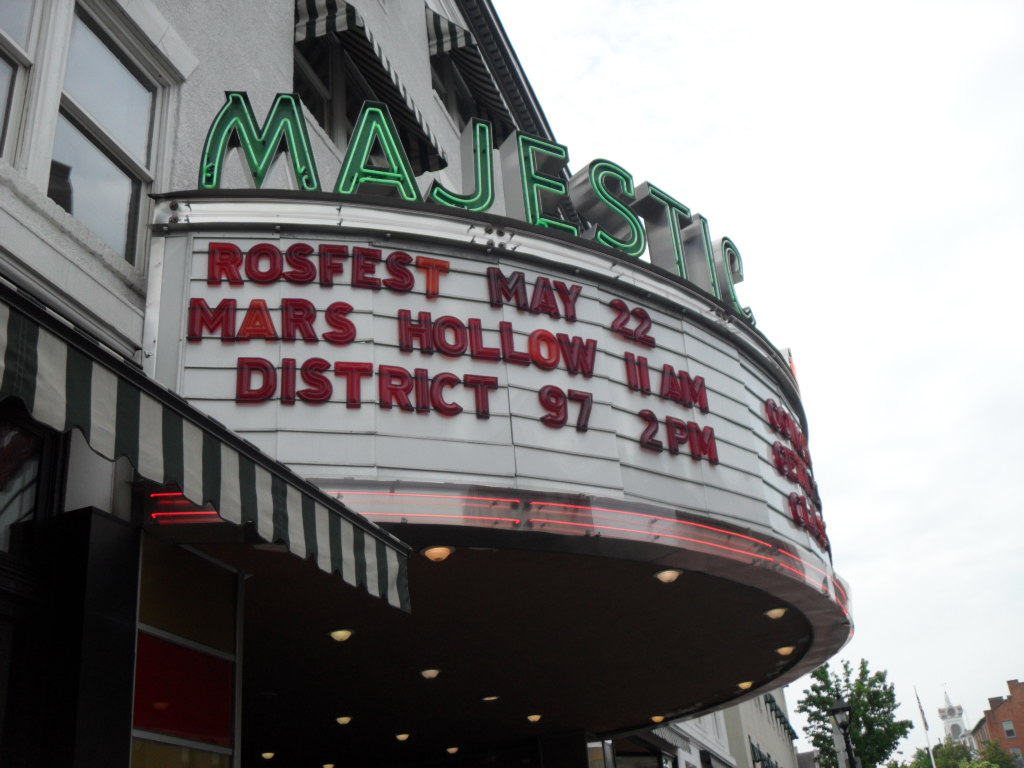
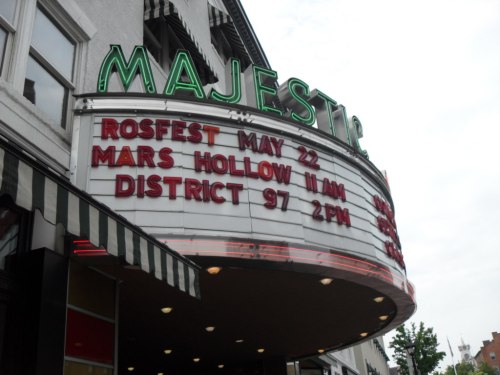
The festival venue was a treat – a gorgeous Art Deco theatre with an excellent seating arrangement, crystal chandeliers and plenty of that old-fashioned charm that seems to have been banished by the spread of modern multiplexes. Though not as spacious as Bethlehem’s Zoellner Arts Centre, and lacking in enough seats for people waiting in the lobby between sets, it offered nicely appointed spaces, with the gallery taken over by vendors and band merchandising (though I think the bands might have used a bit more room), and a nice table set up in the lobby for CD signing after each show. The abundance of eating places in the immediate vicinity, as well as the generous breaks between sets, made it easier for the attendees to take their time without having to rush about in order not to miss anything; the bar was also fairly priced as things go, and manned (or perhaps I should say ‘womanned’) by a couple of very nice ladies. The theatre also employed a group of equally nice ladies as ushers (something I had not seen for a long time), though I have to admit I missed the very convenient wristband system implemented by other events.

Unfortunately, in spite of the NEARfest cancellation having redirected some would-be attendees to ROSfest, there were quite a few empty seats in the theatre. The crowd, however, made up in enthusiasm what was lacking in numbers. Some people had chosen to get tickets only for Saturday and Sunday, but there was still a fair attendance on Friday night, mainly on account of headliners Moon Safari. On the whole, it can be estimated that the Majestic Theatre was 70-75% full – not bad per se, but neither the sell-out that some were anticipating. Times are still tough for many people in the US, and the splintering of the ‘prog community’ in a myriad of sub-groups does not help matters. Not all the NEARfest orphans had  chosen to support ROSfest, and for a very simple reason: as I mentioned in the opening paragraph, ROSfest mainly caters to what I often call the more conservative set of prog fans, those who like melody, vocal-oriented compositions, and, more often than not, anything that seems to recreate the magic of the Seventies (a slant that was reflected by many of the CDs on sale in the vendor area). Nothing wrong with that, of course: there are plenty of bands and artists on the current scene that prefer to look to the past for their main inspiration, and many of them do it very well. Even if my loyal readership might sometimes get the idea that I am biased against ‘retro-prog’, there are quite a few acts falling under this category that I enjoy a lot, as long as their music ‘speaks’ to me somehow.

This year, organizers George Roldan and Krista Phillips and their team had made a somewhat bold move, and dispensed with any nostalgia acts in favour of a rather intriguing range of relatively new bands, about half of them hailing from the US (which, knowing the audience, might have been a factor in the relatively low attendance). In particular, Sunday headliners Quidam, though familiar to devotees of neo-prog and Polish prog in general, did not possess the clout or vintage credentials of last year’s headliners Renaissance. However, judging from what was seen on stage over the past weekend, in musical terms it was a move that paid in spades. Both my husband and I were impressed by the diversity of the acts selected for this year’s edition, and were also pleasantly surprised on several occasions. Needless to say, the sound quality and the lighting were first-rate, and the intimate feel of the venue made for a nice community experience, further enhanced by the warmth and professional attitude of the organizers.

The festival kicked off at 5 p.m. of Friday, May 20, with local band Epiicycle, featuring George’s son Anthony Roldan. A young quartet, though already with three albums under their belt, they sounded somewhat out of synch with the event’s general musical direction, sounding more akin to the likes of Porcupine Tree, Tool and other ‘alt-prog’ bands than Yes or Genesis (though their last song, which featured violin and cello, had a more conventional proggy feel with shades of Anekdoten). In spite of some obvious weaknesses, especially in the vocal department, their enthusiasm was endearing, and the event obviously provided a great chance for them to play in front of a considerable audience, as well as to grow and refine their sound.

Though I was not familiar with Tinyfish’s music, I remembered guitarist/vocalist Simon Godfrey as one of the old-time members of the progressive rock forum where I started my ‘career’, and had often seen the band mentioned there. However, even if I had never had the opportunity to check them out, their set (which, regrettably, we had to leave early due to a prior engagement) was one of the real surprises of the weekend for both of us. Simply put, Simon Godfrey is an incredible vocalist, probably the best heard over the weekend (no mean feat, since there was quite a bunch of fine singers on display), with a strong, passionate voice that adds depth and interest to the band’s classy musical output. With a sound harking back to the glory days of vintage Neo-Prog, clean and melodic yet with a nicely sharp edge – more Pink Floyd than Genesis – immaculate musicianship, a powerhouse of a drummer in Leon Camfield,  and a liberal sprinkling of that wonderful English humour, they delivered a flawless set that left the audience deeply impressed.  The narration (courtesy of lyricist Rob Ramsay) of the background story to their latest album, The Big Red Spark =  an elaborate sci-fi concept that has gained a lot of critical acclaim since its release – also injected a welcome dose of theatrics into the proceedings. Tinyfish would definitely have deserved to play a longer set, and I would love to see them again in the future.

After a two-hour dinner break, the theatre filled up nicely for the eagerly awaited Friday headliners, Swedish six-piece Moon Safari, ROSfest alumni (they had performed at the 2009 edition of the festival) and firm favourites of the audience. A bunch of tall, good-looking young men with impressive stage craft and a bit of a swagger, they were greeted deliriously by the crowd, who seemed to lap up every single note they played and sung. Unfortunately, I have to admit that their set was one of the low points of the event for me, though not due to any lack of talent on the part of the band. Having read reviews of their three albums, I was aware that their music was probably not going to be my cup of tea – and, in spite of my open mind, this time I was not wrong. True, the band members are extremely gifted, and their vocal harmonies – hinting at early Yes, Queen and (obviously) The Beatles and The Beach Boys –  are nothing short of stunning, with some state-of-the-art a cappella parts; while the impeccably executed instrumental passages reminded me of Collins-era Genesis. Even if some might view Moon Safari as purveyors of ‘prog for the ladies’ (a stereotyped definition that I loathe), they seemed to appeal in equal proportion to many of the men in the audience. Their music is a melodic, airy confection, easy on the ear, with a smooth, nearly effortless flow – yet not enough to hold my attention, though I liked the nod to Bruce Springsteen’s “Jungleland” (a rather unlikely artist to be quoted by a prog band). Anyway, even if their optimistic, upbeat set came across to me as rather underwhelming, it was undeniably performed with genuine enthusiasm and flair, and anyone who is into melodic, accessible prog should definitely give Moon Safari a try.

Due to physical tiredness (I was never at my best over the whole weekend, which occasionally affected my enjoyment of the music and the company), we missed Going for the One’s performance at the after-show party, though we heard quite a bit of commotion from our room, which was located close to the party premises. Though I am personally not a big fan of tribute bands, I have read some very positive comments on their show, and I am glad their show went down so well, especially in these times when it seems so hard for bands to find gigs.

The Saturday bill was introduced by Polish quartet Osada Vida, whose latest album, Uninvited Dreams, I had reviewed for the website with which I was previously involved. As was to be expected after the night’s partying, many people skipped their set, which was a pity, because the band – a group of seasoned performers with an interesting contemporary bent to their sound – put up an excellent show. As I pointed out in my review, the closest term of comparison would be their fellow countrymen Riverside, whose outstanding performance I had enjoyed at last year’s edition of NEARfest – though Osada Vida have less of a metallic edge, the occasional bouts of heaviness in their music used as a complement rather than the main event. Obviously overjoyed at having been invited to play in the US in front of a sizable crowd, the band treated the audience to a nice selection of tracks from their back catalogue, interspersed by bassist/vocalist Lukasz Lisiak’s friendly, self-deprecating banter. He was quick to stress that he was not a true singer (something that I had observed when listening to Uninvited Dreams), his voice perhaps more suited to metal than prog. However, he acquitted himself well,  while the instrumental interplay was superb, with searing guitar leads, and hard-hitting drums complementing Lisiak’s fluid bass lines, everything rounded up by Rafal Paluszek’s unobtrusive but essential keyboards. All in all, it was a very enjoyable set from a band that I would not mind seeing again soon.

In the past five years or so, especially owing to their appearance in the Romantic Warriors documentary and the sheer quality of their releases, Phideaux have attracted a lot of attention in the prog world, and – judging from what was seen on the Majestic stage – very deservedly so. As far as I was concerned, they were one of the main draws of the whole event, and they did not disappoint me at all. Led by the volcanic mind and considerable songwriting talent of Renaissance man Phideaux Xavier (an extremely nice, articulate gentleman whom I met at breakfast together with some other members of the band), they are a mini-orchestra of 10 people rather than a conventional band, which makes for a full, genuinely symphonic sound, very melodic but never cheesy or overtly poppy, enhanced by consistently thought-provoking lyrical concepts. Though not necessarily to everyone’s taste, it is hard to deny that they do not really sound like anyone else, which is a rarity in this day and age. While watching their show, I kept being reminded of Roger Waters – not so much for the actual musical content as for the emphasis placed on the creation of veritable concept-based ‘rock operas’, as well as the presence of an extended lineup. With a wonderfully humorous twist on the supposed ‘end of the world’ that was expected to occur at 6 p.m. on that same day, their set revolved around their breakthrough 2006 album, Doomsday Afternoon, and also included a sizable chunk from their most recent release, the critically acclaimed Snowtorch. In any case, Phideaux’s performance was one of the undisputed highlights of the festival. With splendid vocals, top-notch instrumental performances, Phideaux’s set was a big, ambitious achievement with lots of depth, many of the songs driving to exhilarating crescendos and featuring plenty of light and shade. While there are hardly any sharp edges to Phideaux’s music, it comes across as deeply emotional rather than overly sweet, definitely melodic yet powerful, with a nice balance between the acoustic and electric component and a gentle folksy edge tempering the intensity of the more orchestral parts. Definitely one of the high points of the weekend, it was magnificent performance from one of the most distinctive acts on the current prog scene.

After a nice (and much needed) late lunch at a nearby Irish pub, it was time for us to head back to our seats for the following performance – which might have been the biggest surprise of the whole weekend for both of us. Erik Norlander and his Galactic Collective, a group of fine musicians from the Cleveland area, were introduced by Michelle Moog-Koussa of the Bob Moog Foundation, as Norlander’s appearance was meant as a celebration of what would have been Moog’s 77th birthday on Sunday, May 22. The right side of the stage was taken up by a huge stack of modular synthesizers, affectionately dubbed ‘ the wall of doom’ by Norlander himself (a truly warm and genial host) – which led us to expect an orgy of electronic music in the style of Tangerine Dream or Klaus Schulze. We could not have been more wrong, because, after three rather interesting instrumental tracks, Norlander introduced on stage his wife Lana Lane (as well as another backing vocalist), and things took a decidedly heavy turn. Accompanied by a sci-fi-themed slideshow which complemented the music quite nicely, the musical offer might be described as ‘Pink Floyd on steroids meets ELP backed by an 80’s hair metal band’. It was bombastic, over-the-top, with more than a whiff of cheese, and as subtle as a sledgehammer – the guitarist even played a brief solo spot with his teeth! – but, in some perverse way, hugely entertaining. Though I found the instrumental stuff more captivating in purely musical terms (especially the excellent “Trantor Station”, inspired by Asimov’s Foundation series), as a staunch hard rock/classic metal fan I could not help being impressed by the “Astrology Suite”, a powerful, anthemic number showcasing Lana Lane’s bold yet clear vocals that sounded like something out of the Rainbow/Ronnie James Dio songbook. Pity that the band finished their set some ten minutes late on schedule – the only instance in an event characterized by superb time management.

Led by legendary keyboardist and composer Claudio Simonetti (of Goblin fame), Daemonia might be construed as a tribute band of sorts, with a repertoire based on Simonetti’s iconic horror-movie soundtracks as well as homages to other influential musicians. Mainly a live act, they have a strong progressive metal bias, powered by Titta Tani’s thunderous drums complementing the dramatic sweep of Simonetti’s keyboards. A classically-trained musician, risen to international fame thanks to his movie scores, Simonetti is a very nice, down-to-earth guy who obviously loves his craft, and is genuinely grateful for the success he has achieved over his career. Meeting him and the rest of the band was one of my personal highlights, as all of them hail from my hometown of Rome, and it was great to be able to exchange views and jokes in my native language. Since I was expecting an all-instrumental set, I was somewhat surprised when Simonetti introduced a singer on stage – a petite, very attractive young lady by the name of Silvia Specchio, who proceeded to belt out a few songs (including a Nightwish cover) with a powerful, self-assured voice. As impressive as she was, however, my preference went to the instrumentals, and I particularly appreciated the tributes to Mike Oldfield’s “Tubular Bells” and Keith Emerson’s towering Gothic masterpiece, “Mater Tenebrarum” (from the soundtrack to Dario Argento’s Inferno). The impressively lit show, accompanied by footage of the movies themselves (including a favourite of American audiences, George Romero’s Dawn of the Dead), climaxed with the highly awaited main theme from Dario Argento’s cult thriller, Profondo Rosso, and its sinister, immediately recognizable keyboard riff. As in the case of Galactic Collective, perhaps not the most subtle music around, with a fair amount of bombast and a high heaviness quotient, but very powerful, and a fitting conclusion to the second day of the festival.

The Sunday opening spot – affectionately known as the Church of Prog – was reserved for our most eagerly awaited band, Los Angeles’ very own Mars Hollow. Having followed them right from the release of their debut album one year ago, through their first performance on the East Coast at last year’s edition of ProgDay, we were thrilled to be able to see them again. “Voices”, the preview track posted on the band’s Facebook page, promised great things to come. We had also been impressed by their high level of professionalism – coupled with a truly friendly, level-headed attitude. The Mars Hollow guys (who are all close to me in age, creating an even stronger personal bond) love making music with a passion, and this is very clearly reflected in their overall approach. Their set (which, in my opinion, would have deserved a higher billing) was a flawless combination of first-rate musicianship, gorgeous tunes, warmth and accessibility, showing a band that has grown by leaps and bounds since their already excellent debut. Fronted by the dynamic duo of vocalist/guitarist John Baker and irrepressible bassist/vocalist Kerry Chicoine, with stately yet magnificent keyboard work by Steve Mauk, and powered by Jerry Beller’s tireless, immaculate timekeeping, Mars Hollow treated the audience to a set comprising material from both their debut album and the new one, World in Front of Me. The growth and maturation of their sound was evidently displayed by their new material, definitely more challenging and subtly layered while keeping its listener-friendly quality. I found myself singing along the likes of “Midnight” (a song with serious airplay potential, at least in a perfect world) and the epic “Dawn of Creation”, which wrapped up the set accompanied by Mars-themed images. While Chicoine’s remarkable showmanship and the massive sound of his black-and-white, vintage Rickenbacker captivated the audience’s attention, Baker projected a more sedate presence, his soaring tenor perfectly in control, his lead guitar breaks clear and fluid. All in all, an absolutely superb performance, and the undisputed highlight of the whole event for me.

The presence on the bill of the much-touted District 97 was undeniably one of the biggest draws for a large part of the audience. After months of reading enthusiastic comments about the band being “the future of prog”, their debut album, Hybrid Child, had left me rather underwhelmed, in spite of the obvious talent involved. However, being aware that the live setting often brings out the best in a band or artist, lending more depth and dimension to music all too often emasculated by the recording process, I was looking forward to their set, even if not with the same attitude as their core of die-hard fans. The Chicago-based band, even though unable to avail themselves of the presence of cellist Katinka Kleijn) did not disappoint their followers’ high expectations, and delivered a very strong set that included some new material from their forthcoming second album, as well as excerpts from the “Mindscan” epic, the fast and furious “Termites” and  the superb power-pop tune “I Can’t Take You With Me”. The fresh-faced members of the band are indeed top-notch musicians, with a special mention for powerhouse drummer Jonathan Schang and guitarist Rob Clearfield, and the band as a whole is extremely tight, even if their musical output occasionally gave me the impression of being somewhat overambitious. At times the music suggested the frantic intensity of extreme metal, and it was funny to see the same people who thought Osada Vida were too heavy rave about District 97. The main focus of attention, however, lay in vocalist Leslie Hunt, a diminutive bundle of energy with an impressive stage presence that, in many ways, breaks the mould of the stereotypical female prog singer. I have to admit that, at first, I was a bit annoyed by her constant jumping and dancing about the stage, which seemed somewhat out of synch with the music, but, as the set progressed, the two aspect coalesced with striking results. Odd as it may sound, while watching the band on stage, I could not help thinking that District 97 might very well be considered a 21st-century version of Queen – on account of a very similar, fearlessly genre-bending attitude, blending theatricality, memorable tunes, finely-honed technical skills, melody and sheer heaviness. Like Freddie Mercury, Leslie is a very physical frontwoman, though her performance did not hinge on sex appeal even when wearing just duct tape from the waist up (a matter of comfort rather than titillation). On the whole, even if I cannot say to have been completely converted, now I view District 97 in a much more positive light, and am looking forward to hearing more from them.

Back to the theatre after another visit to the Irish pub, it was time for British band The Reasoning, another act eagerly awaited by quite a few attendees. Formed by bassist Matthew Cohen after his split from Magenta, and fronted by his wife Rachel Cohen (née Jones, formerly with Karnataka), it is one of those bands that I usually tend to bypass in spite of their undeniable talent, and  (as in the case of Moon Safari) their set did nothing to change my views. Though The Reasoning are clearly an accomplished band with plenty of experience under their collective belts, most of their set was marred by the piercingly loud guitar, which felt like having a hole drilled in your brain, and obviously covered the rest of the instruments, as well as the vocals. Rachel Cohen, an attractive young woman with long dark hair and an endearingly witty banter mostly focused on her brainy pursuits, danced around the stage on bare feet, banging her tambourine and delivering an excellent vocal performance, occasionally assisted by keyboardist Tony Turrell. Surely the most typically ‘feminine’ voice heard on stage during the weekend (together with Phideaux’s outstanding Valerie Gracious), her ethereal soprano, though lovely to hear, sounds a bit too similar to a number of other female vocalists. The band’s set hovered between a decidedly heavy direction (sometimes dangerously teetering on the edge of symphonic/Gothic metal) and more subdued, atmospheric numbers with a more melodic bent – skilfully executed and excellently interpreted by Cohen, but ultimately not exciting enough to keep my attention going for two hours. Anyway, even if they are not my cup of tea, The Reasoning are a very proficient outfit whose brand of prog has a dedicated following, and they deserve to find opportunities to perform away from their home turf.

As I already pointed out, Sunday headliners Quidam were not the kind of band that many of the festival regulars would have expected as a fitting conclusion to the event. Though excellent examples of the high level reached by Polish prog bands, as witnessed by their fellow countrymen Osada Vida the previous day, unlike former headliners such as Renaissance, Pendragon or Nektar they are not a household name – and, as proved by the unfortunate NEARfest cancellation, for many fans the names on the bill are the decisive factor, rather than the pleasure of discovery. As with Osada Vida, I had got acquainted with Quidam through my review of their live album, The Fifth Season, a well-rounded, very pleasing effort that had left me much more impressed than I had originally expected. Anyway, any misgivings on the part of some members of the audience notwithstanding, the band played an impressive set, though tinged with special poignancy on account of the news that frontman Bartek Kossowicz had received on the same day from Poland – his wife had lost their first child. With admirable professionalism, Kossowicz – a warm, appealing frontman with a strong voice and a stage presence reminiscent of an old-school metalhead rather than your typical progger – delivered a great performance, doing his best to involve the audience, and conveying the excitement and gratitude of the whole band for having been invited to the event. Their own classy compositions, sung both in English and Polish, blended stylish, Camel-influenced prog, enhanced by the contribution of flutist Jacek Zasada and violinist Tylda Ciołkosz, with classic rock and hard rock undertones in a strongly emotional, melodic package – magnificently embodied by their closing track, the stunning “Alone Together”, a low-key, somewhat somber number featuring a riveting dialogue between keyboards and violin. The band also performed a few covers, as they have been doing for some time during their concerts: King Crimson’s “Red”, The Doors’ magnificent “Riders on the Storm” (very enthusiastically greeted by the crowd), Deep Purple’s “Hush”, and a lovely version of Pink Floyd’s “Wish You Were Here”, with the audience singing along in a very moving ending to a great weekend of music.

Before I wrap up this very long and detailed review, I would like to acknowledge the wealth of female musical talent seen on stage over the weekend. The ladies are really making headway into the progressive world, ad this is also borne out by the increasing number of women in the audience. Next time the old, worn out cliché of “girls don’t listen to prog” comes up, the facts will prove it wrong. I would also like to encourage the organizers to seriously think about having at least one American band as a headliner for the festival’s next edition. There are so many gifted artists in this country that deserve recognition for their tireless work on behalf of progressive music.

Now it is time to mention all the great people I met during the weekend: Chapman stick wizard Rob Martino, James Byron Schoen of Edensong, our dear friends John Fontana and David Bobick of Shadow Circus, Alan Benjamin of Advent and his lovely wife Amy, Mike Visaggio of Kinetic Element, Greg Walker of Syn-Phonic (with whom I talked about his recent visit to Rome), Jim Hoffman,  the lovely ladies Sonya Kukcinovich-Hill (aka Spock’s Babe), Amy V. Simmons, Evelyn Chote and Melissa Palmer, the indefatigable Jose Zegarra Holder and Adele Schmidt (who filmed the whole event, assisted by their daughter Paloma), the members of Phideaux, my fellow Romans of Daemonia, and, of course, our friends of Mars Hollow. Once again, a huge thank you to George, Krista and everyone else who worked hard for months in order to put together such a fantastic event, three unforgettable days of music and fun with like-minded people. We will be sure not to miss ROSfest 2012!

Links:
http://www.rosfest.com

Read Full Post »

Now that the dust has settled, and life is slowly getting back to normal for the ‘prog community’ after a lengthy wound-licking session, it is time to draw some conclusions, and see if there is any way forward for the whole scene after such a traumatic, unexpected event – or else, if we have to consider the possibility that NEARfest’s cancellation might spell the genre’s upcoming demise. The many thoughtful responses to my original article go to show that this unfortunate occurrence had a strong impact on the far-flung community of progressive rock fans. However, it is probably much too soon to gauge if this impact will have a destructive effect on the prog scene, or rather help people to understand that nothing can be taken for granted, and that the music which we all claim to love should be cherished and nurtured.

When the full import of the cancellation finally sank in, some long-time NEARfest attendees reacted as if they had experienced the loss of a loved one, or, at the very least, of something precious and unique. Some, believing that the festival (like the Titanic) was unsinkable, and would always break even, had been completely blindsided the situation. Others, conversely, stood by their conviction that the organizers had somehow ‘asked for it’ by assembling a weak line-up, and claimed their right to bail out if the programme was not attractive enough. All in all, it was not a particularly pretty sight.

Those outside the core group of stalwart festival-goers had rather different insights to provide. While the news made no one happy, most of the ‘outsiders’ contested the motivations that had led the organizers to their decision, and – almost unanimously – laid the blame on the lack of support on the part of the community. After a few days from the announcement, people’s façades of goodwill and equanimity began to slip. Instead of pulling together, the community showed that the cracks were deepening, and none more noticeably than the one between the two main ‘factions’ – those still steeped in nostalgia, and those who choose to look forward. It feels like, to paraphrase Rudyard Kipling, the twain shall never meet, at least not for some time.

One of the biggest implications of the whole débacle is that the prog scene has been left with a metaphorical black eye – even if now, some two weeks after the fact,  everything seems to be back to ‘business as usual’ in the extensive network of prog-related sites. With prog fans’ long-standing reputation for elitism and ‘living in the past’, this is not going to do them any favours with the rest of the underground music scene. In spite of the negative comments that had accompanied the announcement of their headliner status, the members of Umphrey’s McGee had been looking forward to performing for the NEARfest audience, and  the statement posted on their own website after the cancellation made their disappointment quite obvious.

Unfortunately, in their stubborn close-mindedness, many prog fans do not realize that even a relatively successful band like Umphrey’s McGee might be glad to be involved in something that might expose them to a new audience and pose them a challenge of sorts. Caught up in endless, hair-splitting debates about the nature of prog, and obsessed with putting a label on everything they hear, they seem to forget that in their beloved Seventies the music scene was much more open and accepting. It was normal at the time to see bands as diverse as ELP, Deep Purple, Black Sabbath, The Eagles and Earth, Wind and Fire share a stage at California Jam without people having hissy fits –a trend that seems to have made a comeback in recent years, as proved by last year’s High Voltage festival in London. Many festival-goers also seem to have forgotten about the “Art Rock” present in the NEARfest acronym in their cries of woe over the booking of anything that does not fit their own narrow definition of progressive rock.

Indeed, the adventurous spirit of the late Sixties and early Seventies seems to have deserted a large slice of the prog community, in spite of the almost idealized portrait painted by last year’s documentary Romantic Warriors. To paraphrase Genesis, far too many fans seem to know what they like, and like what they know – and, in times of severe economic crisis, this has made them even more suspicious of leaving their individual comfort zones. Therefore, the need for ‘big names’ (a musical equivalent of designer labels) in order to draw the crowds, even when they do not necessarily mean better quality. The 2010 edition of NEARfest was headlined by Eddie Jobson and his Ultimate Zero Project (an impressive collection of gifted musicians), which, against all expectations, left a good part of the audience cold, when not positively frustrated. Indeed, the complaining about the band coming on stage late (with accusations of ‘star behaviour’ liberally thrown around), or just not delivering from a musical point of view, went on for days – just like any discussion brimming with negative comments about Yes’ latest incarnation or Phil Collins’ alleged destruction of Genesis usually does.

Yet, it seems the lesson has not been learned. At least here in the US, any ‘vintage’ band will always have the edge over modern bands, no matter how good the latter may be. The comments that I have often come across about bands or artists not being as good live as they are on CD are quite revealing of this suspicious (for lack of a better word) attitude towards anything new. Moreover, bands or artists who try to publicize their activity on discussion boards may end up being accused of ‘spamming’ – not to mention the deplorable attitude that seems to consider ‘international’ acts the only ones worth spending money on. Apparently, for quite a few prog fans, so-called ‘obscure’ bands are interesting only as additions to their already extensive CD or vinyl collections.

At the time of writing, only three of the major US prog festivals are still standing. ROSfest (which mainly appeals to a more ‘conservative’ audience) will be taking place on the third weekend of May, and has indeed has taken advantage of NEARfest’s cancellation by attracting at least some of its ‘orphans’ (including myself and my husband), especially those living in the Northeast. The ProgDay lineup seems to have already been finalized, though only two bands have been announced so far; while the future of CalProg is still uncertain. In the meantime, Europe, in spite of the economic crisis, is teeming with prog and other music festivals, most of them featuring up-and-coming bands.

As I observed in my opening paragraph, my original essay received a lot of feedback, both from artists and fans. Interestingly (though not surprisingly), the points of view of these two groups often differ quite sharply. While the fans displayed a range of feelings that went from censure to disappointment and even outright sadness, the musicians’ attitude as a whole expressed worry about the future of the scene, especially as regards opportunities for live performances. Having met many of those people in the past few years, and knowing about the constant struggles they face in order to get their music to be heard, I have no qualms in stating that I am completely on their side – even if I have never played a note in my whole life. Here are a few of the points that have emerged from the discussion of the past two weeks.

  • Promoters and independent label owners are growing disenchanted with the overall attitude of the fandom. Bringing international artists to the USA is neither cheap nor fast, and a snag in the visa process may cause a cancellation of a band or artist’s appearance (as it already did several times in the past). Moreover, those who work behind the scenes are quite likely to sustain financial losses in the event of a cancellation, as well as damage to their reputation of reliability – on top of the inevitable practical headaches. Promoters have already started wondering whether is worth going through all that hassle in order to bring bands to the US with the looming risk of seeing  an event evaporate if their prospective audience do not find their names appealing enough.
  • Home-grown acts are growing increasingly frustrated with being relegated to the status of stopgaps to fall back on when international names defect – ignoring the struggles they have to go through in order to find gigs outside the narrow borders of their home states or regions. Some of the comments about last year’s amazing ProgDay line-up being second-rate because of the lack of international bands were rather enlightening, as well as profoundly depressing. The US are currently home to a large number of exciting acts, ranging from the retro-oriented to those of a more avant-garde bent.  Quite a few of them have also produced genuinely challenging music, which does not deserve being dismissed so offhandedly. It is not like any of those bands are able to perform every weekend somewhere around the country. Such a blinkered attitude is not only deeply unfair towards those talented, hard-working musicians, but unmotivated as well. The oversaturation of the market that I so often mention in my reviews does not help either, as it causes a staggering number of bands or solo artists to compete for a handful of live spots.
  • A number of interesting suggestions have come from the ranks of the artists, who in some cases have had direct experience of organizing events. The almost unanimous advice was to stop catering solely to a niche audience, and consider the idea of multi-genre festivals, like the above-mentioned High Voltage, Reading Festival and other lower-profile events taking place in Europe and on the American continent. In spite of the jaded, world-weary attitude of many members of the community, who blithely foresee the death of live performances, people still enjoy live music quite a lot, and multi-genre events have the advantage of offering something to everyone. While most musicians would welcome the opportunity to perform at a festival covering a broader range of genres, they are also aware of the often unbending mindset of many fans. There is a clear disconnect between the two camps, with the fans standing their ground and claiming their right to support only the music they find worthwhile, and musicians feeling increasingly marginalized and taken for granted.
  • The disconnect between the organizers and their prospective audience also played a large role in the festival’s demise. Having been able to rely for years on end on a core of regular attendees, the organizers put too much faith in them, and were caught off guard when support dropped as sharply as it did this year. Practically no efforts were made to reach outside this restricted group, and the tools offered by the Internet were not deployed to their full effect. Not only did the organizers neglect to advertise the event on other progressive sites than their privileged channel (a US-based forum), but they declined to use the three public Facebook pages dedicated to the event, or even their own board. The latter has been down for over a year, and their dedicated mailing list is only accessible to those who register from the event’s website – not as visible as the social networking sites of which other events make widespread use. Since patron sales were the festival’s cornerstone, no efforts should have been spared to gain new supporters – possibly among forward-thinking people who would have jumped at the opportunity of seeing the bands on the bill, instead of turning up their noses because they were not famous or not ‘prog’ enough.
  • A number of NEARfest attendees (including myself and my husband) have often been left with the feeling of intruding on a private club meeting. Some have felt definitely rebuffed, and complained about a borderline hostile atmosphere – an impression that the core community has tried to refute in every way, even to the point of denying the evidence. In my humble opinion, when organizers rely so heavily on patrons’ donations in order to keep the festival going, they cannot afford to give part of the audience the impression of a high-school-style clique that keeps interlopers at bay. Last year’s incident with my review made me briefly consider not to attend in 2011, no matter how much I liked most other aspects of the festival. Other people had decided to stop attending altogether after one snub too many. Unfortunately, it seems that the members of the core group are either unaware of their attitude, or have decided not to care about other people’s opinions.
  • Some people from both camps have also suggested alternative methods of funding events, such as using funding platforms like Kickstarter or CrowdFund – as well as scaling back the size of the events, at least until the economy recovers. Indeed, as illustrated by the previous paragraphs, it is not wise to rely too much on the goodwill of patrons, especially when such reliance implies damaging the prospects of younger bands in order to craft a more attractive line-up. This might be a viable option to pursue in a country like the US, where public funding for the arts is not as widespread as in Europe and other Western countries.

To be perfectly honest, many of the reactions I have come across in the past two weeks do not bode well for the future of the US progressive rock scene. Thanks to the Internet, bands and artists would still be able to get their material across to interested listeners – but the opportunities for live performances would get even more scarce than they currently are, which would favour those bands who are chiefly studio-based projects. The frustration may eventually put an end to the existence of many bands, and the competition for the very few remaining live slots may well become unsustainable. Even worse, many of the more cutting-edge bands that in the past few years have been welcomed under the prog umbrella might decide to seek greener pastures, and disassociate themselves from the scene. That would leave prog as the preserve of those bands that, with their conservative, even ‘regressive’ approach,  are still capable of attracting crowds. The gap between ‘Prog’ and ‘progressive’ would inevitably widen, and become almost impossible to bridge – as a few enlightened people realize. Anyway, even if it is probably too soon to give in to pessimism, as long as the majority of the fans are unwilling to step out of their comfort zones, the future of the scene looks anything but bright.

Read Full Post »

The Internet channels dedicated to progressive rock were bursting at the seams yesterday after the shocking news of the cancellation of one of the year’s most awaited events, the North-East Art Rock Festival, affectionately known as NEARfest.  When I first saw the announcement, posted as a link on the Wall of one of my Facebook friends, my first impulse was to check mentally if it was already April 1…

Unfortunately, yesterday was only March 26, and the news was no joke.  As could be expected, the general mood in the so-called ‘prog community’ was subdued,  and many of the people who had been attending the event for years (not to mention actively contributing to its realization) were positively devastated. For many, NEARfest went beyond a simple music festival: it was an opportunity to meet friends living thousands of miles away, and spend a weekend away from the worries and routine of ‘normal’ life. Now, instead, people are going to lose money they have already paid for airfares, car rentals and the like – not to mention the sadness at seeing their expectations of a wonderful weekend of music and friendship brutally dashed. Considering the average age of the attendees, this is not something that should be discounted.

Obviously, as all too often happens in similar circumstances, speculation was rife, as well as unashamed finger-pointing. People will always be people, and, in their disappointment,  the NEARfest ‘orphans’ were looking for something – or, even better, someone – to shoulder the blame.  While some blamed the poor state of the economy, others pointed their finger squarely at the close-mindedness, snobbishness and elitism of prog fans, which this year reached unprecedented levels due to a rather controversial line-up. The choice of a so-called ‘jam band’ like Umphrey’s McGee as Sunday headliner drew fierce criticism, and – added to a rather ‘experimental’ line-up lacking (unlike the previous years) any of the big names of the Seventies – contributed to a general lack of enthusiasm for this year’s edition. Some were even berating the organizers for not having disclosed the reality of the situation and asked for help before cancelling the event  – something which, after some of the flak they got for their choices, I cannot blame them for not doing.

Did the news take me completely by surprise? To be perfectly honest, it  did not. In some ways, I had seen it coming, especially when I compared last year’s patron sales with this year’s. Anyway, though I started putting down my thoughts yesterday afternoon, I decided to let the night bring me counsel (as we would say in Italy), and complete my essay with a clearer mind, without giving in to the temptation to blast everyone in sight. Having got our tickets in the mail two days before, that temptation would have been understandable.

As a latecomer to NEARfest,  I had been looking forward to the event, possibly even more so than the previous two editions. In the past year I have been able to meet an increasing number of members of the community, both through concert attendances, my activity as a reviewer, and the ubiquitous Facebook.  For me – a relative newcomer to the country, still with a semi-precarious status, and not yet feeling completely at ease in my new surroundings – feeling part of a group of people that shared a passion for a musical genre had provided a sense of belonging that is essential for expatriates. Though last year I had been deeply disappointed by the attitude of the organizers, who never bothered to acknowledge the lengthy review I had written for the website I was collaborating with at the time, I decided to go again this year, and contribute to the festival through the Patron Program (which, for two people, amounts to the not inconsiderable sum of $ 650).

As the regular readers of my blog know quite well, I am not interested in labels, and am by nature very curious of anything new – a prerequisite for anyone who ‘works’ as a more or less official reviewer. I also have rather diverse musical tastes, and will give anything a chance before dismissing it. On the other hand, years of frequentation of the online prog scene have made one thing very clear: for many fans, ‘progressive’ is just a word stripped of its original meaning. This seems to be especially true in my native country of Italy, where people worship Genesis and their ilk to the extent that newer bands are often forced to look for an audience outside the national borders, while tribute bands do a roaring trade. However, Europe as a whole seems to fare somewhat better in this sense, with festivals such as Gouveia Art Rock (which takes place in Portugal, a country that is far from wealthy for Western standards) that keep selling out, not to mention large-scale events such as High Voltage. Moreover, the nature of the continent (including the ease of travelling within the member states of the European Union) makes it easier for artists to tour other European countries if things are not too rosy on their home turf.

Though, as every adult person knows, very little in life is black and white, and things are obviously not as clear-cut as one might wish, I cannot help feeling that a festival that had become one of the year’s bright lights for many people (not to mention an event many bands and artists from all over the world would have sold their souls to play) has been failed, if not outright sabotaged, by the same people who were expected to support it – even if, in many cases, because of very real impediments. Even if this may sound harsh, it is hard not to wonder when one year people flock to see a bunch of glorified tribute bands – financial and other worries notwithstanding – and the following year the festival suddenly loses all appeal for them.

The sad truth, in my view, is that prog fans have become complacent with the astonishing revival of the genre in past few years – and have also got into the typical frame of mind of  ‘having your cake and eating it’, or, if you prefer, ‘my way or the highway’. Yes, they want prog to prosper and all that, and spend hours on the Internet dissecting the most obscure albums – but, when it comes to supporting those bands and artists that are flying the flag in the here and now, then all of a sudden they bail out, unless they see one  of the ‘big names’ (preferably dating back from the Seventies, though a few from later years would also qualify) on the bill. I wonder how any of those ‘new’ bands (many of whom have been around for ten years or more) are supposed to become ‘headliner material’ if no one gives them a chance to play in front of a decent audience. In a sort of perverse way, it reminds me of the situation in which many young job-seekers find themselves – being unable to apply for jobs due to lack of experience, which no one allows them to gain by hiring them.

It does not help either that many of the hardcore members of the ‘community’ have a much more limited view of prog than the one espoused by the press – as even a cursory look at Classic Rock Presents Prog (a magazine I do not particularly care for, but which has been undeniably successful) should be  enough to prove. Additionally, the younger set of prog fans are also more likely to be into progressive metal (even in its more extreme incarnations) or ‘crossover’ acts, both of which are looked upon with suspicion or even disdain by a good deal of the older stalwarts. In spite of the organizers having made it very clear in last year’s festival programme that the 2011 edition was going to be a transitional one, people still refused to accept that the future of progressive rock – if it is to survive – lies beyond the slowly drying out reservoir of  the ‘old guard’, and those newer bands that, to various degrees, reproduce the Seventies vibe. When a band like Iona are considered ‘more prog’ (whatever that means) than The Pineapple Thief or The Mars Volta, then you know that the future of the whole genre is in serious trouble.

Obviously, the above remarks do not apply to everyone, and I would never downplay the very serious difficulties that many people are going through in their everyday lives. It would also be crass of me to suggest people have to force themselves to like music that is not to their taste – I, for one, know how excruciating it can be to sit through a CD you cannot get into. However, while not suggesting that people go against the grain of their own tastes – let alone resort to stealing in order to finance their festival-going habit –  it is also clear that a change of attitude is needed if we do not want progressive music (rock or otherwise) to die out for good.

Anyway, whatever the truth of the situation, yesterday will be remembered as a very sad day for the whole community of progressive rock fans, at least as regards the USA. Even if the NEARfest organizers decide to regroup and make a comeback next year, it is unlikely that things will ever be the same. Might it have been avoided? Not being privy to the organization’s inner workings, I do not claim to have any easy answers. Clearly there were issues of miscommunication, as no one who was not an insider had any idea that the general sales were going so badly. However, it is also difficult to ignore the bickering that went on for days after every band announcement, and the nasty words that accompanied the disclosure of the Sunday headliner. This is why many of yesterday’s proclamations smack of crocodile tears, or at least sound needlessly defensive. I do not want to sound overly pessimistic, but I cannot help wondering if yesterday’s events will mean a death knell for this amazing ‘prog revival’, or rather a much-needed wake-up call for the whole scene.

Read Full Post »

One of the biggest advantages of living in an otherwise crowded, ‘pressure-cooker’ area such as the US Northeast is the staggering variety of music on offer. With an impressive choice of venues of every size and description, as well as a thriving underground scene, the region has become one of the most important hubs for progressive rock, as illustrated by the documentary film Romantic Warriors (reviewed elsewhere on this blog). While gigs are organized more or less throughout the year, things are definitely quieter in the colder months (mainly because of the unavailability of the outdoor venues) – while the summer months offer such a wide range of gigs that fans are obliged to pick and choose, unless they have a unlimited supply of time and cash.

2009 was my first full year in the USA, so Michael, my husband, and I were finally able to start sampling the musical delights offered by our area. Our season included our first participation to NEARfest, four visits to the quaintly bucolic Merriweather Post Pavilion (the last one particularly poignant in retrospect, being the last time that we saw the great Ronnie James Dio on stage before his untimely passing), as well as what has now gone down in the annals of concert history as ‘the monsoon on the Potomac’ – the ill-fated Asia/Yes gig at the National Harbor. At the time, I had just started my reviewing tenure with ProgressoR, and as such was very much a ‘newbie’ of the whole scene. This year, though, was quite a different story…

With my review count growing and my reputation as a reviewer spreading around the prog fandom (helped by the reactivation of my Facebook account), I made friends among musicians, built an increasing network of contacts, slowly but steadily became part of the scene. For a basically shy person as I am, this made me feel much less self-conscious when attending gigs and festivals, and boosted my enjoyment of those functions. While I am very human and enjoy the attention generated by my reviews, I also feel I am helping those who need it the most – the artists – by covering their work and encouraging their efforts.

This year, our season of music was fittingly inaugurated at the very end of May, on Memorial Day weekend (which here in the US marks the beginning of the summer season), with the annual concert organized by the DC Society of Art Rock at the Jammin’ Java. We were already familiar with the venue, as we had seen Eddie Jobson and his band play there last year. A small, friendly coffeehouse, notorious for the ear-shattering volume of its gigs, this year it hosted two local bands, Brave and Ephemeral Sun, plus one of our favourite new acts – New Jersey’s very own 3rd Degree. Though all three bands put up excellent performances, 3rd Degree were our personal highlight of the evening – an extremely tight outfit very much in the vein of vintage Steely Dan, fronted by the amazing talents of vocalist/keyboardist George Dobbs and bassist Robert James Pashman.

A couple of weeks later, it was the turn of two legendary bands such as Jethro Tull and Procol Harum, in the beautiful setting of the Wolf Trap Foundation – a striking wooden pavilion surrounded by deep woods, and the only National Park in the USA dedicated to the performing arts. While Ian Anderson may have lost most of his vocal power, he and his crew are still mightily entertaining to watch, and their back catalogue has very few equals in the rock word. However, the real surprise of the evening were Procol Harum. Unlike Anderson’s, Gary Brooker’s inimitable voice is still in pristine shape, and they wowed the audience with a mix of older and newer material, including the goosebump-inducing “A Salty Dog” and the much-awaited “A Whiter Shade of Pale”.

Our second time at NEARfest, which took place on the third weekend of June, is documented in the lengthy account I wrote for ProgressoR when I was still on board. Since all my articles for said website are covered by copyright, I will post a link to it at the end of this piece. Two days after our return from Pennsylvania, we were back at Wolf Trap for the Yes/Peter Frampton double bill – another great concert from two historic acts, though this time marred by the stiflingly humid heat. After last year’s monsoon, which had literally driven Yes off stage, we had bought tickets for their February concert at the Warner Theatre in DC. It was not, however, meant to be, since the event was first rescheduled because of the heavy snowfall; then – on the evening it was finally going to happen – Michael came home from work with a touch of the flu, so we kissed goodbye to our tickets, and patiently waited for the next opportunity to see the band. In spite of all you can say about the Jon Anderson-less Yes, they did not disappoint, and I was particularly excited by their performance of “Close to the Edge”, which I had never previously seen them play live.

After almost a month’s gap, on July 20 we headed to a venue we were not yet familiar with – the Jiffy Lube arena (formerly Nissan Pavilion) – to see another formidable double bill, firm favourites Iron Maiden with Dream Theater as openers. Unlike either Wolf Trap or the Merriweather Post Pavilion, Jiffy Lube is a largely unprepossessing space, located somewhat in the middle of nowhere and totally devoid of atmosphere. Though we were seated in the covered area, we managed to get relatively wet when a thunderstorm broke out (quite appropriately, seen the title of their latest release) just as Dream Theater took to the stage, and the wind drove the rain beneath the roof of the pavilion. While I found the New York band tolerable at best (their set was mercifully short!), Iron Maiden delivered in spades as usual. With three decades of activity under their belt, they are still one of the most energetic, entertaining live bands in the business, and I was thrilled with their choice to perform some of their more recent material alongside their undisputed classics.

Fast forward to the first weekend of September, and my first time at ProgDay – as described in detail in the review linked below. Barely two weeks of rest, so to speak, and the 2010 edition of the Sonic Circuits festival was upon us – with the organizers having pulled out all the stops by securing the participation of three major draws such as Magma, Univers Zéro and Miriodor, as well as veterans The Muffins and electronic pioneers Richard Pinhas and Merzbow. Though we had bought passes for the whole week, we were only able to attend the opening and closing shows, both held in the gorgeous premises of the Maison Française, the cultural centre of the French Embassy in DC. The marathon-like opening event culminated with a simply incredible performance by Zeuhl legends Magma, a band every self-respecting progressive rock fan should experience at least once. A week later, the festival was closed in style by the utterly stunning musicianship and compositional mastery of Miriodor and Univers Zéro – a once-in-a-lifetime double bill.

Our season of music came to a close last Saturday, with our first-ever visit to the Orion Studios in Baltimore to see Italian band The Watch (who were performing Genesis’ iconic Foxtrot album in its entirety) supported by Shadow Circus – one of the Northeast’s finest new bands, and very good friends of ours. The Orion is indeed one of those places that seem to have come out of a bygone era – a warehouse in a suburban area of Baltimore converted into a temple of progressive music, somewhat small and cramped, but brimming with character and a ‘family’ atmosphere of sorts, with people bringing their own chairs, drinks and food. Unfortunately, tiredness prevented us from attending the whole of The Watch’s performance, though we managed to enjoy all of Shadow Circus’ set. Those guys are going from strength to strength, and will hopefully soon reap the rewards of all their hard work.

In the coming months there will probably be other concerts for us to attend in the area, though not with the same frequency. At any rate, we already have some gigs lined up for next spring, and will also try to attend all three of the big festivals organized on the East Coast. Until then, I will continue to support up-and-coming bands with my reviews and feedback. Watch this space!

Links:

NEARfest 2010 review (http://www.progressor.net/nearfest2010.html)
ProgDay 2010 review (http://www.progressor.net/progday2010.html)

Read Full Post »

I apologize to my readers for having neglected my blog once again, but my ‘official’  reviewing job has kept me very busy, and then there have been some distractions – such as the wonderful event mentioned in the title of this post.

Last year (my first year in the USA) we had toyed with the idea of heading down to North Carolina for ProgDay, since one of our favourite new bands – New Jersey’s 3rd Degree – were on the bill, and the whole of the lineup was very interesting to say the least.  On the other hand, the heat and humidity often prevalent in the area at this time of year discouraged us. Neither of us is a hot weather person, and my husband (who used to live in that part of the country) had to cut short his participation to ProgDay 2006 because of heat exhaustion. However, this year our concerns proved to be unfounded, as the weather this past Labour Day weekend was nothing short of perfect – cool in the morning and evening, pleasantly breezy, and not at all humid – perfect for spending two days in a beautiful outdoor space ringed by lush woods, with grass as soft as a carpet.

I will present my impressions of the event in a more professional manner in the review I am writing for the ProgressoR website. This is just a taster for all of you who were there, and for those who are curious about the longest-running progressive rock festival in the world, but have never had the pleasure of attending it. Suffice it to say that we had a thoroughly wonderful time, feeling part of a small but stalwart community of people for whom music is much more than something to be consumed quickly like a Big Mac, or just left to run in the background when doing something else.

Besides the great music (this year’s lineup was way better than those offered by both the ‘big’ North-Eastern prog festivals), the highlight of the event was meeting so many great people, some of whom had been our ‘virtual’ friends for many months. On Saturday we spent a fantastic evening in the company of the Mars Hollow guys, who on the following day proceeded to rock the ‘house’ down with their perfectly honed blend of classic prog, catchy hooks and vocal harmonies to die for. Then, on Sunday morning we finally got to meet the Shadow Circus guys, who also put on one hell of a show.  We had been regularly in touch with John and David for a long time, and being finally able to talk to them in person felt wonderful, but it was also great to meet the band’s newer members, Felipe, Gino and Andy – all of them very nice guys, and excellent musicians. Their symphonic-meets-vintage hard rock take on prog is exhilarating and highly dramatic, and I cannot wait to see them in full stage regalia when they play on our home turf  (The Orion, Baltimore) on October 28th.

I was also looking forward to seeing Half Past Four in action – since I was one of the first people to be aware of them when they released their brilliant debut album, Rabbit in the Vestibule.  They did not disappoint one bit, and even exceeded expectations. Kyree is an astonishing frontwoman with a commanding, versatile voice, and drummer Ann Brody flies the flag for female musicians who rely on their chops rather than on their looks (though both her and Kyree are very attractive women).

Though the rest of the lineup was of equally high quality, I will save any further details for my ‘real’ review (which should be published before the end of September – watch this space and my Facebook page). This post is mainly intended as a more personal, less polished  account of a really intense weekend – one of those experiences to remember for a lifetime.

Links:
http://www.progressor.net/progday2010.html

Read Full Post »

« Newer Posts