Feeds:
Posts
Comments

Archive for the ‘Instrumental’ Category

TRACKLISTING:
1. Overture 3.07
2. Il Tredici 11.46
3. Dark Age 6.18
4. The Guillotine 6.00
5. Timepiece 5.30
6. Sobriety 8.19
7. Tema 1.08
8. Steam 9.30

LINEUP:
Gadi Ben Elisha – electric and acoustic guitars, mandolin
Sagi Barness – bass guitar
Aviv Barness – keyboards, saxophone
Igal Baram – drums, percussion
Shem-Tov Levi – flute

With:
Michael Lam – English horn
Elinoy Yogev – bassoon

The name Sanhedrin will not fail to ring a bell with those who are familiar with the Gospels – either because of their religious upbringing or inclination, or for reasons of historical interest – as the name indicates the supreme court of ancient Israel by which Jesus Christ was tried. Though there are also three extreme metal outfits bearing the same name, this particular band (unlike the others, and like the original institution)  hails from Israel, a country whose contribution to the progressive rock scene has been steadily growing – especially in terms of quality – over the past few years.

Originally formed by brothers Sagi and Aviv Barness as a Camel tribute band, Sanhedrin soon started writing their own material, influenced by the golden era of progressive rock. After going through the usual turmoil of line-up changes, in 2006 they started recording their debut album. Four years in the making, Ever After was mixed and mastered by renowned Israeli sound engineer and  producer Udi Koomran, and completed in 2010 – to be released in February 2011 as on the Fading Records division of Italian label AltrOck Productions.

The musical connection between Sanhedrin and Camel will soon become evident even to a first-time listener. Andy Latimer’s crew, even if not as hugely influential on the younger generations of prog bands  as the likes of Genesis, Yes or ELP,  have clearly been a source of inspiration for many outfits who choose a more melodic direction while avoiding the excess of bombast that occasionally characterizes symphonic prog. Even if Camel have sometimes been rather unkindly indicted of being purveyors of ‘elevator prog’, or just a second-tier band lacking the clout of the bigger-name acts, it is undeniable that their restrained elegance has won over a lot of fans.

While Ever After may not be the most original album released in the past few months or so, it is definitely not overtly derivative – at least not as much as other albums which I have recently heard, and which are quite highly rated. Fading Records has been created for albums with a more traditional prog bent than the material usually issued by AltrOck Productions, and their first release, Ciccada’s A Child in the Mirror, was a stunning example of ‘retro-prog’ that managed not to sound like a carbon copy of the great Seventies bands. Ever After is much in the same vein, a classy product performed with impressive technical skill, yet exuding a sense of warmth and pastoral beauty that makes listening a genuinely enjoyable experience. While Camel are obviously the most relevant influence, on numerous occasions Pink Floyd (especially their early Seventies output) spring to mind, and echoes of early Genesis can also be detected. However, Sanhedrin also bring their own signature to the table: the ethnic references subtly scattered throughout the album (not just Middle Eastern, but also Celtic and central European) remind the listener of Israel’s multicultural milieu. Like Camel, the basic combination of guitar-bass-drums-keyboards is enhanced by the exquisitely soothing sound of the flute, with additional woodwinds also employed to add depth and dimension. Unlike the English band, though, Sanhedrin have opted for an exclusively instrumental format, which is quite an interesting choice, and a deviation from the standard symphonic tradition, where vocals play a rather important role.

As Israel is part of the Mediterranean region, it is not surprising to find echoes of vintage Italian prog right from the opening track, appropriately called “Ouverture”, together with a nice pinch of Middle Eastern spicing and jazzy touches. The 3-minute number sets the album’s mood very effectively, with its beautifully clear guitar tone, gentle flute and airy keyboards, the various sections flowing seamlessly into each other. The nearly 12-minute ”Il Tredici”, the longest track on the album (which runs at a very sensible 51 minutes), brings the Camel and Pink Floyd influences together in a majestic slice of gently melancholy symphonic prog, with magnificent Latimer- and Gilmour-inspired guitar leads and layers of keyboards. In spite of its slightly macabre title (suggested by the faint recorded sounds of an angry mob heard throughout the piece), “The Guillotine” alternates atmospheric, almost meditative moments with brisker ones driven along by organ and march-like drumming.

More ethnic influences emerge in the first half of “Dark Age”, possibly the highlight of the whole album, dedicated to fellow Israeli musician Arik Hayat of Sympozion, who committed suicide at the end of 2008. The lively, Celtic-tinged tune, described by lilting mandolin and flute, reminded me of some instances of Italian ‘minstrel’ Angelo Branduardi’s output, while the somber, organ-dominated mood of the middle section lifts towards the end, with a slightly dissonant passage suggestive of King Crimson. “Sobriety”, true to its title, merges the Celtic flavour of its flute-and-drum opening with the spacey yet majestic tone of Pink Floyd circa A Saucerful of Secrets (clearly referenced in a particular organ passage), and an intricate ending that brings martial drums and sharp, clear guitar to the fore. While “Timepiece” adds some almost tentative bouts of heavier riffing to a framework that combines the pastoral feel of Camel with the atmospheric mood of Pink Floyd, closing track “Steam” (introduced by the short acoustic interlude of “Tema”) explores definitely heavier territory, especially in its second half, where the assertive tone of the guitar and the subtle shifts in tempo commanded by bass and drums seem to suggest a running train; the electric piano section in the middle brought instead to my mind Ray Manzarek’s stunning performance in The Doors’ iconic “Riders on the Storm”.

While, as the previous paragraphs make it abundantly clear, Ever After may not be the most innovative proposition on the current prog scene, it is an album whose every note spells class and a deep love of the musical craft. A thoroughly enjoyable listen, highly recommended to fans of classic symphonic prog, especially those who lean more towards the instrumental side of things, it is an excellent debut from an equally excellent new band.

Links:
http://www.myspace.com/sanhedrin1

http://www.reverbnation.com/sanhedrin1
http://production.altrock.it/index.htm

Read Full Post »

TRACKLISTING:
1.  Commencement (2:47)
2.  Neap Tide (9:20)
3.  Primrose Path  (6:38)
4.  Dawn  (2:56)
5.  Catlord  (8:54)
6.  Illuminati  (0:42)
7.  Work In Progress  (6:54)
8.  Missing Time (8:49)
9.  Faunus  (11:17)
10. Io  (9:13)

LINEUP:
Michael J. Butzen – electric and acoustic guitars, mandolin
Jeffrey Schuelke – keyboards, piano
Thomas Ford – drums, electronic percussion

With:
Chris Kringel – fretless bass  (1-7, 9-10)
Elizabeth Grimm – violin (8, 9, 10)
Chad Burkholz – bass (8)

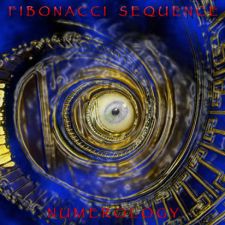
The name ‘Fibonacci sequence’ refers to a series of numbers in which each number is the sum of the previous two. Named after medieval Italian mathematician Leonardo Fibonacci, who introduced it to Western Europe, it is featured in literature, cinema, the visual arts and music: for instance, the lyrics to the title-track of Tool’s celebrated Lateralus album are arranged on the basis of the Fibonacci sequence.

On the other hand, even if Fibonacci Sequence would be a perfect name for a math-rock band, the Milwaukee-based trio bearing this name are quite a different beast. Those who delight in sticking labels on everything and everyone will certainly have their work cut out for them with a band like Fibonacci Sequence, as their unabashed eclecticism makes classification all but impossible. While one moment they may conjure shades of progressive metal, the next passage will take the listener into almost symphonic territory, with clear, melodic sounds and lush layers of keyboards – not to mention the tantalizing Latin and Middle Eastern references and the sprinkling of jazzy touches. Their omnivorous approach is further borne out by the influences mentioned by the band – a list ranging from Yes, Rush and Dream Theater to The Police, Sting and Mahavishnu Orchestra.

For those who thrive on making comparisons with more established acts, I would mention equally eclectic instrumental outfits like From.uz or Djam Karet, as well as more metal-oriented ones like Canvas Solaris or Relocator – as well as the obligatory Liquid Tension Experiment or Planet X. Unlike the latter bands, though, Fibonacci Sequence’s sound is more distinctly guitar-based, with keyboards used as an accent rather than dominating their whole music. Faced with such almost effortless proficiency, which nevertheless does not come across as cold and detached, the listener would be forgiven for thinking that the band are one of the many projects that (often due to practical issues) have no life outside the walls of a recording studio. The band, however, are quite active on the live front in their home town of Milwaukee, and the announcement of their participation to the 2011 edition of ProgDay has whetted the appetite of the  numerous fans of instrumental progressive rock.

The aptly-titled Numerology, Fibonacci Sequence’s debut full-lenght album, was released about a year after the 2-track EP We Three Kings, which featured a very interesting arrangement of the popular 19th century Christmas carol. On this album, the three core musicians avail themselves of the valuable contribution of fretless bassist Chris Kringel (formerly with Cynic and their offshoot Portal) on all but one of the tracks, as well as bassist Chad Burkholz on “Missing Time”, and violinist Elizabeth Grimm on the last three numbers. Most of the tracks on Numerology run between 6 and 11 minutes, long enough to allow the band members to branch out and create intricate musical weaves; the album as a whole clocks in at a quite manageable 65 minutes. The band manage to produce an impressive volume of sound of exceptional clarity, every instrument given a strikingly dimensional feel in the mix. As in the best productions, in spite of the complexity of the compositions, the music flows smoothly and naturally, without giving the impression of being too complicated for its own good.

Right from the opening strains of the short but punchy “Commencement” – a lush, melodic guitar number powered by an impressive drum sound – the sheer quality of the recording comes across in no uncertain terms. While Michael J. Butzen’s guitars take the leading role, the engine propelling Fibonacci Sequence’s music along is Thomas Ford’s powerful yet restrained drumming, a full-bodied sound that manages not to overwhelm the other instruments. Fibonacci Sequence’s trademark blend of melody, heaviness and sleek instrumental expertise emerges in “Neap Tide” (also featured on the EP), a heady, multilayered mix of sharp riffing, acoustic, pastoral beauty and jazzy licks whose dense sonic texture manages not to feel stifling or contrived. On the other hand, “Primrose Path” comes across as a contemporary-sounding version of vintage Santana, down to the jazzy, Latin-tinged guitar work. Perfectly descriptive of its title, “Dawn” is a slow, meditative acoustic guitar piece introduced by atmospheric keyboards and birdsong, which introduces the thunderously drum-driven “Catlord”, its heaviness spiced by Eastern touches in the clean, mesmerizing guitar lines.

After the very short ambient piece “Illuminati”, Fibonacci Sequence display more of their exciting compositional skills in the album’s final four tracks, starting with the splendid bass showcase that is “Work in Progress”, peppered by frequent pauses that, instead of disrupting the flow of the music, seem to stimulate the listener’s attention. With “Missing Time” we enter Liquid Tension Experiment/Planet X territory, Jeffrey Schuelke’s keyboards taking more of a lead role and Butzen’s guitar injecting a touch of fiery, yet shred-free edginess, and the violin adding a symphonic note to the second half of the track. The 11-minute “Faunus” (the longest track on the album) is deceptively more linear in structure, with a tense, riff-laden first half and a slow, almost melancholy ending punctuated by lovely guitar and violin; while closing track “Io” picks up from where the previous number left off, with a moody beginning and a mainly keyboard-driven middle section, culminating with an extended guitar solo of outstanding quality. Interestingly, the album begins and ends with the crackling of an old vinyl record – a sound dear to many old-school prog fans.

Besides the obvious quality of their  music, both in terms of composition and execution, Fibonacci Sequence’s nature of real live outfit makes them an even more intriguing proposition. The simple fact that they are not easy to pigeonhole should be seen as a positive sign, especially in these times when increasingly outrageous labels are created with alarming regularity. In any case, Numerology is one of the finest instrumental prog albums released in the past couple of years or so, and their ProgDay appearance will hopefully contribute to putting Fibonacci Sequence on the map for those progressive rock fans who are still unaware of them. Highly recommended.

Links:
http://fib-seq.blogspot.com/

http://www.myspace.com/fibonaccisequenceband


Read Full Post »

TRACKLISTING:
1. The Cave (23:35)
2. White Light, No Heat (11:28)
3. God’s Elastic Acre (18:16)
4. Sati & The Trainman (11:14)

LINEUP:
Gayle Ellett – analog and digital keyboards, electric guitar, effects
Chuck Oken, Jr. – analog, digital and modular keyboards, electronic percussion, effects, loop processing and reconstruction

With:
Richard Pinhas – guitar loops (1-3)

Ukab Maerd’s The Waiting Room, the second of Djam Karet’s side projects to be  released in 2010, is a very different affair from Mike Henderson’s song-oriented White Arrow Project. The brainchild of Djam Karet’s founding members Gayle Ellet and Chuck Oken, Jr., with legendary French musician Richard Pinhas guesting on three out of four tracks, Ukab Maerd (“Baku Dream” spelled backwards – a reference to DK’s 2003 album A Night for Baku) is a vehicle for the creation of hypnotic soundscapes inspired by the European electronic music of the Seventies. The two musicians describe the album’s content as mind music that draws its inspiration from dream language and Surrealist art – a definition that fits it to a T.

While neither an expert nor a dedicated listener of progressive electronic music, I recognize its importance both in historical and artistic terms, and The Waiting Room provides a fine example of the possibilities offered by technology. Even if its running time of about 64 minutes (divided into four tracks, none under 11 minutes) might turn it into an ordeal for people who are not used to listening to music produced almost exclusively with electronic instruments, the album undeniably possesses a mesmerizing quality, at least if taken in judicious doses. As can be expected, the main points of reference are German giants such as Tangerine Dream and Klaus Schulze, as well as their followers from other European countries (including Pinhas’ former band Heldon). Most of the album was recorded live at two different performances by Ellett and Oken, with Pinhas’ parts added subsequently.

Many people are put off by electronic music on account of its supposedly cold, overly cerebral nature, unlike warmer, more down-to-earth musical forms such as rock or blues. While this may in some respects not be entirely wrong, the music presented on The Waiting Room intrigues and captures in a sharply different fashion than guitar-driven rock, progressive or otherwise. As the pointed out in the press release, it is music that appeals to the mind rather than the body, conceived to be listened to with some degree of concentration, and therefore always at risk of fading in the background if used as a soundtrack for other activities. With a minimal amount of percussion, and guitars manipulated in such a way as to become unrecognizable, the music ebbs and flows with hypnotic regularity, while all kinds of electronic sound effects enhance the moods and atmospheres created by layers of synthesizers.

“The Cave” evokes the titular place with uncanny accuracy, eerie sounds suggesting machinery or sloshing underground waters, the keyboards surging in waves or subsiding with a movement that may come across as monotonous, but also subtly unsettling and quite fascinating. The following “White Light, No Heat” alternates between majestic keyboard surges that create a sense of keen tension and disturbing industrial noises, replaced in the second half by tinkling yet vaguely robotic keys; while “God’s Elastic Acre” unfolds in a cinematic sweep underpinned by clanging, echoing sounds, droning and bubbling noises, while the solemn tone of the keyboards takes on a more upbeat, Eastern-tinged note towards the end. Album closer “Sati and the Trainman”, the more accessible number by far, revolves around a pulsating synth line paralleled by a slower, more atmospheric tune that suggests a train running through a darkened, slightly sinister landscape.

Needless to say, devotees of this particular genre will be able to show The Waiting Room the appreciation it deserves; while those listeners who can only process small quantities of almost completely electronic music might find it a bit too demanding to sit through the whole 64 minutes, and decide instead to break the album into separate segments. On any account, The Waiting Room is a fine example of vintage progressive electronics, and –  even for those who, like me, have never been keen followers of electronic music – it is very much worth a listen.

Links:
http://www.myspace.com/ukabmaerd
http://www.djamkaret.com

Read Full Post »

TRACKLISTING:
1. La Faulx  (25:03)
2. Jack the Ripper (13:20)
3. Vous Le Saurez En Temps Voulu (12:51)
4. Chaos Hermetique (bonus track) (11:52)

LINEUP:
Michel Berckmans – oboe, bassoon (1-3)
Daniel Denis – drums, percussion
Patrick Hanappier – violin, viola
Vincent Motouille – keyboards (4)
Guy Segers – bass, voice
Roger Trigaux – guitar, piano, organ, harmonium

Released when the original prog movement had, for the most part, already run out of steam, over the years Heresie has built a reputation as one of the gloomiest, most disturbing records ever produced in a progressive rock context. A descent into unadulterated darkness, Univers Zéro’s second album enjoys near-legendary status in the more forward-thinking circles of prog fans. As technically brilliant as any of the ‘big name’ bands of the early Seventies (and possibly even more so), the Belgian outfit approach the creation of highly challenging music from a distinctly different angle than the likes of Genesis or Yes – while a comparison with King Crimson might feel more appropriate.

Almost 32 years after Heresie’s release, Univers Zéro are the only founding band of the Rock in Opposition movement to be still active. With their latest release, Clivages, hailed as one of the last year’s landmark albums, their performance at the 2010 edition of the Sonic Circuits Festival in Washington DC (thanks to the joint efforts of the festival organizers and the band’s label, Cuneiform Records) was nothing short of breathtaking. They are also, however, a very divisive band to the more conservative set of prog fans, who often look upon the whole RIO/Avant scene as little more than a bunch of purveyors of jarring, overly demanding fare with pseudo-intellectual pretensions. While most of the classic prog of the ‘70s is symphonic in inspiration, with Univers Zéro we enter ‘chamber rock’ territory – which, just like its classical counterpart, can be the object of equally intense love or loathing.

Originally running at a whopping 50 minutes (very unusually for a single vinyl album), and almost completely acoustic, Heresie undoubtedly shares more with academic music than conventional rock, with typical rock instruments like the guitar taking a back seat. While Daniel Denis’ astounding drumming forms the core of the band’s sound, his style distinctly clashes with the common image of the powerhouse rock drummer. Having been so lucky as to see him and Magma’s Christian Vander on stage in the space of a week, I was struck by how both of them come across as almost antithetic to the brash, flamboyant style of drummers such as Mike Portnoy. Indeed, both Denis’ and Vander’s  approach to drumming brings to mind the role of percussion in an orchestra –  not merely propulsive, but textural and expressive at the same time. .

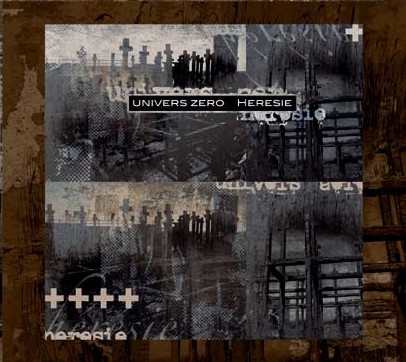
Though frequently described as the ideal soundtrack to a horror movie (or even to one of HP Lovecraft’s insomnia-inducing short stories), Heresie does not have a lot in common with the hard-hitting, yet slightly garish music produced by the likes of Goblin and Keith Emerson for Dario Argento’s iconic slasher flicks. As pointed out in the very thorough liner notes (courtesy of Renato Moraes and Aymeric Leroy, Canterbury expert extraordinaire and founder of the Calyx website), the album’s centrepiece, the monumental, 25-minute “La Faulx” (The Scythe) parallels the structure of Ingmar Bergman’s legendary The Seventh Seal – also suggested by the bleak, sepia-tinted cover artwork. Though “La Faulx” might at first appear as Univers Zéro’s idiosyncratic take on that old prog warhorse, the ‘epic’, I see it as perfectly contained chamber piece rather than a mini-symphony like “Close to the Edge”or “Supper’s Ready”. Opening with about seven minutes of nightmarishly chaotic sounds, echoing drum beats and menacing vocal growls in an invented language that would give any death metal band a run for their money, it develops into an intense, mesmerizing theme propelled along by Denis’ subtle yet relentless drumming and Michel Berckmans’ rich tapestry of woodwinds, interspersed by the plaintive voice of the violin. When, towards the end, the controlled chaos subsides, a hint of melody surfaces, as well as a measure of calm that seem to reflect the ending of Bergman’s masterpiece.

While apparently more cohesive and linear in compositional structure, “Jack the Ripper” suggests the devastation wrought by the titular character by means of harsh violin slashes, while the bassoon and drums at the beginning evoke the slow, plodding pace of a funeral march. The whole structure of the track is indeed ruled by the drums, whose expressive potential unfolds fully, lending them a ‘voice’ that transcends mere rhythmic beat. On the other hand, “Vous Le Saurez En Temps Voulu” (We’ll Let You Know in Due Time) is the most classically-inspired of the three original compositions, with a tuneful, almost upbeat first half reminiscent of Stravinsky, gradually driving towards a disturbing, doom-laden culmination – the ‘due time’ of the title probably referring to the moment of death.

The thorough remixing process undergone by Heresie lifts the music from the murky depths of the original version – perhaps effective in terms of atmosphere, but much less so in terms of musical enjoyment. However, besides the definite improvement of the sound quality, the main attraction of the album lies in the previously unreleased track “Chaos Hermetique”, remastered from an audio cassette copy and originally recorded in 1975,  prior to Berckmans’ arrival. With a definitely more electric direction, it revolves around composer Roger Trigaux’s guitar, conjuring shades of the sleek angularity of King Crimson; while Denis assumes a more conventional rock drummer role, providing plenty of bottom end in unison with Guy Segers’ bass.

Splendidly composed and flawlessly executed, Heresie can nonetheless prove nearly unapproachable for those who believe melody and memorable tunes are essential components of music. While not as harsh or atonal as other efforts by RIO/Avant bands, and much more disciplined and tightly knit than one might expect, this is an album that needs to be listened to with care and attention, preferably when the time and mood are right – and not just because it is ‘scary’ music that might not make you sleep at night. Based on painstaking detail (like most chamber music) rather than broad sweeps, it also possesses the austere beauty of medieval architecture, stark though not exactly minimalistic, yet full of  majesty and power. In any case, I would recommend Heresie to anyone interested in authentically progressive, challenging music, though not necessarily ‘prog’ in the canonical sense of the word. A liking for early 20th-century academic music would also help when approaching Univers Zéro’s output as a whole.

Links:
http://www.univers-zero.com
http://www.cuneiformrecords.com

Read Full Post »

TRACKLISTING:
1. Hungry Ghost (8:32)
2. The Red Threaded Sexy Beast (12:42)
3. Consider Figure Three (9:48)
4. The Packing House (12:56)
5. Dedicated to KC (9:48)
6. The Gypsy and the Hegemon (10:55)

LINEUP:
Gayle Ellett – organ, analog synth, mellotron, digital synths
Mike Henderson – guitars, ebow, effects
Aaron Kenyon – 5-string bass, effects
Mike Murray – guitars, ebow, effects
Chuck Oken, Jr. – drums, altered voices

Despite their decades-long career as one of the foremost US progressive rock bands, I have to admit that this album was my very first approach to Djam Karet’s music. Although I was obviously familiar with the name – Edward Macan devoted a section of his seminal book Rocking the Classics to them as examples of ‘post-progressive’ rock – but, for some reason or the other, I had never got around to hearing any of their material. Thankfully, the opportunity came some time in 2010, when I got in touch with Gayle Ellett after reviewing the second album of his side project Fernwood, and he sent me a copy of The Heavy Soul Sessions. And what better introduction to a band’s music than a live album, even if recorded in the studio rather than before an audience? Indeed, The Heavy Soul Sessions was recorded immediately after the band’s performance at the French prog festival Crescendo in the summer of 2009, with a view to recreating the atmosphere of a live setting in the studio without any resource to overdubs or the like. An elusive outfit for most of their career, Djam Karet have not been very active on the live front in the past few years, and seeing them perform on a stage has become a rare treat for their loyal following.

Released five years after Djam Karet’s latest studio effort to date, Recollection Harvest, The Heavy Soul Sessions gathers five tracks from the band’s back catalogue, plus a cover of “Dedicated to KC” from Richard Pinhas’ album L’Ethique. The oldest number, “Consider Figure Three”, originally appeared on the Suspension and Displacement album, released in 1991 as a companion effort to the harder-edged Burning the Hard City. “The Packing House” and “The Gypsy and the Hegemon” are taken from Recollection Harvest, while “Hungry Ghost” and the “The Red-Threaded Sexy Beast” (which actually conflates two separate compositions, “Red Threads” and “Sexy Beast”) come from 2003’s A Night for Baku.  The album as a whole runs at a reasonable 64 minutes (with individual tracks between 8 and 12 minutes), presenting a highly satisfying picture of the band’s skills and expressive potential, accrued in the almost 30 years of their musical career. To Djam Karet newcomers like myself, the six tracks are a real boon, as they show a band that has grown and matured constantly over the years, and whose individual members’ side projects have proved to be a source of enrichment rather than a drain.

Djam Karet’s music has often been described as ‘King Crimson meets Pink Floyd’ – a definition which is only partly true. Following Macan’s advice, the band have finally managed to bridge the gap between their rock side and their inclination towards spacey, ambient textures that make good use of cutting-edge technology. Their unabashed eclecticism emerges from even a cursory listen to The Heavy Soul Sessions: the dynamic, riff-heavy opener “Hungry Ghost”; the gentle, almost pastoral moods of “The Gypsy and the Hegemon”; the trippy, Pinkfloydian passages in “The Red-Threaded Sexy Beast”; the airy, measured beauty of the piano and guitar work in “The Packing House”; the choppy, galloping pace of the organ-led “Dedicated to K.C.” On the other hand, “Consider Figure Three” showcases the ambient/electronic side of the band’s creativity (further explored in the side project Ukab Maerd, soon to be reviewed here). Mentioned in Macan’s overview, it is a haunting, brooding piece where the recorded voice of a doctor recites a dry scientific text over a background of spacey electronic effects, surging keyboard waves and Eastern-tinged chanting.

The compositions are ruled by the seamless interaction between Gayle Ellett’s keyboards and Mike Murray (the band’s newest member) and Mike Henderson’s guitars. Unlike the traditional ‘twin guitar’ format of many classic and hard rock bands, their main function is to add layers of sound and complement the keyboards, rather than act as perpetual sparring partners, or provide relentless rifferama – though riffs surface every now and then, aided and abetted by the powerful yet restrained rhythm section of Chuck Oken Jr and Aaron Kenyon. The music’s natural flow is not at odds with its complexity; even the frequent pauses and changes in time signature do not create that impression of patchiness or lack of a coherent structure that seem to be a constant in the output of ambitious yet less experienced bands. The remarkably fluid interplay between all the instruments puts to shame the displays of virtuosity for its own sake that plague many recent releases.

While the band’s hardcore fanbase will probably be disappointed by the lack of any new material after a five-year wait, The Heavy Soul Sessions provides a great opportunity for those who (like myself) want to get acquainted with Djam Karet’s output. Hopefully this excellent album will encourage more people to delve into the band’s back catalogue, available through their website. Highly recommended to lovers of instrumental prog, and an excellent introduction to the work of one of the most representative bands of the ‘second generation’ of progressive rock.

Links:
http://www.djamkaret.com

Read Full Post »

TRACKLISTING:
1. The Encounter ( 5:03 )
2. The Push ( 3:36 )
3. Out Of The Mist ( 8:25 )
4. Sequence Of Events ( 3:25 )
5. DIP ( 6:56 )
6. The Departure ( 4:40 )
7. Gray Matter ( 6:16 )
8. Orb ( 7:47 )
9. 11th Heaven Blues ( 4:00 )
10. Still (Unsettled ) ( 2:10 )

LINEUP:
Dean Watson – all instruments

While so-called ‘solo-pilot’ instrumental albums seem to be rather ubiquitous these days (with results not always up to scratch), it is far from an everyday occurrence to come across an album as impressive as Unsettled, Dean Watson’s debut release – even more so if we consider that we are dealing with a wholly independent production. An amazingly accomplished disc, structured in a remarkably balanced way, it presents music that is eclectic without being directionless, and complex without being unnecessarily convoluted.

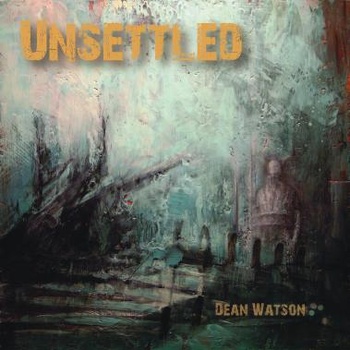
For such a proficient composer and multi-instrumentalist, Toronto-based Dean Watson is a very unassuming character, in spite of his decades-long experience in the music world. Dispensing with the bells and whistles to which so many new acts seem to be addicted, he has embarked on the promotion of his music completely on his own, offering his album for review on progressive rock discussion boards, and eliciting almost unanimously positive feedback. Indeed, though it falls somewhat short of perfection,  Unsettled as a whole is an impressively cohesive effort: inspired by the painting of the same name by Ron Eady (a visual artist also based in Toronto), it is conceived as a sonic rendition of the painting itself, realized with a successful blend of emotion and technical skill that often eludes all-instrumental productions.

Other reviewers have labelled Unsettled as progressive fusion, and, in some ways at least, the description fits the album quite well – especially if we take into account the many diverse sources of inspiration (listed by Watson on his MySpace page) that make up its sound.  the actual jazz-rock component in Unsettled is rather restrained, sharing the stage with spacey touches, progressive metal overtones, and even subtle classic rock influences. Although comparisons have been made with the likes of Planet X and Liquid Tension Experiment – at least as regards those moments on the album where things take a more metallic turn – I feel they limit the scope of Watson’s creative impulse. In fact, while some tracks on the album may bring to mind the aforementioned, hyper-technical instrumental combos, others reveal a vintage jazz-rock feel akin to Jeff Beck’s two seminal mid-Seventies albums, Blow by Blow and Wired, eschewing the feeling of chilly perfection that often plagues the output of metal-fusion acts.

Unsettled’s main flaw lies in the use of programmed drums, though they are nowhere as annoying than on other similar projects. True, their artificial nature occasionally surfaces, marring (albeit slightly) the otherwise warm and engaging sound of the compositions, and making one wonder how the album would sound if Watson had instead gone for the real thing. A couple of tracks also come across as somewhat less cohesive than the others, with abrupt changes in mood and pace that may leave the listener a tad baffled. However, the level of both composition and execution is so consistently high that it amply compensates for these shortcomings.

Running at around 52 minutes, Unsettled is a compact album that strikes the right balance between longer, more complex compositions and shorter numbers with a more direct impact. Watson’s approach definitely helps the listener to concentrate on each number, and appreciate the diversity on offer. Watson always keeps melody at the forefront, opting for power rather than harshness when introducing heavy riffing into the fabric of his songs, so that even the heaviest moments are amazingly tuneful. Opener “The Encounter” is a good example of how Watson merges progressive metal vibes with more sedate moods;  the use of keyboard-based riffs reminded me of Relocator’s self-titled debut (another excellent instrumental album released in 2010), with various electronic effects adding a spacey note, and some remarkable Hammond organ and guitar work. “Sequence of Events”, one of the shortest items on the album at barely over 3 minutes, offers an intense, almost concentrated atmosphere made of brisk keyboard flights and hard-edged riffing reminiscent of classic instrumental metal-fusion; while the brisk, high-energy “Orb” would have been more effective without the overpowering drums and whistling synth sounds.

On the other hand, Watson’s talent emerges most clearly in those tracks where the prog-metal component is kept to a minimum – such as the jazzy, almost funky “The Push”, relying on some fine organ-guitar interplay with a warm, rugged Seventies sound, or the exhilarating “Gray Matter”, propelled by energetic bass and drums and showcasing Watson’s outstanding skills as a guitarist. His soloing here, as well as in the splendid first half of “The Departure”, possesses a clean, melodic feel that evokes  the aforementioned Jeff Beck, as well as another guitar great, Irish legend Gary Moore. While the latter number is somewhat marred by an abrupt change in pace and style towards the end, its slow-burning, wistful first half brought to my mind some of Moore’s more meditative pieces, such as “Sunset”, “The Loner” or “Gary’s Lament”. With “Out of the Mist”, the longest piece on the album (and possibly its highlight), we are presented with a musical version of Ron Eady’s intriguing cover painting, with its romantic, melancholy beginning, backed by strings that add depth to the beautiful strumming of the acoustic and electric guitars, and a second half full of tension and menace, driven by intense riffing and crashing drums.

Though the problem with an album such as Unsettled might lie in its evident metal subtext – which may put off the more conservative jazz-fusion fans – lovers of eclectic instrumental rock will definitely find a lot to enjoy in this finely-crafted effort, an excellent debut from an outstanding musician. In any case, it would be interesting to see Watson branch out and enlist the help of some other musicians, in order to bring his compositions before a live audience.

Links:
http://www.myspace.com/deanwatson2
http://www.roneady.com

Read Full Post »

TRACKLISTING:
1. Save The Yuppie Breeding Grounds (4:12)
2. Ephebus Amoebus (4:55)
3. Nacho Sunset (4:29)
4. $9 Pay-Per-View Lifetime TV Movie (5:51)
5. Manifest Density (3:55)
6. Uncle Tang’s Cabinet of Dr. Caligari (4:01)
7. Disillusioned Avatar (5:15)
8. Kuru (5:02)
9. Revenge Grandmother (5:11)
10. Staggerin’ (4:41)
11. Middlebräu (6:46)

LINEUP:
Dennis Rea – electric guitar
Ruth Davidson – cello
Alicia Allen – violin
Kevin Millard – bass guitar, baliset
Jay Jaskot – drums

The city of Seattle has long been known as a hotbed for innovative music, from Jimi Hendrix to the grunge movement through progressive metal pioneers Queensryche. For several decades, it has also been the home of globe-trotting guitarist and composer Dennis Rea, originally from upstate New York, but now a full-fledged member of the Pacific Northwest artistic community. While Rea, in  his many years of tireless activity in the realms of creative music-making, has gathered an impressive discography (especially in terms of quality), he has never become a household name as he would have amply deserved. Luckily, the release of Moraine’s debut album in 2009, as well as his first solo album proper, View from Chicheng Precipice, and Iron Kim Style’s debut in 2010, have contributed to putting Rea’s name on the sprawling map of the progressive music scene.

Indeed, Moraine were selected for the 2010 edition of NEARfest, where they elicited quite a lot of interest – in spite of having been described as ‘avant-garde’ on the festival’s press material, a definition which (coupled with their placement in the opening Sunday slot, also known as the ‘rude awakening’, and generally reserved for rather idiosyncratic bands) kept the more conservative members of the audience away from their set. The members of the band, and Rea in particular, were somewhat amused at having been lumped together with much more ‘mainstream’ bands under the all-encompassing prog banner. In these times of derivative acts being peddled as the best thing since sliced bread, Moraine were possibly the most genuinely progressive band on the bill – though, as purveyors of hard-to-pinpoint music, they left some of the more label-happy members of the audience a tad baffled.

Although instrumental albums are seemingly a dime a dozen these days, Manifest Density (a brilliant pun on one of the most obnoxious aspects of US history) is not your average cookie-cutter instance of amazing chops unencumbered by soul and emotion. With a total of 11 tracks averaging 5 minutes in length  (the longest running at under 7 minutes),  and all of the five band members but drummer Jay Jaskot contributing to the compositional process, it is very much an ensemble effort, a collection of contemporary chamber rock pieces that comes with a liberal helping of almost Canterbury-like dry wit – though more geared to 21st-century American society. The essential input of the violin may draw comparisons with bands such as King Crimson circa Larks’ Tongue in Aspic or Mahavishnu Orchestra, while the pervasive presence of the cello may bring to mind Swedish Gothic proggers Anekdoten. However, in Moraine’s sound the cello’s unmistakable drone does not create the same kind of claustrophobic atmosphere, but rather adds that kind of depth that is generally supplied by the keyboards in the output of more conventional prog bands.

Since the individual members of Moraine have parallel involvements in a number of very diverse projects, ranging from jazz to stoner rock, it will not come as a surprise that eclecticism is the name of the game on Manifest Density. However, those anticipating a hodge-podge of disparate ideas that ultimately do not coalesce would be making the wrong assumption: the album as a whole impresses for its cohesion, even allowing for the different compositional styles of each band member. While Dennis Rea’s compositions (such as “Kuru” or “Staggerin’”) tend to favour a jazzier, more experimental style, two of the three tracks penned by co-founder Ruth Davidson (“$9 Pay-Per-View Lifetime TV Movie” and “Revenge Grandmother”) possess a wistful, low-key quality, shared by Alicia Allen’s deeply lyrical “Disillusioned Avatar”. On the other hand, album opener “Save the Yuppie Breeding Grounds”, also written by Davidson, is an energetic yet haunting number with a strong Crimsonian vibe; while bassist Kevin Millard’s “Ephebus Amoebus” opens in a slow, atmospheric fashion, then develops into a frenzied workout, with guitar and violin sparring with each other.

The quirky track titles inject a welcome dose of humour into the proceedings – a recurring feature in the work of other modern instrumental bands, but which Moraine (and especially Dennis Rea) seem to have got down to a fine art. Actually, the titles fit the musical content astonishingly well: “Uncle Tang’s Cabinet of Dr Caligari” is suitably dissonant, at times chaotic, with subtle Gothic undertones; while the upbeat “Nacho Sunset”, embellished by stunningly clear, lilting guitar work and gentle violin, has a relaxed, almost Latin feel. Though the album’s sound is mostly driven by the flawlessly intricate interplay between Rea’s distinctive guitar and Allen’s versatile violin lyrical and assertive in turns, none of the other instruments is confined to a mere supporting role, and each of them contributes in keeping the sonic texture tight. An excellent example of this is album closer (and personal favourite) “Middlebräu”: after a funky first half, propelled by magnificent bass and drums (very much in classic jazz-rock vein),  a pause signals an abrupt change of pace, and the beginning of a simply magnificent, almost slo-mo coda featuring an intense, meditative guitar solo (the closest Rea comes to a traditional rock solo).

When Moraine performed at NEARfest, their lineup had changed, with obvious consequences for their sound. Ruth Davidson and Jay Jaskot had moved away from Seattle, and been replaced by  drummer Stephen T Cavit (also an award-winning composer of film and TV scores), and woodwind player Jim DeJoie ( now Alicia Allen’s husband). The switch from cello to woodwinds lent the music a brighter, but also slightly more angular quality, reminiscent of those bands, such as Henry Cow, on the more experimental end of the Canterbury scene. This bodes well for the band’s second album, which is already in the works at the time of writing. In the spring of 2011 Moraine will also embark on a tour of the US East Coast, with dates at the New Jersey Proghouse and the legendary Orion Studios in Baltimore already confirmed. Catch them if you can – they are a very entertaining live act, and Manifest Density qualifies as one of the most promising debut albums of the past decade in the progressive music field.

Links:
http://www.moraineband.com

Read Full Post »

TRACKLISTING:
1. U-5  (7:13)
2. BB-2  (5:07)
3. Q-1  (7:39)
4. W-1A  (3:21)
5. W-5  (7:28)
6. W-1B  (2:19)
7. T-6  (4:55)
8. AA-5  (5:41)
9. Q-2  (7:19)
10. AA-4  (5:04)

LINEUP:
Willie Oteri – guitars, live loops
Dave Laczko – trumpet, effects

With:
Dino J.A. Deane – lap steel dulcimer, beat jockey
Scott Amendola – drums, percussion

Born in California, though currently based in the university town of Austin (Texas),  guitarist and composer Willie Oteri is something that has become increasingly rare in this day and age – a professional musician. Although he may not be a household name for most readers of this blog, he has got as impressive a  résumé as they come, with numerous high-profile collaborations under his belt (he has worked with the likes of Tony Levin, Pat Mastelotto, Mike Keneally and Stu Hamm). His latest project, WD-41, was put together in 2009 by Oteri and trumpeter Dave Laczko, after Oteri came back from spending almost four years in the Italian town of Padova (home to one of the oldest universities in the Western world). Indeed, the album’s Italian-language title pays homage to Oteri’s own roots, as well as his love for the boot-shaped Mediterranean peninsula.

Unlike WD-41’s debut album, entirely performed by just Oteri and Laczko, Temi Per Cinema sees the participation of two guest musicians (as implied by the +2 added to the outfit’s name) – multi-instrumentalist Dino J.A. Deane (known for his collaborations with John Zorn and Jon Hassell) and drummer Scott Amendola. Their presence adds depth to compositions that are largely based on live loops, with Oteri and Laczko creating trippy, highly cinematic soundscapes, at times soothing, at others somewhat disquieting. Though the guitar, together with the trumpet, is the main driving force of the album, Temi Per Cinema can be said to be the polar opposite of those ‘guitar hero’ efforts who seem to be very popular nowadays, especially with the younger generations. Thankfully, there is no shredding involved here, nor any such vanity showcases: for Oteri, the guitar is a starting point for a variegated range of modes of expression, a means to an end rather than an end in itself.

Though not really alike sound-wise, I believe Temi Per Cinema might be successfully compared to two albums released earlier this year by another guitarist driven by a rather unconventional creative impulse – Seattle’s very own Dennis Rea. In particular, the album shares its wholly improvised (though far from haphazard) nature with Iron Kim Style’s self-titled debut – though the latter has a more ‘mainstream’ jazz-rock bent; while its meditative yet intense atmospheres bring to mind Rea’s View from Chicheng Precipice (reviewed elsewhere on this blog). Oteri and Rea are both artists whose passion for music shines throughout their work, both keen on exploring their instrument’s endless possibilities beyond a conventional rock approach.

Oddly enough, while undeniably anything but an easy, comfortable listen, Temi Per Cinema is not the kind of album that will fade in the background unless approached with the utmost concentration. On the contrary (probably on account of  its essentially ‘soundtrack-y’ nature), its demanding, frequently angular musical content possesses an undefinable quality that seems to capture the listener’s attention. Apparently unstructured, yet never gratuitously chaotic, it takes elements from ambient, free-jazz, avant-garde and psychedelic/space rock and fuses them in a compelling though challenging  mélange.

Running at a very sensible 52 minutes, Temi Per Cinema features ten numbers that, while sharing a similar mood and conception, are in no way carbon copies of each other – indeed, repeated listens will reveal peculiarities and otherwise hidden nuances. Interestingly, none of the tracks have been given conventional titles – a highly unusual choice, whose main aim is to encourage the listener’s own interpretation of the music by eliminating the images normally conjured by conventional titles. By rendering their compositions somehow impersonal, Oteri and Laczko try to promote a more active role on the part of the listener – in the words of Miles Davis, “Call it Anything”.

With track times ranging from 7 to 2 minutes, Temi Per Cinema lends itself equally well to being approached  piecemeal and as an organic whole. Opener “U-5” presents a subtle yet clearly perceivable Eastern spicing amidst the moody, ambient-like waves of electronic effects punctuated by Laczko’s floating trumpet – a dense, multilayered track, with all the instruments blending and sparring at the same time. The eerie, intensely atmospheric “Q-1”, led by the mournful sound of the trumpet, brought to my mind images of the vast expanse of the sea, reinforced by Oteri’s low-key guitar work; while in the entrancing “W-5” the guitar takes centre stage, albeit in a slow, measured way, creating the perfect soundtrack for a vintage Gothic movie. On the other hand, other tracks (such as “BB-2” and “W-1B”) come across as distinctly free-form, and quite devoid of melody (at least intended in a conventional sense) – therefore much harder to swallow for the more conservative set.

Temi Per Cinema is, indeed, the kind of album that not every fan of progressive rock is bound to appreciate. While the actual ‘rock’ component is rather thin on the ground, at least in conventional terms, the lead role played by the trumpet may put off those who generally shun jazz. However, fans of King Crimson, Robert Fripp’s solo output (with or without Brian Eno), and all those bands (like, for instance, US prog veterans The Muffins) whose line-up and compositional approach somewhat diverge from the mainstream rock tradition, are likely to warm to this impressive effort, brought to us by an extremely talented, dedicated duo of musicians who clearly deserve more exposure.

Links:
http://www.myspace.com/wd41music

http://www.myspace.com/willieoteri

Read Full Post »

« Newer Posts