Feeds:
Posts
Comments

Archive for the ‘Progressive Metal’ Category

Progressive metal may not be everyone’s cup of tea, but it is definitely a phenomenon that is here to stay, and that has also brought a much-need input of new ideas to the often stale prog scene. As a result, an increasing number of events specifically dedicated to this subgenre are cropping up both in Europe and America. Europe, however, seems to have the edge in this respect, also helped by the fact that it is relatively easy for festival organizers to get public funding, and therefore avoid imposing steep ticket prices on would-be attendees.

The latest addition to the roster of progressive metal festivals, Generation Prog 2011 is an ‘inside job’, so to speak, being the brainchild of Relocator bassist Michael Schetter (formerly Pruchnicki). The event, scheduled to take place on September 23 and 24 in the historic  German city of Nuremberg , will see the participation of 8 European bands, including local acts Effloresce, Ocean Spout and Theory of Elements, as well as Relocator (whose live keyboardist, Sergej Schamber, is also a member of  Ocean Spout).  The line-up will be completed by two British bands, To-Mera and Haken, ground-breaking Dutch ‘jazz-metal’ combo Exivious, and Swedish outfit Andromeda as Saturday night headliner.

As the schedule is not yet 100%  final, I would recommend that anyone interested in attending check both the event’s website (which is in German, with a shorter English section) and its Facebook page for the latest updates.

By way of a conclusion, I would like to praise Michael Schetter and his collaborators for taking the plunge, and investing so much time (and possibly money) into the organization of an event that will serve as a showcase for up-and-coming bands, as well as more established ones. In my view, this is the way to go, if we really want the progressive rock scene to survive and prosper for a long time.

Links:
http://www.generation-prog.com/?page_id=41

https://www.facebook.com/GenerationProg

Read Full Post »

TRACKLISTING:

1. Geistly Suite (7:51)
2. Importance (7:34)
3. Fallen Tiger (6:53)
4. Things Unsaid (5:14)
5. Odessa (5:44)
6. Angelus Novusaum (7:26)
7. When the Fog Clears (6:01)
8. Midnight (6:43)

LINEUP:
Gregg Johns – guitar, bass, keyboards, vocals
Ceci Whitehurst – lead vocals
Clay Pell – bass
Todd Sears – drums, percussion, keyboards, vocals

With:
Jeff Hamel – guitar, keyboards (1)
Bones Theriot – guitar (4)
Michael Fortenberry – trumpet (6)
Bridget Shield – lead vocals (8)

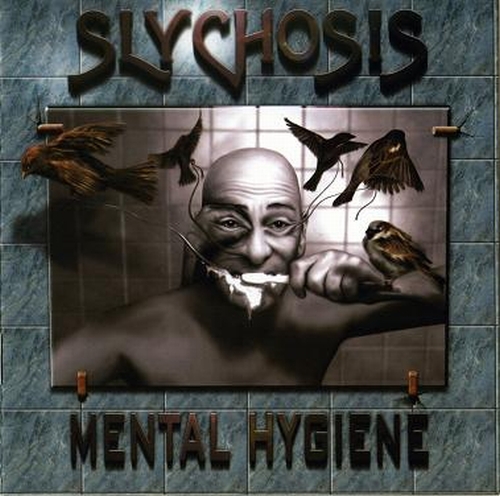
Two years ago I received Slychosis’ second album, Slychedelia, to review, and was immediately impressed by the CD’s striking artwork. Visuals have always been essential in progressive rock, and the Mississippi-based outfit had pulled out all the stops by enlisting the services of Surrealist Ukrainian artist Vladimir Moldavsky. Such a strong visual appeal boded well for the album – which, while not as downright quirky as Moldavsky’s imagery, nonetheless presented an intriguing blend of skilfully used electronics and more traditional instrumentation firmly rooted in a prog framework, with a nice balance between vocal and instrumental parts. My main criticism towards Slychedelia was that it was basically a solo album by mainman Gregg Johns with some guest musicians rather than a band effort, and in some of the tracks the presence of programmed drums (that reliable staple of many a ‘solo-pilot’ project) was often hard to ignore.

For Slychosis’ third album, Gregg Johns seemingly followed my advice by putting together a real band, with vocalist Ceci Whitehurst and drummer/vocalist Todd Sears (both of whom had appeared on Slychedelia), and brand-new bassist Clay Pell. While on Slychedelia a number of tracks had been recorded by Johns without any outside help, Mental Hygiene (a title that hints at Johns’ day job as a psychologist), is very much a group effort, and can also count on the contribution of some guest musicians. With a remarkably restrained running time of under 54 minutes (almost 10 minutes shorter than the previous effort), and tracks averaging 6 minutes, the album sounds like a definite step forward for Slychosis – in the same way as putting together a steady line-up was a step forward for Majestic, the band led by Jeff Hamel, Johns’ collaborator in the Proximal Distance project (guesting here on one track).

However, while I am sure that Slychosis’ evolution will be appreciated by a lot of listeners, my view is (perhaps perversely so) somewhat different. Though the album was obviously put together with a lot of care and dedication, I cannot help seeing it as a step backward if compared with Slychedelia, an album I had found genuinely enjoyable in spite of its flaws. My first listen of Mental Hygiene, on the other hand, left me somewhat puzzled, and – while subsequent listens helped me warm to the album somehow – I still do not find it as convincing as I was expecting it to be. Though there are undoubtedly a number of good ideas there, they are not fully brought to fruition. It feels almost as if the album had two souls – a progressive one, with frequent excursions into prog-metal territory, and a more listener-friendly one, expressed by catchy choruses and engaging melodies. This is the kind of formula perfected by Porcupine Tree (a clear influence on this album) in their more recent releases, and nowadays employed by quite a few outfits – with varying degrees of success

Mental Hygiene makes use of both a female and a male vocalist, one of the hottest trends on the current prog scene Now, though Ceci Whitehurst’s low-pitched, well-modulated voice is undoubtedly pleasing, it does not seem completely suited to the material on offer here. The Slychedelia song on which she guested, the wry “Cosmic Irony”, made good use of her somewhat androgynous tone. Here, instead, she is occasionally swamped by the heavy riffing, and I often found myself wishing for a higher-pitched voice– such as Majestic’s Jessica Rasche, who also contributed her impressive pipes to Proximal Distance’s debut. Moreover, when Todd Sears steps behind the microphone, he sounds oddly similar to Whitehurst – while the definite metallic bent of some of the compositions would call for more assertive voices.

Opener “Geistly Suite” is a prime example of  some of the album’s shortcomings. In less than 8 minutes, three or four main sections can be identified, each of them somewhat at odds with the other. While the first part veers towards prog-metal, with hints of Queensryche’s more symphonic-oriented pieces, the second part features some funky electric piano and synth work, and is then followed by a sedate, vocal-led section vaguely reminiscent of Genesis. While all the instrumental performances are quite worthy of note, the composition as a whole sounds a bit patchy. The same problem surfaces in closing track “Midnight” (featuring guest singer Bridget Shield’s soulful vocals), where a catchy chorus, heavy riffing and distorted guitar coexist without really harmonizing.

Most of the tracks are in a similar mould, with really good bits let down by some less successful ones. The lone instrumental “Odessa”, probably the album’s highlight, provides a showcase for Johns’ considerable skill as a guitarist, ranging from a beautiful, melodic solo with echoes of David Gilmour to wild, unleashed wailing. On the other hand, the melodic ballad “Fallen Tiger” borders dangerously on cheesiness, and might have been omitted without any detriment to the album.  The Celtic-tinged “Things Unsaid” (whose melody reminds me in some odd way of Mike Oldfield’s “Moonlight Shadow”) features an aggressive guitar solo by Bones Theriot of Louisiana-based band Abigail’s Ghost; while the short trumpet solo in the slow, almost plodding “Angelus Novusaum” seems somewhat misplaced in the fabric of the song.

Though this review may come across as a tad harsh, Mental Hygiene – while not as intriguing as Slychosis’ previous release – is nevertheless a perfectly competent album, and points to a band that is gradually coming of age, so to speak. It is to be hoped, however, that their next effort will see them concentrate more on the compositional aspect, as well as not leaning too heavily on the Porcupine Tree/symphonic prog metal influences. The members of Slychosis are obviously talented musicians with a lot to offer, but – in my opinion – they need to find a more distinctive voice of their own, or they will risk going unnoticed on the oversaturated progressive rock scene.

Links:
http://www.slychosis.com

http://www.vladimir-moldavsky.com

Read Full Post »

TRACKLISTING:
1. Disarray (3:02)
2. Faceless (7:57)
3. Wither (9:23)
4. Star Bound (4:43)
5. Numb (4:05)
6. Astral Dream (7:03)
7. Delusion (4:06)
8. Dance of the Elders  (8:18)
9. Takes My Breath Away (2010)  (14:14)
10. Altered State (9:43)
11. Reflections (5:14)

LINEUP:
Jeff Hamel – guitars, keyboards, bass, vocals
Jessica Rasche – vocals
Chris Nathe – drums

With:
Jerry Swan – bass (5)
John Wooten – drums (6, 8)
Gregg Johns – guitars, talkbox (10)
Jeremy Hamel – guitars (11)

When I reviewed Majestic’s album Descension in the summer of 2009, my words reflected my lack of enthusiasm for what I saw as yet another ‘solo pilot’ project by a very skilled multi-istrumentalist (Jeff Hamel, formerly of prog-metal band Osmium), ambitious yet lacking in direction. Things took a definite turn for the better with their following album Arrival – the first recorded with the participation of vocalist Jessica Rasche – though I still expressed some reservations about the compositional aspect. Rasche’s arrival (pardon the pun), however, brought some welcome depth and intensity to Hamel’s lengthy, sometimes rambling compositions, and the added bonus of one of the best female voices heard on CD in the past few years.

With Ataraxia (a philosophical concept meaning ‘freedom from worry’ in Greek) it would not be overstating the case to speak about a quantum leap for the Minneapolis-based outfit – now become a real band, with Rasche’s husband Chris Nathe on drums. With the collaboration of a few guests (including Gregg Johns, Hamel’s partner in Proximal Distance, and leader of Mississippi-based project Slychosis), though resting mainly on Hamel’s talents as a multi-instrumentalist, Majestic have produced an album that is unabashedly ambitious – almost 80 minutes long, offering a wide range of sounds and styles that had already been foreshadowed in the band’s previous efforts, though not as coherently developed. The evident progressive metal bent of Arrival is here kept to a minimum, while the symphonic component emerges with far more authority. Indeed, Majestic seem to have grown out of that fascination with prog-metal that, in my view, caused Arrival to be not as impressive as it might have been.

This time, Majestic decidedly head for more traditional prog territories, with most of the compositions bridging the gap between Pink Floyd-style spacey moods and symphonic textures, solemn and pastoral in turn. The longer, weightier compositions (between 7 and 12 minutes) are interspersed by shorter, more accessible numbers that prevent the album from turning into too onerous a listen on account of its length. Most important, though, the music on Ataraxia keeps melody at the forefront, all the while avoiding any descents into cheesiness. As a matter of fact, the danger of sounding too close to those terminally cheesy, female-fronted symphonic metal bands (whose progressive quotient is often rather flimsy) is thankfully kept at bay by Jessica Rasche’s stunning performance. Her clear yet assertive voice steers clear of the operatic excesses of so many female singers, relying on a near-perfect balance between sweetness and power.

All but two of the tracks on Ataraxia feature vocals – mostly Jessica’s, though Jeff Hamel makes a brief appearance on the last two tracks. Touches of Genesis circa Wind and Wuthering surface in the cascading finale of the wistful, melodious opener “Disarray”; while following number “Faceless” begins very much in the prog-metal vein displayed on Majestic’s previous recording effort, then subsiding in favour of a fuller, more symphonic mood with plenty of tempo changes to add interest. The longest track on the album, the 14-minute “Take My Breath Away”, takes instead a more stately direction, with solemn, march-like passages and a lovely, nostalgic mood, enhanced by Jessica’s pure, heartfelt tones and Hamel’s clear, Gilmourian guitar. Another highlight, “Wither displays all of Jessica’s vocal versatility, with a darker mood and a sense of tension that contrast with the almost pastoral quality of “Faceless“, and more of  Hamel’s excellent guitar work.

As wonderful as Rasche’s vocals are, the two instrumentals can easily be numbered among the album’s highlights. The hard-edged riffing and overall ‘metallic’ touches in “Astral Dream” are never overdone, and do not overwhelm the spacey atmosphere created by the synths and the clear, piercing tone of the guitar; while the aptly-titled “Dance of the Elders” reveals a folksy inspiration in its lilting pace and a classical feel in the guitar parts, as well as reminiscences of the likes of Vangelis or Tangerine Dream in the haunting keyboard passages. As to the shorter tracks, the piano-led, funky workout of “Star Bound” allows Jessica to pay homage to her idol Ann Wilson of Heart, and the equally dynamic “Delusion” reveals a distinct influence of Pink Floyd circa Dark Side of the Moon, with a final section where Jessica’s vocalizing made me think of Clare Torry in the immortal “The Great Gig in the Sky”; while “Numb” and “Reflections” are both subdued, romantic ballads which, in my opinion, do not add a lot to the album – the latter providing a rather anticlimactic, though soothing, conclusion.

While Majestic do not pretend to be reinventing the wheel, Ataraxia is a classy offering, showcasing the work of a band brimming with an enthusiasm and love of their craft that have become increasingly rare in the music world, and whose compositional skills are growing by leaps and bounds. Though, as my faithful readers know, I tend to be rather critical of albums that exceed one hour in length, and believe that Ataraxia would have benefited from a bit of trimming, its refreshing lack of pomposity and ‘cheese factor’ balance its undeniable ambitiousness. Moreover, Jessica Rasche’s delightful vocals alone are worth the price of admission – she is a real find, and living proof of how a female singer does not need to indulge in operatic or cloyingly sweet excesses to offer a credible performance in a prog context.

Links:
http://www.majesticsongs.com

Read Full Post »

TRACKLISTING:
1. The Encounter ( 5:03 )
2. The Push ( 3:36 )
3. Out Of The Mist ( 8:25 )
4. Sequence Of Events ( 3:25 )
5. DIP ( 6:56 )
6. The Departure ( 4:40 )
7. Gray Matter ( 6:16 )
8. Orb ( 7:47 )
9. 11th Heaven Blues ( 4:00 )
10. Still (Unsettled ) ( 2:10 )

LINEUP:
Dean Watson – all instruments

While so-called ‘solo-pilot’ instrumental albums seem to be rather ubiquitous these days (with results not always up to scratch), it is far from an everyday occurrence to come across an album as impressive as Unsettled, Dean Watson’s debut release – even more so if we consider that we are dealing with a wholly independent production. An amazingly accomplished disc, structured in a remarkably balanced way, it presents music that is eclectic without being directionless, and complex without being unnecessarily convoluted.

For such a proficient composer and multi-instrumentalist, Toronto-based Dean Watson is a very unassuming character, in spite of his decades-long experience in the music world. Dispensing with the bells and whistles to which so many new acts seem to be addicted, he has embarked on the promotion of his music completely on his own, offering his album for review on progressive rock discussion boards, and eliciting almost unanimously positive feedback. Indeed, though it falls somewhat short of perfection,  Unsettled as a whole is an impressively cohesive effort: inspired by the painting of the same name by Ron Eady (a visual artist also based in Toronto), it is conceived as a sonic rendition of the painting itself, realized with a successful blend of emotion and technical skill that often eludes all-instrumental productions.

Other reviewers have labelled Unsettled as progressive fusion, and, in some ways at least, the description fits the album quite well – especially if we take into account the many diverse sources of inspiration (listed by Watson on his MySpace page) that make up its sound.  the actual jazz-rock component in Unsettled is rather restrained, sharing the stage with spacey touches, progressive metal overtones, and even subtle classic rock influences. Although comparisons have been made with the likes of Planet X and Liquid Tension Experiment – at least as regards those moments on the album where things take a more metallic turn – I feel they limit the scope of Watson’s creative impulse. In fact, while some tracks on the album may bring to mind the aforementioned, hyper-technical instrumental combos, others reveal a vintage jazz-rock feel akin to Jeff Beck’s two seminal mid-Seventies albums, Blow by Blow and Wired, eschewing the feeling of chilly perfection that often plagues the output of metal-fusion acts.

Unsettled’s main flaw lies in the use of programmed drums, though they are nowhere as annoying than on other similar projects. True, their artificial nature occasionally surfaces, marring (albeit slightly) the otherwise warm and engaging sound of the compositions, and making one wonder how the album would sound if Watson had instead gone for the real thing. A couple of tracks also come across as somewhat less cohesive than the others, with abrupt changes in mood and pace that may leave the listener a tad baffled. However, the level of both composition and execution is so consistently high that it amply compensates for these shortcomings.

Running at around 52 minutes, Unsettled is a compact album that strikes the right balance between longer, more complex compositions and shorter numbers with a more direct impact. Watson’s approach definitely helps the listener to concentrate on each number, and appreciate the diversity on offer. Watson always keeps melody at the forefront, opting for power rather than harshness when introducing heavy riffing into the fabric of his songs, so that even the heaviest moments are amazingly tuneful. Opener “The Encounter” is a good example of how Watson merges progressive metal vibes with more sedate moods;  the use of keyboard-based riffs reminded me of Relocator’s self-titled debut (another excellent instrumental album released in 2010), with various electronic effects adding a spacey note, and some remarkable Hammond organ and guitar work. “Sequence of Events”, one of the shortest items on the album at barely over 3 minutes, offers an intense, almost concentrated atmosphere made of brisk keyboard flights and hard-edged riffing reminiscent of classic instrumental metal-fusion; while the brisk, high-energy “Orb” would have been more effective without the overpowering drums and whistling synth sounds.

On the other hand, Watson’s talent emerges most clearly in those tracks where the prog-metal component is kept to a minimum – such as the jazzy, almost funky “The Push”, relying on some fine organ-guitar interplay with a warm, rugged Seventies sound, or the exhilarating “Gray Matter”, propelled by energetic bass and drums and showcasing Watson’s outstanding skills as a guitarist. His soloing here, as well as in the splendid first half of “The Departure”, possesses a clean, melodic feel that evokes  the aforementioned Jeff Beck, as well as another guitar great, Irish legend Gary Moore. While the latter number is somewhat marred by an abrupt change in pace and style towards the end, its slow-burning, wistful first half brought to my mind some of Moore’s more meditative pieces, such as “Sunset”, “The Loner” or “Gary’s Lament”. With “Out of the Mist”, the longest piece on the album (and possibly its highlight), we are presented with a musical version of Ron Eady’s intriguing cover painting, with its romantic, melancholy beginning, backed by strings that add depth to the beautiful strumming of the acoustic and electric guitars, and a second half full of tension and menace, driven by intense riffing and crashing drums.

Though the problem with an album such as Unsettled might lie in its evident metal subtext – which may put off the more conservative jazz-fusion fans – lovers of eclectic instrumental rock will definitely find a lot to enjoy in this finely-crafted effort, an excellent debut from an outstanding musician. In any case, it would be interesting to see Watson branch out and enlist the help of some other musicians, in order to bring his compositions before a live audience.

Links:
http://www.myspace.com/deanwatson2
http://www.roneady.com

Read Full Post »

I apologize to my readers for having neglected my blog once again, but my ‘official’  reviewing job has kept me very busy, and then there have been some distractions – such as the wonderful event mentioned in the title of this post.

Last year (my first year in the USA) we had toyed with the idea of heading down to North Carolina for ProgDay, since one of our favourite new bands – New Jersey’s 3rd Degree – were on the bill, and the whole of the lineup was very interesting to say the least.  On the other hand, the heat and humidity often prevalent in the area at this time of year discouraged us. Neither of us is a hot weather person, and my husband (who used to live in that part of the country) had to cut short his participation to ProgDay 2006 because of heat exhaustion. However, this year our concerns proved to be unfounded, as the weather this past Labour Day weekend was nothing short of perfect – cool in the morning and evening, pleasantly breezy, and not at all humid – perfect for spending two days in a beautiful outdoor space ringed by lush woods, with grass as soft as a carpet.

I will present my impressions of the event in a more professional manner in the review I am writing for the ProgressoR website. This is just a taster for all of you who were there, and for those who are curious about the longest-running progressive rock festival in the world, but have never had the pleasure of attending it. Suffice it to say that we had a thoroughly wonderful time, feeling part of a small but stalwart community of people for whom music is much more than something to be consumed quickly like a Big Mac, or just left to run in the background when doing something else.

Besides the great music (this year’s lineup was way better than those offered by both the ‘big’ North-Eastern prog festivals), the highlight of the event was meeting so many great people, some of whom had been our ‘virtual’ friends for many months. On Saturday we spent a fantastic evening in the company of the Mars Hollow guys, who on the following day proceeded to rock the ‘house’ down with their perfectly honed blend of classic prog, catchy hooks and vocal harmonies to die for. Then, on Sunday morning we finally got to meet the Shadow Circus guys, who also put on one hell of a show.  We had been regularly in touch with John and David for a long time, and being finally able to talk to them in person felt wonderful, but it was also great to meet the band’s newer members, Felipe, Gino and Andy – all of them very nice guys, and excellent musicians. Their symphonic-meets-vintage hard rock take on prog is exhilarating and highly dramatic, and I cannot wait to see them in full stage regalia when they play on our home turf  (The Orion, Baltimore) on October 28th.

I was also looking forward to seeing Half Past Four in action – since I was one of the first people to be aware of them when they released their brilliant debut album, Rabbit in the Vestibule.  They did not disappoint one bit, and even exceeded expectations. Kyree is an astonishing frontwoman with a commanding, versatile voice, and drummer Ann Brody flies the flag for female musicians who rely on their chops rather than on their looks (though both her and Kyree are very attractive women).

Though the rest of the lineup was of equally high quality, I will save any further details for my ‘real’ review (which should be published before the end of September – watch this space and my Facebook page). This post is mainly intended as a more personal, less polished  account of a really intense weekend – one of those experiences to remember for a lifetime.

Links:
http://www.progressor.net/progday2010.html

Read Full Post »

« Newer Posts