Feeds:
Posts
Comments

Archive for the ‘Progressive Rock’ Category

TRACKLISTING:
1. Beginning (1:51)
2. Progressions (4:53)
3. What (2:23)
4. In Memoriam (5:39)
5. Guantanabu 1 (7:07)
6. Guantanabu 2 (1:38)
7. Guantanabu 3 (4:15)
8. Straviko (5:59)
9. Before the End (0:32)
10. Mereditika (7:34)

LINEUP:
Carolina Restuccia – vocals
Pol González – vocals
Paul Torterolo – drums
Fernando Taborda – guitars
Nahuel Tavosnanska – bass
Alan Courtis – guitars
Carlos Lucero – guitars
Fabian Keroglian – vibraphone, percussion
Sebastian Schachtel –  accordion
Sergio Catalán – flutes
Federico Landaburu – clarinet
Will Genz – bassoon, double bassoon
Mauro Rosales – soprano sax
Nolly Rosa – alto and baritone sax
Dana Najlis – clarinet
Mauro Zannoli – electronic processes

Chamber orchestra directed by Marcelo Delgado

Hailing from Buenos Aires, the capital of Argentina (a city generally not associated with progressive music, rock or otherwise, in spite of its venerable musical tradition), Factor Burzaco are the brainchild of composer Abel Gilbert. However, Gilbert is not part of the impressive line-up performing on the band’s second album – while he was directly involved as a musician on Factor Burzaco’s debut, released in 2007 on the homegrown label Viajero Inmóvil.  The album was greeted with lavish praise in RIO/Avant prog circles, and also managed to win over a few of the more conservative fans of ‘mainstream’ prog. Their sophomore effort, simply titled II, was recorded between 2008 and 2010, and released in the first half of 2011.

Calling Factor Burzaco a band in the rock sense of the word would be very limiting, as well as rather inaccurate. With a staggering sixteen musicians credited as playon on the album, the term ‘chamber ensemble’ would definitely sound more appropriate. Additionally, the music showcased on II only bears a slight resemblance to conventiona ‘progressive rock’, even more so than in the case of other RIO/Avant outfits. Though Abel Gilbert mentions bands like King Crimson and Henry Cow among his chief sources of inspiration, while listening to the album I was sharply reminded of the work of classical composers such as Debussy or Stravinsky (also listed by Gilbert as major influences on his writing).

Though the album, at under 40 minutes, is very short for today’s standards, it is definitely not an easy listening experience, not even for  devotees of all things RIO/Avant. The 10 tracks, rather than as individual numbers, are meant to be seen as movements of a single composition, a true chamber piece that commands the utmost attention from the listener, and will not tolerate being relegated to the role of sonic wallpaper. Indeed, II is not for the faint-hearted, and will appeal to those who like music to stimulate the mind rather than the body. As the liner notes illustrate quite clearly, this is a highly intellectual musical effort, and not one for the casual listener.

Factor Burzaco’s most distinctive feature lies in Carolina Restuccia’s acrobatic, unconventional soprano, which has drawn comparisons to Kate Bush and Dagmar Krause. A couple of tracks also brought to mind another intriguing new band in a similar vein, Italian outfit Nichelodeon and their outstanding singer Claudio Milano. While Restuccia’s voice is pivotal to the fabric of the music, it does not dominate it, performing the function of an additional instrument rather than overwhelming the others. In a few tracks she is flanked by male vocalist, Pol González, which creates an intensely dramatic contrast imbued with a sort of skewed operatic quality.

In spite of the sheer number of musicians involved, the music on II comes across as somewhat minimalistic, and eminently sophisticated – the kind that you cannot just let run in the background and more or less ignore. Its complexity does not come from piling up elements, or packing more tempo changes into a single track than anyone can wrap their heard around. Its layers are gossamer thin, its moods a play of light and shade, the music itself forming sharp peaks and valleys of sound, with sudden climaxes and equally sudden pauses, moving from whispers to screams. Some passages are intensely cinematic, their sparse, ominous quality the perfect foil for some movie based on psychological horror rather than in-your-face gore. Though conventional melody may be thin on the ground, the dissonant patterns are expertly handled, so they never feel gratuitously jarring.

With an album of this nature, a detailed track-by-track description would be ineffective, as well as counterproductive. In fact, as previously intimated, II should be approached as a single composition divided into separate movements, the shorter ones intended as interludes or introductory pieces – as in the case of the aptly-titled “Beginning”, in which slowly mounting keyboards and vocals set the tone for the entire album – and making use of electronic effects to evoke a sense of anticipation or sheer tension. Mallet percussion instruments produce cascades of tinkling sounds to fill the pauses, while melancholy reeds paint delicate soundscapes reminiscent of Debussy – especially noticeable in “Straviko” and “Mereditika”, a magnificently atmospheric number that provides a perfect ending for the album. On the other hand, “In Memoriam” relies on the theatrical effect produced by vocal and guitar bursts interspersed by whispers; while “Guantanabu 1” and “Guantanabu 3” revolve around the stunning interplay of Restuccia and González’s voices emoting and chasing each other over a loose, haunting instrumental backdrop.

As the previous paragraphs should make it abundantly clear, Factor Burzaco’s sophomore effort is not recommended for those listeners who find it difficult to step outside their individual comfort zones. Those looking for the rock component in the ‘progressive rock’ definition are also quite likely to be disappointed, as II qualifies more as modern chamber music than conventional rock  (though typical rock instruments such as guitar and bass are featured in the line-up). Open-minded, inquisitive listeners, on the other hand, will find a lot to love in this album, although it may need repeated spins in order to fully sink in. All in all, another excellent release from the ever-reliable AltrOck Productions, and a must for fans of RIO/Avant prog.

Links:
http://www.myspace.com/factorburzaco

http://production.altrock.it/


Read Full Post »

TRACKLISTING:
1. Stone Salad (13:26)
2. Familiarization Results (7:45)
3. Harry Heller Theater (12:11)
4. Perfect Place (1:37)
5. Parallels (20:01)
6. Influence of Time (10:22)
7. Crashmind (9:57)
8. Desert Circle (15:51)
9. Babylon Dreams (9:38)

LINEUP:
Igor Elizov – keyboards, grand piano
Al Khalmurzaev – keyboards, synths, 12-string guitar, flute
Vitaly Popeloff  – acoustic steel & nylon guitars, voice
Ali Izmailov – drums, percussion
Sur’at Kasimov – fretless bass

While quite a few people might consider the Central Asian republic of Uzbekistan little more than a backwater plagued by many of  the same issues as most developing countries, very few would ever associate it with rock, let alone prog. However, the country, situated on the ancient Silk Road, is anything but irrelevant in terms of historical and cultural heritage, and has a surprisingly high literacy rate – higher than many Western countries. Though its contribution to progressive rock (like the majority of Asian countries with the exception of Japan and very few others) is certainly not large in terms of quantity, the few outfits hailing from Uzbekistan have attracted enough attention to put the country on the prog map, and none more effectively than Tashkent-based quintet From.uz.

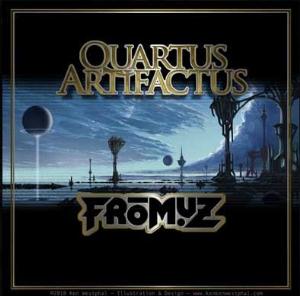
Formed in 2004 by guitarist Vitaly Popeloff and bassist/producer Andrew Mara-Novik, From.uz proudly declare their origins in their own name, with the dot added on occasion of the release of their third album, Seventh Story, in order to make the meaning “from Uzbekistan” even clearer. The band underwent a line-up change prior to the release of Seventh Story, with only Vitaly Popeloff and Al Khalmurzaev left from the line-up that had recorded their first two albums, and three new musicians joining the ranks. From.uz’s new configuration is the one featured on the aptly-titled Quartus Artifactus, a double CD/DVD set recorded live in June 2009. As the album’s subtitle points out, Quartus Artifactus contains “the best of From.uz in a progressive chamber style”, yhet there is definitely more to it than the usual live album/compilation format.

The live setting seems to be the most natural for a band like From.uz, whose debut, Audio Diplomacy (2007), was a live recording – quite an unusual choice for an album of completely new material. Quartus Artifactus, on the other hand, contains mainly acoustic versions of material taken from the band’s three previous albums. Since practical issues make playing abroad rather difficult for them, the recourse to the DVD format is the band’s chosen way to bring their music out to their growing fanbase. Being signed to US-based label 10T Records has obviously helped them to gain a larger following than if they had kept within their borders, and their music possesses an undeniably exotic appeal. While many other outfits bring ethnic elements to their sound, From.uz are the real thing, bridging the East-West divide with a musical offer that brings together the great Russian classical tradition, centuries of Eastern folk music and the modernity of rock and jazz – as well as other, perhaps less obvious influences.

The members of From.uz are very accomplished musicians, but thankfully they never give the impression of wanting to hit the listener over the head with their technical skill. While their music is undeniably quite complex, and requiring quite a bit of attention, the acoustic dimension lends additional warmth and depth to it, smoothing the occasionally hard edges of its electric counterpart. Furthermore, the accompanying DVD, even in its almost stark simplicity, reveals a genuine sense of enjoyment on the part of the musicians. While the quality of the images may not be as pristine as in other productions, watching the band perform injects new life into the material. Arranged in a semicircle, and seated most of the time, the band members come across as concentrated but never detached from the audience, and the intimate setting of the small theatre reinforces the ‘chamber’ definition mentioned in the album’s subtitle. The extra features allow us a look behind the scenes, showing the crew’s tireless work and the band members’ unassuming yet dedicated attitude.

Running at abour 100 minutes, the 9 tracks featured  on the set offer a well-rounded picture of the band’s output and general approach. As anyone already familiar with From.uz will know, their compositions tend to be rather long, with only the short guitar/vocal interlude “Perfect Place” and “Familiarization Results” clocking in at below 9 minutes. The music’s inherent complexity benefits from the semi-acoustic rendition immensely, retaining its head-spinning intricacy while acquiring more than a hint of endearing softness.  Guitarist Vitaly Popeloff’s is a delight to watch (or even just to hear), his stunningly accomplished acoustic playing, together with Ali Izmailov’s spectacular drumming, the engine behind From.uz’s sound. While he is very much in evidence throughout the set, Popeloff’s showcase spot occurs in the first half of “Desert Circle”, where he runs the gamut of his instrument’s expressive possibilities, ranging from slow, meditative tones to jazzier, Latin-tinged licks. He is also a more than capable vocalist, as proved by his performance on the aforementioned “Perfect Place” and “Parallels”.

Opener “Stone Salad” (from Overlook) introduces the listener to the lush tapestry of From.uz’s music, with its jazz-rock foundation overlaid by many different influences, including the expected Eastern ones. The earlier material from the Audio Diplomacy album (“Familiarization Results”, “Harry Heller Theatre” and “Babylon Dreams”) possesses a more distinct classical flavour, though the latter number takes a sharper, jazzy route. The monumental “Parallels” (taken from Seventh Story, like “Perfect Place”, “Desert Circle” and “Influence of Time”,), at 20 minutes the longest item on the album, blends the symphonic, the atmospheric and the jazzy component of the band’s inspiration in a richly complex, yet deeply emotional creation; while “Crashmind” (also from Overlook) is a dynamic, fusiony number based on variations on a theme that runs through the whole composition. Igor Elizov and Al Khalmurzaev’s keyboards add rich, subtly shaded layers of sound, and Sur’at Kasimov’s fretless bass acts as a discreet but reliable driving force.

The splendid artwork, courtesy of the band’s official artist and US manager, Ken Westphal, offers an added bonus to both newcomers and fans of the band. Westphal’s style, here rendered in gorgeous shades of blue, green and grey, is subtly reminiscent of Roger Dean, though more streamlined – the dreamlike quality of the  inner gatefold image of water and sky tempered by a life-like touch. All in all, Quartus Artifactus provides a stunningly-packaged introduction to one of the best instrumental progressive rock bands on the current scene, and one that will hopefully get an opportunity to perform in the US in the near future.


Links:
http://www.fromuzband.com/

http://10trecords.com/

http://www.kenwestphal.com/


Read Full Post »

TRACKLISTING:
1. Overture 3.07
2. Il Tredici 11.46
3. Dark Age 6.18
4. The Guillotine 6.00
5. Timepiece 5.30
6. Sobriety 8.19
7. Tema 1.08
8. Steam 9.30

LINEUP:
Gadi Ben Elisha – electric and acoustic guitars, mandolin
Sagi Barness – bass guitar
Aviv Barness – keyboards, saxophone
Igal Baram – drums, percussion
Shem-Tov Levi – flute

With:
Michael Lam – English horn
Elinoy Yogev – bassoon

The name Sanhedrin will not fail to ring a bell with those who are familiar with the Gospels – either because of their religious upbringing or inclination, or for reasons of historical interest – as the name indicates the supreme court of ancient Israel by which Jesus Christ was tried. Though there are also three extreme metal outfits bearing the same name, this particular band (unlike the others, and like the original institution)  hails from Israel, a country whose contribution to the progressive rock scene has been steadily growing – especially in terms of quality – over the past few years.

Originally formed by brothers Sagi and Aviv Barness as a Camel tribute band, Sanhedrin soon started writing their own material, influenced by the golden era of progressive rock. After going through the usual turmoil of line-up changes, in 2006 they started recording their debut album. Four years in the making, Ever After was mixed and mastered by renowned Israeli sound engineer and  producer Udi Koomran, and completed in 2010 – to be released in February 2011 as on the Fading Records division of Italian label AltrOck Productions.

The musical connection between Sanhedrin and Camel will soon become evident even to a first-time listener. Andy Latimer’s crew, even if not as hugely influential on the younger generations of prog bands  as the likes of Genesis, Yes or ELP,  have clearly been a source of inspiration for many outfits who choose a more melodic direction while avoiding the excess of bombast that occasionally characterizes symphonic prog. Even if Camel have sometimes been rather unkindly indicted of being purveyors of ‘elevator prog’, or just a second-tier band lacking the clout of the bigger-name acts, it is undeniable that their restrained elegance has won over a lot of fans.

While Ever After may not be the most original album released in the past few months or so, it is definitely not overtly derivative – at least not as much as other albums which I have recently heard, and which are quite highly rated. Fading Records has been created for albums with a more traditional prog bent than the material usually issued by AltrOck Productions, and their first release, Ciccada’s A Child in the Mirror, was a stunning example of ‘retro-prog’ that managed not to sound like a carbon copy of the great Seventies bands. Ever After is much in the same vein, a classy product performed with impressive technical skill, yet exuding a sense of warmth and pastoral beauty that makes listening a genuinely enjoyable experience. While Camel are obviously the most relevant influence, on numerous occasions Pink Floyd (especially their early Seventies output) spring to mind, and echoes of early Genesis can also be detected. However, Sanhedrin also bring their own signature to the table: the ethnic references subtly scattered throughout the album (not just Middle Eastern, but also Celtic and central European) remind the listener of Israel’s multicultural milieu. Like Camel, the basic combination of guitar-bass-drums-keyboards is enhanced by the exquisitely soothing sound of the flute, with additional woodwinds also employed to add depth and dimension. Unlike the English band, though, Sanhedrin have opted for an exclusively instrumental format, which is quite an interesting choice, and a deviation from the standard symphonic tradition, where vocals play a rather important role.

As Israel is part of the Mediterranean region, it is not surprising to find echoes of vintage Italian prog right from the opening track, appropriately called “Ouverture”, together with a nice pinch of Middle Eastern spicing and jazzy touches. The 3-minute number sets the album’s mood very effectively, with its beautifully clear guitar tone, gentle flute and airy keyboards, the various sections flowing seamlessly into each other. The nearly 12-minute ”Il Tredici”, the longest track on the album (which runs at a very sensible 51 minutes), brings the Camel and Pink Floyd influences together in a majestic slice of gently melancholy symphonic prog, with magnificent Latimer- and Gilmour-inspired guitar leads and layers of keyboards. In spite of its slightly macabre title (suggested by the faint recorded sounds of an angry mob heard throughout the piece), “The Guillotine” alternates atmospheric, almost meditative moments with brisker ones driven along by organ and march-like drumming.

More ethnic influences emerge in the first half of “Dark Age”, possibly the highlight of the whole album, dedicated to fellow Israeli musician Arik Hayat of Sympozion, who committed suicide at the end of 2008. The lively, Celtic-tinged tune, described by lilting mandolin and flute, reminded me of some instances of Italian ‘minstrel’ Angelo Branduardi’s output, while the somber, organ-dominated mood of the middle section lifts towards the end, with a slightly dissonant passage suggestive of King Crimson. “Sobriety”, true to its title, merges the Celtic flavour of its flute-and-drum opening with the spacey yet majestic tone of Pink Floyd circa A Saucerful of Secrets (clearly referenced in a particular organ passage), and an intricate ending that brings martial drums and sharp, clear guitar to the fore. While “Timepiece” adds some almost tentative bouts of heavier riffing to a framework that combines the pastoral feel of Camel with the atmospheric mood of Pink Floyd, closing track “Steam” (introduced by the short acoustic interlude of “Tema”) explores definitely heavier territory, especially in its second half, where the assertive tone of the guitar and the subtle shifts in tempo commanded by bass and drums seem to suggest a running train; the electric piano section in the middle brought instead to my mind Ray Manzarek’s stunning performance in The Doors’ iconic “Riders on the Storm”.

While, as the previous paragraphs make it abundantly clear, Ever After may not be the most innovative proposition on the current prog scene, it is an album whose every note spells class and a deep love of the musical craft. A thoroughly enjoyable listen, highly recommended to fans of classic symphonic prog, especially those who lean more towards the instrumental side of things, it is an excellent debut from an equally excellent new band.

Links:
http://www.myspace.com/sanhedrin1

http://www.reverbnation.com/sanhedrin1

http://production.altrock.it/index.htm

Read Full Post »

TRACKLISTING:
1. Bella Lee (3:34)
2. Parliamone (5:43)
3. Infraditi (7:36)
4. Fungo (6:42)
5 Cane di Schiena (6:32)
6. Pappa Irreale (2:27)
7. Antenna (7:59)
8. Klez (4:16)
9. Max Dembo (8:47)

LINEUP:
Filippo Cantarella – violin, viola
Marco Ravera – electric and acoustic guitar, synthesizer
Tommaso Rolando  – acoustic bass, electric bass, acoustic guitar, synthesizer, sampler, trumpet
Nando Magni – trombone
Nicola Magri – drums

With:
Cosimo Francavilla – soprano saxophone (2)
Antonio Carletti – weird vocals (7)

In my writings I have often mentioned the lively music scene of the great port of Genoa – not surprising for a city that, throughout its long history, has been one of the many melting pots of the Mediterranean region, bringing together East and West, North and South in a heady mixture of tradition and modernity. This is the kind of fertile ground from where Fabrizio De André’s Creuza de Ma, one of the undisputed masterpieces of the whole ‘world music’ scene, originated. Five-piece Calomito, a relatively recent addition to the variegated Italian music scene, bring an unique twist to the time-honoured musical heritage of their home town, with a sound that marries the warmth of the Mediterranean with a strong international bent.

Calomito have been around since the mid-2000, releasing their debut album, Inaudito, in 2005. After a five-year hiatus and some line-up changes, the band have made a comeback with Cane di Schiena, issued in the first half of 2011 by Milan-based label AltrOck Productions (also responsible for outstanding, cutting-edge releases such as Yugen’s three albums and mirRthkon’s Vehicle). Though they have been almost forcibly placed under the RIO/Avant umbrella, Calomito are one of those bands that – luckily for fans of genuinely interesting music, much less so for those who delight in labelling everything – are extremely hard to pigeonhole, due to their boldly eclectic approach to music-making.

As a fellow Italian reviewer  jokingly stated at the beginning of his own review of the album, you may want to consider taking a couple of days off in order to listen to Cane di Schiena properly. Indeed, though clocking in at a mere 53 minutes, the album presents an  incredibly dense (though never claustrophobic) amount of music which unfolds with each successive listen, and therefore devoid of any immediately digestible tunes. On the other hand, unlike what many believe about any kind of music that bears even a faint whiff of ‘avant-garde’, there is nothing discordant, abrasive or random about Calomito’s sound. Each of the tracks is clearly very carefully structured, as it is nearly always the case with ‘chamber rock’ outfits – a definition that, in my view, fits Calomito to a T. Like their label mates Yugen, they transcend the boundaries of the RIO/Avant classification, and should rather be seen as purveyors of eclectic yet oddly intimate music tha requires all of the listener’s attention to be fully appreciated.

This does not imply that Cane di Schiena is one of those deadly serious albums that command a quasi-religious devotion. Calomito’s humorous disposition, which descends directly from the likes of Stormy Six and Picchio dal Pozzo (as well as the Canterbury scene, which is also a clear musical influence), immediately comes across from titles such as “Pappa Irreale”(a pun on pappa reale, the Italian for “royal jelly”) or “Infraditi” (an intentionally ungrammatical spelling of the  word meaning “flip-flops”). The music itself, while quite light-hearted at times, can on occasion reach for a more subdued, sober tone. On the whole, Cane di Schiena comes across as a flawlessly executed album that never descends into a depressing or overly involved tone.

As is the case of other ‘chamber prog’ ensembles, Calomito employ a number of other instruments alongside the traditional rock trinity of bass, guitar and drums, assisted by various synthesizers. The substantial contribution of the horns evokes parallels with bands such as Miriodor, which emerge quite clearly right from the album’s opening track, “Bella Lee” – an incredibly dense 3 minutes of music; while the equally important role played by strings (violin and viola) brings instead to mind one of the best modern‘chamber rock’ outfits,  Seattle-based band Moraine, as well as vintage Frank Zappa. The more upbeat passages, suggesting a jazz-rock or Canterbury matrix, made me think of Forgas Band Phenomena, though Calomito sound slightly more angular than the French band. Furthermore, while Univers Zéro’s broodingly apocalyptic production seems to be the polar opposite in tone to Calomito’s essentially cheerful approach, Nicola Magri’s stunning, beyond-merely-propulsive drumming style cannot but evoke the way in which Daniel Denis supports the whole fabric of the Belgian outfit’s sound.

Trying to describe any of the nine tracks in detail would not do any of them justice. While “Infraditi” is probably the one track with the strongest connections to the RIO/Avant school of progressive rock – an astoundingly complex, 7-minute rollercoaster ride apparently throwing in anything but the proverbial kitchen sink, from carnival-like music to jazzy touches to jagged, almost dissonant passages – the somewhat low-key “Parliamone”, true to its title (meaning “let’s talk about it”) seems to reproduce a dialogue between two persons, with horns and synthesizers in the role of human voices. The choppy, dynamic “Fungo” exemplifies the way in which Calomito use pauses to create interest, rather than produce an impression of patchiness; while the title-track’s slow, meditative mood, some passages so low as to be barely audible, produces an intense, almost mesmerizing effect.

Especially in the second half of the album some intriguingly exotic influences show up, which bring to mind comparisons with Slivovitz, another über-eclectic Italian outfit hailing from Naples, my home country’s second biggest port (and musical capital). “ Pappa Irreale”’s lilting, dance-like pace punctuated by violin is sharply redolent of Irish folk, or even American country; and the upbeat, drum-driven “Klez”, as the title points out, contains elements of klezmer and Eastern European gypsy music. A folksy also tone emerges in parts of the initially low-key “Antenna”, possibly the most complex number on the album (and the only one briefly featuring ‘weird vocals’), ending with an exhilarating crescendo in which guitar, trombone and violin seem to engage in a sort of conversation. Closing track “Max Dembo” introduces some new elements, such as spacey sound effects that  enhance the powerful, rolling tone of the drums and the echoing guitar lines, as well as shades of Brazil in the relaxed, almost sultry pace of first half of the track.

In spite of the density of its musical content, Cane di Schiena is far from inaccessible, and – while undoubtedly a challenging listen – does not rely on spiky, jarring sounds to make its impact. There is plenty of melody to be found on the album, and the music possesses a natural flow and easy elegance that make listening a pleasure rather than a chore. Even though fans of traditional symphonic prog may be daunted by anything bearing the label of ‘avant-garde’, I would encourage everyone who loves progressive music to give Calomito a try. With their successful blend of technical skill, seemingly boundless creativity, eclectic influences and keen sense of humour, they are one of the most interesting bands heard in the past couple of years, and definitely one to watch.

Links:
http://www.calomito.com/

http://www.myspace.com/calomito

http://production.altrock.it/start.asp

Read Full Post »

TRACKLISTING:
1. Walk On Alone (12:31)
2. Voices (6:24)
3. Weapon (6:52)
4. What I Have Done (5:56)
5. Mind Over Matter (2:38)
6. Prelude (1:48)
7. World in Front of Me (11:19)

LINEUP:
John Baker – lead and backing vocals, guitars, guitar synthesizer, mandolin
Kerry Chicoine – bass, backing vocals
Steve Mauk – keyboards, backing vocals
Jerry Beller – drums, percussion, backing vocals

A quartet of experienced musicians based in Los Angeles, Mars Hollow were brought to the attention of progressive rock fans by the release of their self-titled debut album, almost one year ago. The highly awaited disc did not disappoint, and the band were immediately invited to perform at the 2010 edition of ProgDay, where I had the pleasure to meet them and see them on stage. In spite of the dreaded word ‘hype’ rearing its ugly head, or of those who may point out that Mars Hollow’s music does not really bring anything new to the prog table, and that it is also too poppy for its own good, the band’s dedication to music-making is undeniable, as is their professional attitude.

These days it is certainly not usual for artists to release an album a year, and long waits are often in order for fans of any musical genre. This seems to be even truer in the world of prog, when it is not uncommon for acts to let at least three years pass between releases – mainly due to those practical issues that I have often mentioned in my writing. Mars Hollow, however, chose to buck the trend by going into the studio a mere two months after their successful ProgDay appearance – with a well-respected musician and producer like Billy Sherwood (of Yes, Conspiracy and Circa fame) at the helm, and a strong commitment to delivering the goods in an even more impressive manner than their debut. Needless to say, the band’s sophomore effort – heralded by another prestigious live appearance, this time at the 2011 edition of ROSfest – was even more highly awaited than their debut, though the anticipation was tinged with the kind of anxiety engendered by far too many examples of anything but lucky second times.

While Mars Hollow, with refreshing honesty, have never claimed to be purveyors of daringly cutting-edge music (as is the case with some acts that, in my opinion, are nowhere as consistently good), World in Front of Me rises way above any considerations of innovation, progression, or whatever you choose to call it. Even though their self-titled debut was a hugely enjoyable slice of catchy, melodic prog with modern production values and all-round excellent performances, World in Front of Me is, simply put, pure gold – an album possessed of an almost timeless quality, a flawlessly executed homage to the best that progressive rock has to offer that, in many ways, transcends the very definition of prog. Odd as it may sound, I would compare it with another recent release that has left a lasting impression on me – Black Country Communion’s debut. Now, while the latter are definitely more of a classic hard rock act than a progressive one, their first album is also one of those very rare efforts that manage to reach a very high standard of quality without reinventing the wheel, so to speak.

Clocking in at a perfect 47 minutes, World in Front of Me is bookended by two 10-minute-plus tracks which – like “Dawn of Creation” on their debut album – eschew the tired, worn-out template of the ultra-convoluted (and ultimately patchy) ‘epic’ in favour of an orgy of enchanting melodies, splendid vocal parts, and scintillating instrumental interplay. With consummate sense of balance, the five tracks sandwiched between those two display a variety of moods, from the melancholy, mainly acoustic “Mind Over Matter” to the jagged, somewhat tense “Voices” – shorter, yet no less dense and involved. To use a cliché, Mars Hollow are like a well-oiled machine, their individual skills honed by years of experience and a genuine love of their craft, creating layer upon layer of lovely sounds that, while sustaining that uplifting quality so evident in their debut, are tinged with a hint of gentle sadness suggesting the wisdom that comes with maturity. And mature is probably one of the most effective descriptions for World in Front of Me: though lacking anything as infectious as “Midnight”, it is hard not to find yourself singing along the title-track or “Walk on Alone”, as well as listening raptly to the seamless ebb and flow of the instrumental passages.

As was the case with the band’s debut, World in Front of Me is strongly keyboard-based, with John Baker’s guitar used in a supporting (though indispensable) role rather than as the star of the show. However, Sherwood’s crystal-clear production has given the rhythm section a much more prominent role. Jerry Beller’s dynamic yet sophisticated drumming is not merely propulsive, but adds a lot of dimension to the music, sometimes following the melody laid out by the keyboards and guitar, sometimes playing in a sort of counterpoint; while Kerry Chicoine’s rumbling, pneumatic Rickenbacker bursts out of the densely woven fabric of the sound in a way rarely heard since Chris Squire introduced his ‘lead bass’ approach to the instrument. Indeed, Yes might be mentioned as probably the biggest influence on this album – though, rather than the toweringly unapproachable Yes of Close to the Edge fame, Mars Hollow bring to mind the band that, with their first three albums, gave the music world a textbook-perfect example of contamination between classic pop-rock and the fledgling progressive trend.

Steve Mauk handles his array of keyboards with impressive aplomb, supported by the relentless work of the rhythm section. While the gorgeously wistful, rippling piano piece that is “Prelude” puts him directly in the spotlight, his lush yet sedate contribution to the overall sound perfectly complements John Baker’s understated guitar work and commanding vocal performance. As I stated in my review of Mars Hollow’s debut, Baker’s voice – a soaring, admirably controlled tenor reminiscent of a smoother Geddy Lee, with touches of early Steve Walsh – may not be to everyone’s taste, but his handling of the somewhat downbeat, meditative lyrics (mostly focusing on the end of a relationship) is nothing short of masterful, and the harmony sections suggest the effortless grace of vintage Yes and, occasionally, even Gentle Giant.

As regards the individual tracks, opener “Walk On Alone” and the title-track are classic prog heaven, blending memorable melodies – catchy, though in a very subtle fashion, and dispensing with a conventional verse-chorus-verse structure – with instrumental passages of stunning elegance and understated complexity. While the former number is more airy and relaxed, the latter seems to slowly build up to a climax, with a sense of tension occasionally surfacing. “Voices” and “Weapon”, though shorter, are conceived along similar lines, successfully merging haunting vocal sections with intense instrumental passages; while “What I Have Done”, with its more streamlined approach and catchy harmony vocals, comes closest to the spirit of Mars Hollow’s debut, though without the bold airplay potential of songs like “Midnight” or “Eureka”.

Down to its stylish cover photo, depicting the stark beauty of the Death Valley desert, World in Front of Me is a supremely elegant album that succeeds in the task of combining accessibility with dazzling technical proficiency and a genuine feeling of warmth. Let us forget for a moment about ‘retro-prog’ or any such ultimately pointless labels. Mars Hollow’s intention was never to revolutionize the music world, but rather to produce an album that people will enjoy, cherish, and possibly relate to in terms of their own experience. A pleasure from start to finish, this is definitely a very serious contender for album of the year.

Links:
http://www.marshollow.com/

http://www.10trecords.com/


Read Full Post »

TRACKLISTING:
1. 4378th Day (15:41)
2. No (5:59)
3. War, Act 2 (21:06)

LINEUP:
Rodrigo San Martín – electric and acoustic guitars, bass, mellotron, hammond organ, Moog synthesizer, piano, keyboards, orchestra arragements, synthesized glockenspiel, drum programming
Jelena Perisic – vocals
Craig Kerley – vocals

South America has been a hotbed for progressive rock ever since the beginning of the movement, and Argentina – with its richly diverse musical heritage – is no exception. Even though Argentine prog bands are rarely household names, keen followers of the genre are well aware of the generally excellent level of those outfits. While many of those bands and artists follow in the footsteps of the classic symphonic prog tradition (with some of them displaying Italian prog influences – not surprising in a country where about half of the population is of Italian origin), many of the newer acts have embraced other styles, like progressive metal, and are not afraid of incorporating them into a traditional symphonic fabric.

Rodrigo San Martín is a gifted multi-instrumentalist with a lot of experience on the Argentine music scene as a musician, composer, producer and event organizer, in spite of his young age (he was born in 1988).  He is the lead guitarist of prog band De Rien, as well as the mastermind of the project Souls Ignite. His debut album as a solo artist, simply called 1, was released in April 2010, and featured a 40-minute composition performed solely by San Martín. Conversely, on his sophomore effort, There’s No Way Out (released in November of the same year), San Martín avails himself of the contribution of two guest singers, Jelena Perisic from Serbia and  Craig Kerley from the US.

Clocking in at a mere 42 minutes (a very short running time for today’s standards), There’s No Way Out has a distinctive structure, with two epic-length tracks bookending a more conventional song. The three numbers are different enough from each other to sustain the listener’s interest, and even the two epics are rather nicely balanced, projecting an impression of cohesiveness which is not always the case with long compositions. San Martín handles all the instruments with admirable expertise, though the unmistakably artificial sound of programmed drums is hard to miss, and sometimes clashes with the overall warmth of the music. On the other hand, the vocal performances are consistently good, both singers handling the material authoritatively and stamping their own individual mark on the songs.

Opener “4387th Day” is the closest the album gets to traditional symphonic prog, especially in the first half, dominated by atmospheric keyboards, mellotron and orchestral arrangements with flute and strings, as well as Jelena Parisic’s melodious, yet not sickly sweet voice. Then pace and intensity increase with the introduction of heavy guitar riffs and whistling synth, while towards the end things calm down again. “No”, running slightly over 5 minutes, functions as a sort of interlude between the two ‘main events’, and brings a classic rock note (with touches of AOR) to the ambitious prog context of the album. Distorted guitar, with a distinct Seventies flavour, features prominently here, and Craig Kerley’s gutsy vocal performance is a perfect fit for the overall tone of th song – though the juxtaposition of a more sentimental mood, enhanced by strings and harmony vocals, with harder-edged suggestions occasionally teeters on the brink of cheesiness.

The third and final track, “War, Act2”,  is the undisputed highlight of the album, and – at least in my view –quite superior to both the previous numbers. In spite of its 21-minute running time, it never outstays its welcome, and manages to paint a near-perfect sonic rendition of its title. Here, the contrast between furiously riff-driven sections bordering on extreme metal and dreamy, rarefied passages which, nonetheless, suggest a slow but relentless build up of tension works very well. Jelena Parisic’s voice, while still soothing and well-modulated, reaches for a lower register in order to convey a subtle feeling of menace, and the beautiful guitar solo in the middle brings to mind David Gilmour’s signature style, melodic yet faintly brooding. The frequently occurring changes o mood and pace, unlike what happens in other compositions of comparable scope and length, do not project an impression of patchiness, but rather create an impressively organic whole.

Though not without flaws (mainly lying in the use of programmed drums, whose all too recognizable sound often detracts from the listening experience), There’s No Way Out is a very promising album from an extremely talented young artist, featuring a healthy dose of eclecticism. While the more conservative set of prog fans may be turned off by the strong metal component, particularly evident in the final track, those with a more open-minded disposition are likely to appreciate Rodrigo San Martín’s skill as a composer and multi-instrumentalist. I will be definitely looking forward to hearing the forthcoming De Rien album, to see what he is capable of in a band context.

Links:
http://www.rodrigosanmartin.com.ar/


Read Full Post »

TRACKLISTING:
1.  Commencement (2:47)
2.  Neap Tide (9:20)
3.  Primrose Path  (6:38)
4.  Dawn  (2:56)
5.  Catlord  (8:54)
6.  Illuminati  (0:42)
7.  Work In Progress  (6:54)
8.  Missing Time (8:49)
9.  Faunus  (11:17)
10. Io  (9:13)

LINEUP:
Michael J. Butzen – electric and acoustic guitars, mandolin
Jeffrey Schuelke – keyboards, piano
Thomas Ford – drums, electronic percussion

With:
Chris Kringel – fretless bass  (1-7, 9-10)
Elizabeth Grimm – violin (8, 9, 10)
Chad Burkholz – bass (8)

The name ‘Fibonacci sequence’ refers to a series of numbers in which each number is the sum of the previous two. Named after medieval Italian mathematician Leonardo Fibonacci, who introduced it to Western Europe, it is featured in literature, cinema, the visual arts and music: for instance, the lyrics to the title-track of Tool’s celebrated Lateralus album are arranged on the basis of the Fibonacci sequence.

On the other hand, even if Fibonacci Sequence would be a perfect name for a math-rock band, the Milwaukee-based trio bearing this name are quite a different beast. Those who delight in sticking labels on everything and everyone will certainly have their work cut out for them with a band like Fibonacci Sequence, as their unabashed eclecticism makes classification all but impossible. While one moment they may conjure shades of progressive metal, the next passage will take the listener into almost symphonic territory, with clear, melodic sounds and lush layers of keyboards – not to mention the tantalizing Latin and Middle Eastern references and the sprinkling of jazzy touches. Their omnivorous approach is further borne out by the influences mentioned by the band – a list ranging from Yes, Rush and Dream Theater to The Police, Sting and Mahavishnu Orchestra.

For those who thrive on making comparisons with more established acts, I would mention equally eclectic instrumental outfits like From.uz or Djam Karet, as well as more metal-oriented ones like Canvas Solaris or Relocator – as well as the obligatory Liquid Tension Experiment or Planet X. Unlike the latter bands, though, Fibonacci Sequence’s sound is more distinctly guitar-based, with keyboards used as an accent rather than dominating their whole music. Faced with such almost effortless proficiency, which nevertheless does not come across as cold and detached, the listener would be forgiven for thinking that the band are one of the many projects that (often due to practical issues) have no life outside the walls of a recording studio. The band, however, are quite active on the live front in their home town of Milwaukee, and the announcement of their participation to the 2011 edition of ProgDay has whetted the appetite of the  numerous fans of instrumental progressive rock.

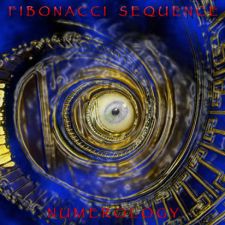
The aptly-titled Numerology, Fibonacci Sequence’s debut full-lenght album, was released about a year after the 2-track EP We Three Kings, which featured a very interesting arrangement of the popular 19th century Christmas carol. On this album, the three core musicians avail themselves of the valuable contribution of fretless bassist Chris Kringel (formerly with Cynic and their offshoot Portal) on all but one of the tracks, as well as bassist Chad Burkholz on “Missing Time”, and violinist Elizabeth Grimm on the last three numbers. Most of the tracks on Numerology run between 6 and 11 minutes, long enough to allow the band members to branch out and create intricate musical weaves; the album as a whole clocks in at a quite manageable 65 minutes. The band manage to produce an impressive volume of sound of exceptional clarity, every instrument given a strikingly dimensional feel in the mix. As in the best productions, in spite of the complexity of the compositions, the music flows smoothly and naturally, without giving the impression of being too complicated for its own good.

Right from the opening strains of the short but punchy “Commencement” – a lush, melodic guitar number powered by an impressive drum sound – the sheer quality of the recording comes across in no uncertain terms. While Michael J. Butzen’s guitars take the leading role, the engine propelling Fibonacci Sequence’s music along is Thomas Ford’s powerful yet restrained drumming, a full-bodied sound that manages not to overwhelm the other instruments. Fibonacci Sequence’s trademark blend of melody, heaviness and sleek instrumental expertise emerges in “Neap Tide” (also featured on the EP), a heady, multilayered mix of sharp riffing, acoustic, pastoral beauty and jazzy licks whose dense sonic texture manages not to feel stifling or contrived. On the other hand, “Primrose Path” comes across as a contemporary-sounding version of vintage Santana, down to the jazzy, Latin-tinged guitar work. Perfectly descriptive of its title, “Dawn” is a slow, meditative acoustic guitar piece introduced by atmospheric keyboards and birdsong, which introduces the thunderously drum-driven “Catlord”, its heaviness spiced by Eastern touches in the clean, mesmerizing guitar lines.

After the very short ambient piece “Illuminati”, Fibonacci Sequence display more of their exciting compositional skills in the album’s final four tracks, starting with the splendid bass showcase that is “Work in Progress”, peppered by frequent pauses that, instead of disrupting the flow of the music, seem to stimulate the listener’s attention. With “Missing Time” we enter Liquid Tension Experiment/Planet X territory, Jeffrey Schuelke’s keyboards taking more of a lead role and Butzen’s guitar injecting a touch of fiery, yet shred-free edginess, and the violin adding a symphonic note to the second half of the track. The 11-minute “Faunus” (the longest track on the album) is deceptively more linear in structure, with a tense, riff-laden first half and a slow, almost melancholy ending punctuated by lovely guitar and violin; while closing track “Io” picks up from where the previous number left off, with a moody beginning and a mainly keyboard-driven middle section, culminating with an extended guitar solo of outstanding quality. Interestingly, the album begins and ends with the crackling of an old vinyl record – a sound dear to many old-school prog fans.

Besides the obvious quality of their  music, both in terms of composition and execution, Fibonacci Sequence’s nature of real live outfit makes them an even more intriguing proposition. The simple fact that they are not easy to pigeonhole should be seen as a positive sign, especially in these times when increasingly outrageous labels are created with alarming regularity. In any case, Numerology is one of the finest instrumental prog albums released in the past couple of years or so, and their ProgDay appearance will hopefully contribute to putting Fibonacci Sequence on the map for those progressive rock fans who are still unaware of them. Highly recommended.

Links:
http://fib-seq.blogspot.com/

http://www.myspace.com/fibonaccisequenceband


Read Full Post »

TRACKLISTING:

1. Schizoid & Guntrip (2:46)
2. In the Movie of You (7:57)
3. Devotee (7:24)
4. Ambiance for the Active Mind (6:40)
5. Fantastic Dreamer (6:26)
6. Releasing (5:21)
7. Fading in the Rain (6:29)
8. Upon Further Review (4:26)
9. Vision (13:50)

LINEUP:

Henry Tarnecky – vocals, keyboards
Blake Tobias – keyboards, bass
Jack Wright – guitars, drums

With:
Glenn Arpino – keyboards
Tom Shiben – bass
Nicole Tarnecky – vocals

Temporal Chaos Project (TCP for short) are a trio based in different states of north-eastern USA, who initially met on the Internet and started a collaboration that resulted in the album The Way, released in 2009. Their second album, Fantastic Dreamer, followed in April 2011, with the core group of Henry Tarnecky, Blake Tobias and Jack Wright augmented by three guest musicians. Both albums were released on Georgia-based label 10T Records, one of the most interesting independent labels for progressive rock.

In spite of their name, there is nothing chaotic about TCP. Fantastic Dreamer, which has garnered a lot of positive critical attention since its release, is one of those albums for which the definition ‘solid’ seems to be tailor-made. Though studio-only projects can often be hit-and-miss, formally perfect but somewhat lacking in the soul department – therefore producing an overall unsatisfactory impression – TCP’s sophomore effort comes across as a mature, well-balanced album, with excellent instrumental performances, enough compositional complexity to appeal to fans of traditional prog, and more than just a smattering of contemporary flair. While some bands or artists show a more or less clear direction (as in symphonic, neo or prog-metal), TCP are unabashedly eclectic, with roots in the great progressive tradition and some recognizable classic influences, yet no fear of dipping their collective toes in more modern waters. While TCP’s eclecticism is of a different kind than the one displayed by bands of a more innovative disposition, the end result is definitely worthy of attention.

Running at about one hour (in my opinion, the almost perfect length), Fantastic Dreamer features 10 tracks, most of them between 2 and 8 minutes, with the exception of the ‘epic’ “Visions”, an ambitious yet cohesive piece that wraps up the album in fitting fashion.. Though, like many modern prog albums, Fantastic Dreamer is very much vocal-based, TCP achieve admirable balance between the singing and the lush, varied instrumental sections. Keyboardist Henry Tarnecky is in charge of the vocals, and does a fine job of it. His voice brings to mind the husky, slightly rough around the edges tone of Peter Gabriel, with some hints of the dramatic power of Peter Hammill or Fish, and fits the material perfectly.

Though clocking in at under 3 minutes, opener “Schizoid & Guntrip” already sets the tone for the whole album – a melodic yet assertive number, evoking a vintage hard rock vibe, with a subtly catchy quality and sleek instrumental interplay. “In the Movie of You” blends suggestions of early Pink Floyd (down to the use of recorded ambient sounds) with heavier tones, the sharpness of the guitar tempered by the gentleness of the piano. Pink Floyd references also crop up in the aptly-titled “Ambiance for the Active Mind”, where the atmospheric surge of the keyboards climaxes in dramatic rifferama before loosening up in a lovely guitar solo amidst waves of mellotron; while the mid-paced “Releasing”, with the faintly eerie tone of the guitar solo, points rather to the later output of the seminal English band. The catchiest number on the album, “Devotee” pushes keyboards and vocals to the forefront, with plenty of drama and melody in the vein of crossover/art rock bands like Queen or Supertramp.

With the title-track and “Fading in the Rain”, TCP tread similar territory, displaying their grandiose, even bombastic side, though without overdoing things; the latter song in particular, in which Tarnecky is assisted by a female guest vocalist, Nicole Tarnecky, clearly references Genesis, with airy guitar soloing and masses of stately keyboards. The folksy, mainly acoustic “Upon Further Review”, embellished by harpsichord and Mellotron, acts as an introduction of sorts to the 13-minute “Visions”, a powerful keyboard-driven extravaganza composed by guest musician Glenn Arpino, in which a climactic crescendo somewhat reminiscent of Supertramp’s more ambitious pieces is bookended by rarefied, understated passages and fluidly melodic guitar leads.

While I would not go as far as to call Fantastic Dreamer a masterpiece (as other enthusiastic reviewers have done), it is undoubtedly a very well-crafted album, with all-round excellent performances, and an interesting compositional structure. The occasional bouts of heaviness do not disrupt the melodic, nicely knit fabric of the music, and Henry Tarnecky’s expressive vocals tackle the often ambitious lyrical matter with assurance and aplomb. The very detailed CD booklet, enhanced by striking artwork and photography, adds visual interest to a substantial musical package. Even if TCP are, at least for the time being, a studio-based project, I hope they will consider taking their music on the road in the near future, because they sound like a band worth hearing in a live setting.

Links:
http://www.temporalchaos.com/html/home.html

http://10trecords.com/


Read Full Post »

TRACKLISTING:
1. Day Of Destiny (4:06)
2. The Wrap (Intro) (5:16)
3. Under The Wrap (38:19)
4. An Angel (5:42)
5. Ilusionist (1:16)
6. The Wrap (Outro) (4:59)

 LINEUP:
Antony Kalugin – keyboards, vocals, percussion
Maxim Velichko – electric guitars
Sergey Balalaev – drums
Kostya Ionenko – bass
Sergey Kovalev – bayan, vocals
Roman Gorielov – acoustic guitar, backing vocals

With:
Helen Bour – oboe (1, 2)
Alexandr Pastukhov – bassoon (1, 2, 3)
Oksana Podmaryova – cello (3, 6)
Max Morozov – viola (3, 6)
Daria Maiourova – violin (3, 6)

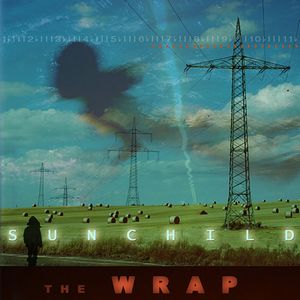
One of the projects by talented and prolific Ukrainian musician Antony Kalugin (also involved with Karfagen and Hoggwash), Sunchild released their debut album, The Gnomon, in 2008, followed by The Invisible Line in 2009. The Wrap, the band’s third album, was recorded over a two-year period, and released in September 2010. An accomplished artists in spite of his young age, Kalugin has picked a group of gifted Ukrainian musicians for his projects, including string and woodwind players that give his bands’ musical output a well-rounded symphonic dimension.

Like a number of other bands from the Russian Federation, Sunchild’s approach to progressive rock is more traditional than innovative, though carried through with panache and impressive technical skill. While the band’s sound is not as openly influenced by classical music as the likes of Little Tragedies, Kalugin’s use of keyboards favouring piano and synthesizers rather than organ, quite a few diverse influences are detectable in Sunchild’s music other than the expected symphonic/Neo-prog strain. Alongside the intense melodic content, enhanced by pleasing vocal harmonies and lovely piano and flute passages, a distinct progressive metal feel surfaces in some of the compositions, which is in line with the trend followed by many contemporary bands that might be gathered under the Neo umbrella.

Like its two predecessors, The Wrap is based around an elaborate, rather esoteric philosophical concept, in this case the conflict between the self and its shadow – something that is likely to send some people running for the exits, and cause great delight in others. Although Kalugin was assisted by a native speaker of English, Will Mackie, in penning the lyrics, they are somewhat hit and miss – which anyway is not a particularly important factor, as I am first and foremost interested in the music. Unless lyrics contain something highly offensive (which is not the case here), I tend to be quite indifferent to them, unlike other critics that are often quick to point out any lyrical shortcomings. In any case, Kalugin is a more than adequate vocalist, capably assisted by his bandmates in the harmony parts, and even his slight accent does not detract from his delivery as is the case of other non-English-speaking musicians

Running at slightly below 60 minutes, The Wrap is dominated by the almost 40-minute epic “Under the Wrap”, which is strategically placed in the middle of the album (a good move, in my view). As I have pointed out on several occasions, I believe that it is extremely difficult for any given band or artist to sustain a composition of such length when it is conceived as a single block, and “Under the Wrap” is no exception. In spite of the undeniable quality of the music, the epic is more of a collection of disparate passages following one another without a common thread than an organic whole, which would have probably benefited from being presented in separate sections. As things are, the composition comes across as quite patchy, its first half starting out in subdued fashion, with subtle references to the great Russian composers of the Romantic era (reinforced by the presence of a bassoon and a string section), and then heading in a strongly metal-flavoured direction suggestive of Dream Theater circa Images and Words. The second half, instead, is strongly reminiscent of Genesis, with a couple of vocal passages in which Kalugin sounds very much like Peter Gabriel, a definitely classical-sounding, string-led section, and then a beautifully melodic guitar solo fading out at the end. Though the musicianship is consistently top notch, there are simply too many ideas left somehow underdeveloped, and not enough cohesion.

The remaining five tracks on the album are noticeably shorter the epic, and certainly much more successful in sheer compositional terms. Three of them feature vocals, and are generally mid-paced, melodic pieces with lush keyboard and guitar textures and excellent vocal parts. Opener “Day of Destiny” borders on AOR, with a very catchy chorus and flawless instrumental interplay; while closing track “The Wrap (Outro)” briefly reprises the opener’s main theme, with a brief metal-tinged section leading to an atmospheric, string-led conclusion. On the other hand, “An Angel”, followed by the short, soothing acoustic interlude “Illusionist”, as the title implies is a lovely, rarefied ballad featuring a gorgeous guitar solo backed by piano and percussion. The other instrumental track, “The Wrap (Intro)”, seems to reproduce the structure of the epic, though in a more cohesive way, blending prog-metal suggestions with pastoral moments in the vein of vintage Genesis or Camel.

As the previous paragraphs illustrate quite clearly, The Wrap is quite likely to appeal to fans of classic symphonic and Neo-prog, even if the occasional prog metal overtones may put off some of the more traditionally-oriented listeners. In any case, even if decidedly retro in tone, it is a finely-crafted album brimming with enjoyable melodies, and executed with undisputable skill and professionalism. The very thorough booklet, with its stylish artwork and photography, is also deserving of a mention. In spite of the somewhat patchy nature of the epic, the album would be a worthy addition to the music collection of any melodic prog lover.

Links:
http://www.antonykalugin.net/


Read Full Post »

Since I moved to the USA two and a half years ago, progressive rock festivals have always been one of the highlights of the year for me and my husband. However, we had skipped both of the previous editions of the Rites of Spring Festival (aka ROSfest) – mainly on account the general musical direction of the event, since our tastes tend to lean more towards the more adventurous side of prog. We both pride ourselves on our open-mindedness, though, and the cancellation of this year’s edition of NEARfest was the catalyst that made us decide to take the plunge. As it is often the case in life, a very positive experience came out of a negative (and quite unexpected) occurrence.

The 2011 edition of ROSFest was organized, for the second year in a row, in the small historic town of Gettysburg, Pennsylvania. One of the prime US tourist sites, Gettysburg is known worldwide for one of the bloodiest battles of its time, the clash between the Union and Confederate armies that occurred on July 1-3, 1863, and pretty much decided the final outcome of the Civil War (hence the title of my review). The town itself exudes a quaint, out-of-time vibe, with plenty of antique and craft shops, as well as fine eating and drinking establishments, though hardly any stores catering for everyday needs (such as pharmacies or grocery stores), and no taxis or any public transportation except for some vintage-looking blue buses.  The drive from the official festival hotel to the town centre goes through part of the huge battlefield, a sobering sight dotted with markers commemorating all the different regiments that fought on those fateful three days, said to be haunted by the ghosts of the over 50.000 soldiers who lost their lives there. In the month of May, the countryside is at its very best, the colours fresh and bright, flowers growing by the roadside, the road lined with quaint houses and bright red barns: however, it is hard not to think of the bloodshed and wholesale slaughter, and when driving through the battlefield at night it is easy to imagine ghosts wandering in the misty darkness.

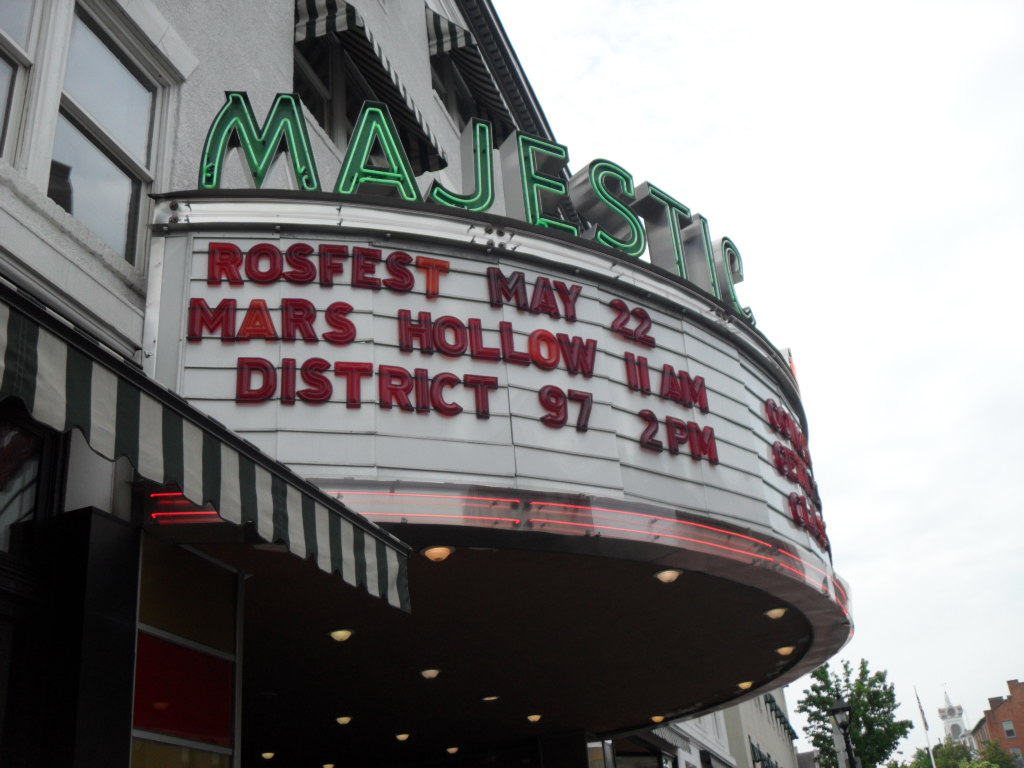
The festival venue was a treat – a gorgeous Art Deco theatre with an excellent seating arrangement, crystal chandeliers and plenty of that old-fashioned charm that seems to have been banished by the spread of modern multiplexes. Though not as spacious as Bethlehem’s Zoellner Arts Centre, and lacking in enough seats for people waiting in the lobby between sets, it offered nicely appointed spaces, with the gallery taken over by vendors and band merchandising (though I think the bands might have used a bit more room), and a nice table set up in the lobby for CD signing after each show. The abundance of eating places in the immediate vicinity, as well as the generous breaks between sets, made it easier for the attendees to take their time without having to rush about in order not to miss anything; the bar was also fairly priced as things go, and manned (or perhaps I should say ‘womanned’) by a couple of very nice ladies. The theatre also employed a group of equally nice ladies as ushers (something I had not seen for a long time), though I have to admit I missed the very convenient wristband system implemented by other events.

Unfortunately, in spite of the NEARfest cancellation having redirected some would-be attendees to ROSfest, there were quite a few empty seats in the theatre. The crowd, however, made up in enthusiasm what was lacking in numbers. Some people had chosen to get tickets only for Saturday and Sunday, but there was still a fair attendance on Friday night, mainly on account of headliners Moon Safari. On the whole, it can be estimated that the Majestic Theatre was 70-75% full – not bad per se, but neither the sell-out that some were anticipating. Times are still tough for many people in the US, and the splintering of the ‘prog community’ in a myriad of sub-groups does not help matters. Not all the NEARfest orphans had  chosen to support ROSfest, and for a very simple reason: as I mentioned in the opening paragraph, ROSfest mainly caters to what I often call the more conservative set of prog fans, those who like melody, vocal-oriented compositions, and, more often than not, anything that seems to recreate the magic of the Seventies (a slant that was reflected by many of the CDs on sale in the vendor area). Nothing wrong with that, of course: there are plenty of bands and artists on the current scene that prefer to look to the past for their main inspiration, and many of them do it very well. Even if my loyal readership might sometimes get the idea that I am biased against ‘retro-prog’, there are quite a few acts falling under this category that I enjoy a lot, as long as their music ‘speaks’ to me somehow.

This year, organizers George Roldan and Krista Phillips and their team had made a somewhat bold move, and dispensed with any nostalgia acts in favour of a rather intriguing range of relatively new bands, about half of them hailing from the US (which, knowing the audience, might have been a factor in the relatively low attendance). In particular, Sunday headliners Quidam, though familiar to devotees of neo-prog and Polish prog in general, did not possess the clout or vintage credentials of last year’s headliners Renaissance. However, judging from what was seen on stage over the past weekend, in musical terms it was a move that paid in spades. Both my husband and I were impressed by the diversity of the acts selected for this year’s edition, and were also pleasantly surprised on several occasions. Needless to say, the sound quality and the lighting were first-rate, and the intimate feel of the venue made for a nice community experience, further enhanced by the warmth and professional attitude of the organizers.

The festival kicked off at 5 p.m. of Friday, May 20, with local band Epiicycle, featuring George’s son Anthony Roldan. A young quartet, though already with three albums under their belt, they sounded somewhat out of synch with the event’s general musical direction, sounding more akin to the likes of Porcupine Tree, Tool and other ‘alt-prog’ bands than Yes or Genesis (though their last song, which featured violin and cello, had a more conventional proggy feel with shades of Anekdoten). In spite of some obvious weaknesses, especially in the vocal department, their enthusiasm was endearing, and the event obviously provided a great chance for them to play in front of a considerable audience, as well as to grow and refine their sound.

Though I was not familiar with Tinyfish’s music, I remembered guitarist/vocalist Simon Godfrey as one of the old-time members of the progressive rock forum where I started my ‘career’, and had often seen the band mentioned there. However, even if I had never had the opportunity to check them out, their set (which, regrettably, we had to leave early due to a prior engagement) was one of the real surprises of the weekend for both of us. Simply put, Simon Godfrey is an incredible vocalist, probably the best heard over the weekend (no mean feat, since there was quite a bunch of fine singers on display), with a strong, passionate voice that adds depth and interest to the band’s classy musical output. With a sound harking back to the glory days of vintage Neo-Prog, clean and melodic yet with a nicely sharp edge – more Pink Floyd than Genesis – immaculate musicianship, a powerhouse of a drummer in Leon Camfield,  and a liberal sprinkling of that wonderful English humour, they delivered a flawless set that left the audience deeply impressed.  The narration (courtesy of lyricist Rob Ramsay) of the background story to their latest album, The Big Red Spark =  an elaborate sci-fi concept that has gained a lot of critical acclaim since its release – also injected a welcome dose of theatrics into the proceedings. Tinyfish would definitely have deserved to play a longer set, and I would love to see them again in the future.

After a two-hour dinner break, the theatre filled up nicely for the eagerly awaited Friday headliners, Swedish six-piece Moon Safari, ROSfest alumni (they had performed at the 2009 edition of the festival) and firm favourites of the audience. A bunch of tall, good-looking young men with impressive stage craft and a bit of a swagger, they were greeted deliriously by the crowd, who seemed to lap up every single note they played and sung. Unfortunately, I have to admit that their set was one of the low points of the event for me, though not due to any lack of talent on the part of the band. Having read reviews of their three albums, I was aware that their music was probably not going to be my cup of tea – and, in spite of my open mind, this time I was not wrong. True, the band members are extremely gifted, and their vocal harmonies – hinting at early Yes, Queen and (obviously) The Beatles and The Beach Boys –  are nothing short of stunning, with some state-of-the-art a cappella parts; while the impeccably executed instrumental passages reminded me of Collins-era Genesis. Even if some might view Moon Safari as purveyors of ‘prog for the ladies’ (a stereotyped definition that I loathe), they seemed to appeal in equal proportion to many of the men in the audience. Their music is a melodic, airy confection, easy on the ear, with a smooth, nearly effortless flow – yet not enough to hold my attention, though I liked the nod to Bruce Springsteen’s “Jungleland” (a rather unlikely artist to be quoted by a prog band). Anyway, even if their optimistic, upbeat set came across to me as rather underwhelming, it was undeniably performed with genuine enthusiasm and flair, and anyone who is into melodic, accessible prog should definitely give Moon Safari a try.

Due to physical tiredness (I was never at my best over the whole weekend, which occasionally affected my enjoyment of the music and the company), we missed Going for the One’s performance at the after-show party, though we heard quite a bit of commotion from our room, which was located close to the party premises. Though I am personally not a big fan of tribute bands, I have read some very positive comments on their show, and I am glad their show went down so well, especially in these times when it seems so hard for bands to find gigs.

The Saturday bill was introduced by Polish quartet Osada Vida, whose latest album, Uninvited Dreams, I had reviewed for the website with which I was previously involved. As was to be expected after the night’s partying, many people skipped their set, which was a pity, because the band – a group of seasoned performers with an interesting contemporary bent to their sound – put up an excellent show. As I pointed out in my review, the closest term of comparison would be their fellow countrymen Riverside, whose outstanding performance I had enjoyed at last year’s edition of NEARfest – though Osada Vida have less of a metallic edge, the occasional bouts of heaviness in their music used as a complement rather than the main event. Obviously overjoyed at having been invited to play in the US in front of a sizable crowd, the band treated the audience to a nice selection of tracks from their back catalogue, interspersed by bassist/vocalist Lukasz Lisiak’s friendly, self-deprecating banter. He was quick to stress that he was not a true singer (something that I had observed when listening to Uninvited Dreams), his voice perhaps more suited to metal than prog. However, he acquitted himself well,  while the instrumental interplay was superb, with searing guitar leads, and hard-hitting drums complementing Lisiak’s fluid bass lines, everything rounded up by Rafal Paluszek’s unobtrusive but essential keyboards. All in all, it was a very enjoyable set from a band that I would not mind seeing again soon.

In the past five years or so, especially owing to their appearance in the Romantic Warriors documentary and the sheer quality of their releases, Phideaux have attracted a lot of attention in the prog world, and – judging from what was seen on the Majestic stage – very deservedly so. As far as I was concerned, they were one of the main draws of the whole event, and they did not disappoint me at all. Led by the volcanic mind and considerable songwriting talent of Renaissance man Phideaux Xavier (an extremely nice, articulate gentleman whom I met at breakfast together with some other members of the band), they are a mini-orchestra of 10 people rather than a conventional band, which makes for a full, genuinely symphonic sound, very melodic but never cheesy or overtly poppy, enhanced by consistently thought-provoking lyrical concepts. Though not necessarily to everyone’s taste, it is hard to deny that they do not really sound like anyone else, which is a rarity in this day and age. While watching their show, I kept being reminded of Roger Waters – not so much for the actual musical content as for the emphasis placed on the creation of veritable concept-based ‘rock operas’, as well as the presence of an extended lineup. With a wonderfully humorous twist on the supposed ‘end of the world’ that was expected to occur at 6 p.m. on that same day, their set revolved around their breakthrough 2006 album, Doomsday Afternoon, and also included a sizable chunk from their most recent release, the critically acclaimed Snowtorch. In any case, Phideaux’s performance was one of the undisputed highlights of the festival. With splendid vocals, top-notch instrumental performances, Phideaux’s set was a big, ambitious achievement with lots of depth, many of the songs driving to exhilarating crescendos and featuring plenty of light and shade. While there are hardly any sharp edges to Phideaux’s music, it comes across as deeply emotional rather than overly sweet, definitely melodic yet powerful, with a nice balance between the acoustic and electric component and a gentle folksy edge tempering the intensity of the more orchestral parts. Definitely one of the high points of the weekend, it was magnificent performance from one of the most distinctive acts on the current prog scene.

After a nice (and much needed) late lunch at a nearby Irish pub, it was time for us to head back to our seats for the following performance – which might have been the biggest surprise of the whole weekend for both of us. Erik Norlander and his Galactic Collective, a group of fine musicians from the Cleveland area, were introduced by Michelle Moog-Koussa of the Bob Moog Foundation, as Norlander’s appearance was meant as a celebration of what would have been Moog’s 77th birthday on Sunday, May 22. The right side of the stage was taken up by a huge stack of modular synthesizers, affectionately dubbed ‘ the wall of doom’ by Norlander himself (a truly warm and genial host) – which led us to expect an orgy of electronic music in the style of Tangerine Dream or Klaus Schulze. We could not have been more wrong, because, after three rather interesting instrumental tracks, Norlander introduced on stage his wife Lana Lane (as well as another backing vocalist), and things took a decidedly heavy turn. Accompanied by a sci-fi-themed slideshow which complemented the music quite nicely, the musical offer might be described as ‘Pink Floyd on steroids meets ELP backed by an 80’s hair metal band’. It was bombastic, over-the-top, with more than a whiff of cheese, and as subtle as a sledgehammer – the guitarist even played a brief solo spot with his teeth! – but, in some perverse way, hugely entertaining. Though I found the instrumental stuff more captivating in purely musical terms (especially the excellent “Trantor Station”, inspired by Asimov’s Foundation series), as a staunch hard rock/classic metal fan I could not help being impressed by the “Astrology Suite”, a powerful, anthemic number showcasing Lana Lane’s bold yet clear vocals that sounded like something out of the Rainbow/Ronnie James Dio songbook. Pity that the band finished their set some ten minutes late on schedule – the only instance in an event characterized by superb time management.

Led by legendary keyboardist and composer Claudio Simonetti (of Goblin fame), Daemonia might be construed as a tribute band of sorts, with a repertoire based on Simonetti’s iconic horror-movie soundtracks as well as homages to other influential musicians. Mainly a live act, they have a strong progressive metal bias, powered by Titta Tani’s thunderous drums complementing the dramatic sweep of Simonetti’s keyboards. A classically-trained musician, risen to international fame thanks to his movie scores, Simonetti is a very nice, down-to-earth guy who obviously loves his craft, and is genuinely grateful for the success he has achieved over his career. Meeting him and the rest of the band was one of my personal highlights, as all of them hail from my hometown of Rome, and it was great to be able to exchange views and jokes in my native language. Since I was expecting an all-instrumental set, I was somewhat surprised when Simonetti introduced a singer on stage – a petite, very attractive young lady by the name of Silvia Specchio, who proceeded to belt out a few songs (including a Nightwish cover) with a powerful, self-assured voice. As impressive as she was, however, my preference went to the instrumentals, and I particularly appreciated the tributes to Mike Oldfield’s “Tubular Bells” and Keith Emerson’s towering Gothic masterpiece, “Mater Tenebrarum” (from the soundtrack to Dario Argento’s Inferno). The impressively lit show, accompanied by footage of the movies themselves (including a favourite of American audiences, George Romero’s Dawn of the Dead), climaxed with the highly awaited main theme from Dario Argento’s cult thriller, Profondo Rosso, and its sinister, immediately recognizable keyboard riff. As in the case of Galactic Collective, perhaps not the most subtle music around, with a fair amount of bombast and a high heaviness quotient, but very powerful, and a fitting conclusion to the second day of the festival.

The Sunday opening spot – affectionately known as the Church of Prog – was reserved for our most eagerly awaited band, Los Angeles’ very own Mars Hollow. Having followed them right from the release of their debut album one year ago, through their first performance on the East Coast at last year’s edition of ProgDay, we were thrilled to be able to see them again. “Voices”, the preview track posted on the band’s Facebook page, promised great things to come. We had also been impressed by their high level of professionalism – coupled with a truly friendly, level-headed attitude. The Mars Hollow guys (who are all close to me in age, creating an even stronger personal bond) love making music with a passion, and this is very clearly reflected in their overall approach. Their set (which, in my opinion, would have deserved a higher billing) was a flawless combination of first-rate musicianship, gorgeous tunes, warmth and accessibility, showing a band that has grown by leaps and bounds since their already excellent debut. Fronted by the dynamic duo of vocalist/guitarist John Baker and irrepressible bassist/vocalist Kerry Chicoine, with stately yet magnificent keyboard work by Steve Mauk, and powered by Jerry Beller’s tireless, immaculate timekeeping, Mars Hollow treated the audience to a set comprising material from both their debut album and the new one, World in Front of Me. The growth and maturation of their sound was evidently displayed by their new material, definitely more challenging and subtly layered while keeping its listener-friendly quality. I found myself singing along the likes of “Midnight” (a song with serious airplay potential, at least in a perfect world) and the epic “Dawn of Creation”, which wrapped up the set accompanied by Mars-themed images. While Chicoine’s remarkable showmanship and the massive sound of his black-and-white, vintage Rickenbacker captivated the audience’s attention, Baker projected a more sedate presence, his soaring tenor perfectly in control, his lead guitar breaks clear and fluid. All in all, an absolutely superb performance, and the undisputed highlight of the whole event for me.

The presence on the bill of the much-touted District 97 was undeniably one of the biggest draws for a large part of the audience. After months of reading enthusiastic comments about the band being “the future of prog”, their debut album, Hybrid Child, had left me rather underwhelmed, in spite of the obvious talent involved. However, being aware that the live setting often brings out the best in a band or artist, lending more depth and dimension to music all too often emasculated by the recording process, I was looking forward to their set, even if not with the same attitude as their core of die-hard fans. The Chicago-based band, even though unable to avail themselves of the presence of cellist Katinka Kleijn) did not disappoint their followers’ high expectations, and delivered a very strong set that included some new material from their forthcoming second album, as well as excerpts from the “Mindscan” epic, the fast and furious “Termites” and  the superb power-pop tune “I Can’t Take You With Me”. The fresh-faced members of the band are indeed top-notch musicians, with a special mention for powerhouse drummer Jonathan Schang and guitarist Rob Clearfield, and the band as a whole is extremely tight, even if their musical output occasionally gave me the impression of being somewhat overambitious. At times the music suggested the frantic intensity of extreme metal, and it was funny to see the same people who thought Osada Vida were too heavy rave about District 97. The main focus of attention, however, lay in vocalist Leslie Hunt, a diminutive bundle of energy with an impressive stage presence that, in many ways, breaks the mould of the stereotypical female prog singer. I have to admit that, at first, I was a bit annoyed by her constant jumping and dancing about the stage, which seemed somewhat out of synch with the music, but, as the set progressed, the two aspect coalesced with striking results. Odd as it may sound, while watching the band on stage, I could not help thinking that District 97 might very well be considered a 21st-century version of Queen – on account of a very similar, fearlessly genre-bending attitude, blending theatricality, memorable tunes, finely-honed technical skills, melody and sheer heaviness. Like Freddie Mercury, Leslie is a very physical frontwoman, though her performance did not hinge on sex appeal even when wearing just duct tape from the waist up (a matter of comfort rather than titillation). On the whole, even if I cannot say to have been completely converted, now I view District 97 in a much more positive light, and am looking forward to hearing more from them.

Back to the theatre after another visit to the Irish pub, it was time for British band The Reasoning, another act eagerly awaited by quite a few attendees. Formed by bassist Matthew Cohen after his split from Magenta, and fronted by his wife Rachel Cohen (née Jones, formerly with Karnataka), it is one of those bands that I usually tend to bypass in spite of their undeniable talent, and  (as in the case of Moon Safari) their set did nothing to change my views. Though The Reasoning are clearly an accomplished band with plenty of experience under their collective belts, most of their set was marred by the piercingly loud guitar, which felt like having a hole drilled in your brain, and obviously covered the rest of the instruments, as well as the vocals. Rachel Cohen, an attractive young woman with long dark hair and an endearingly witty banter mostly focused on her brainy pursuits, danced around the stage on bare feet, banging her tambourine and delivering an excellent vocal performance, occasionally assisted by keyboardist Tony Turrell. Surely the most typically ‘feminine’ voice heard on stage during the weekend (together with Phideaux’s outstanding Valerie Gracious), her ethereal soprano, though lovely to hear, sounds a bit too similar to a number of other female vocalists. The band’s set hovered between a decidedly heavy direction (sometimes dangerously teetering on the edge of symphonic/Gothic metal) and more subdued, atmospheric numbers with a more melodic bent – skilfully executed and excellently interpreted by Cohen, but ultimately not exciting enough to keep my attention going for two hours. Anyway, even if they are not my cup of tea, The Reasoning are a very proficient outfit whose brand of prog has a dedicated following, and they deserve to find opportunities to perform away from their home turf.

As I already pointed out, Sunday headliners Quidam were not the kind of band that many of the festival regulars would have expected as a fitting conclusion to the event. Though excellent examples of the high level reached by Polish prog bands, as witnessed by their fellow countrymen Osada Vida the previous day, unlike former headliners such as Renaissance, Pendragon or Nektar they are not a household name – and, as proved by the unfortunate NEARfest cancellation, for many fans the names on the bill are the decisive factor, rather than the pleasure of discovery. As with Osada Vida, I had got acquainted with Quidam through my review of their live album, The Fifth Season, a well-rounded, very pleasing effort that had left me much more impressed than I had originally expected. Anyway, any misgivings on the part of some members of the audience notwithstanding, the band played an impressive set, though tinged with special poignancy on account of the news that frontman Bartek Kossowicz had received on the same day from Poland – his wife had lost their first child. With admirable professionalism, Kossowicz – a warm, appealing frontman with a strong voice and a stage presence reminiscent of an old-school metalhead rather than your typical progger – delivered a great performance, doing his best to involve the audience, and conveying the excitement and gratitude of the whole band for having been invited to the event. Their own classy compositions, sung both in English and Polish, blended stylish, Camel-influenced prog, enhanced by the contribution of flutist Jacek Zasada and violinist Tylda Ciołkosz, with classic rock and hard rock undertones in a strongly emotional, melodic package – magnificently embodied by their closing track, the stunning “Alone Together”, a low-key, somewhat somber number featuring a riveting dialogue between keyboards and violin. The band also performed a few covers, as they have been doing for some time during their concerts: King Crimson’s “Red”, The Doors’ magnificent “Riders on the Storm” (very enthusiastically greeted by the crowd), Deep Purple’s “Hush”, and a lovely version of Pink Floyd’s “Wish You Were Here”, with the audience singing along in a very moving ending to a great weekend of music.

Before I wrap up this very long and detailed review, I would like to acknowledge the wealth of female musical talent seen on stage over the weekend. The ladies are really making headway into the progressive world, ad this is also borne out by the increasing number of women in the audience. Next time the old, worn out cliché of “girls don’t listen to prog” comes up, the facts will prove it wrong. I would also like to encourage the organizers to seriously think about having at least one American band as a headliner for the festival’s next edition. There are so many gifted artists in this country that deserve recognition for their tireless work on behalf of progressive music.

Now it is time to mention all the great people I met during the weekend: Chapman stick wizard Rob Martino, James Byron Schoen of Edensong, our dear friends John Fontana and David Bobick of Shadow Circus, Alan Benjamin of Advent and his lovely wife Amy, Mike Visaggio of Kinetic Element, Greg Walker of Syn-Phonic (with whom I talked about his recent visit to Rome), Jim Hoffman,  the lovely ladies Sonya Kukcinovich-Hill (aka Spock’s Babe), Amy V. Simmons, Evelyn Chote and Melissa Palmer, the indefatigable Jose Zegarra Holder and Adele Schmidt (who filmed the whole event, assisted by their daughter Paloma), the members of Phideaux, my fellow Romans of Daemonia, and, of course, our friends of Mars Hollow. Once again, a huge thank you to George, Krista and everyone else who worked hard for months in order to put together such a fantastic event, three unforgettable days of music and fun with like-minded people. We will be sure not to miss ROSfest 2012!

Links:
http://www.rosfest.com

Read Full Post »

« Newer Posts - Older Posts »