Feeds:
Posts
Comments

Archive for the ‘RIO/Avant’ Category

TRACKLISTING:
1. Beginning (1:51)
2. Progressions (4:53)
3. What (2:23)
4. In Memoriam (5:39)
5. Guantanabu 1 (7:07)
6. Guantanabu 2 (1:38)
7. Guantanabu 3 (4:15)
8. Straviko (5:59)
9. Before the End (0:32)
10. Mereditika (7:34)

LINEUP:
Carolina Restuccia – vocals
Pol González – vocals
Paul Torterolo – drums
Fernando Taborda – guitars
Nahuel Tavosnanska – bass
Alan Courtis – guitars
Carlos Lucero – guitars
Fabian Keroglian – vibraphone, percussion
Sebastian Schachtel –  accordion
Sergio Catalán – flutes
Federico Landaburu – clarinet
Will Genz – bassoon, double bassoon
Mauro Rosales – soprano sax
Nolly Rosa – alto and baritone sax
Dana Najlis – clarinet
Mauro Zannoli – electronic processes

Chamber orchestra directed by Marcelo Delgado

Hailing from Buenos Aires, the capital of Argentina (a city generally not associated with progressive music, rock or otherwise, in spite of its venerable musical tradition), Factor Burzaco are the brainchild of composer Abel Gilbert. However, Gilbert is not part of the impressive line-up performing on the band’s second album – while he was directly involved as a musician on Factor Burzaco’s debut, released in 2007 on the homegrown label Viajero Inmóvil.  The album was greeted with lavish praise in RIO/Avant prog circles, and also managed to win over a few of the more conservative fans of ‘mainstream’ prog. Their sophomore effort, simply titled II, was recorded between 2008 and 2010, and released in the first half of 2011.

Calling Factor Burzaco a band in the rock sense of the word would be very limiting, as well as rather inaccurate. With a staggering sixteen musicians credited as playon on the album, the term ‘chamber ensemble’ would definitely sound more appropriate. Additionally, the music showcased on II only bears a slight resemblance to conventiona ‘progressive rock’, even more so than in the case of other RIO/Avant outfits. Though Abel Gilbert mentions bands like King Crimson and Henry Cow among his chief sources of inspiration, while listening to the album I was sharply reminded of the work of classical composers such as Debussy or Stravinsky (also listed by Gilbert as major influences on his writing).

Though the album, at under 40 minutes, is very short for today’s standards, it is definitely not an easy listening experience, not even for  devotees of all things RIO/Avant. The 10 tracks, rather than as individual numbers, are meant to be seen as movements of a single composition, a true chamber piece that commands the utmost attention from the listener, and will not tolerate being relegated to the role of sonic wallpaper. Indeed, II is not for the faint-hearted, and will appeal to those who like music to stimulate the mind rather than the body. As the liner notes illustrate quite clearly, this is a highly intellectual musical effort, and not one for the casual listener.

Factor Burzaco’s most distinctive feature lies in Carolina Restuccia’s acrobatic, unconventional soprano, which has drawn comparisons to Kate Bush and Dagmar Krause. A couple of tracks also brought to mind another intriguing new band in a similar vein, Italian outfit Nichelodeon and their outstanding singer Claudio Milano. While Restuccia’s voice is pivotal to the fabric of the music, it does not dominate it, performing the function of an additional instrument rather than overwhelming the others. In a few tracks she is flanked by male vocalist, Pol González, which creates an intensely dramatic contrast imbued with a sort of skewed operatic quality.

In spite of the sheer number of musicians involved, the music on II comes across as somewhat minimalistic, and eminently sophisticated – the kind that you cannot just let run in the background and more or less ignore. Its complexity does not come from piling up elements, or packing more tempo changes into a single track than anyone can wrap their heard around. Its layers are gossamer thin, its moods a play of light and shade, the music itself forming sharp peaks and valleys of sound, with sudden climaxes and equally sudden pauses, moving from whispers to screams. Some passages are intensely cinematic, their sparse, ominous quality the perfect foil for some movie based on psychological horror rather than in-your-face gore. Though conventional melody may be thin on the ground, the dissonant patterns are expertly handled, so they never feel gratuitously jarring.

With an album of this nature, a detailed track-by-track description would be ineffective, as well as counterproductive. In fact, as previously intimated, II should be approached as a single composition divided into separate movements, the shorter ones intended as interludes or introductory pieces – as in the case of the aptly-titled “Beginning”, in which slowly mounting keyboards and vocals set the tone for the entire album – and making use of electronic effects to evoke a sense of anticipation or sheer tension. Mallet percussion instruments produce cascades of tinkling sounds to fill the pauses, while melancholy reeds paint delicate soundscapes reminiscent of Debussy – especially noticeable in “Straviko” and “Mereditika”, a magnificently atmospheric number that provides a perfect ending for the album. On the other hand, “In Memoriam” relies on the theatrical effect produced by vocal and guitar bursts interspersed by whispers; while “Guantanabu 1” and “Guantanabu 3” revolve around the stunning interplay of Restuccia and González’s voices emoting and chasing each other over a loose, haunting instrumental backdrop.

As the previous paragraphs should make it abundantly clear, Factor Burzaco’s sophomore effort is not recommended for those listeners who find it difficult to step outside their individual comfort zones. Those looking for the rock component in the ‘progressive rock’ definition are also quite likely to be disappointed, as II qualifies more as modern chamber music than conventional rock  (though typical rock instruments such as guitar and bass are featured in the line-up). Open-minded, inquisitive listeners, on the other hand, will find a lot to love in this album, although it may need repeated spins in order to fully sink in. All in all, another excellent release from the ever-reliable AltrOck Productions, and a must for fans of RIO/Avant prog.

Links:
http://www.myspace.com/factorburzaco

http://production.altrock.it/


Read Full Post »

TRACKLISTING:
1. Bella Lee (3:34)
2. Parliamone (5:43)
3. Infraditi (7:36)
4. Fungo (6:42)
5 Cane di Schiena (6:32)
6. Pappa Irreale (2:27)
7. Antenna (7:59)
8. Klez (4:16)
9. Max Dembo (8:47)

LINEUP:
Filippo Cantarella – violin, viola
Marco Ravera – electric and acoustic guitar, synthesizer
Tommaso Rolando  – acoustic bass, electric bass, acoustic guitar, synthesizer, sampler, trumpet
Nando Magni – trombone
Nicola Magri – drums

With:
Cosimo Francavilla – soprano saxophone (2)
Antonio Carletti – weird vocals (7)

In my writings I have often mentioned the lively music scene of the great port of Genoa – not surprising for a city that, throughout its long history, has been one of the many melting pots of the Mediterranean region, bringing together East and West, North and South in a heady mixture of tradition and modernity. This is the kind of fertile ground from where Fabrizio De André’s Creuza de Ma, one of the undisputed masterpieces of the whole ‘world music’ scene, originated. Five-piece Calomito, a relatively recent addition to the variegated Italian music scene, bring an unique twist to the time-honoured musical heritage of their home town, with a sound that marries the warmth of the Mediterranean with a strong international bent.

Calomito have been around since the mid-2000, releasing their debut album, Inaudito, in 2005. After a five-year hiatus and some line-up changes, the band have made a comeback with Cane di Schiena, issued in the first half of 2011 by Milan-based label AltrOck Productions (also responsible for outstanding, cutting-edge releases such as Yugen’s three albums and mirRthkon’s Vehicle). Though they have been almost forcibly placed under the RIO/Avant umbrella, Calomito are one of those bands that – luckily for fans of genuinely interesting music, much less so for those who delight in labelling everything – are extremely hard to pigeonhole, due to their boldly eclectic approach to music-making.

As a fellow Italian reviewer  jokingly stated at the beginning of his own review of the album, you may want to consider taking a couple of days off in order to listen to Cane di Schiena properly. Indeed, though clocking in at a mere 53 minutes, the album presents an  incredibly dense (though never claustrophobic) amount of music which unfolds with each successive listen, and therefore devoid of any immediately digestible tunes. On the other hand, unlike what many believe about any kind of music that bears even a faint whiff of ‘avant-garde’, there is nothing discordant, abrasive or random about Calomito’s sound. Each of the tracks is clearly very carefully structured, as it is nearly always the case with ‘chamber rock’ outfits – a definition that, in my view, fits Calomito to a T. Like their label mates Yugen, they transcend the boundaries of the RIO/Avant classification, and should rather be seen as purveyors of eclectic yet oddly intimate music tha requires all of the listener’s attention to be fully appreciated.

This does not imply that Cane di Schiena is one of those deadly serious albums that command a quasi-religious devotion. Calomito’s humorous disposition, which descends directly from the likes of Stormy Six and Picchio dal Pozzo (as well as the Canterbury scene, which is also a clear musical influence), immediately comes across from titles such as “Pappa Irreale”(a pun on pappa reale, the Italian for “royal jelly”) or “Infraditi” (an intentionally ungrammatical spelling of the  word meaning “flip-flops”). The music itself, while quite light-hearted at times, can on occasion reach for a more subdued, sober tone. On the whole, Cane di Schiena comes across as a flawlessly executed album that never descends into a depressing or overly involved tone.

As is the case of other ‘chamber prog’ ensembles, Calomito employ a number of other instruments alongside the traditional rock trinity of bass, guitar and drums, assisted by various synthesizers. The substantial contribution of the horns evokes parallels with bands such as Miriodor, which emerge quite clearly right from the album’s opening track, “Bella Lee” – an incredibly dense 3 minutes of music; while the equally important role played by strings (violin and viola) brings instead to mind one of the best modern‘chamber rock’ outfits,  Seattle-based band Moraine, as well as vintage Frank Zappa. The more upbeat passages, suggesting a jazz-rock or Canterbury matrix, made me think of Forgas Band Phenomena, though Calomito sound slightly more angular than the French band. Furthermore, while Univers Zéro’s broodingly apocalyptic production seems to be the polar opposite in tone to Calomito’s essentially cheerful approach, Nicola Magri’s stunning, beyond-merely-propulsive drumming style cannot but evoke the way in which Daniel Denis supports the whole fabric of the Belgian outfit’s sound.

Trying to describe any of the nine tracks in detail would not do any of them justice. While “Infraditi” is probably the one track with the strongest connections to the RIO/Avant school of progressive rock – an astoundingly complex, 7-minute rollercoaster ride apparently throwing in anything but the proverbial kitchen sink, from carnival-like music to jazzy touches to jagged, almost dissonant passages – the somewhat low-key “Parliamone”, true to its title (meaning “let’s talk about it”) seems to reproduce a dialogue between two persons, with horns and synthesizers in the role of human voices. The choppy, dynamic “Fungo” exemplifies the way in which Calomito use pauses to create interest, rather than produce an impression of patchiness; while the title-track’s slow, meditative mood, some passages so low as to be barely audible, produces an intense, almost mesmerizing effect.

Especially in the second half of the album some intriguingly exotic influences show up, which bring to mind comparisons with Slivovitz, another über-eclectic Italian outfit hailing from Naples, my home country’s second biggest port (and musical capital). “ Pappa Irreale”’s lilting, dance-like pace punctuated by violin is sharply redolent of Irish folk, or even American country; and the upbeat, drum-driven “Klez”, as the title points out, contains elements of klezmer and Eastern European gypsy music. A folksy also tone emerges in parts of the initially low-key “Antenna”, possibly the most complex number on the album (and the only one briefly featuring ‘weird vocals’), ending with an exhilarating crescendo in which guitar, trombone and violin seem to engage in a sort of conversation. Closing track “Max Dembo” introduces some new elements, such as spacey sound effects that  enhance the powerful, rolling tone of the drums and the echoing guitar lines, as well as shades of Brazil in the relaxed, almost sultry pace of first half of the track.

In spite of the density of its musical content, Cane di Schiena is far from inaccessible, and – while undoubtedly a challenging listen – does not rely on spiky, jarring sounds to make its impact. There is plenty of melody to be found on the album, and the music possesses a natural flow and easy elegance that make listening a pleasure rather than a chore. Even though fans of traditional symphonic prog may be daunted by anything bearing the label of ‘avant-garde’, I would encourage everyone who loves progressive music to give Calomito a try. With their successful blend of technical skill, seemingly boundless creativity, eclectic influences and keen sense of humour, they are one of the most interesting bands heard in the past couple of years, and definitely one to watch.

Links:
http://www.calomito.com/

http://www.myspace.com/calomito

http://production.altrock.it/start.asp

Read Full Post »

TRACKLISTING:
1. Pyjamageddon  4:16
2. Blind Jack of Knaresborough  4:21
3. Yockenthwaite  3:59
4. Metal Trees  4:52
5. The Cloud Of Unknowing 6:56
6. Blind Jack’s Unicycle 0:59
7. The Modern Architrave  5:43
8. Kirton In The Rain  3:55
9. Long Shore Drift  3:33
10. Rubber Road  3:16
11. Crossing the Bay 0:37
12. The Sun Unconquered  3:34

LINEUP:
Mark Joell – keyboards, tumbi, shouting through cymbals, funny vocals, funny handshake
Colin Robinson – 6-string fretless bass, corrupted vocals, shehnai, xaphoon, tablas, junk
Alex Stone –  guitar, accordion, kantele, portable harmonium, serious vocals

With:
Sean Corlett – voice (1)
Tim Bradshaw – trombone  (7)
Nastassja Joell – vocals (8,12)

In spite of England’s exalted status as the cradle of the original progressive rock movement, I do not get to review modern English bands very often. This week, however, I have chosen to devote both of  my new reviews to bands hailing from the British Isles, even if I can hardly imagine two acts as different from each other as purveyors of classy pop-prog Exhibit A and arch-experimental outfit Big Block 454.

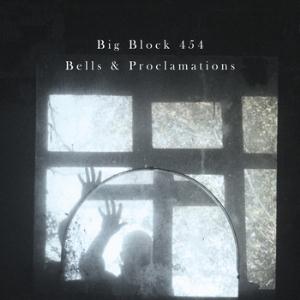
Hailing from the north-western English city of Manchester – better known for its pre-Britpop scene of the early Nineties than for progressive music – Big Block 454 (named after a car engine developed in the Seventies) were founded in 1988 by Colin Robinson and Pete Scullion, and have been active since then, though in different configurations. Bells and Proclamations, their seventh album, sees them stripped down to a trio of multi-instrumentalists (including Robinson, the one constant member of the band) with guest musicians featured on some tracks.

Even a cursory look at Big Block 454’s back catalogue will clearly reveal their self-proclaimed nature as “a semi-amorphous post-modern / situationist neo-dada cross-platform compositional construct” rather than a band in the traditional sense. While quirky, absurdist titles such as Their Coats Flapped Like God’s Chops (their fifth album, released in 2004) might bring to mind post-rock bands, Big Block 454 are quite a different beast – a veritable melting pot of diverse influences and sources of inspiration, rendered in an outwardly conventional song form, with short, even snappy morsels which are instead densely packed with ideas and variations. This is art-rock in its purest and most literal form – indeed, in its earliest manifestation, the band provided the soundtrack for a Dadaist art installation. Though the easiest way to categorize Big Block 454 would be to place them squarely in the somewhat overcrowded RIO/Avant camp, if you expect something along the lines of the darkly mesmerizing chamber-rock of Univers Zéro or the Canterbury-meets-avant-garde compositions of Henry Cow, you will be disappointed. In fact, the band lean more towards the humorous side of the RIO/Avant spectrum, as embodied by the likes Samla Mammas Manna or Stormy Six, though with an uniquely British twist.

Armed with an impressive instrumentation, including both conventional rock staples and more exotic items, the band offer 12 tracks none of which runs longer than 7 minutes, and which might be very effectively described as deconstructed pop songs. While there faint mainstream suggestions to be found in Bells and Proclamations, they are treated as parts of a fascinating mosaic. Indeed, though the very first impression may be a bit too off-kilter for comfort, threads of melody will emerge from repeated listens, and the album as a whole may prove much less impenetrable than a lot of music bearing the RIO/Avant tag. Eclecticism is the name of the game here, and – though it will probably not have symphonic prog fans jumping for joy – the album will intrigue and reward motivated listeners.

All of the 12 numbers feature vocals, and the vocal style adopted by the members of the band complements the music perfectly – deep-toned, not exactly melodic, yet oddly catchy, occasionally even infectious. Opener “Pyjamageddon” immediately sets the tone, both with its quirky title (used as a chorus of sorts throughout the song) and its extensive use of electronic effects, enhancing an almost danceable tune that might bring to mind some instances of techno/house music. The next two songs develop in a similar vein: “Blind Jack of Knaresborough” blends snippets of melody with electronic noises, theatrical vocals and blaring sax over a strong percussive background; while “Yockenthwaite”, with its mix of the pastoral, the quirky and the experimental, made me think of Barrett-era Pink Floyd. Things turn mellower with the haunting, folksy “Metal Trees” and its accordion-infused coda, and especially the beautiful “The Cloud of Unknowing”, the album’s longest item at almost 7 minutes – a hypnotic, psychedelic mini-epic driven by organ and melancholy guitar chords and vocals, again strongly reminiscent of early Pink Floyd – like a 21st-century version of “Careful With That Axe, Eugene” minus the scream.

After the short, chaotic interlude of “Blind Jack’s Unicycle”, “The Modern Architrave” offers a skewed take on an Eighties synth-pop song, suggestive of archetypal ‘pronk’ acts such as The Stranglers, followed by an entertaining (though quite unrelated), circus-like section; while the brisk “Kirton in the Rain” evokes memories of Devo, with its funny vocal harmonies weaving in and out of the song. The hauntingly minimalistic “Long Shore Drift” is another highlight, with its slow, almost liquid movement and mournful vocals, which seems to flow into the muted, lullaby-like “Rubber Road”, peppered by faintly sinister creaking sounds. The album is then wrapped up by the snappy “Crossing the Bay”, almost like a Fifties’ pop song filtered through modern electronics, and the New Wave-meets-raga of  “The Sun Unconquered”, with its quirky, slightly out-of-tune vocals and atmospheric keyboard coda.

From the above description, it should be quite clear that Bells and Proclamations is the kind of album that is likely to send fans of traditional prog running for the exits. Indeed, I would call it a textbook example of the ‘great divide’ between ‘progressive’ and ‘Prog’. Needless to say, an open mind is indispensable in approaching this album, as well as the whole of Big Block 454’s output. This is an album that, as I previously hinted, may need repeated listens in order to sink in fully, and is also very unlikely to appeal to people who prize melody and great hooks. On the other hand, fans of Krautrock, Eighties new wave, electronic music and genre-bending acts such as Zappa, Gong and King Crimson (and eclectic-minded listeners in general) will find a lot to appreciate in Bells and Proclamations – a genuinely progressive effort with a welcome dose of offbeat, very British humour. The album can be downloaded (for free or by naming your own price) from Big Block 454’s Bandcamp page.

Links:
http://bigblock454.bandcamp.com/

http://bigblock454.tumblr.com/

Read Full Post »

TRACKLISTING:
1. Le Labyrinthe Du Cochon (9:15)
2. Jeudi (De) Poisson (10:34)
3. Sombre Trafic Sur Le Nil (3:40)
4. La Marmite Du Pygmée (8:55)
5. Le Château De L’Eléphant (6:26)
6. Cravate Sauvage (9:27)
7. Oppression, Dépression, Les Valeurs Du Cool (13:37)

LINEUP:
Arnaud M’Doihoma – bass, vocals
Gregory Pozzoli – guitars, vocals
Thomas Larsen – drums, percussion, vocals
Philippe Prebet – guitars, vocals

Just like Jethro Tull and Pink Floyd (“by the way, which one’s Pink?”), Jack Dupon is not a solo artist, but a French quartet whose debut album, L’Echelle du Désir, was released in the second half of 2008. It is also the name of the fictitious character whose picaresque stories are told in the band’s songs and live performances. Formed in 2001 by three school mates, Arnaud M’Doihoma, Gregory Pozzoli and Thomas Larsen (now in their late twenties), in 2004 Jack Dupon was joined by an older, more experienced musician, guitarist Philippe Prebet.  In September 2010 the band embarked on their first US tour, playing in venues such as the legendary Orion Studios in Baltimore, as well as the ProgDay Festival Pre-Show – their quirky, theatrical performances leaving a strong impression on American audiences.

My first contact with Jack Dupon occurred in 2009, when I reviewed L’Echelle du Désir, and was left with mixed feelings. While I could not help appreciating the band’s eclecticism and the undeniable impact of their music, I also felt they had been overambitious in recording an album that clocked in at nearly 75 minutes, and opened with a 30-minute epic. It seemed that the members of Jack Dupon, as talented and inventive as they obviously were, had not yet learned the valuable lesson that sometimes less is more – with the result that the album, after a while, overstayed its welcome. This time around, however, they seem to have heeded the advice of most reviewers, and gone for a relatively pared-down offering, slightly over an hour long, and avoiding the over-indulgence of L’Echelle du Désir’s two sprawling epics.

Unlike other bands placed under the RIO/Avant umbrella (a subgenre that is much more diverse than its detractors might think), Jack Dupon use a very traditional rock instrumentation – which means no strings, no woodwinds, no saxes, and even no keyboards. Indeed, their configuration (two guitars plus rhythm section) closely resembles King Crimson’s in the Eighties and onward – and Fripp’s crew, together with Frank Zappa, are clearly one of the main inspirations behind Jack Dupon’s output. However, the theatrical bent of the band, as well as the ‘mythology’ on which their music is based,  possess an unmistakably European flavour. While their French origins bring to mind concept-based bands like Magma and Gong (as well as Ange, a clear blueprint for the vocal department), some Italian bands of the Seventies are also evoked, especially those that, like Jumbo and the short-lived Pholas Dactylus, pushed the dramatic element at the forefront of their sound.

One of the biggest obstacles for people who approach Jack Dupon’s music are undeniably the vocals, mostly handled by bassist Arnaud M’Doihoma with the assistance of his bandmates. Harsh, grating and exaggerated, reminiscent of Ange’s Christian Descamps or even Jumbo’s Alvaro Fella, M’Doihoma’s singing style fits the music like a glove, but is likely to put off those who like a more traditional approach. Personally, I see the vocals very much as another instrument.  From the instrumental point of view, though there is plenty of razor-sharp riffing, Jack Dupon’s sound hardly ever suggests the heaviness of metal, but rather the angularity of King Crimson – with interlocking guitar lines very much in Fripp/Belew style, insistent to the point of occasional monotonousness, and frequent surges followed by pauses of relative calm that create sonic peaks and valleys. The undercurrent of zany, Dadaist humour running through the album (also reflected by the titles, as well as by the nonsensical lyrics and distinctive artwork suggestive of German Expressionism) – echoes not only Zappa, but also Gong (whose flying teapots are referenced in “Le Château de l’Eléphant”), RIO/Avant bands like Samla Mammas Manna and Höyry-Kone, and borderline progressive bands like Primus and Les Claypool’s Frog Brigade.

The tracks on Démon Hardi (“Bold Demon”), with the sole exception of the Middle-Eastern-tinged instrumental “Sombre Trafic Sur le Nil”, an unusually melodic, guitar-driven piece, are all over 6 minutes in length, though this time the longest number is strategically placed at the album’s close. The remaining tracks are prevailingly similar in structure, with an ‘ebb and flow’ movement that alternates slow, almost ominous passages and frantic ones, the vocals used sparingly but forcefully to add further intensity to the musical texture. The Zappa influence clearly surfaces in the more upbeat sections, as in the almost cheerful “Le Château de l’Eléphant”, a veritable drum tour de force with a classic rock feel in the guitar parts and occasionally funky touches. “Cravate Sauvage”, on the other hand, is somber and somewhat monotonous, spiced up with effects-laden guitars seemingly ‘conversing’ with the drums in the style perfected by King Crimson in their Eighties period; while “La Marmite du Pygmée” drags a bit at times, but features some outstanding guitar work. The longer tracks (such as opener “Le Labyrinthe du Cochon” or the jazz-meets-King-Crimson “Jeudi (de) Poisson”) offer plenty of changes, even though an impression of patchiness may occasionally emerge – as on closing track “Oppression, Dépression, Les Valeurs du Cool” (at 13 minutes the longest track on the album), whose riff-driven intro hints at metal and is then followed by a sedate, melodic section with a bluesy guitar solo, then climaxes with a choppy, funky passage.

As other reviewers have pointed out, Jack Dupon’s music seems to be tailor-made for the stage – which means that its effectiveness is not always as strong as one might expect when heard on CD. While the vocals are undeniably an acquired taste, they go hand-in-hand with the music and the concept behind it, and it is not hard to imagine that a live setting would increase their impact exponentially. The somewhat repetitive, jam-like nature of the music, with its often hypnotic pacing, also seems to be much more suited to live performance than more or less ‘passive’ listening. On any account, even if clearly not everyone’s cup of tea, Démon Hardi is definitely an interesting album, and Jack Dupon a very promising band that have obviously grown a lot since their debut. Though their musical offer may not be to everyone’s taste, and needs the right disposition on the part of the listener to be appreciated in full, they manage to deliver a product in which the various influences are reworked in a genuinely personal manner. At the time of writing, Jack Dupon are about to embark on a European tour, and are scheduled to appear at the 2011 edition of the Rock in Opposition Festival (Carmaux, France) in September.

Links:
http://www.jack-dupon-rock-progressif.net/

Read Full Post »

« Newer Posts