Feeds:
Posts
Comments

Archive for the ‘Rock Progressivo Italiano (RPI)’ Category

TRACKLISTING:
1. Fino all’Aurora (6:44)
2. D-Sigma (4:13)
3. 4.18 (1:37)
4. Discesa (7:32)
5. Tra Due Petali di Fuoco (6:06)
6. L’Inganno (7:20)
7. Agli Uomini Che Sanno Già Volare (4:36)
8. Il Declino (5:44)
9. Phoenix (5:07)
10. La Notte Trasparente (7:47)

LINEUP:
Alessandro Corvaglia – vocals
Fabio Zuffanti –  bass, bass pedals, backing vocals
Agostino Macor – keyboards
Andrea Monetti – flute, sax
Matteo Nahum – guitars
Maurizio Di Tollo – drums, backing vocals

One of the many projects in which Genoa-based bassist and composer Fabio Zuffanti is involved, La Maschera di Cera (The Wax Mask, named after a ‘50s horror movie starring Vincent Price) have been active since the beginning of the new millennium, releasing four studio albums and a live one. Their third album, LuxAde (released in 2006, and based on the Greek myth of Orpheus) brought them to the attention of the many fans of classic Italian prog scattered around the globe, which culminated with their appearances at the 2007 edition of NEARfest and the 2009 edition of ProgDay, two of the highest-profile progressive rock events in the world. They also appeared in the Romantic Warriors documentary, alongside fellow Italians D.F.A.

Petali di Fuoco, their fourth studio release (produced by a veritable RPI icon such as PFM drummer/frontman Franz Di Cioccio) marks a distinct change in the band’s compositional approach, and consequently also in their sound, which has been somewhat streamlined. While the band’s three previous albums had the hard-edged, retro-symphonic sound of Seventies outfits such Il Balletto di Bronzo and Biglietto per l’Inferno down pat, dispensing with the electric guitar in favour of luxurious keyboard textures and plenty of Mellotron – as well as sporting a strong conceptual bent – Petali di Fuoco takes a more mainstream direction, featuring 9 shorter, unconnected songs with more straightforward lyrics. While there are still Italian bands paying homage to the great tradition of the elaborate concept album, La Maschera di Cera seem to have followed the example set by other Genoese bands like Delirium (with their superb comeback release Il Nome del Vento) and Il Tempio delle Clessidre, and chosen a more accessible format for this album.

On Petali di Fuoco, the core of founding members Alessandro Corvaglia, Fabio Zuffanti, Agostino Macor and Andrea Monetti (plus drummer Maurizio Di Tollo, who joined the band in 2004) has been augmented by guitarist Matteo Nahum, who proves to be the album’s real ace in the hole. A classically-trained musician (and devoted Steve Hackett fan)  with the perfect combination of flawless technique (without any concessions to the deplorable shredding trend) and genuine emotion, his contribution lifts the level of the album from merely good to excellent. Even though the music is unabashedly retro, a loving homage to the classic Italian prog sound of the Seventies without any real claim to innovation, and the songs sometimes skirt the Italian melodic pop tradition a bit too close for comfort, Petali di Fuoco delivers a very satisfying listening experience, at least for those people who like their prog with lots of vocals. On the other hand, Alessandro Corvaglia’s strong, confident voice, markedly different from the operatic style of the likes of Francesco Di Giacomo, but equally suited to tackling material at the same time melodic and challenging, can bring to mind some internationally-known Italian pop singers, and therefore come across as vaguely annoying to those who like the angular, acquired-taste vocal styles of so many prog singers.

Running at about 55 minutes, Petali di Fuoco is a well-balanced effort that never threatens to outstay its welcome. Most of the songs – as immediately evidenced by opener “Fino all’Aurora”, an upbeat, organ- and flute-driven number ending with a beautiful guitar solo  – have a conventional verse-chorus-verse structure, but the lush orchestration and seamless instrumental interplay reveal their progressive matrix. Though Corvaglia’s voice often seems to dominate the proceedings, the instruments spin a tightly-knit web of sound that provides a solid foundation for the development of each song. While “D-Sigma” and “Discesa” keep things simmering in the same spirit as the opener, with melodious, Hackett-inspired guitar passages opening airy spaces in the dense, keyboard-driven heavy prog textures of the songs, the title-track and “Agli Uomini Che Sanno Già Volare” take a more subdued direction, with a sparser, somewhat melancholy instrumental backdrop that pushes the vocals to the forefront and leaves a lot of room for Corvaglia’s emotional delivery.

Though Petali di Fuoco is a strongly vocal-driven album, two instrumentals have been included – one, “4.18”, a short classical guitar number in the style of Genesis’ “Horizons”, the other, “Phoenix”, starting out slowly but building up to a crescendo powered by keyboards and drums – a structure paralleled by “Il Declino”, in which a somewhat somber piano solo is offset by the unbridled passion of Corvaglia’s vocals. On the other hand, with “L’Inganno” La Maschera di Cera explore vintage hard rock territory, powered by Agostino Macor’s rumbling Hammond organ and whistling Moog, and featuring an almost jazzy piano passage in the middle, as well as a soaring guitar solo at the end. The album ends with a veritable bang: “La Notte Trasparente”, at almost 8 minutes the longest track on the album, is also the most complex, with all the instruments creating intricate yet airy textures with more than a nod to classic Genesis, and a showcase for Matteo Nahum’s spectacular guitar work. His solo at the end starts out slowly, and then gradually drives towards an exhilarating climax that had me think about Gary Moore or Blue Oyster Cult’s Buck Dharma.

Though some prog fans may be disappointed by the lack of epics and the generally more streamlined nature of Petali di Fuoco, the album will certainy prove a treat for lovers of the sounds of vintage Italian prog. With lush instrumentation, a nice balance between orchestral grandiosity and more intimate, subdued moments, plenty of melody and warm, passionate vocals, it contains all the elements that keep attracting many listeners to Italian progressive rock – as well as those that often turn people off, such as the enhanced sentimentality and occasionally bombastic passage (though not as prominently as in their previous studio albums). It is, indeed, very much a ‘retro-prog’ effort – which might make it pointless (as a fellow reviewer put it) in the eyes of some of the more jaded set – but it cannot be denied that Petali di Fuoco is a quality offering brimming with flair and songwriting expertise. Even if, speaking from a strictly personal point of view, the music on the album is not always my cup of tea, I would not hesitate to recommend the album to everyone interested in Italian prog.

Links:
http://www.myspace.com/lamascheradicera

http://www.zuffantiprojects.com/

Read Full Post »

TRACKLISTING:
1. Un Dono (2:13)
2. Wizard Intro (3:03)
3. Madre Africa (7:54)
4. Questa Penombra E’ Lenta (6:57)
5. Chimera (4:23)
6. The Game (10:38)
a. Wizard of your Sky
b. Mickey’s
c. Jump
d. Wizard of your Life
7. Cluster Bombs (6:43)
8. This Open Show (3:16)
9. C’Era Una Volta (2:59)

LINEUP:
Paolo Siani – drums, vocals, keyboards, bass, guitars

With:
Ricky Belloni – electric guitar (6)
Carlo Cantini – violin (6)
Guido Guglielminetti – bass (2, 4, 6)
Mauro Pagani / flute (3)
Alessandro Siani – electronics (1, 5)
Franco Testa – bass (5)
Roberto Tiranti – vocals (3, 6, 7)
Giorgio Usai – Hammond organ (6)
Joe Vescovi – Hammond organ (3)
Marco Zoccheddu – electric guitar (2, 3, 4, 7), piano (5, 7)
Gianni Alberti – sax (5)
Ottavia Bruno – vocals (5)
Giacomo Caiolo – acoustic guitar (4)
Nadia Enghèben – soprano (3)
Alberto “Artley” Buttarelli – vocals, flute (8)
Diego Gordi – piano (8)
Fabio Gordi – piano (8)
Daniele Pagani – piano (8)
Giuliano Papa – cello (8)
Vittorio Pedrali – vocal recitation (1)

In spite of his tenure as the drummer of Italian Seventies band Nuova Idea, Paolo Siani is certainly not a household name in the world of progressive rock – unless you count those dedicated fans of the scene who collect even the most obscure albums. Additionally, he shares the same name with an Italian-American artist of vastly different temperament, which can be misleading to those who are looking for more information. Although an excellent outfit, Nuova Idea did not achieve the fame of their fellow Genoese New Trolls (whom keyboardist Giorgio Usai and guitarist Ricky Belloni joined after the band’s demise) or Delirium, and disbanded after their third album, the highly-regarded Clowns, released in 1973. Subsequently Siani joined avant-garde outfit Opus Avantra for their second album, then beat band Equipe 84. Though he dropped off the musical radar for almost three decades, he worked as a producer and kept writing and recording his own music. It was the renewed interest in prog and the Italian Seventies scene that prompted Siani to resume his career as a musician – as well as a commendable humanitarian purpose, that is, raising funds on behalf of Genoa’s renowned Gaslini paediatric hospital.

Though Castles, Wings, Stories and Dreams, released by Genoa-based label Black Widow, is to all intents and purposes a solo project by Siani, it also sees a reunion of sorts of his mother band, as well as an impressive roster of guest musicians, including three of his former Nuova Idea bandmates: the above-mentioned Giorgio Usai and Ricky Belloni, plus guitarist Marco Zoccheddu, who had left the band to join Osage Tribe after Nuova Idea’s debut. Unlike many albums of this kind, however, it is remarkably tight from a compositional point of view. Moreover, despite Italian prog’s reputation for being somewhat overwrought,  the album avoids that particular trap, keeping melody and clarity at the forefront while not neglecting the occasional flight of instrumental fancy.

Clocking in at under 50 minutes, Castles, Wings, Stories and Dreams is a decidedly song-oriented effort that manages to achieve a good balance between vocal and instrumental parts. The album opens with “Un Dono”, where an expressive male voice recites a brief, uplifting text by Mahatma Gandhi on a backdrop of sparse electronic keyboards. The following instrumental, “Wizard Intro”, blends symphonic suggestions à la Yes with hard rock touches, all infused with an unmistakable Italian flavour. “Chimera”, also instrumental, hints instead at a jazzy inspiration, with a loose structure made up of different solo spots (bass, sax and piano) over a train-like background rhythm provided by drums and keyboards. Siani’s voice can be heard on one track, “Questa Penombra E’ Lenta” (which is also the closest the album gets to a conventional ballad in the unique Italian style), assisted by the clear, melodic voice of Ottavia Bruno, and complemented by lovely acoustic guitar and an airy synth solo.

Three tracks feature the powerful yet clear voice of Roberto Tiranti, lead singer of power/progressive metal band Labyrinth (with a brief stint in New Trolls in the late Nineties). His gritty performance on “Cluster Bombs” – a hard-hitting, anti-war song powered by Hammond and military-style drumming that owes more than a little to Deep Purple or Uriah Heep – increases the song’s emotional impact. Tiranti shows his more melodic side on the 10-minute, 4-part epic “The Game”, a richly textured composition where all the instruments get their chance to shine without overwhelming each other, with Hammond flurries and wistful violin strains. Tiranti then reverts to a more authoritative, hard-rocking persona in the haunting “Madre Africa”, where the Deep Purple influences represented by Joe Vescovi (formerly of The Trip, a band that briefly included Ritchie Blackmore among his members) and his Hammond organ are tempered by Mauro Pagani’s flute, whose sound brings to mind Delirium or Osanna. The album is wrapped up by two short, low-key pieces, the melancholy, cello-driven “This Open Show” and the instrumental “C’Era Una Volta”, a Baroque-inspired number performed by Siani alone.

As can be expected, Castles, Wings, Stories and Dreams is not particularly innovative, nor does it pretend to be such. Like other fellow reviewers, I also have some reservations on the choice of mixing Italian and English lyrics. The supposed ‘international appeal’ of English vocals, in my opinion, dilutes that unique quality of Italian prog that is so often connected with the use of such a great vehicle for music as the Italian language. However, in spite of these drawbacks, the album is a solid effort, a fine slice of vintage Italian prog with a thoroughly 21st-century sound quality, and excellent performances all round from Siani and his guest musicians. The album should also appeal to fans of classic hard rock with progressive overtones. At the time of writing, Paolo Siani is planning a live show in October in his hometown of Genoa, which hopefully will not remain a one-off.

Links:
http://www.blackwidow.it

http://www.progarchives.com/forum/forum_posts.asp?TID=77100


Read Full Post »

TRACKLISTING:
1. Oro Caldo (18:30)
2. Stanza Città (1:45)
3. Animale Senza Respiro (21:36)

LINEUP:
Danilo Rustici – guitars, vox organ, electric piano, vocals
Lino Vairetti – lead vocals, rhythm guitars, ARP 2600, Mellotron
Elio D’Anna – tenor and soprano sax, flute, vocals
Massimo Guarino – drums, vibraphone, percussion
Lello Brandi – bass

Palepoli (The Old Town, currently the gorgeous seafront area called Santa Lucia) is the original nucleus of the city that would later become Naples, one of the most loved and loathed places in the world – the Italian music capital, and a notorious abode of crime and squalor (cue the hard-hitting movie Gomorrah, and the deplorable rubbish débacle of a few years ago, which seems to have reared its ugly head once again). Naples is breathtaking in its splendour, and infuriating in its unbridled anarchy – perhaps not the best place to live for those who like quiet and order, but also one to  experience  at least once in a lifetime (for the glorious food as well as for the scenery, the art and the music). The old adage  “See Naples and then die” is indeed quite true. A walk in the so-called Spanish quarters is the closest you can get to a Middle Eastern souk in the heart of western Europe – and probably no one has managed to capture that heady atmosphere better than the third album released by Naples’ own Osanna.

One of the most distinctive bands of the original RPI scene, Osanna were hot stuff back in the Seventies. With their painted faces (harking back to the city’s traditional mask of Pulcinella) and wild, energetic sound, they blended British-style heavy rock with influences coming from the venerable musical tradition of their hometown. It has even been intimated that Peter Gabriel took his cue from Osanna for his stage make-up when the two bands toured Italy together. Like so many of their fellow Neapolitans, the five members of the band had music in their blood – not the tasteful, restrained kind practiced by northern Italians PFM, though, but rather a full-throttle blend of passion, energy and chops.

Much in the same way as ELP’s output, Palepoli is not for those in search of subtlety, though I would not call it self-indulgent either. The chaos on display on the album is of the controlled variety, in spite of the somewhat fragmented nature of the compositions. However, those fragments, like the pieces of a puzzle, eventually fall together to form a complete picture. The two main tracks, sprawling epics that approach or even exceed 20 minutes in length, are linked by a short piece reprising the opening of the album itself, and give an entirely new meaning to the expression ‘rollercoaster ride’. It is no wonder that Palepoli commands such adoration on the part of prog fans. Indeed, it shows progressive rock at its authentic best, soothing and lyrical at times, and at others raw, aggressive and passionate. It also offers further proof of the invaluable contribution brought by local musical traditions  to the progressive melting pot.

Unlike Banco del Mutuo Soccorso and their fellow Neapolitans Balletto di Bronzo, Osanna’s sound is driven by Danilo Rustici’s slashing guitar and Elio D’Anna’s sax and flute – which add a mixture of lyricism and aggression to the already exciting texture of the music – rather than by keyboards. However, it is Lino Vairetti’s stellar vocal performance that lends the album a unique appeal.  Heir to one of the greatest singing traditions in the Western world, Vairetti fully deserves pride of place among the great prog singers:  in my view, his clear, versatile voice is probably second only to Banco’s Francesco Di Giacomo on the Italian prog scene.

The intro to the first track, “Oro Caldo”, a colourful, richly-textured patchwork of musical moods,  suggests the atmosphere of Naples’ narrow alleys and street markets, dirty, noisy, and thoroughly fascinating, a babel of sounds, voices and sights. The influence of Neapolitan folk music, such as the frantic rhythms of the tarantella, is evident throughout the piece, especially when, at the beginning, the band members sing in Neapolitan – probably one of the best vehicles for song and music known to man, and a language with a rich literary tradition in its own right.  “Oro Caldo” rocks hard, but also offers quieter, more meditative moments – just like escaping the chaotic atmosphere of the Naples alleys into a darkened, half-deserted church.

The second epic, “Animale Senza Respiro”, is a somewhat more structured piece, though it does adopt the same eclectic approach as “Oro Caldo”. It is also a distinctly darker offering, with some angular, jazzy stylings bordering on the avant-garde, dominated by flutes and saxes, interspersed with almost unexpected acoustic breaks. Though it is definitely not as easy on the ear as PFM’s stately, melodic compositions, it is nonetheless a captivating number with a strong emotional impact.

If you want soothing, pastoral beauty, or music that does not demand too much engagement from the listener, give this one a miss. Like the city of Naples itself, Palepoli is not for the squeamish. However, if you like your prog with some bite (and here there is plenty – think lashings of red hot pepper), and do not mind hearing people sing in a language other than English, this will grab you like few other discs produced in the Seventies. A concept album that is rooted in gritty reality and not in the airy-fairy, supported by first-class musicianship and singing, Palepoli has  acquired near-legendary status among prog fans, and deservedly so.

After an almost 20-year hiatus, Osanna reformed in the early 2000s (though only Lino Vairetti remains of the original line-up), and recently joined forces with former Van Der Graaf Generator’s saxophonist David Jackson. Their 2009 album, Prog Family, is an excellent compendium of the band’s whole output, with new arrangements of their classics and the contribution of such distinguished guests as singer Sophya Baccini (also a native of Naples), Balletto di Bronzo keyboardist Gianni Leone, and former King Crimson violinist David Cross.

Below this post you will find a link to an interview with Lino Vairetti which I translated for the ProgSphere website, shedding some light on the band’s past and recent history. In the light of the events of the past weekend (amply discussed in my previous blog post), the interviewer’s mention of NEARfest  feels particularly poignant. In my view, Osanna would have made a wonderful headliner for the festival, but were not even considered… Food for thought?

Links:
http://www.osanna.it/

http://www.prog-sphere.com/index.php?s=Lino+Vairetti

Read Full Post »

I recently received this press release from Black Widow Records –  the Genoa-based label whose roster includes a number of historic Italian progressive rock acts, as well as many newer ones – which I am glad to share with my readers, especially the many fans of Italian prog.

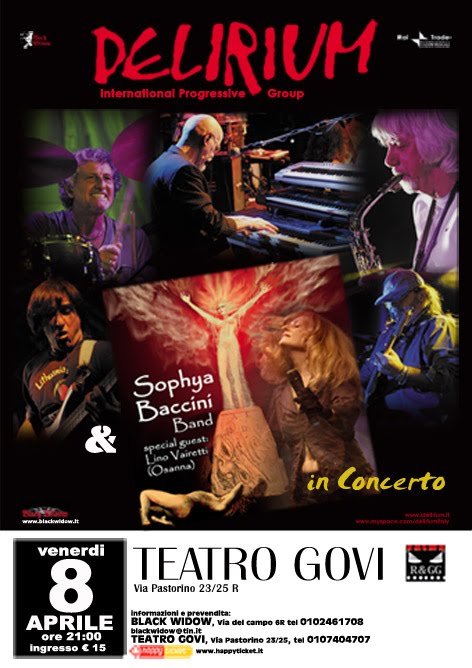
On Friday, April 8, 2011, Delirium,  one of the seminal bands of the original Rock Progressivo Italiano movement, will be performing at Genova’s Teatro Govi.  The concert will be opened by gifted Neapolitan singer Sophya Baccini (whose excellent solo debut, Aradia, was released in 2009), with legendary Osanna vocalist Lino Vairetti as a special guest.

In the course of the evening, Delirium will present their new DVD, Il Viaggio Continua: La Storia 1970-2010 (recently released by Black Widow), which features original live footage from the Seventies, plus a recording of the band’s concert at the Teatro Politeama (also in Genoa) in 2008. Their setlist will include material from both  their ’70s albums and their critically acclaimed 2009 CD Il Nome del Vento – as well as semi-acoustic arrangements of some of their best-known songs.

Though I am aware that for most of my readers it will not be possible to attend this event, if any of you happen to be in the area, this is definitely an opportunity not to be missed. In the next couple of weeks Genoa will host a number of  events that will further strengthen its status as a hotbed for great progressive rock.

The concert will start at 9 p.m. Tickets are € 15.

Teatro Govi – Via P. Pastorino 23-25 R – Genoa, Italy.

Links:
http://www.blackwidow.it

http://www.sophyabaccini.com

Read Full Post »

TRACKLISTING:
1. Verso l’Alba (2:52)
2. Insolita Parte di Me  (7:20)
3. Boccadasse  (5:20)
4. Le Due Metà della Notte  (5:18)
5. La Stanza Nascosta  (5:10)
6. Danza Esoterica di Datura  (6.07)
7. Faldistorum  (6:06)
8. L’Attesa  (4:36)
9. Il Centro Sottile  (9:39)
10. Antidoto Mentale  (3:30)

LINEUP:
Stefano “Lupo” Galifi  – vocals
Elisa Montaldo – piano, keyboards, organ, concertina, vocals, sound effects
Fabio Gremo – bass
Giulio Canepa – guitars
Paolo Tixi – drums

With:
Max Manfredi – voice (7)
Antonio Fantinuoli – cello (5)

Known outside Italy as the hometown of Christopher Columbus, the bustling seaport of Genoa has had a long tradition as a hotbed of musical creativity – starting as far back as the late 18th century with legendary violinist Niccolò Paganini. Then, in the early 1960s came the ‘Genoese school of singer-songwriters’, whose foremost representative, Fabrizio De André, is known to prog fans for his collaboration with PFM. About ten years later, a number of influential progressive rock bands were formed,  such as Delirium and New Trolls – two outfits that are still producing great music in the early 21st century. In particular, Delirium’s comeback album of 2009, Il Nome del Vento (reviewed elsewhere on this blog) stood out among the plethora of prog releases for successfully marrying the glorious heritage of Italian prog with a thoroughly modern sound quality. The same accomplished nature is shared by this stunning debut by Delirium’s label mates (and fellow Genoese) Il Tempio delle Clessidre.

Named after the final section of the titular suite of Museo Rosenbach’s one-off Zarathustra – one of the most iconic albums of the Italian Seventies – Il Tempio delle Clessidre (“The Temple of Hourglasses”) have been around since the summer of 2006, when keyboardist Elisa Montaldo and bassist Gabriele Guidi Colombi met former Museo Rosenbach vocalist Stefano “Lupo” Galifi. The idea that brought the band together was to perform the whole of the Zarathustra album live on stage with Museo Rosenbach’s original singer, using vintage instruments, and subsequently start penning original compositions inspired by the spirit of the golden years of Italian prog. After some line-up changes, Il Tempio delle Clessidre’s self-titled debut album was released in September 2010 by Genoa-based label Black Widow Records.

For all its cult status, Italian prog can be seen as very much of an acquired taste – mainly on account of its operatic, occasionally overblown nature, especially as regards the vocal department. In this respect, Galifi’s warm, bluesy vocals (also heard on one track of Delirium’s 2009 album), which add an emotional yet somehow informal note to the lush textures of the band’s music, are definitely Il Tempio delle Clessidre’s not-so-secret weapon. The tightly organized compositions, never gratuitously meandering, strike the right balance between melody and complexity, without a second wasted in pointless noodling, and with enough changes of pace to make the most demanding prog fan happy. Although the singing is strongly emphasized,  there is also a lot of room for the instrumentalists to display their considerable chops. Indeed, the pristine sound quality allows each of the musicians’ performances to shine, and captures every nuance of Galifi’s seasoned vocal delivery, honed in years of fronting blues-rock bands; while the pronounced melodic bent tempers the intensity of the lyrics and the dense esoteric symbolism of the cover art and booklet.

Interestingly, with the sole exception of the almost 10-minute “Il Centro Sottile”, the tracks on the album are all relatively short, with an average running time of 5 minutes. The album itself, at about 55 minutes, is markedly shorter than the majority of current prog releases, some of which skirt the 80-minute mark. Those who appreciate the instrumental aspect of progressive rock rather than the vocal one will be glad to learn that Il Tempio delle Clessidre manages to balance both sides quite admirably. Opener “Verso l’Alba”, the only completely instrumental track on the album, sets the scene with the deep, Gothic sound of the organ and wind-like effects, developing into a keyboard- and guitar-driven piece reminiscent of a heavier Genesis. “Insolita Parte di Me”, at 7 minutes the second longest track, alternating quieter passages with more dramatic ones, dominated by Elisa Montaldo’s magnificent keyboards, is a perfect example of how the band manage to achieve the structural complexity typical of prog without sacrificing the unique Italian attention to melody. Montaldo, who is the main composer together with bassist Fabio Gremo, handles her array of instruments with impressive skill and flair. “Le Due Metà della Notte”, interpreted with warmth and feeling by Galifi, is a splendid keyboard showcase that combines melody and intensity; while in the sedate “La Stanza Nascosta” the piano and Galifi’s stunning vocals conjure a melancholy, meditative atmosphere. On the other hand, the mid-paced “Boccadasse” (dedicated to a picturesque mariner’s neighbourhood of Genoa) is a more conventionally structured song, with a very catchy chorus and a beautiful, melodic guitar solo.

However, it is the two central numbers that prove to be the most distinctive, in keeping with Black Widow’s keen interest in the mystical and the esoteric. “Danza Esoterica di Datura”, as the title implies, opens with a brisk, dance-like pace, and culminates with an extract from Shakespeare’s Macbeth, chanted by Montaldo in tense, dramatic fashion; some of the keyboard inserts are appropriately reminiscent of Goblin’s Dario Argento soundtracks, such as the renowned Profondo Rosso. The cryptically-titled “Faldistorum” sees the Hammond organ take the lead in parallel with the drums, introducing a male voice reciting a short text in an emphatic, melodic yet slightly ominous manner, reinforced by the closing strains of a church organ. The following “L’Attesa”, a rich, energetic keyboard-fest, is very much in the vein of classic Italian heavy progressive acts such as Il Balletto di Bronzo and Biglietto per l’Inferno; while in the solemnly melodic “Il Centro Sottile” all the instruments strive to create a lush texture that can bring to mind Genesis or Banco del Mutuo Soccorso in their heyday. After a somewhat lengthy pause, the album is wrapped up by the poppy, rather undistinguished “Antidoto Mentale”, which in my view is the only track that smacks a bit of filler.

Blending the warmth and melodic flair of the Mediterranean musical tradition with the driving energy of rock and the artistic ambition of prog, Il Tempio delle Clessidre’s debut deserves to be hailed as one of the standout releases of 2010, and one of the most promising albums to have come out of Italy in a long while. While taking their cue from the music produced in the Seventies – and, thankfully, not pretending to reinvent the wheel – the band manage to sound fresh and up-to-date, and not a mere exercise in nostalgia. A flawlessly performed, lovingly presented effort, Il Tempio delle Clessidre will surely bring a lot of listening pleasure to the many fans of Italian progressive rock.

Links:
http://www.myspace.com/iltempiodelleclessidre

http://www.museo.it

http://www.blackwidow.it

Read Full Post »

TRACKLISTING:
1. Epilogo  (2:41)
2. Giù nella Forra  (1:47)
3. Casa di Blu  (0:58)
4. La Guida  (1:28)
5. Cosa Dice Quella Porta Chiusa  (0:53)
6. Dimmi Chi Sei  (2:30)
7. Cosa Dice Quella Porta Schiusa  (0:53)
8. Fame Che Ride  (1:18)
9. Ladri e Stranieri  (4:49)
10. Soldati  (2:01)
11. Un Lupo  (3:29)
12. Canto Antico  (2:38)
13. Casa Non Mai Vista  (2:23)
14. Cristo Guarito  (3:10)
15. La Lettera  (1:52)
16. Gli Scantinati  (3:56)
17. Requiem  (2:29)
18. Nessuno Muore Mai  (1:37)
19. Non Sono Morto  (2:21)

LINEUP:
Leonardo Bonetti – vocals, bass, acoustic guitar, keyboards
Paola Feraiorni – vocals
Fabio Brait – acoustic guitar
Aldo Orazi – drums

Racconto d’Inverno (A Winter Tale), the third album by Rome-based outfit Arpia,  was released in early 2009 together with band mastermind Leonardo Bonetti’s critically acclaimed novel of the same title.  Like Arpia’s previous two albums, Liberazione (1995) and Terramare (2006), Racconto d’Inverno is a concept album,  a musical rendition of a book that in turn is based on two other works, Andrei Tarkovsky’s film Stalker and Italian writer Tommaso Landolfi’s short story Racconto d’Autunno (An Autumn Story). It is also one of those albums that are extremely difficult to define. It is progressive rock, but not as we commonly know it –  indeed, if taken superficially, it can even come across as remarkably accessible in a ‘sophisticated pop-rock’  kind of way.  Moreover, it  is almost completely acoustic, with keyboards used as a complement rather than as a main ingredient.

Though they have been active for over 25 years with the same core line-up, Arpia are anything but a prolific band. Racconto d’Inverno, however, is the effort that really raises the bar in terms of the development and maturation of their individual style, and not just any old, tired variation on the ‘rock opera’ theme. The concise, yet supremely elegant lyrics, perfectly suited to the dual vocal approach adopted by the band, emphasize the aura of mingled fear and fascination pervading the whole disc. In a way, though musically quite different, it could be compared to another similarly structured album released in the first months of 2009, The Decemberists’ The Hazards of Love.

The story (which follows a circular narrative pattern) is told from the point of view of its protagonist, a drifter roaming in the mountains near the border during World War Two. While trying to escape from the war zone, he meets a mysterious young man who guides him to an equally mysterious, derelict house deep in a forested gorge, haunted by the presence of a woman. Though those familiar with Italian literature will immediately notice the link with the rich tradition of fiction set against the background of those terrible years, Racconto d’Inverno is not a realistic account of the horrors of war, but rather a hauntingly Gothic tale that may also be read metaphorically.

From a musical perspective, Racconto d’Inverno does not suggest ‘traditional’ Italian prog, but rather bands that merge folk and world music influences with darkly rarefied atmospheres, such  as Australian outfit Dead Can Dance –  to which I would add seminal British prog-folk band The Pentangle (especially as regards the use of dual male and female lead vocals). There is indeed a clear folk undercurrent in Arpia’s music, emphasized by the use of the acoustic guitar as the main instrument, and further reinforced by the expressive singing style of Leonardo Bonetti and Paola Feraiorni (already featured as a guest on Terramare, and now a full member of the band). Indeed, Paola’s voice is one of the main draws of the album – crystal-clear in tone, yet forceful, in the tradition of the great folk-rock female singers of the Seventies such as Maddy Prior or Sandy Denny. Her pristine, controlled delivery, far removed from the modern penchant for either saccharine sweetness or operatic grandiosity in female vocals, is the ideal vehicle for the often unsettling subject matter, dominated by the presence of death.

Arpia are also to be commended for having kept the album  at a very restrained 42 minutes, aware of the pitfalls of excessive length, especially on a project of this nature. The music, which favours the repetition of themes in selected episodes (as demonstrated, for instance, by the mirror-like melody of “Epilogo” and “Non Sono Morto”), may initially come across as somewhat monotonous, a bit like the shades of grey of the album cover and booklet –  though further listens will easily dispel this impression. Given the importance of the storyline, familiarity with the Italian language is definitely a bonus, though not indispensable in order to enjoy the album. Even without understanding the actual words, Leonardo and Paola’s stunning vocals  help the listener to connect with the story.

Racconto d’Inverno should be seen as a suite in 19 short movements (only the imperious, Middle Eastern-tinged “Ladri e Stranieri” approaches the 5-minute mark) rather than a standard collection of songs. As to be expected on an album of this nature, the music is very much at the service of the story, rather than the other way around. Though the acoustic guitars play by far the biggest role (together, obviously, with the vocals), the keyboards lurk in the background, introduced first in “Un Lupo”, and finally taking the lead in the climactic ending of the tale, the dual punch of  “Gli Scantinati” and “Requiem”. Here, combined with the mournful sound of strings and the almost unbearably intense vocals, the keyboards create a dirge-like melody that suggest some decidedly sinister goings-on in the vein of Edgar Allan Poe and its ilk.

By releasing an album of such peculiar nature, Arpia have made an extremely bold move, putting artistic integrity before any concerns of commercial success. Intensely original in its combination of mesmerizing music, intriguing storytelling and splendid vocal performances, minimalistic yet deeply moving, Racconto d’Inverno is a masterpiece of atmosphere and restraint,  an album that will appeal to all lovers of music relying on simplicity and purity rather than technical flash. Those who have a good knowledge of Italian might also want to check out the novel, and possibly its source, Tommaso Landolfi’s Racconto d’Autunno – as well as Bonetti’s latest literary effort,  Racconto di Primavera (A Spring Tale), released in October 2010.

Links:
http://www.arpia.info
http://www.leonardobonetti.it

Read Full Post »

TRACKLISTING:
1. Intro/Dio del Silenzio (1:23)
2. Il Nome del Vento (6:01)
3. Verso il Naufragio (6:35)
4. L’Acquario delle Stelle (6:15)
5. Luci Lontane (4:14)
6. Profeta Senza Profezie (4:20)
7. Ogni Storia (5:02)
8. Note di Tempesta (4:29)
9. Dopo il Vento (9:40)
10. Cuore Sacro (8:49)
11. L’Aurora Boreale (4:26) (bonus track)

Bonus Video:
L’Acquario delle Stelle

LINEUP:
Ettore Vigo – keyboards
Martin Grice – sax, flute, keyboards
Pino Di Santo – drums, vocals
Roberto Solinas – guitars, vocals
Fabio Chighini – bass
Mimmo Di Martino – vocals (2)

String quartet:
Chiara Giacobbe Chiarilla – violin
Diana Tizzani – violin
Simona Merlano – viola
Daniela Caschetto Helmy – cello

With:
Stefano “Lupo” Galifi – vocals (6)
Sophya Baccini – backing vocals (2, 4, 7, 9), piano (9)

After having spent the past few months concentrating on albums from the English-speaking world, now it is time for me to to spotlight some  Italian bands and artists. Though many great albums (in some cases essential for a true prog fan) have come out of my native country from the Seventies onwards, only a part of this vast, exciting output has received the attention it deserves.  Here in the US most of the attention tends to be directed at the likes of  Le Orme, PFM and Banco (also owing to their relatively frequent visits to the New World), to the detriment of other acts who seem to be familiar only to a selected few.

Genoa-based band Delirium hold a special place in my heart, since their debut album, Dolce Acqua, was the first progressive rock album that I bought – at the ripe old age of 11. Among the founders of the original Italian progressive rock scene, in 1972 they experienced mainstream success with  the anthemic single “Jesahel”, which introduced the Italian public to the gritty, bluesy vocal talents of Ivano Fossati.  Soon afterwards Fossati  left the band  to embark on a successful career as  a singer-songwriter, to be replaced by British-born Martin Frederick Grice.  After the release of their third album, released in 1974, Delirium split up, but thankfully got back together in 2001 with most of the original members on board.

When listening to Il Nome del Vento, one might almost be tempted to feel that the 30-year hiatus between  Delirium III and this album has in some way been beneficial to the band – a lengthy yet necessary ‘recharging of the batteries’, so to speak. This is indeed a mature, finely-crafted album, very much in the way of  PFM’s  Stati di Immaginazione – a sumptuous, accomplished effort from seasoned prog veterans that had been forgotten or written off far too soon.

Although Il Nome Del Vento is a concept album of sorts (the wind symbolizing the energies that sweep negativity away and usher positive change), it does not feel as contrived as many similar efforts can be. Shunning the clichés than often plague concept albums, Mauro La Luce’s lyrics opt instead for simplicity and emotion, a perfect complement to the outstanding performances of all the vocalists involved. The latter are nicely balanced by the brilliance of the instrumental sections, where the background of each musician, their individual tastes and preferences, is put to effective use. While Martin Grice’s love of jazz and vintage English prog shines through his flute and sax  work, guitarist/vocalist Roberto Solinas (a true revelation) injects a welcome dose of classic rock energy in what is largely an acoustic effort. The presence of an all-female string quartet contributes an authentically symphonic feel to many of the compositions, infused by that uniquely Italian flair for melody and lyricism.

The continuity between the new and the old incarnation of Delirium is highlighted right from the start, as “Intro/Dio del Silenzio (Reprise)” references one of the songs featured on Delirium III. This brief, intense introduction (complete with sounds of rain and thunder at the beginning) sets the scene for what is to come. The title-track is a magnificent slice of complex yet melodic prog, soulfully interpreted by the band’s former guitarist Mimmo Di Martino, whose deep, bluesy tones find a perfect foil in Sophya Baccini’s ethereal soprano. The following track, “Verso il Naufragio” (one of two instrumentals featured on the album), is an exhilarating rollercoaster ride of slow, majestic keyboard washes and electrifying guitar riffs; it also incorporates a passage from George Martin’s “Theme One” (also covered by Van Der Graaf Generator, Cozy Powell and Osanna). The jaw-dropping duel between sax and organ in the second half of the track displays the band’s jazzier side, a constant of their sound since their debut album, Dolce Acqua.

More jazzy influences surface in the uptempo “Profeta Senza Profezie”, further enriched by a  commanding vocal performance by Stefano ‘Lupo’ Galifi (of Museo Rosenbach fame), somewhat reminiscent of the late Demetrio Stratos’ acrobatics; while the romantic “L’Acquario delle Stelle” (dedicated by Martin Grice to his first grandson) is a gorgeous slice of classic Italian prog, in which flute and keyboards emote over a lush background of strings. However, it is the double whammy of “Dopo il Vento” and “Cuore Sacro” that forms the album’s climactic point. The former alternates jazzy passages with calmer, more melodic ones, the string quartet holding the fabric of the song together; while the latter is markedly darker and rockier, enhanced by rippling piano, dynamic drumming, and assertive flute work that recalls early Jethro Tull.

A truly classy offering, and undoubtedly one of the top releases of 2009, Il Nome Del Vento is the ideal showcase for the unique talents of a band that seem to be finally about to get the recognition they highly deserve. It is also a textbook example of how classic progressive rock can sound modern without jettisoning its glorious past. Hopefully this stunning comeback disc will lead the way for more releases of the same high quality from a band that still has a lot to offer to the discerning prog fan.

Links:
http://www.idelirium.it
http://www.blackwidow.it

Read Full Post »

Tracklisting:

1. Sequenze e frequenze (16:22)
2. Aries (5:26)
3. Aria di rivoluzione (5:01)
4. Da Oriente ad Occidente (6:32)

Lineup:

Franco Battiato – lead vocals, VCS 3, guitar, piano, calimba
Gianfranco D’Adda – percussion
Gianni Bedori –  tenor sax (2)
Jane Robertson – violoncello (3)
Daniele Cavallanti – clarinet, soprano sax (3)
Gaetano Galli – oboe (4)
Rossella Conz – soprano (1)
Jutta Nienhaus – recitative vocals (3), soprano (1, 4)

After two reviews of English-language albums, I thought it was time for me to introduce one of the greatest artists on the Italian scene – a musician that, while still relatively obscure in English-speaking countries,  has quite a strong following all over Europe.

Possibly the most eclectic, innovative artist on the Italian pop/rock scene, Sicilian-born Franco Battiato, like many of his contemporaries, started his long career in the early Seventies, when Italy was swept by a wave of musical creativity inspired by the British progressive rock movement, though only partly rooted in it. The ancient island of Sicily possesses a rich cultural tradition, where north and south, east and west comfortably meet and influence each other, and Battiato’s music is the living embodiment of this archetypal ‘melting pot’. Even his poppier Eighties songs are brimming with references to the heady exoticism of the Middle East and India, or the melancholy, decadent milieu of Central Europe before WWI. Similarly, he is not averse to using foreign languages in his lyrics, or even his native Sicilian dialect (which, like every other Italian dialect, was once a full-fledged language). His erudite, thought-provoking lyrics draw upon a vast body of knowledge, not solely limited to the western world. Philosophy, mythology, religion, literature, art, all is fair game for Battiato, the man who brought multiculturalism to Italy way before  the current wave of immigration had even begun.

Released in 1973, at the height of the popularity of progressive rock in Italy and elsewhere, Sulle corde di Aries is in every way a quantum leap from Battiato’s first two albums, the still rather immature Fetus and the more accomplished Pollution. Even if for today’s standards it is a very short recording (a bit over 30 minutes in length), its four tracks pack an aural and emotional wallop that most of the much longer offerings released nowadays can only dream of achieving. The 16-minute-plus, electronic tour-de-force  Sequenze e frequenze opens with haunting strains of synths and wind instruments, which only hint at what is to come. Then Battiato’s filtered voice kicks in, a voice miles away from the big, dramatic vocals often associated with Italian prog. Somewhat thin and reedy, with a heavy Sicilian accent, it is however perfectly, exquisitely modulated, and strongly redolent of the Middle East – almost reminiscent of a muezzin’s call. The short lyrics are incredibly evocative in a visual sense, so that when he sings “ogni tanto passava una nave” (every now and then a ship passed), in my mind’s eye I can almost see a ship slowly moving over the horizon in a hazy summer’s day.  When the singing finally fades away, the track turns into an orgy of eerie, trippy sounds wrung out of a VC3 S, overlaid by the hypnotic, lilting beat of a kalimba – and almost nothing else. It is all very simple, even minimalistic, but at the same time extremely powerful, in a way that so much electronic music can rarely achieve.

Introducing what used to be the B-side of the album, Aries is a mostly instrumental track with a definite avant-garde vibe, featuring harsh saxophone and galloping percussion beats. An excellent piece of music indeed, but in my opinion not as successful as the remaining two tracks, where Battiato’s distinctive singing style is pushed to the fore. Aria di rivoluzione paints a picture of Europe in the years between the two world wars – the Italian lyrics reference the Abyssinian war, while the German ones  (courtesy of Wolf Biermann, spoken by Analogy’s Jutta Nienhaus in a tone that hovers between martial and sensual) mention Hitler and Stalin. The juxtaposition of two such different languages, of the singing and the spoken word (a strategy that Battiato would further pursue in his career), adds depth and interest to what is the most melodic offering on the album. Finally, Da Oriente a Occidente seems to foreshadow the increasing influence of  world music in more recent times, with Battiato’s chanting vocals skillfully backed by two sopranos, and a beautiful, mandolin-led coda.

I saw Battiato performing live in the early Eighties, when he was on his way to his major commercial breakthrough. I entered the theatre as a sceptic, and came out as a convert. This unique musician, who brought a genuine breath of fresh air to the staid Italian pop scene, showed that there was a whole musical world to be explored beyond the established traditions of the opera and the canzone. Years after, I introduced my all-American husband to Battiato’s music, and am happy to say that this album has become one of his desert island discs.

Sulle corde di Aries is undoubtedly one of the great masterpieces of Italian prog, and one of the still-undiscovered gems of progressive rock. Even if the album may not be easy to find for people outside Europe, I hope this review  will encourage more people to delve into the music of this amazing artist – as well as dispel any preconceived notions about the supposedly sickly-sweet, mock-classical nature of Italian progressive rock.

Read Full Post »

« Newer Posts