Feeds:
Posts
Comments

TRACKLISTING:
1. U-5  (7:13)
2. BB-2  (5:07)
3. Q-1  (7:39)
4. W-1A  (3:21)
5. W-5  (7:28)
6. W-1B  (2:19)
7. T-6  (4:55)
8. AA-5  (5:41)
9. Q-2  (7:19)
10. AA-4  (5:04)

LINEUP:
Willie Oteri – guitars, live loops
Dave Laczko – trumpet, effects

With:
Dino J.A. Deane – lap steel dulcimer, beat jockey
Scott Amendola – drums, percussion

Born in California, though currently based in the university town of Austin (Texas),  guitarist and composer Willie Oteri is something that has become increasingly rare in this day and age – a professional musician. Although he may not be a household name for most readers of this blog, he has got as impressive a  résumé as they come, with numerous high-profile collaborations under his belt (he has worked with the likes of Tony Levin, Pat Mastelotto, Mike Keneally and Stu Hamm). His latest project, WD-41, was put together in 2009 by Oteri and trumpeter Dave Laczko, after Oteri came back from spending almost four years in the Italian town of Padova (home to one of the oldest universities in the Western world). Indeed, the album’s Italian-language title pays homage to Oteri’s own roots, as well as his love for the boot-shaped Mediterranean peninsula.

Unlike WD-41’s debut album, entirely performed by just Oteri and Laczko, Temi Per Cinema sees the participation of two guest musicians (as implied by the +2 added to the outfit’s name) – multi-instrumentalist Dino J.A. Deane (known for his collaborations with John Zorn and Jon Hassell) and drummer Scott Amendola. Their presence adds depth to compositions that are largely based on live loops, with Oteri and Laczko creating trippy, highly cinematic soundscapes, at times soothing, at others somewhat disquieting. Though the guitar, together with the trumpet, is the main driving force of the album, Temi Per Cinema can be said to be the polar opposite of those ‘guitar hero’ efforts who seem to be very popular nowadays, especially with the younger generations. Thankfully, there is no shredding involved here, nor any such vanity showcases: for Oteri, the guitar is a starting point for a variegated range of modes of expression, a means to an end rather than an end in itself.

Though not really alike sound-wise, I believe Temi Per Cinema might be successfully compared to two albums released earlier this year by another guitarist driven by a rather unconventional creative impulse – Seattle’s very own Dennis Rea. In particular, the album shares its wholly improvised (though far from haphazard) nature with Iron Kim Style’s self-titled debut – though the latter has a more ‘mainstream’ jazz-rock bent; while its meditative yet intense atmospheres bring to mind Rea’s View from Chicheng Precipice (reviewed elsewhere on this blog). Oteri and Rea are both artists whose passion for music shines throughout their work, both keen on exploring their instrument’s endless possibilities beyond a conventional rock approach.

Oddly enough, while undeniably anything but an easy, comfortable listen, Temi Per Cinema is not the kind of album that will fade in the background unless approached with the utmost concentration. On the contrary (probably on account of  its essentially ‘soundtrack-y’ nature), its demanding, frequently angular musical content possesses an undefinable quality that seems to capture the listener’s attention. Apparently unstructured, yet never gratuitously chaotic, it takes elements from ambient, free-jazz, avant-garde and psychedelic/space rock and fuses them in a compelling though challenging  mélange.

Running at a very sensible 52 minutes, Temi Per Cinema features ten numbers that, while sharing a similar mood and conception, are in no way carbon copies of each other – indeed, repeated listens will reveal peculiarities and otherwise hidden nuances. Interestingly, none of the tracks have been given conventional titles – a highly unusual choice, whose main aim is to encourage the listener’s own interpretation of the music by eliminating the images normally conjured by conventional titles. By rendering their compositions somehow impersonal, Oteri and Laczko try to promote a more active role on the part of the listener – in the words of Miles Davis, “Call it Anything”.

With track times ranging from 7 to 2 minutes, Temi Per Cinema lends itself equally well to being approached  piecemeal and as an organic whole. Opener “U-5” presents a subtle yet clearly perceivable Eastern spicing amidst the moody, ambient-like waves of electronic effects punctuated by Laczko’s floating trumpet – a dense, multilayered track, with all the instruments blending and sparring at the same time. The eerie, intensely atmospheric “Q-1”, led by the mournful sound of the trumpet, brought to my mind images of the vast expanse of the sea, reinforced by Oteri’s low-key guitar work; while in the entrancing “W-5” the guitar takes centre stage, albeit in a slow, measured way, creating the perfect soundtrack for a vintage Gothic movie. On the other hand, other tracks (such as “BB-2” and “W-1B”) come across as distinctly free-form, and quite devoid of melody (at least intended in a conventional sense) – therefore much harder to swallow for the more conservative set.

Temi Per Cinema is, indeed, the kind of album that not every fan of progressive rock is bound to appreciate. While the actual ‘rock’ component is rather thin on the ground, at least in conventional terms, the lead role played by the trumpet may put off those who generally shun jazz. However, fans of King Crimson, Robert Fripp’s solo output (with or without Brian Eno), and all those bands (like, for instance, US prog veterans The Muffins) whose line-up and compositional approach somewhat diverge from the mainstream rock tradition, are likely to warm to this impressive effort, brought to us by an extremely talented, dedicated duo of musicians who clearly deserve more exposure.

Links:
http://www.myspace.com/wd41music

http://www.myspace.com/willieoteri

TRACKLISTING:
1. …The Launch (0:19)
2. Spyplane (6:19)
3. Waste Management (6:20)
4. Me & My TV (5:52)
5. Dance of the Wild Koba (7:26)
6. The Curse  (7:38)
7. Interlude  (0:40)
8. Redemption (5:55)
9. Everything  (5:52)
10. Zero Hour (6:22)
11. Escape from Rome  (8:05)

LINEUP:
Joe Scatassa – guitar
Dan Asher – bass
Jason Isaac – drums
Seth Moutal – percussion
Matt Iselin – organ, clavinet, el. piano, vocals (3)

With:
Ronnie Cuber – baritone saxophone, bass clarinet
Justin Flynn – tenor saxophone
Rafi Malkiel – trombone
Jeff Pierce – trumpets
Rick Trolsen – trombone solo (6)
Mark Teofilo – orchestral percussion (11)
Michael Taylor – vocals (9)

Before I start my review in earnest, a word of warning is needed for the hardcore proggers among my readers:  To Obscurity and Beyond is quite a different beast from what might be conventionally seen as prog. Described by its creators – the New York-by way of-New Orleans outfit Afroskull – as a ‘sonic gumbo’ with ingredients such as Black Sabbath, Funkadelic, Zappa and a generous pinch of jazz influences, this is an album that is exciting, exhilarating and musically impeccable as any canonical progressive rock offering.

To Obscurity and Beyond, released about one year ago after a number of line-up changes and a brief hiatus, follows Afroskull’s 2000 excellent recording debut, Monster for the Masses. A mostly instrumental effort, with only two out of 11 tracks featuring vocals, it possesses enough energy and swing to make you want to dance to it, coupled with the kind of musicianship that makes you want to listen. It is, in some ways, an old-school album, where the accessibility quotient does not come across as contrived in many modern releases, and the technical skill is not used to bludgeon the listener on the head, but rather to convey the musical message in the clearest terms available. The band’s inspiration is rooted in the past – albeit with a thoroughly modern flavour – with influences such as Chicago Transit Authority, Blood Sweat and Tears, Colosseum, and, of course Funkadelic and Zappa’s more fusion-oriented output. This is the kind of disc that a band like the Red Hot Chili Peppers might have produced if they had not turned to more lucrative pursuits.

A quintet augmented by a horn section (brilliantly dubbed “The Horns of Doom”), plus a number of guest musicians, Afroskull sound like a mini-orchestra, their music well-rounded and multi-dimensional. Going very much against the grain of this age where programmed drums and all kinds of digital equipment seem to hold sway, the band employ real instruments, in the finest rock tradition, which results in a genuinely warm, expressive sound. Next to the chilly though formally impeccable mood evidenced by so many current releases, listening to  To Obscurity and Beyond might be compared to the sheer comfort offered by an old-fashioned, home-cooked meal.

Muscular and compelling, Afroskull’s music is also capable of subtlety. Though, at a superficial glance, it may sound like a good-time, shake-your-butt album, there is a lot of variation on To Obscurity and Beyond, as a careful listen of individual tracks will reveal. While the album opens with the funky pyrotechnics of  “Spyplane”, the band show their more restrained side in tracks like the aptly-titled, slow-burning “Redemption”, with the pace slowing down to an almost Sabbathian plod in the ominous “The Curse”.  Gritty guitar riffs and scintillating solos, courtesy of mainman Joe Scatassa, spar with the powerful blaring of the horns and the smooth yet understated presence of the keyboards, powered by Jason Isaac’s and Seth Moutal’s stellar percussive work and Dan Asher’s relentless bass lines. “Waste Management” and “Everything”, the only two vocal tracks, blend bluesy, soulful vocal performances  – respectively by keyboardist Matt Iselin (somewhat reminiscent of a less histrionic Chris Farlowe) and guest singer Michael Taylor – with irresistible funky rhythms, fiery guitar licks and triumphant horns. The album ends with a bang, with the highly cinematic “Escape from Rome” – an 8-minute tour-de-force veering from the almost free-jazz opening to the intense, martial pace of the main body of the track, in which all the instruments take their turn in creating a hypnotic, powerful texture.

A stunning collection of flawlessly penned tunes, supported by incredible musicianship and a sense of genuine enjoyment, To Obscurity and Beyond definitely deserves to be tagged as one of the outstanding releases of the past year, and possibly of the whole decade. This is an album the likes of which is all too rarely seen in the current music world, and one that will appeal to most self-respecting fans of great rock music – especially those who do not believe that great grooves and interesting musical structures are mutually exclusive. Even if prog purists may find the album a bit too funky for comfort, many discerning listeners are bound to appreciate the marriage of boundless energy and disciplined musicianship featured on To Obscurity and Beyond – as well as its ebullient, unabashedly crossover appeal. Hopefully Afroskull  will not make its many fans wait another nine years for their next release, even if this one was definitely worth the wait.


Links:
http://www.afroskull.com

TRACKLISTING:
1. Cannonball (7:40)
2. Still in Love (4:28)
3. No Inbetween (4:41)
4. Better Days (6:12)
5. Brother Where You Bound (16:34)
6. Every Open Door (3:05)

LINEUP:
Rick Davies – keyboards, vocals
John Helliwell – saxophone, vocals
Bob Siebenberg – drums
Dougie Thompson – bass, Cha Cha, background vocals (2)

With:
David Gilmour – guitar solos (5)
Scott Gorham –  guitar (5)
Scott Page – flute (4, 5)
Marty Walsh – guitar (1, 2, 4, 5)
Doug Wintz – trombone (1)

When Roger Hodgson left the band in 1983, many were ready to write Supertramp off for good. After all, the interplay between his distinctive high-pitched vocals and Rick Davies’ gruff, bluesy tones, as well as their differing songwriting styles, had always been one of the main points of attraction for the many fans of the band. It was therefore quite a shock for the sceptics to be confronted with such a strong release as 1985’s Brother Where You Bound – a still relatively underappreciated album that, however, can easily be put on a par with the band’s renowned Seventies output.

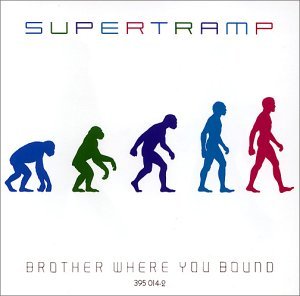
Starting from the elegantly minimalistic cover, depicting the stages of man’s evolution in five different colours on a pristine white background, Brother Where You Bound simply oozes class. Supertramp always had the uncanny knack of marrying catchy hooks with interesting, thought-provoking lyrics, and this album is no exception. Rick Davies, left alone to cope with vocal duties, unleashes a performance that is nothing short of awesome, especially on the album’s pièce de resistance, the 16-minute title-track. Add a couple of prestigious guest musicians to the mix, and you have a near-masterpiece on your hands.

In the best tradition of a band known for strong opening tracks, “Cannonball” does not disappoint the listener. Backed by a steady, almost danceable beat, and introduced by Davies’ scintillating piano, it is one of the vocalist/keyboardist’s many songs about a broken relationship, where you can positively hear the anger in his voice, belying the mock-cheerfulness of the sudden bursts of horns and the almost singalong coda. However, while the horn-heavy “Still in Love” seems to reprise the apparently carefree mood of Breakfast in America, on the whole the songs come across as definitely more somber and less accessible. Both the slow, understated “No Inbetween” (featuring great keyboards and sax) and the relentless “Better Days”, with its frantic pace and splendid flute solo, convey an aura of almost claustrophobic pessimism and disillusion

Interestingly, it is mainly Davies’ voice that makes Brother Where You Bound a markedly darker, less upbeat offering than Supertramp’s 1979 mega-hit, Breakfast in America.The title-track, in particular, is anything but an easy, radio-friendly listen, made up as it is of various parts interspersed by recorded voices, odd noises and sudden silences, underpinning the oppressive atmosphere conjured up by lyrics imbued with all the paranoia of the Cold War years. Davies’ stunning, highly dramatic vocal performance and David Gilmour’s trademark, crystal-clear guitar tones link all the pieces together to create what is possibly the band’s best epic. In comparison with such a wild, exhilarating ride, album closer “Every Open Door”, a slow, moody piece, is a tad anticlimactic, also on account of its decidedly more optimistic message.

If you only know Supertramp for the likes of “Dreamer” and “The Logical Song” (which is as perfect a pop song as they come), you will probably be inclined to dismiss them as little more than ‘prog-lite’ for those who hesitate to delve into the more demanding examples of the genre. Although it is true that the band possess a great feel for melody and memorable hooks, they are also outstanding musicians, and purveyors of above-average lyrics.  While they may represent the ‘easier’ side of prog, they do so with inimitable style and class, displaying songwriting skills that are far from average. Brother Where You Bound is a prime example of ‘crossover’  prog at its very best, and as such highly recommended to anyone but those prog fans who think that ‘pop’ is inevitably a bad word.

TRACKLISTING:
1. Simon Magus  (6:23)
2. Diamondized  (6:33)
3. The Night I Killed Steve Shelley  (9:07)
4. Royal Oil Can  (5:15)
5. Out of the Oceans  (7:17)
6. He is Like a Spider  (6:20)
7. Nuclear Density Gauge  (7:21)
8. Tumbleweeds  (4:09)
9. Astro  (11:30)

LINEUP:
Patrick McGowan – vocals, guitar
Dan McGowan – vocals, guitar
Kyle Minnick – drums
Becky Osenenko – bass

With:
Tom Brislin – keyboards

In 2008, New Jersey-based trio The Tea Club’s debut release made waves on the progressive rock scene, and sparked a lot of interest in this youthful new band. A completely self-produced effort, General Winter’s Secret Museum brimmed with freshness, enthusiasm and not inconsiderable chops. Moreover – most important in this age of manufactured, cookie-cutter musical outfits – it sounded original, not sporting its influences too openly. The Tea Club were at the forefront of the new generation of ‘crossover’ progressive rock bands, fuelled by the raw energy of post-punk and indie/alternative rock, with an eye to melody and another to complexity –  a power trio for the new millennium, with enough quirkiness and intricacy to appeal to the old-school set, and contemporary-sounding enough to make headway with the younger fans.

It is no wonder, therefore, that the release of Rabbit, the band’s sophomore effort, was eagerly awaited in prog circles. Due to their ideal location right in the middle of the ‘prog hub’ of the US Northeast (the main subject of the documentary film Romantic Warriors), they have been able to gain a loyal following, as well as the opportunity to increase their visibility by playing relatively frequent live shows. Unlike other bands of recent formation, they have never suffered from overhype, and still retain an endearingly down-to-earth attitude. On the other hand, Rabbit comes across as a clearly more ambitious project that its somewhat stripped-down predecessor. With the basic lineup augmented by bassist Becky Osenenko, longer track times (including a couple of almost epic-length numbers) and the unobtrusive but constant presence of the keyboards (manned by an experienced musician such as Tom Brislin, known for his associations with the likes of Yes and Renaissance), the albums marks a shift away from General Winter’s… immediate, hard-rocking impact into more nuanced modern prog territories.

This time around,The Tea Club are a tad less restrained about letting their sources of inspiration show – though this does by no means spell derivativeness. The band occasionally sound like a toned-down version of The Mars Volta, an impression compounded by the McGowan brothers’ high-pitched vocals – even though they go for a distinctly more melodic approach than Cedric Bixler-Zavala’s occasionally abrasive tones. There actually are some numbers that bring to mind the generally low-key mood of Octahedron, the Volta’s latest release. The first two songs, “Simon Magus” and “Diamondized”, are both sophisticated, well-constructed numbers, the former with a more dramatic edge, the second relying on atmosphere rather than power. Indeed, Rabbit’s most remarkable distinguishing feature is its slower pacing, seemingly light years removed from General Winter’s… exhilarating urgency. Its reflective, somewhat attenuated mood cannot but bring to mind  the haunting atmospheres created by bands like Radiohead and The Pineapple Thief. A song like the 9-minute “The Night I Killed Steve Shelley” (one of the undisputed highlights of the album) seems to bring together the two strains of the band’s creative impulse, alternating understated, almost meditative, moments with bursts of intensity driven by fat bass chords, eerie keyboard effecs and high-energy riffing.

True to their new direction, The Tea Club also throw a couple of slow-burners into the mix – namely the muted, mesmerizing “Royal Oil Can”, with its solemn drumming and tinkling guitars, and the gentle, percussion-less “Tumbleweeds”, reminiscent of Radiohead circa OK Computer. While the closing epic “Astro”, in my view, is not a completely successful endeavour, reproducing in some way the stop-start structure of “…Steve Shelley” (though featuring a nice instrumental section with one of the rare guitar solos on the album, as well as assertive keyboard touches and commanding vocals), Rabbit’s real highlight lies in the powerful “Nuclear Density Gauge”, a kind of mellower yet subtly menacing version of a Mars Volta number spiced by jagged drum patterns, neat bass lines and haunting vocal exchanges.

Although I suspect Rabbit is one of those albums that will slowly but relentlessly grow on me, I also have to admit that, at least on the first couple of listens, it did not grip me in the same way as General Winter’ Secret Museum. As a whole, the album seems to lack the ‘peaks and valleys’ that made its predecessor such a compelling effort, and sometimes the tracks seem to blur into each other. I also found the ubiquitous vocalizing a tad off-putting, as if it deprived the music of some much-needed energy. Personally speaking, I would be glad to see The Tea Club adopt a more ‘back to basics’ approach for their next release, recapturing some of the edginess and vitality of their debut and blending it with their newfound sophistication. However, in spite of these shortcomings, Rabbit is undeniably a lovingly-crafted effort from a band that oozes potential. With a striking cover in gorgeous hues of blue and green (courtesy of  Kendra DeSimone), the McGowan brothers’ own quirky artwork gracing the booklet, and intriguing, thought-provoking lyrics, it offers a complete package in the finest progressive rock tradition.

Links:
http://www.theteaclub.net

One of the biggest advantages of living in an otherwise crowded, ‘pressure-cooker’ area such as the US Northeast is the staggering variety of music on offer. With an impressive choice of venues of every size and description, as well as a thriving underground scene, the region has become one of the most important hubs for progressive rock, as illustrated by the documentary film Romantic Warriors (reviewed elsewhere on this blog). While gigs are organized more or less throughout the year, things are definitely quieter in the colder months (mainly because of the unavailability of the outdoor venues) – while the summer months offer such a wide range of gigs that fans are obliged to pick and choose, unless they have a unlimited supply of time and cash.

2009 was my first full year in the USA, so Michael, my husband, and I were finally able to start sampling the musical delights offered by our area. Our season included our first participation to NEARfest, four visits to the quaintly bucolic Merriweather Post Pavilion (the last one particularly poignant in retrospect, being the last time that we saw the great Ronnie James Dio on stage before his untimely passing), as well as what has now gone down in the annals of concert history as ‘the monsoon on the Potomac’ – the ill-fated Asia/Yes gig at the National Harbor. At the time, I had just started my reviewing tenure with ProgressoR, and as such was very much a ‘newbie’ of the whole scene. This year, though, was quite a different story…

With my review count growing and my reputation as a reviewer spreading around the prog fandom (helped by the reactivation of my Facebook account), I made friends among musicians, built an increasing network of contacts, slowly but steadily became part of the scene. For a basically shy person as I am, this made me feel much less self-conscious when attending gigs and festivals, and boosted my enjoyment of those functions. While I am very human and enjoy the attention generated by my reviews, I also feel I am helping those who need it the most – the artists – by covering their work and encouraging their efforts.

This year, our season of music was fittingly inaugurated at the very end of May, on Memorial Day weekend (which here in the US marks the beginning of the summer season), with the annual concert organized by the DC Society of Art Rock at the Jammin’ Java. We were already familiar with the venue, as we had seen Eddie Jobson and his band play there last year. A small, friendly coffeehouse, notorious for the ear-shattering volume of its gigs, this year it hosted two local bands, Brave and Ephemeral Sun, plus one of our favourite new acts – New Jersey’s very own 3rd Degree. Though all three bands put up excellent performances, 3rd Degree were our personal highlight of the evening – an extremely tight outfit very much in the vein of vintage Steely Dan, fronted by the amazing talents of vocalist/keyboardist George Dobbs and bassist Robert James Pashman.

A couple of weeks later, it was the turn of two legendary bands such as Jethro Tull and Procol Harum, in the beautiful setting of the Wolf Trap Foundation – a striking wooden pavilion surrounded by deep woods, and the only National Park in the USA dedicated to the performing arts. While Ian Anderson may have lost most of his vocal power, he and his crew are still mightily entertaining to watch, and their back catalogue has very few equals in the rock word. However, the real surprise of the evening were Procol Harum. Unlike Anderson’s, Gary Brooker’s inimitable voice is still in pristine shape, and they wowed the audience with a mix of older and newer material, including the goosebump-inducing “A Salty Dog” and the much-awaited “A Whiter Shade of Pale”.

Our second time at NEARfest, which took place on the third weekend of June, is documented in the lengthy account I wrote for ProgressoR when I was still on board. Since all my articles for said website are covered by copyright, I will post a link to it at the end of this piece. Two days after our return from Pennsylvania, we were back at Wolf Trap for the Yes/Peter Frampton double bill – another great concert from two historic acts, though this time marred by the stiflingly humid heat. After last year’s monsoon, which had literally driven Yes off stage, we had bought tickets for their February concert at the Warner Theatre in DC. It was not, however, meant to be, since the event was first rescheduled because of the heavy snowfall; then – on the evening it was finally going to happen – Michael came home from work with a touch of the flu, so we kissed goodbye to our tickets, and patiently waited for the next opportunity to see the band. In spite of all you can say about the Jon Anderson-less Yes, they did not disappoint, and I was particularly excited by their performance of “Close to the Edge”, which I had never previously seen them play live.

After almost a month’s gap, on July 20 we headed to a venue we were not yet familiar with – the Jiffy Lube arena (formerly Nissan Pavilion) – to see another formidable double bill, firm favourites Iron Maiden with Dream Theater as openers. Unlike either Wolf Trap or the Merriweather Post Pavilion, Jiffy Lube is a largely unprepossessing space, located somewhat in the middle of nowhere and totally devoid of atmosphere. Though we were seated in the covered area, we managed to get relatively wet when a thunderstorm broke out (quite appropriately, seen the title of their latest release) just as Dream Theater took to the stage, and the wind drove the rain beneath the roof of the pavilion. While I found the New York band tolerable at best (their set was mercifully short!), Iron Maiden delivered in spades as usual. With three decades of activity under their belt, they are still one of the most energetic, entertaining live bands in the business, and I was thrilled with their choice to perform some of their more recent material alongside their undisputed classics.

Fast forward to the first weekend of September, and my first time at ProgDay – as described in detail in the review linked below. Barely two weeks of rest, so to speak, and the 2010 edition of the Sonic Circuits festival was upon us – with the organizers having pulled out all the stops by securing the participation of three major draws such as Magma, Univers Zéro and Miriodor, as well as veterans The Muffins and electronic pioneers Richard Pinhas and Merzbow. Though we had bought passes for the whole week, we were only able to attend the opening and closing shows, both held in the gorgeous premises of the Maison Française, the cultural centre of the French Embassy in DC. The marathon-like opening event culminated with a simply incredible performance by Zeuhl legends Magma, a band every self-respecting progressive rock fan should experience at least once. A week later, the festival was closed in style by the utterly stunning musicianship and compositional mastery of Miriodor and Univers Zéro – a once-in-a-lifetime double bill.

Our season of music came to a close last Saturday, with our first-ever visit to the Orion Studios in Baltimore to see Italian band The Watch (who were performing Genesis’ iconic Foxtrot album in its entirety) supported by Shadow Circus – one of the Northeast’s finest new bands, and very good friends of ours. The Orion is indeed one of those places that seem to have come out of a bygone era – a warehouse in a suburban area of Baltimore converted into a temple of progressive music, somewhat small and cramped, but brimming with character and a ‘family’ atmosphere of sorts, with people bringing their own chairs, drinks and food. Unfortunately, tiredness prevented us from attending the whole of The Watch’s performance, though we managed to enjoy all of Shadow Circus’ set. Those guys are going from strength to strength, and will hopefully soon reap the rewards of all their hard work.

In the coming months there will probably be other concerts for us to attend in the area, though not with the same frequency. At any rate, we already have some gigs lined up for next spring, and will also try to attend all three of the big festivals organized on the East Coast. Until then, I will continue to support up-and-coming bands with my reviews and feedback. Watch this space!

Links:

NEARfest 2010 review (http://www.progressor.net/nearfest2010.html)
ProgDay 2010 review (http://www.progressor.net/progday2010.html)

TRACKLISTING:
1. Leslie Anne Levine    (4:12)
2. Here I Dreamt I Was an Architect (4:31)
3. July, July! (2:51)
4. A Cautionary Song  (3:08)
5. Odalisque (5:20)
6. Cocoon (6:48)
7. Grace Cathedral Hill  (4:28)
8. The Legionnaire’s Lament  (4:44)
9. Clementine (4:07)
10.California One / Youth and Beauty Brigade  (9:50)

LINEUP:
Colin Meloy – lead vocals, guitars, percussion
Chris Funk – guitars, pedal steel, theremin
Jenny Conlee – Hammond organ, Rhodes piano, regular piano, accordion
Nate Query –  upright bass
Ezra Holbrook – drums, percussion, backing vocals

Many of those people who (sometimes in spite of themselves) were won over by The Decemberists’ award-winning 2009 release, the sumptuous rock opera The Hazards of Love, will certainly have felt the impulse to delve into the Portland band’s back catalogue, and thus come across their debut, Castaways and Cutouts. Though the specialized press has often placed the band under the ‘progressive rock’ umbrella (as  was definitely the case with the first article I read about them,  in the autumn of 2006), true-blue prog fans are sharply divided about this issue. While the more conservative set often refuse to acknowledge anything not sounding like the Seventies bands, the more open-minded fans have equally often embraced the band as a firm favourite.

As is the case of all Decemberists releases but The Hazards of Love (and possibly their 2004 EP, The Tain),  Castaways and Cutouts is an effort that can only in part be called progressive. In fact, a good proportion of the songs follow in the footsteps of  the great American folk tradition, influenced by its European counterpart, yet at the same time noticeably different.  It is nevertheless an album that prog fans can definitely find appealing (unless they are of a seriously close-minded disposition), and even features a couple of tracks that might be tagged as ‘epics’. Based on a series of vignettes often focused on the plight of the less fortunate members of society (as the title implies), handled in terms that range from the downright grotesque to the deeply compassionate, the album undeniably possesses a powerful lyrical impact – which has become a constant of the band’s output, making very effective use of Colin Meloy’s fertile, erudite imagination and remarkable skill as a wordsmith.

Meloy’s stories, deeply rooted in the folklore of both the Old and the New World, are not meant to leave the listener cold, even resorting to shock tactics in their stark description of seedy milieus and events. Indeed, some of the situations depicted on  Castaways and Cutouts are not for the faint-hearted, even without resorting to excessively graphic detail. Luckily, not all is not doom and gloom on this album. Meloy approaches his subject matter, no matter how sordid or depressing, from a perspective of poetic realism, presenting the events with a compassionate stance, avoiding the almost masochistic wallowing in misery that, for instance, seems to be almost the rule for progressive metal bands. His voice, with its somewhat nasal twang and precise enunciation, may be an acquired taste for some, but is also quite perfect for the sort of storytelling displayed on the album.

I have always been impressed by The Decemberists’ ability to produce memorable opening tracks – in my view, one of the real strengths of a band in compositional terms – and “Leslie Ann Levine” is no exception. A hard-hitting account of suicide and stillbirth, told from the point of view of a dead baby, it is the follow-up to “We All Go Down Together” (featured on  Picaresque, the band’s third studio release), which, however, does not pack the same punch, either musically or lyrically. While its folksy, accordion-driven tune, with its vague French flavour, is only mildly wistful, the lyrics drip with sadness and regret. Some of the songs are straight-up acoustic folk numbers, where the music seems to take a back seat, and as such might appear too ‘simple’ to those craving the complexity (whether authentic or fake) of ‘mainstream’ progressive rock. The profoundly disturbing, dirge-like “A Cautionary Song” (a tale of prostitution motivated by abject poverty), and the wistfully romantic love songs  “Grace Cathedral Hill” and “Clementine” belong to this group, where the minimalistic musical accompaniment allows the narrative component to emerge, driven along by Meloy’s plaintive, nostalgia-filled vocal style.

On the other hand, the upbeat “July! July!”, whose deceptively optimistic mood conceals another disquieting tale of violent death, and the haunting dreamscapes of “I Dreamed I Was an Architect” display a catchier, more listener-friendly approach, with memorable choruses and a richer instrumental background. The aptly-titled “Cocoon”, a dreamy, almost slow-motion number inspired by the science fiction of the late Kurt Vonnegut, feels almost reassuring in the midst of so much turmoil; while “The Legionnaire’s Lament” is an infectious divertissement sporting some of the wackiest rhymes this side of Lewis Carroll. That leaves the two aforementioned epics, though in terms of running time only album closer “California One/Youth and Beauty Brigade” might be described as such. However, the mesmerizing, Hammond-drenched strains of “Odalisque” – another pitch-black, convoluted tale of sexual perversion, rape and (probably) infanticide – are such a towering achievement as to give the impression of a much longer song. “California One”, on the other hand, celebrates the beauty of nature and youth with a deep vein of nostalgia for a bygone past – its almost 11 minutes, driven by piano, pedal-steel guitar and touches of theremin, evoking a distinct Sixties West Coast feel.

An outstanding debut album, lavishly packaged in a booklet graced by the quirky illustrations of Carson Ellis (Colin Meloy’s then-girlfriend, now his wife, and a professional graphic artist), Castaways and Cutouts is highly recommended to those who are constantly seeking for both lyrical challenges and music that manages to be catchy and thought-provoking at the same time. Though here they will not find the myriad complexities and head-spinning changes of canonical progressive rock, open-minded (and curious) prog fans could do much worse than get acquainted with the wild and wonderful world of Colin Meloy and The Decemberists.

Links:
http://www.decemberists.com

TRACKLISTING:
1. Lake of Fire (4:22)
2. Money Speaks (4:40)
3. You’ll Just Have to See It to Believe (5:22)
4. Stars of Sayulita (6:12)
5. Warning (4:20)
6. What Have They Done to the Rain (4:56)
7. Abandoned Mines (5:45)
8. Suicide Train (4:23)
9. Telstar (3:55)
10. Dateless Oblivion & Divine Repose (1:54)

Bonus tracks:
11. Abandoned Mines – Forest Fang Remix (8:26)
12. You’ll Just Have to See It to Believe – Alternate Mix (5:48)
13. Lake of Fire – Evan Schiller Remix (4:21)

LINEUP:
Barry Cleveland – electric & acoustic guitar, electric & acoustic 12-string guitar, Moog guitar, GuitarViol, sampled percussion, sampled Mellotron, voice (8), bass (8)
Robert Powell – pedal-steel guitar (1-5, 7, 9, 11-13), lap-steel guitar (4)
Michael Manring – bass (1-9, 11-13)
Celso Alberti – drums, percussion (1-4, 6-9, 11-13)
Amy X Neuburg – vocals (1, 2, 6, 9, 10 & 13).

With:
Harry Manx – vocals (4)
Deborah Holland – vocals (4)
Artist General – voice (5)
Erdem Helvacioglu – acoustic-electric guitar, electronics (3,13)
Rick Walker – chain-link drums, teapot (5), congas (4), dumbec (7)
Gino Robair – dumbec, kendang (6)

As anticipated in my previous post, here is my third review in a row of an album released in 2010 by MoonJune Records – and, like its predecessors, definitely one of the top releases of the year. Hologramatron, the fifth album credited to the name of San Francisco-based guitarist, composer and journalist Barry Cleveland (currently Associate Editor for Guitar Player magazine), has recently been submitted for the Grammy Award as “Best Alternative Rock Album of 2010” – and deservedly so.  A labour of love, whose recording took several years to complete, Hologramatron (whose title, according to the artist himself, means ‘whatever you need it to mean’) is one of those rare musical efforts that manage to sound like very little else. With derivative acts a dime a dozen on the current music scene, listening to such an album can be an exhilarating experience. Although Barry Cleveland’s name may be the most prominent on the cover, unlike your average ‘solo pilot’ release this is very much a collective effort, in which the input of each member of the band is recognizable, yet at the same time meshes with the others to form an organic whole.

Unabashedly eclectic,  Hologramatron has been called a modern ‘protest album’, and with very good reason – though only part of the songs have an unmistakable socio-political bent. However, it is first and foremost a collection of inspired, thought-provoking compositions performed by a group of amazingly talented, experienced musicians who manage to come across as an extremely tight unit rather than a combination of over-inflated egos. While vocalist Amy X Neuburg (a classically-trained singer, and a truly serendipitous find for Cleveland) may be relatively unknown outside dedicated avant-garde circles – in spite of an impressive curriculum as a composer and ‘avant-cabaret’ artist – the name of bassist Michael Manring is nothing short of legendary among four-string fans, and both drummer Celso Alberti and pedal-steel guitarist Robert Powell can claim a number of prestigious affiliations. When such collective talent is gathered together, the results may often be a tad underwhelming – especially when musicians forget that they are at the service of the music, and not the other way round.

Thankfully, this is not the case with Hologramatron. The impressive cohesion between all the artists involved, band members and guests, results in 10 tracks that display a remarkably original approach, even when external influences can be detected . While listening to the album for the first time, the closest comparison that came into my mind was with the late ‘90s – early 2000’s incarnation of King Crimson – and Robert Fripp is undoubtedly one of Barry Cleveland’s most noticeable sources of inspiration. In contrast with the majority of prog albums released in the past year or so, Hologramatron is based on relatively short compositions, none longer than 6 minutes –  and, indeed, half of the tracks are songs with a more or less ‘conventional’ verse-chorus-verse structure. The album might even be seen as a lesson on how to produce music that does not rely on 30-minute epics or convoluted concept stories in order to be progressive.

As I previously pointed out, eclecticism is the name of the game, with the hard-hitting earnestness of tracks like “Lake of Fire” or “Money Speaks” relieved by the inclusion of two covers of Sixties hit songs (which, in my personal view, do not really fit too well with the rest of the album), or the gentle yet emotional content of “Stars of Sayulita”. The psychedelic-meets-ambient component of Cleveland’s creativity (which was brilliantly showcased in the band’s live performance at ProgDay 2010) is here represented by the instrumental tracks, namely “You’ll Just Have to See It to Believe It” and “Abandoned Mines” – where Cleveland’s array of traditional and electronic guitars, effectively supported by Robert Powell’s pedal-steel guitar, Manring’s stellar bass and understated percussion patterns, weave subtly entrancing, multilayered textures.

On opener “Lake of Fire” (whose firebrand lyrics point a sharp finger at Christian fundamentalism),  Amy X Neuburg adopts two sharply different singing styles in the verse and the chorus – soothing, almost seductive in the former, venomously aggressive in the latter. The splendidly bass-driven “Money Talks” and the haunting “Stars of Sayulita”, graced by the warm, bluesy vocals of Harry Manx and Deborah Holland, follow a similar ‘mainstream’ pattern – as, obviously, do the two covers, “What Have They Done to the Rain” and “Telstar”, whose cheerful nature contrasts almost jarringly with the rest. Two of the tracks with vocals, however, diverge quite sharply: the ominous, electronics-laden avant-rap of the aptly-titled “Warning” (with vocals courtesy of long-time Cleveland collaborator Michael Masley, aka Artist General), and the tense “Suicide Train” (interpreted by Cleveland himself), an effort that borders on metal, featuring a beautiful, hypnotic guitar solo bolstered by crashing drums.

Running at around 64 minutes, Hologramatron is nowhere as cumbersome as many other current releases, though the three bonus tracks tagged at its end do not really add a lot (unless you happen to be a staunch completist) – with the possible exception of the remix of “Abandoned Mines” (nearly three minutes longer than the original), which possesses an eerily cinematic quality.  A masterful blend of mainstream sensibilities, socially-aware lyrics, intriguing atmospheres and stunning instrumental and vocal performances, this is a unique album that is warmly recommended to progressive music fans.

Links:
http://www.barrycleveland.com

TRACKLISTING:
…Rattlin’ All the Time
:
1. Tarabos  (5:10)
2. Chloe And The Pirates  (7:56)
3. All White  (6:24)
4. The Man Who Waved At Trains  (3:54)
5. As If  (4:14)
6. Hibou, Anemone And Bear  (3:28)
7. Out-Bloody-Rageous  (8:36)
8. Pig   (4:28)
9. Esther’s Nose Job   (6:04)
10. Slightly All the Time  (9:32)

…Before the Moon:
11. Leonardo’s E-Mail  (4:11)
12. Moonvision   (2:17)
13. Many Moons, Many Junes  (3:05)

…After the Moon:
14. Lunar Impression  (1:17)
15. Circular Lines In The Air  (2:46
16. Moon Geezers (to Elton and Hugh)  (3:27)

LINEUP:
Beppe Crovella – Mellotron, Wurlitzer E200 electric piano, Fender Rhodes Stage 73 electric piano, Hammond organ M102, Hohner electric piano, Hohner Clavinet D6, Roesler Grand Piano, Farfisa Professional

This is meant as the second instalment in a trio of reviews of albums released by one of the most forward-thinking independent labels on the current music scene  – New York-based MoonJune Records. As a follow-up to View from Chicheng Precipice, here is another album that many listeners may very well see as nearly unapproachable, but whose authentically progressive nature can hardly be denied.

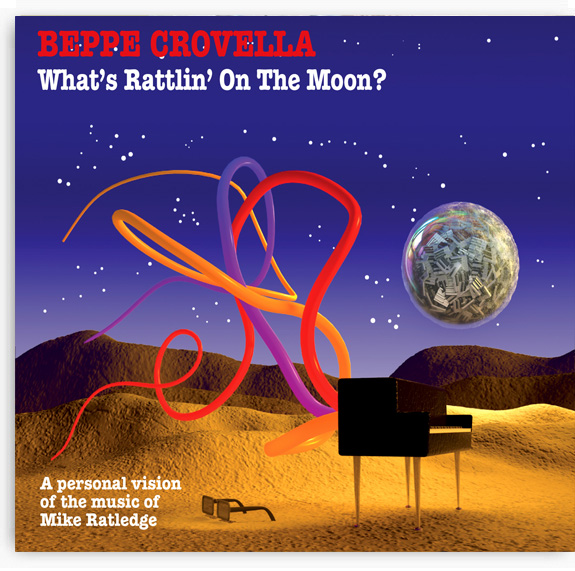
The subtitle to Beppe Crovella’s  What’s Rattlin’ on the Moon? reads “A Personal Vision of the Music of Mike Ratledge” – which alone should put paid to any allegations that this is yet another run-of-the-mill tribute album. An extraordinary musician in his own right, with an impressive career both as a solo artist and the mind behind Italian jazz-rock outfit Arti e Mestieri, Crovella is clearly not interested in faithfully reproducing music that is available elsewhere – but rather in offering his own reinterpretation of some of the legendary Soft Machine keyboardist’s ground-breaking compositions. The result of this daring, enlightened operation (conceived by Crovella and MoonJune Records mainman Leonardo Pavkovic) is a disc that, while anything but easy to approach, and obviously possessing very limited mass appeal, is a fascinating listen, especially for anyone with a keen interest in vintage keyboards.

Since the music of Soft Machine is undeniably an acquired taste in itself, commanding an almost fanatical adoration on the part of its fans, and an equally strong rejection on the part of ‘unbelievers’, an album offering an apparently one-dimensional take on said music is very likely to send a lot of people running for the exits. First of all, it requires quite a bit of patience on the part of the listener, even from those who should be used to the less than easily digestible nature of most progressive rock. Moreover, the distinct lack of the ‘rock’ part of the genre definition can prove a turn off – and the sheer length of the project (close to 80 minutes) is not likely to help sceptics warm to it.  However, those who will stick with the album and give it the attention it deserves will reap their rewards, because  What’s Rattlin’ on the Moon? offers many moments of real interest, and some of sheer delight.

A master of his craft, Crovella recreates the sound of an entire band with his array of vintage keyboards – ruling out the use of those synthesizers and their ilk that have become so indispensable in modern music-making. It is often astonishing to hear those keyboards fulfil the role of the bass or drums, though in most cases they just weave layers of sound in the Softs’ typically free-form style. As the album is divided into three recognizable parts,  the pauses between the individual numbers are almost non-existent – as if each part was meant to be listened to as a single track. This makes for a very distinctive listening experience, the polar opposite of a conventional song-based approach – though equally far removed from the somewhat sterile displays of technical dexterity that are often an integral part of ‘prog’ recordings.

The ten Soft Machine compositions are reinterpreted in such a way as to be nearly unrecognizable. This is especially the case of the two tracks from the band’s iconic Third album, “Out-Bloody-Rageous” and “Slightly All the Time”, the latter being possibly the highlight of the disc with its hypnotic yet melodic line and fascinating use of the Mellotron to provide choral effects. All the compositions share the same rarefied, riveting texture, which is intended to be savoured slowly, possibly not in one take. At every successive listen, different effects will unfold – pulsating,  surging, solemn, sometimes flowing, sometimes choppy, creating subtly shifting layers of sound. It is the kind of music that will fade in the background if left unattended, so to speak – meant to be listened to, not just heard.

The two mini-suites at the end of the album are original Crovella compositions intended, in some ways, to ‘describe’ the creative process behind the album. Both are largely piano-based and less idiosyncratic than the first part of the disc, with a stronger melodic development and some jazzy touches. “Moon Geezers”, dedicated to the sadly deceased former Soft Machine members Elton Dean and Hugh Hopper, closes the album on a suitably measured, melancholy note.

As already intimated, What’s Rattlin’ on the Moon? is not an album that will appeal to everyone, especially not those with short attention spans. It does, however, stand head and shoulders above the many hackneyed tribute albums that flood the progressive rock market. Experimental and very personal (even if a tad overlong), this is a must-listen for Soft Machine fans, and highly recommended to lovers of genuinely personal takes on prog classics.

Links:
http://www.beppecrovella.com/

TRACKLISTING:
1. Three Views From Chicheng Precipice (after Bai Yuyi) (9:52)
2. Tangabata (15:52)
3. Kan Hai De Re Zi  (Days by the Sea) (3:44)
4. Aviariations on “A Hundred Birds Serenade the Phoenix” (6:48)
5. Bagua  (Eight Trigrams) (10:41)

LINEUP:
Dennis Rea electric and resonator guitars, melodica, Naxi jaw harp, kalimba, dan bau (Vietnamese monochord)
Alicia Allenviolin (1, 3)
Greg Campbell drums, percussion (2)
Ruth Davidson cello (1, 3)
James DeJoie bass flute, bamboo flute, bass clarinet (2)
Caterina De Re voice (4)
Stuart Dempster trombone, conch shell (2)
Will Dowd – drums, percussion (1)
Elizabeth Falconer koto (5)
John Falconer shakuhachi (5)
Jay Jaskot drums (3)
Paul Kikuchi percussion (5)
Kevin Millard baliset (3)

In spite of China’s venerable musical tradition, very few people outside the ‘Asian studies’ circles are aware the authentic musical heritage of the Far East, unless it is in the most superficial of terms. Mentions of Chinese music might conjure, at least to the uninitiated, memories of the cheesy (when not downright ghastly) ‘sonic wallpaper’ that will accompany a meal in most Chinese restaurants of the Western world. However, I am happy to report that Views from Chicheng Precipice – the first recording effort solely credited to Seattle-based guitarist and composer Dennis Rea, a true veteran of the progressive music scene of the US Pacific Northwest – is light years removed from any such kitschy scenario.

Those who are familiar with Rea’s current main projects, the eclectic art-rock of Moraine and the improvisational jazz-rock of Iron Kim Style, will probably find themselves somewhat puzzled by this album – which, on the other hand, provides further proof of the guitarist’s broad horizons and dedication to the pursuit of creative musical avenues. While world music may be all the rage in a some circles, it is nevertheless not easy to find artists that approach the tradition of a country as distant (both literally and metaphorically) as China with such rigorously philological spirit as Rea manages to do – informed by his first-hand, in-depth knowledge of the musical and cultural background of both China and Taiwan, where he spent the years between 1989 and 1993.

Recorded between 2006 and 2008, Views from Chicheng Precipice sees the participation of members of both Moraine and Iron Kim Style, as well as other musicians from the Seattle scene, such as Japanese music specialists Elizabeth and John Falconer, and trombone master Stuart Dempster. Running at under 50 minutes, the album features five tracks presenting different facets of the Chinese musical heritage, seen through the eyes of a Western artist in a respectful yet uniquely personal way. Indeed, four out of five numbers (the sole exception being the title-track) are traditional compositions arranged by Rea so as to preserve their spirit even when reinterpreting their form.

Out of those five tracks, the East-West collision of “Days by the Sea” might almost be described as a pop song of sorts (also on account of its markedly shorter running time). Rea’s guitar weaves a tune that, while respectful to the original, incorporates elements of African-American blues, sparring with Alicia Allen’s violin in a stunning dialogue that brought to my mind Rea’s work with Moraine. The title-track, on the other hand, is built around three pentatonic motifs that comprise an original sonic triptych, with a recurring theme and plenty of scope left for improvisations. The composition was performed by Moraine during their performance at NEARfest 2010, though not many members of the audience were able to grasp its sheer elegance and grace in a live setting. Here the triptych comes across in all its understated power, the seamless flow of the music evoking the beauty of the titular mountain landscape (Qingcheng Mountain is the site of a Daoist sanctuary in China’s Sichuan Province). Rea’s guitar converses smoothly with Allen’s violin, while a drum-led improvisation adds a free-jazz touch to the central part of the composition.

The remaining three numbers are of a distinctly more challenging nature, since each of them develops in a fashion that is definitely less attuned to the Western ear. The 15-minute “Tangabata” and the 10-minute “Bagua” both have their roots in ceremonial music, as borne out by their stately, measured pace. The latter makes use of traditional Japanese instruments such as the koto and the shakuhachi (a bamboo flute), supported by solemn yet dramatic percussion work in the creation of a gently meditative mood. “Tangabata”, though a far from accessible piece, might be called the real highlight of the album. While featuring a distinctly Western-flavoured, free-jazz improv section at its very end, most of the composition remains faithful to its ancient origins – a sparse melody of austere beauty, almost suspended in time, made of deep, echoing sounds occasionally brightened by chiming bells. Finally, in “Aviariations on A Hundred Birds Serenade the Phoenix” (whose gently punning title reflects Rea’s ever-present sense of humour) the Chinese oboe traditionally used in the titular piece is replaced by Caterina De Re’s piercing vocal acrobatics, mimicking birdsong in a performance that brings together contemporary Western academic music and Chinese opera. Rea plays guitar and kalimba, whose sounds almost merge with De Re’s impossibly high notes.

Miles away from any tawdrily commercial ‘world music’ recreations, Views from Chicheng Precipice is, as Rea himself puts it, a love letter to the country where he spent four years of his life, an experience that was essential for his development as a musician. A refined, understated listen, it is an album made of subtle contrasts of light and shade, and as such needs to be approached with respect and concentration. The music possesses the delicate, almost brittle beauty of Far Eastern art, in stark contrast with the ‘in-your-face’ nature of much that is fashionable in this day and age. Being such an unabashed labour of love, imbued with profound feelings towards the country and its culture, sets it head and shoulders above the many blatantly contrived releases flooding the current music market. Those who will find themselves intrigued by the album could do much worse than get hold of a copy of Dennis’ book Live at the Forbidden City, a thoroughly enjoyable, extremely well-written account of his years in China and Taiwan – and a perfect companion to this disc. A special mention is also deserved by the stunningly minimalistic cover artwork and detailed liner notes – a simple yet classy package for an album that everyone with an interest in world music should check out.

Link:
http://www.dennisrea.com

TRACK LIST:
STAGE:
1. Hipster Spinster  (6:06)
2. March To Orion  (5:11)
3. Mystic Jam  (7:28)
4. Market Square  (8:13)

STUDIO:
5. Hide & Seek  (3:58)
6. Jazzmin  (5:07)
7. Say What?  (3:38)
8. The Timekeeper  (2:53)
9. 28 Degrees  (4:34)
10. Neon Noodle  (4:17)

FILM:
11. Z’Hadum  (10:26)
12. Phantom Lair  (4:41)
13. Break A Leg  (4:03)
14. Christine’s Theme  (2:40)

LINEUP:
Vic Samalot – electric and acoustic guitar
Bobbi Holt – keyboards, 2nd guitar (10), percussion (5)
Jeffrey Scott – bass guitar
Ivan George – drums
Vince Broncaccio – drums (8, 10)
Phil Quidort – trumpet (4)

Sessions is the fifth album released by Cleveland-based outfit Rare Blend, founded by guitarist Vic Samalot and keyboardist Bobbi Holt in 1993. Celebrating their 17th year of activity in 2010, Rare Blend are indeed aptly named – a band that successfully blends jazz-fusion, traditional progressive rock and jam-band attitudes, coupled with a healthy dose of sterling musicianship and a genuine sense of enjoyment. A remarkably tight band, capable of tackling complex compositions and recording them in one take, they emphasize live performance rather than polished studio recording – as their long experience and affiliation with local festivals, supported by their obvious dedication to their music, allow them to take advantage of every opportunity to perform before an audience.

Sessions clearly proves that the band have come a long way since their debut as a duo, Cinefusion, released in 1995. Honed by years of regular gigging,  they have gradually moved from the generic ‘prog’ approach of that first release towards a fluid form of jazz-rock rooted in the golden years of the genre, though infused with a personal touch. Rare Blend are in the habit of recording everything they play, be it in the studio or on stage, which spells a remarkable confidence in their craft. Though never rehearsed, their music shows a kind of discipline does not so much stem from endless hours spent perfecting each and every one of their compositions, as from an easy familiarity with the demands of performance.

The first part of the album contains four tracks recorded live in various venues (including the legendary Orion Studios in Baltimore, recently featured in the documentary film Romantic Warriors). Opener “Hipster Spinster” blends fluid, vintage jazz-rock stylings with atmospheric keyboards à la Pink Floyd – an influence that also surfaces in the Middle Eastern-tinged “Mystic Jam”; while “March to Orion” is driven by Jeff Scott’s solid bass line (a constant of the album, like glue holding the fabric of the compositions together), underpinning Samalot’s ever-reliable guitar forays. “Market Square” (named after the place in Cleveland where the track was originally recorded) sees the impromptu participation of Phil Quidort on trumpet, adding a wistful note to a dynamic yet oddly mesmerizing number, and sparring with Samalot’s guitar over Scott’s pumping bass line.

The six studio tracks (recorded in one take during rehearsals) display more of the band’s trademark free-form, yet appealingly melodic approach, with a loose texture ensuring that every instrument gets the chance to shine. All the tracks are rather short (with the aptly-titled “Jazzmin” the longest at 5 minutes), the funky, uptempo “The Timekeeper” and “Say What?” nicely balanced by the atmospheric mood of “Neon Noodle”, enhanced by some beautiful interplay between electric and acoustic guitar.

The Film section features four compositions conceived as soundtracks to two famous silent movies of the 1920s. The album’s longest track, the strongly cinematic “Z’Hadum” (inspired by Fritz Lang’s iconic Metropolis),  is a suitably Gothic offering,with a peculiar structure broken down by frequent pauses that create a sense of palpable tension, its hypnotic pace providing an ideal backdrop for synth and guitar excursions. The three remaining numbers (inspired by the 1925 version of The Phantom of the Opera), all markedly shorter and veering towards classic  progressive rock territories, share a similarly ominous mood.

If I had to level some criticism at Sessions, it would be on account of its running time of almost 72 minutes. Though somehow justified by the album’s distinctive format, I still feel that some judicious editing would not have gone amiss. However, the album aims at offering as complete as possible a picture of Rare Blend’s varied output, and its three-part structure makes it easier to break it down into sections for listening purposes. In any case, Sessions is packed with energetic, brilliantly executed compositions that will definitely appeal to fans of jazz-rock/fusion, especially those who enjoy spontaneous, unscripted performances. It is also an excellent introduction to Rare Blend for those who are not yet familiar with the band.

Link:
http://www.rareblend.net