Feeds:
Posts
Comments

TRACK LIST:
1. Look! It’s Coming  7:45
2. Old World News  8:22
3. Truth Seeker  9:48
4. Belteshazzar’s Dream  8:10
5. Plowshares Into Swords  10:15
6. Locust Swarm  4:31

LINEUP:
J.R. Fernandez – keyboards, acoustic and electric guitars, bass guitar, lead vocals (2, 3, 5)
Anthony Davis – lead vocals (1, 5 – second verse), voice (4)
A.I. Fernandez – bass guitar (3)

With:
Scott Rockenfield – drums

Novus Rex is a project formed by the father/son duo J.R. and A.I. Fernandez. Now based in Denver, Colorado (USA), J.R. Fernandez was raised in the New York City metropolitan area during the Seventies, and his interest in keyboards began at an early age. Later, he brought to bear his formal education in electronics engineering and computer science in his musical activity, especially as regards the use of  Digital Audio Workstation (DAW) technology.

The title of Novus Rex’s debut album, as well as the idea behind it, was inspired by the Bible, in particular the books of the prophets Daniel, Isaiah and Joel (the album title is actually taken from the latter) – as well as by history and current events. As concept albums go,  Plowshares Into Swords is quite a rare occurrence, since, for the most part, it lets the music – rather than the words – do the talking. Though elaborate concepts do have a loyal following, other people (including myself) often find themselves put off by the excessive wordiness (when not outright preachy nature) of many of those efforts – where the music often seems to be pushed in the background in favour of the verbal message. Luckily, J.R. Fernandez’ priorities for his project’s debut release are very clear: indeed,  while four out of the six tracks that comprise Plowshares Into Swords have lyrics, these are short and to the point, and in no way detract from what is really the focus of the album – the musical content.

Rooted in vintage progressive rock, with touches of jazz-rock and electronica, Plowshares Into Swords revolves around Fernandez’s skill as a keyboardist. With both digital and analog keyboards thrown into the mix, the album sounds lush and warm, with an easy, natural flow that is often hard to achieve properly. The synthesizers never sound wheezing or piercing as it frequently happens in modern recordings, and the passages in which Fernandez lets rip on the Hammond organ can be positively stunning. The album’s organic feel is further enhanced by the contribution of Queensryche drummer Scott Rockenfield, which prevents the dreaded artificial effect caused by the all too common use of programmed drums.

The album’s press release mentions such influences as Pink Floyd, Vangelis and ELP – and, for once, this is not just throwing names around for the sake of it, since these three acts are clearly referenced in Novus Rex’s music. However, it would be unfair to label the album as overtly derivative, because Plowshares Into Swords reveals a genuinely personal imprint, even if steeped in the glorious tradition of the Seventies. Fernandez has listened to a lot of different music in his lifetime, which obviously informs his compositional approach. While his handling of keyboard duties does bring Keith Emerson to mind, he is definitely more restrained, and never indulges in over-the-top soloing. The rich layers of keyboards that feature so prominently on the album are at the service of the compositions rather than the other way around.

“Look! It’s Coming” opens the album in a dramatic, cinematic way, with spacey, multilayered keyboards and eerie sound effects, bringing to mind Vangelis, Mike Oldfield and Pink Floyd – the latter comparison reinforced by the Gilmourian echoes in the guitar solo. However, the distinctive vocal contribution of the late Anthony Davis (an experienced musician and good friend of Fernandez,  who also wrote the song’s lyrics) adds a touch of its own. Emerson’s influence surfaces most clearly in the following tracks, such as the intense “Old World News”, the imperious, almost martially-paced “Beltheshazzar’s Dream” (in my view the most successful number on the album), and the somewhat more low-key title-track. On the other hand, the heavy riffing and guitar-keyboard interplay in  “Truth Seeker” brings to mind vintage hard rock acts such as Blue Oyster Cult. The disc is closed by the relatively short, atmospheric instrumental “Locust Swarm”, where layers of keyboards weave a dance-like tune.

Running below 50 minutes, Plowshares Into Swords is a compact, well-rounded album that is both accessible and suitably complex. J.R. Fernandez proves that he can fuse disparate influences with his own inspiration, and come up with an album that, while not wildly innovative, manages to hit the progressive spot. Lovers of classic, keyboard-oriented prog will find a lot to interest them in this solid debut by a gifted musician and composer. This a disc that makes good use of both tradition and technological innovation, and is also a very pleasing, rewarding listen for everyone but the most snobbish of progressive rock fans.

Link:
http://www.novusrex.net

As I mentioned in my post of about two weeks ago,  I mean to give this blog a somewhat different function – not just a repository of reviews of  vintage albums, but mainly a showcase for new material.  The blog format will allow me to concentrate on the musical content of any album without having to worry about giving a rating – something that I have been increasingly feeling as a pointless constraint.

With my previous post –  the review of the Romantic Warriors documentary film – I have inaugurated my blog’s new trend. In the next few days I will start posting reviews of albums released in the past year or so, most of them exclusive to this site – which means my updates will be more frequent.  I know I have a small but loyal readership, and many musicians have appreciated the care and effort I put into the reviews I used to write for other sites. This is something I want to continue, though this time at my own pace, and in my own terms.

Produced and directed by José Zegarra Holder and Adele Schmidt
Produced by Zeitgeist Media LLC
Total time: 95 minutes

A clever pun on the title of the 1976 jazz-rock-meets-symphonic-prog album by Return To Forever, Romantic Warriors can claim to be the first documentary film that focuses not so much on the musical protagonists of the progressive rock scene, but rather on the people without whose loyalty and dedication the genre would have completely died out at the end of the Seventies, after its ‘glory days’ of critical and commercial success had waned. Born, almost by chance, from the professional and personal partnership between a dedicated prog fan (Peruvian-born José Zegarra Holder) and an award-winning filmmaker (German-born Adele Schmidt), the film is set on the East Coast of the USA, in a small yet thriving corner of a much wider scene. While neither of the authors is native to the US, their location right in the midst of things, in the Washington DC area (where their production company, Zeitgeist Media LLC, is also based) allows them an ideal vantage point as inside observers.

Divided into five main sections, the documentary mostly revolves around the three major prog festivals organized every year in the area under scrutiny (ROSfest, NEARfest and ProgDay) – as well as one of the main hubs for devotees of the genre, the near-legendary Orion Studios in Baltimore, Maryland. Besides a number of bands and artists from different milieus, both homegrown and international, some key figures of the scene provide the viewers with their invaluable, first-hand insight into the progressive rock phenomenon. Mike Potter, owner of Orion Studios, illustrates his activity on behalf of both local bands and acts coming from all over the globe – offering them not just a place to rehearse and perform, but also to spend the night; while Steve Feigenbaum, founder and owner of Cuneiform Records and the online music store Wayside Records, weighs in with his experience of running a niche enterprise, motivated by passion rather than any hope of substantial financial gain.

The acts featured in Romantic Warriors cover most of the bases of the current progressive rock scene – from the über-eclectic, avant-garde approach of Cheer-Accident to the orchestral, multilayered sound of Phideaux, from the sleek jazz-rock of DFA (whose magnificent “Baltasaurus” is used at the opening of the film) to Cabezas de Cera’s highly individual take on world music. The central section of the film pays homage to one of the seminal bands of the original movement, Gentle Giant,  both through the words of guitarist Gary Green, and some intriguing live footage dating back from1974 – which will not just appeal to the nostalgia-steeped brigade, but also to the younger fans who want to see what prog looked like in its heyday. The musicians interviewed range from established protagonists of the scene such as Roine Stolt to the extremely talented Dan Britton, the fresh-faced mastermind behind up-and-coming bands such as Deluge Grander and Birds and Buildings. Moreover, the documentary’s strong international bias (in keeping with the filmmakers’ personal history) sheds some light on how bands and artists originating from a wide range of geographical locations – from the US to Japan – share the same struggles and concerns, as well as the same musical vision.

As befits a true documentary, Romantic Warriors is not glamorous, nor does it aim to be. While  most of the people involved are middle-aged and average-looking (not tarted up to look their best  as they would be in most TV programmes), they are also very real people to whom music means much more than just a flavour-of-the-month pursuit. The film touches upon a number of hot-button issues, from the possibility (or lack thereof) for musicians to make a living from their craft (with wry yet good-natured commentary from The Muffins’ Paul Sears and the members of Cheer-Accident) to the more technical aspects of the music, such as instrumentation and recording. While the ground-breaking importance of the Internet is given due recognition, Internet discussion forums are mentioned all but shortly, in spite of the major role these virtual communities play in the diffusion of the genre. On the other hand, the extensive, tightly-knit underground network that allows prog to prosper in spite of lack of major financial support and/or widespread commercial success is given the proper emphasis, as is the community atmosphere of the major prog festivals. I particularly appreciated the (albeit brief) reference to the much-debated ‘women and prog’ question – the alleged lack of interest of women in the genre disproved by the contribution of people like radio DJ Debbie Sears.

Those who expect a music video with some occasional commentary are going to be inevitably disappointed, because Romantic Warriors is a bare-bones account of the scene, filmed on location in an almost cinema-verité style that completely rules out the presence of the two filmmakers: in fact, all the viewer can see is the people who answer their questions – musicians, fans, and everything in between.  The musical content, while undeniably important,  is mainly meant to reinforce the verbal message. While it all feels very natural and unstaged, it can also leave some viewers rather puzzled – especially those who, having had little or no previous exposure to the scene, may end up struggling to put labels on people and situations. The film does not really offer any detailed explanation of how the whole progressive rock movement originally came about – except when, in the first part of the documentary, geo-historical maps of the genre are briefly displayed. However, as a true documentary should do, it encourages the viewers to delve deeper into the topic, and explore both the music and the history on their own. I personally found this approach very enjoyable as well as effective, though I can understand how some people might instead find the filmmakers’ unadorned style a bit on the dry side. Another criticism that might be levelled at Romantic Warriors is that it seems to hover between ‘preaching to the converted’ (that is, taking it for granted that the audience will be aware of much of the information presented) to a more instructional bent,  targeted to newcomers to the genre rather than long-time followers.

Though released in the late spring of 2010, Romantic Warriors is only now starting to get the recognition it deserves outside the restricted community of prog fans. Its screening on the evening of September 10, 2010,  at the Mexican Cultural Centre in Washington DC, offered a prime opportunity to ‘prog virgins’ to get acquainted with the music. Indeed, the film whetted people’s curiosity, which led to some interesting questions being asked. The evening was wrapped up by Dan Britton and Mauricio Sotelo’s astonishing performance (respectively on piano and Chapman stick), which offered the audience a real-time taster of some of the distinctive features of prog – the technical brilliance, the flair for improvisation, the input of classical and world music in the creation of the progressive sound. Those who, before the screening, were unaware of the whole scene could not help being fascinated (as well as moved) by the variety of the musical offer, the colourful appearance of the crowds at the festivals, the everyday struggles of the artists, and the overall sense of dedication that could be gleaned from the documentary. The audience’s reaction should remind the often insular and cliquish ‘prog community’ that it is not a good idea to look down upon those who are not yet in the know. This attitude might very well stifle some people’s budding interest in the music – which, after all, beyond any pledges of allegiance to a common cause, is the only thing that really counts.

Links:
http://www.progdocs.com

http://www.zeitgeistmedia.tv

http://www.facebook.com/#!/pages/Romantic-Warriors-A-Progressive-Music-Saga/136452959730143

TRACKLISTING:
1. Sat in Your Lap (3:30)
2. There Goes a Tenner (3:26)
3. Pull Out the Pin (5:30)
4. Suspended in Gaffa (3:58)
5. Leave It Open (3:25)
6. The Dreaming (4:41)
7. Night of the Swallow (5:25)
8. All the Love (4:35)
9. Houdini (3:52)
10. Get Out of My House (5:30)

LINEUP:
Kate Bush – vocals, piano, keyboards, strings
Alan Murphy – electric guitar (5, 10)
Brian Bath – electric guitar (3)
Ian Bairnson – acoustic guitar (5, backing vocals (1)
Paddy Bush – mandolin, strings (4, ), bullroarer (6), backing vocals (1, 6, 10)
Liam O’Flynn – Uillean pipes, penny whistles (7)
Sean Keane – fiddle (7)
Donal Lunny – bouzouki (7)
Rolf Harris – digeridu (6)
Del Palmer – bass (2, 4, 7, 8), backing vocals (9)
Eberhard Weber – bass (9)
Jimmy Bain – bass (1, 5, 10)
Danny Thompson – bass (3)
Dave Lawson – synclavier (2, 4), string arrangement (9)
Geoff Downes – CMI trumpet section (1)
Bill Whelan – string arrangement (7)
Andrew Powell – string arrangement (9)
Preston Heyman – drums (1,  3,  5, 10)
Stuart Elliot –  drums (2, 4, 6, 7, 8, 9)
Esmail Sheikh – drum talk (10)
Gary Hurst –  backing vocals (1)
Stewart Arnold – backing vocals (1)
Dave Gilmour – backing vocals (3)
Gordon Farrell – backing vocals (9)
Paul Hardiman – backing vocals (10)
Gosfield Goers – crowd (6)
Percy Edwards -animals (6)
Richard Thornton – choirboy (8)

After a few weeks’ break, my blog is ready to resume is activity with another milestone release of the early Eighties – proving once again that the  much-maligned decade was not the wasteland for challenging music that many hardcore progressive rock fans purport it to be.

I have been a fan of Kate Bush for as long as I can remember.  Being a woman, I have been able to focus my appreciation of this multi-faceted, highly individual (and often imitated) artist  on her musical and lyrical output, without any considerations on her physical appearance clouding my judgment. A genuinely progressive artist (though seen by far too many people as little more than a purveyor of  intelligent art-pop),  known for her almost obsessive search for privacy and the infrequency of her releases (especially in the past two decades), Kate Bush has blazed a trail for a slew of women artists ranging from Tori Amos to P.J. Harvey – all of them very intriguing in their own way, though rarely as mesmerizing as  Kate can be.

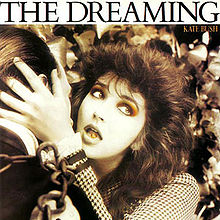
The Dreaming, Kate Bush’s fourth studio album, is generally considered inferior to its follow-up, Hounds of Love – especially by those who find it way too adventurous for its own good.  With multilayered vocals, an impressive, often exotic instrumentation, eerie sound effects, lyrics dealing with intense, occasionally disturbing topics, it is probably Kate’s most progressive album in the true sense of the word, and as such not to everyone’s taste. Indeed, The Dreaming may be effectively compared to her good friend Peter Gabriel’s ’80s releases, which share the pervasive presence of ethnic rhythms  and instruments (immediately introduced in opening track “Sat on Your Lap”), as well as topics like the plight of indigenous populations. The influence of  the so-called New Wave movement  is also quite evident in both Kate’s and Peter’s output of those years, especially as regards the use of electronics – though it is only one of the ingredients of an intensely personal mixture.

There is very little in the way of filler on The Dreaming, although, in my view, the lilting, lighter-hearted “There Goes a Tenner” and “Suspended in Gaffa” are not as successful as the other tracks. On the other hand, the album’s  highlights rank among Kate’s best work. The echoing, heavily percussive title-track is awash with the voices and sounds of the Australian outback; while the achingly beautiful “Houdini” (to which the cover picture refers) sees one of Kate’s most poignant vocal performances, enhanced by plaintive strings and sparse piano.  Kate also explores her Celtic roots with the gentle ballad “Night of the Swallow”, laced with the distinctive sounds of the Uillean pipes and fiddle. However, the album features a true masterpiece in the haunting “Pull Out the Pin”:  with Pink Floyd’s legendary guitarist David Gilmour eerily emoting on backing vocals, the song focuses on the Vietnam war seen from the point of view of a Vietcong: “Just one thing in it, me or him/And I love life…” The lyrics starkly reflect on the absurdity of war, bearing once again witness to Kate’s deep insight into human nature.

The Dreaming is arguably not as easy to get into as either its predecessor, Never For Ever, or the highly praised Hounds of Love. With markedly fewer instances of catchy melodies such as “Wuthering Heights” or “Babooshka” , and an overall experimental feel, it also relies quite heavily on innovative production techniques, which at the time many listeners found rather baffling . However, none of these factors mar the excellence of an album that, even more so than other Kate Bush releases, manages to be soothing and unsettling at the same time – a truly ground-breaking effort from one of the most iconic artists on the current music scene.

Interlude: Changes

Many things change in  people’s lives, some unexpectedly, others less so.  Last week saw the end of my collaboration with the website I had been writing for over the last 15 months – an event that, while unexpected, was not completely unforeseen. The amount of CDs I was expected to review on my own was so staggering that it could not be sustained any longer – hence a meltdown, and my return to the status of ‘free agent’.

I do not know how long this situation will last. Now I need to regroup, and devote my time (or at least part of it) to other things not related to music. This does not mean I will neglect my blog – on the contrary. Finally free from the obligation of having to crank out 10-12 reviews per month, I will be able to give this space an even more pleasing (not to mention useful) shape, including reviews of newer material along the ‘retro’ stuff I have been dealing with since the blog’s opening.

Thank you once again for visiting and supporting my little venture!

Tracklisting:
1. Elephant Talk (4:43)
2. Frame by Frame (5:09)
3. Matte Kudasai  (3:47)
4. Indiscipline  (4:33)
5. Thela Hun Ginjeet  (6:26)
6. The Sheltering Sky (8:22)
7. Discipline (5:13)

Lineup:
Adrian Belew – lead vocals, guitars
Robert Fripp – guitars, devices (Frippertronics)
Tony Levin – bass, Chapman stick, backing vocals
Bill Bruford – drums, percussion

After two posts dedicated to recent albums,  now it is time to go back almost thirty years – to the beginning of that decade that, in the eyes of many people, is synonymous with the ‘dark ages’ as far as progressive rock is concerned.  In the eyes of many, the Eighties marked the triumph of style over substance, and therefore offered very little of interest to anyone looking for authentically progressive music. Obviously, this is in many ways a misconception, because during those momentous ten years for the history of the world a lot of great music was  produced – even though it sounded different from anything released by the trailblazing acts of the early Seventies.

One of those bands, King Crimson (whose 1969 masterpiece, the legendary In the Court of the Crimson King, had reputedly marked the official birth of the progressive rock era), had been laid to rest by its mastermind Robert Fripp after the release of the monumental Red in 1974.  Very few people expected them to resurface at the beginning of the new decade, when prog had become all but a four-letter word – not just with the inevitable Fripp at the helm, but also drummer Bill Bruford on board, as well as two newcomers (though with already a sizable amount of experience behind them) – bassist Tony Levin with his Chapman stick, and guitarist/vocalist Adrian Belew.

For those who had known King Crimson during their Seventies glory days, the release of Discipline in 1981 was nothing short of a shock.  No mellotrons (or any keyboards for that matter), no majestic vocal performances, no visionary lyrics – just a rhythm section to die for, two gifted guitarists trying to outdo each other at every opportunity, an incredibly expressive vocalist with an endearingly lazy American twang, and oodles of intriguing ethnic influences – notably Javanese gamelan music.  On the other hand, it would not be correct to say that Discipline has no connection with  the Crims ’70s  output.  Indeed, in some ways it takes up where “Lark’s Tongue in Aspic” left off – there is more than a touch of Jamie Muir’s crazy percussive brilliance in Bruford’s performance on this album.

One very evident influence on  Discipline,  especially as regards the  tracks featuring vocals,  is celebrated New Wave band Talking Heads, easily one of the most ‘progressive’ (in the true sense of the word) representatives of the so-called post-punk era – and no wonder, seen as Adrian Belew collaborated for some time with the New York band before being invited by Fripp to join the new incarnation of King Crimson. Belew’s manic, emotionally charged vocal delivery is noticeably influenced by David Byrne’s, although in my view Belew is by far the better vocalist. Needless to say, his style is light years removed from Greg Lake’s smooth, quintessentially English tones, or John Wetton’s rawer yet powerful delivery: as much of an acquired taste as Belew’s vocals may be, they are a perfect fit for the music showcased on Discipline.

It must be pointed out, however, that the numbers which feature more or less traditional singing amount to just half of the album. The true strength of “Discipline” lies in its magnificent instrumental tracks: the tense electric storm of “Indiscipline”, slashed by almost violent guitar flurries, and featuring a slightly disturbing spoken-word section; the ambient-influenced, African-tinged mood piece of “The Sheltering Sky” (inspired, like The Police’s  “Tea in the Sahara”, by Paul Bowles’ novel of the same title), which provides a welcome respite from the overall intensity of the album; and the title-track, which rounds things off in style with Fripp and Belew’s dueling guitars weaving in and out of Bruford’s and Levin’s thunderous, intricate rhythmic background.

Of the tracks featuring vocals, the laid-back, atmospheric ballad “Matte Kudasai” (Japanese for “please wait”), an alternate version of which is provided as a bonus track in the 2004 edition of the album, is the closest the album gets to the mainstream.  Though it is not a bad song by any means, displaying Belew’s gentler side as a vocalist, it feels somewhat out of place among the other, more exciting and innovative tracks. Conversely, opener “Elephant Talk”, spiked by all sorts of weird noises (courtesy of Belew’s notorious “elephant guitar”), a real vocal tour de force, with Belew half-singing, half-reciting his whimsical lyrics, sets immediately the scene, making it clear what the new Crimson are all about.  In a similar vein are the dynamic, though not as frantic, “Frame by Frame”, and the funky, percussion-driven “Thela Hun Ginjeet” (anagram of “Heat in the Jungle”), in whose central section Belew relates his narrow escape from muggers in NYC.

King Crimson  have always been quite famous for their stunning cover art, and Discipline is no exception, though – almost paralleling the album’s musical content  – the cover is much more minimalistic and streamlined than such baroque masterpieces as ITCOTCK and “Lizard”. Incidentally, the background colour is that shade of dark red commonly known as crimson, framing a spectacularly intricate Celtic knot – deceptively simple, extremely stylish, just like the album it contains.  However, do not be mistaken into thinking that Discipline might be – in true Eighties fashion – a triumph of style over substance. Although it may not everyone’s cup of tea, it is one of the undisputed masterpieces of progressive rock, and an enormously influential effort – as pointed out by Edward Macan, who dedicated a whole chapter of his seminal book Rocking the Classics to King Crimson’s comeback album.

Tracklisting:
CD 1:
1. The Bruised Romantic Glee Club
2. Variations on a Theme by Holst
3. Catley’s Ashes
4. When Peggy Came Home
5. Highgate Hill
6. Forgiving
7. No One Left to Lie To
8. The Things We Throw Away
9. Doxy, Dali and Duchamp
10. Srebrenica
11. When We Go Home

CD 2:
1. As Long As He Lies Perfectly Still (incorporating: That Still and Perfect
Summer – Astral Projection in Pinner)
2. Pictures of an Indian City
3. Nirvana for Mice
4. Islands
5. The Citizen King
6. Soon After

Lineup:
Jakko M. Jakszyk – vocals, electric and acoustic guitar, keyboards, mellotron, bass guitar, balalaika, sitar, flute, strings, whistles, sound effects, percussion, programming
Gavin Harrison – drums
Mel Collins – alto and tenor saxes, flute
Dave Stewart – keyboards (CD 1 – 9, CD 2 – 1, 3, 5)
Robert Fripp – soundscapes, electric guitars (CD 1 – 6, 11)
Danny Thompson – double bass (CD 1 – 9, CD 2 – 4)
Mark King – bass guitar (CD 1 -3)
Nathan King – bass guitar (CD 1 – 5)
John Giblin – bass guitar (CD 1 – 6)
Lyndon Connah – piano (CD 1 – 8 )
Ian MacDonald – flute (CD 1 – 2)
Caroline Lavelle – cello (CD 1 – 2)
Helen Kaminga – viola (CD 1 – 2)
Clive Brooks – drums (CD 2 – 1)
Gary Barnacle – alto flute, flute, bass flute and piccolo, tenor and soprano saxes (CD 2 – 1)
Hugh Hopper – bass guitar (CD 1 – 1)
Pandit Dinesh – tabla, vocals (CD 2 – 2)
Ian Wallace – drums (CD 2 – 4)
Suzanne Barbieri – backing vocals (CD 1 – 11)
Django Jakszyk – voice (CD 1 – 11)
Camille Jakszyk – voice (CD 1 – 11)
Chris Baker – Irish priest (CD 1 – 4)

After my review of the groundbreaking yet controversial debut by The Mars Volta, here is another album released during the first decade of the 21st century – though a vastly different one. This is one of the hidden progressive rock gems of recent years, courtesy of a musician who, in spite of his decades-long career and impressive curriculum, is still nowhere close to becoming a household name. In fact, while Jakko M. Jakszyk is in his early fifties, and has shared a stage or a recording studio with many a revered protagonist of the prog scene, most of the bands he has played with over the years are of the positively obscure kind. Before he joined the 21st Schizoid Band in the role that was of Robert Fripp, Jakszyk had been little more than what in my native Italy we would term as an ‘illustrious unknown’, in spite of his short-lived tenure in a relatively high-profile band like Level 42.

Much like its author, “The Bruised Romantic Glee Club” (released in 2006 to a lot of critical acclaim, and become unavailable soon afterwards, due to the record label going under) enjoys cult status among prog fans, though not many people have been able to listen to it. I was lucky to find a copy (at an almost bargain price for a double album) in one of the music stores I used to visit regularly when I lived in Rome. And what a great purchase!  This is an  album that most dedicated prog listeners will appreciate, with all the trademark features of our favourite genre, plus a healthy dose of melody and accessibility. Fans of cover versions will also be absolutely delighted by the contents of CD2 – a splendid collection of classics by the likes of King Crimson, Soft Machine and Henry Cow, performed by some of the stalwarts of the original Canterbury scene.

Right from its cover, a gorgeous, muted snapshot of Jakko walking on Brighton beach at sunset, “The Bruised Romantic Glee Club” is a thoroughly classy package. Everything – the pictures, the detailed liner notes, the graphics, the music – is designed to appeal to listeners of sophisticated tastes, who look upon an album as a complete experience. I would not hesitate to call it a beautiful album in the true sense of the word – not only on account of the very accomplished nature of the music contained within, but also of the stories behind each of the songs.

From even a casual reading of the liner notes, Jakko comes across as a very sensitive, vulnerable human being, consequently bruised by life, but keeping up his optimistic side. Some of the stories attached to individual songs are very moving indeed, especially those related to his family. As many adopted children, he got to meet his real mother much later in life, not long before her untimely death. This part of his life story is the subject of the haunting, Celtic-tinged instrumental “When Peggy Came Home”, dedicated to the burial of his natural mother’s ashes in her birthplace in Ireland; while the following song, “Highgate Hill”, reminisces about Jakko’s own birth in a hospital in the titular area of northern London.

Musically speaking, the first CD features a number of songs and instrumental tracks performed by Jakszyk and a handful of high-profile guest musicians – namely Porcupine Tree drummer Gavin Harrison, Mel Collins, former Level 42 bassist Mark King (a well-respected four-stringer), double bass legend Danny Thompson, and even His Majesty Robert Fripp himself. Canterbury keyboard king Dave Stewart also performs on one track (“Doxy, Dali and Duchamp”), as well as on most of CD2. Comparisons to other bands or artists are anything but easy to draw – I have read one review comparing some of the songs on “The Bruised Romantic Glee Club” to David Sylvian’s output, and I find myself in agreement with such a remark. Though Jakko does not have Sylvian’s distinctive, world-weary voice, I find his vocals are the perfect foil for the album’s elegant, somewhat understated musical mood.

On the other hand, there is a distinctly jazzy feel running through the album. The marvellous “Catley’s Ashes”, driven by Mark King’s pneumatic bass, is richly laced with Mel Collins’ masterful saxophone; while the melancholy “The Things We Throw Away” features Jakko’s long-time friend and former bandmate Lydon Connah, and the majestic “Srebrenica” is based on the traditional music of Serbia. Infused with sadness and loss, the atmospheric, rarefied “When We Go Home” (dedicated to the artist’s adoptive mother, Camille) features Fripp on electric guitar, as well as Camille’s own recorded voice.

All the songs are of consistent high quality, with a particular mention for the title-track and the already mentioned “Highgate Hill”. Admittedly, they sometimes border on pop, though in an adult, well-rounded kind of way, and definitely not an overtly easy or commercial one.  Jakszyk also deserves kudos for his skills as a lyricist, something not precisely common in the prog world. While he lays his soul bare, he hardly ever descends into mawkishness, and occasionally injects some humour in the overall wistfulness of his musings.

There is not much that can be said about CD2, if not that it is quite magnificent. The quality of the  ‘raw material’ alone would guarantee excellent results, but what really makes these versions special is the obvious love lavished on them by both Jakko and his distinguished guests. It would be very hard for me to pick out a highlight, though the cover of Henry Cow’s “The Citizen King” is nothing short of stunning, capturing the blend of  wistful beauty and biting irony of the original to perfection. Jakszyk’s Oriental-tinged take on King Crimson’s “Pictures of a City”, featuring Indian percussionist Pandit Dinesh (another former collaborator of the artist), also wins points for inventiveness; while “Islands”, remarkably faithful to the original, fits  perfectly within the album’s stylishly melancholy atmosphere.

As previously pointed out, up  to a couple of years ago or so, “The Bruised Romantic Glee Club” was, to all intents and purposes, impossible to find.  Now it has been reissued, which is great news with anyone whose curiosity will be whetted by this review – as it can be easily counted as one of the best releases of the past decade, a progressive rock album that pays homage to a glorious past, and at the same time feels thoroughly modern. With its intimate, confessional quality, and lush, sophisticated music, it is highly recommended to most prog fans, especially those who appreciate beautiful melodies coupled with flawless instrumental performances.

Tracklisting:
1. Son et Lumiere (1:35)
2. Inertiatic ESP (4:24)
3. Roulette Dares (The Haunt of) (7:31)
4. Tira Me a las Arañas (1:29)
5. Drunkship of Lanterns (6:20)
6. Eriatarka (7:06)
7. Cicatriz ESP (12:29)
8. This Apparatus Must Be Unearthed (4:58)
9. Televators (6:19)
10. Take the Veil Cerpin Taxt (8:42)

Lineup:
Cedric Bixler-Zavala – vocals
Omar Rodriguez-Lopez – guitars
Juan Alderete – bass
Flea – bass
Jon Theodore – drums
Ikey Isaiah Owens – keyboards
Jeremy Michael Ward – sounds

After inaugurating my blog with a series of reviews of classic albums ranging from the late Sixties to the early Eighties, now it is time for me to tackle a modern classic – one of the albums that, in my view, define modern progressive rock, and one of the few really ground-breaking releases of the first decade of the new millennium. Like many masterpieces, it is a divisive effort, and the band itself – the brilliantly-named The Mars Volta, a bunch of extremely gifted musicians led by volcanic guitarist and composer Omar Rodriguez-Lopez – almost a textbook definition of the expression ‘an acquired taste’.  On the other hand, it is undeniable that the release of  De-Loused in the Comatorium set new standards for contemporary prog.

This album was not my first experience with The Mars Volta (TMV for short). On the strength of some very positive reviews, some months before I had bought Frances the Mute, which I immediately loved  in spite of its shortcomings. However, De-loused in the Comatorium, the Hispanic-American band’s first full-length recording, is quite a different story – one of those almost perfect debut albums that it is often impossible (or at least very difficult) for a band to top.

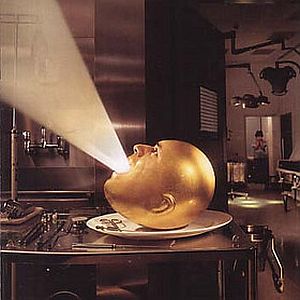
Hate them or love them, it is hard to deny that The Mars Volta are progressive in the true sense of the word. Born from the ashes of post-hardcore band At The Drive-in, they are not afraid to take elements from such disparate genres as prog, punk, metal, jazz and Latin music, and throw them together in a metaphorical blender, stamping their individual seal over the end result. The band’s display of dazzling musicianship, left-field lyrical concepts, stunning cover art (courtesy of legendary graphic artist Storm Thorgerson, better known for his work with Pink Floyd) and no-holds-barred songwriting are the hallmarks of a first-rate outfit that is ready to push prog – that stereotypically earnest, stuck-in-a-time-warp musical genre – right into the 21st century.

Most of the tracks on this album are over the 5-minute mark, with “Cicatriz Esp” clocking in at over 12 minutes. Both band mastermind Omar Rodriguez-Lopez and vocalist/lyricist Cedric Bixler-Zavala wanted to expand their horizons after leaving At the Drive-In, as shown by the clear influence of such giants of progressive rock as King Crimson and Rush. In time-honoured prog tradition, De-Loused… is also a concept album, relating the tale of Cerpin Taxt’s week-long, drug-induced coma and subsequent suicide (a story inspired by the death of former bandmate Julio Venegas).

Even if Omar and Cedric’s original punk roots rear their heads every now and then, they add a measure of spice to the exotic mixture that is TMV’s sound. The musicianship is first-rate throughout, with a special mention for inventive, powerful drummer Jon Theodore, whose rhythmic sparring partner is on this occasion a very special guest, Michael Balzary aka Flea of Red Hot Chilli Peppers fame (one of the best four-stringers on the market, even if you are not too keen on his mother band). The crisp, clear production values further enhance Theodore’s intricate, occasionally explosive drumming, as immediately shown by  killer opener  “Inertiatic ESP” (preceded by the deceptive quiet of “Son and Lumière).

In my personal opinion, though, the real strength of TMV lies in the supercharged vocals of Cedric Bixler-Zavala, whose banshee wail, interspersed with more reflective, almost lyrical moments, provided a textbook example of  really expressive singing. A richer, fuller version of Geddy Lee, he stamps his mark all over the album, perfectly complemented by his partner in crime  Omar Rodriguez Lopez’s wildly atmospheric guitar playing. Unlike on follow-up  Frances the Mute, here the band keep the use of weird, electronic noises to a minimum, with epic “Cicatriz ESP” ‘s middle section being a prime example of how such sounds can be used sparingly to their maximum effect.

With such an overall strong album, it would be difficult for me to pick any standout tracks, apart from those I have already mentioned. Haunting ballad “Televators” is a much better effort in this sense than “The Widow” on Frances the Mute; while “Eriatarka”, “This Apparatus Must Be Unearthed” and album closer “Take the Veil, Cerpin Taxt” brim with energy and freshness, Cedric’s manically brilliant vocals soaring above the band’s unleashed instrumental fury.

A brash, loud, yet sophisticated statement of intent, De-Loused in the Comatorium was clearly not conceived with mass appeal in mind – even if The Mars Volta have become a relatively successful act in their field. This is thoroughly modern progressive rock, and a must-listen for all serious devotees of the genre – weird and wonderful, and a really wild ride, but also one to enjoy to the fullest.

Interlude: ProgDay 2010

I apologize to my readers for having neglected my blog once again, but my ‘official’  reviewing job has kept me very busy, and then there have been some distractions – such as the wonderful event mentioned in the title of this post.

Last year (my first year in the USA) we had toyed with the idea of heading down to North Carolina for ProgDay, since one of our favourite new bands – New Jersey’s 3rd Degree – were on the bill, and the whole of the lineup was very interesting to say the least.  On the other hand, the heat and humidity often prevalent in the area at this time of year discouraged us. Neither of us is a hot weather person, and my husband (who used to live in that part of the country) had to cut short his participation to ProgDay 2006 because of heat exhaustion. However, this year our concerns proved to be unfounded, as the weather this past Labour Day weekend was nothing short of perfect – cool in the morning and evening, pleasantly breezy, and not at all humid – perfect for spending two days in a beautiful outdoor space ringed by lush woods, with grass as soft as a carpet.

I will present my impressions of the event in a more professional manner in the review I am writing for the ProgressoR website. This is just a taster for all of you who were there, and for those who are curious about the longest-running progressive rock festival in the world, but have never had the pleasure of attending it. Suffice it to say that we had a thoroughly wonderful time, feeling part of a small but stalwart community of people for whom music is much more than something to be consumed quickly like a Big Mac, or just left to run in the background when doing something else.

Besides the great music (this year’s lineup was way better than those offered by both the ‘big’ North-Eastern prog festivals), the highlight of the event was meeting so many great people, some of whom had been our ‘virtual’ friends for many months. On Saturday we spent a fantastic evening in the company of the Mars Hollow guys, who on the following day proceeded to rock the ‘house’ down with their perfectly honed blend of classic prog, catchy hooks and vocal harmonies to die for. Then, on Sunday morning we finally got to meet the Shadow Circus guys, who also put on one hell of a show.  We had been regularly in touch with John and David for a long time, and being finally able to talk to them in person felt wonderful, but it was also great to meet the band’s newer members, Felipe, Gino and Andy – all of them very nice guys, and excellent musicians. Their symphonic-meets-vintage hard rock take on prog is exhilarating and highly dramatic, and I cannot wait to see them in full stage regalia when they play on our home turf  (The Orion, Baltimore) on October 28th.

I was also looking forward to seeing Half Past Four in action – since I was one of the first people to be aware of them when they released their brilliant debut album, Rabbit in the Vestibule.  They did not disappoint one bit, and even exceeded expectations. Kyree is an astonishing frontwoman with a commanding, versatile voice, and drummer Ann Brody flies the flag for female musicians who rely on their chops rather than on their looks (though both her and Kyree are very attractive women).

Though the rest of the lineup was of equally high quality, I will save any further details for my ‘real’ review (which should be published before the end of September – watch this space and my Facebook page). This post is mainly intended as a more personal, less polished  account of a really intense weekend – one of those experiences to remember for a lifetime.

Links:
http://www.progressor.net/progday2010.html

Tracklisting:
1. Let There Be More Light (5:38)
2. Remember a Day (4:33)
3. Set the Controls for the Heart of the Sun (5:28)
4. Corporal Clegg (4:12)
5. A Saucerful of Secrets (11:57)
6. See-Saw (4:36)
7. Jugband Blues (2:59)

Lineup:
Syd Barrett – guitar, vocals
David Gilmour – guitar, vocals
Nick Mason – drums
Roger Waters – bass, vocals
Richard Wright – organ, piano, vocals

Needless to say,  Pink Floyd do not belong to the contingent of lower-profile or just plain obscure bands that are often featured in blogs like mine. On the contrary, their fame is such that, outside the restricted circles of progressive rock fans, they are considered as mainstream an act as the likes of Madonna or Michael Jackson. However, with A Saucerful of Secrets we are as far removed as possible from the stadium-filling phenomenon the band would become just a few years later. This a disc of whose existence most fans of the band’s best-selling albums are barely aware, and that gets unfairly overshadowed by the cult status achieved by The Piper at the Gates of Dawn.

Pink Floyd’s sophomore effort is undoubtedly an album that can polarize listeners’ opinions. Some see it as dated, or lacking in cohesion, since it was released at a turning point for the band, when Syd Barrett, who was slowly descending into mental illness, was being gradually replaced by his friend David Gilmour – which involved a significant shift in the band’s overall sound. In my personal opinion, though, it is one of the great unsung masterpieces of  progressive rock.

No mean feat for a band specialized in killer openers, A Saucerful of Secrets can boast of one of the strongest opening tracks ever committed to record.  “Let There Be More Light” is the archetypal psych/prog composition, with weird, mesmerizing, Eastern-influenced sound effects, and vocals alternating between chant-like whispers and shouts. Together with the album’s best-known song, the equally iconic and hypnotic “Set the Controls for the Heart of the Sun” (whose definitive version appears on the “Live at Pompeii” movie), the track was written by Roger Waters, who was well on his way to becoming the band’s true driving force. Those who maintain that Waters was a less gifted composer than Gilmour should probably take a careful listen to both songs.

The mood changes almost abruptly with the following number, the Richard Wright-penned “Remember a Day”. With soothing, wistful vocals that match the nostalgia-filled lyrics (which seem to foreshadow Wright’s untimely passing), it is a delicate, charming piece that is definitely easier on the ear in a musical sense. In a similar key, the lullaby-like “See Saw” (also written by the late keyboardist) is not, however, equally successful, and is, in my view, the weakest track on the album. On the other hand  “Corporal Clegg” and “Jugband Blues”  hark back to the whimsy of much of the Floyd’s debut album, with endearingly zany vocals, odd noises and ironic, nonsense-filled lyrics. “Jugband Blues”, which closes the album in stark contrast to the eerie soundscapes of the opener, can be seen as Barrett’s testament, and feels particularly poignant nowadays, four years after Syd’s demise.

An album’s title-track often acts as its focal point, and this is particularly true of the schizophrenic masterpiece that is “A Saucerful of Secrets”. Over 12 minutes long, the track is introduced by an uncontrolled chaos of weird noises and hypnotic percussive patterns, a sonic storm that suddenly abates to be replaced by a solemn, organ-driven section, featuring wordless singing somewhat suggestive of a church choir. In a way, the song reflects the nature of the album itself, and the circumstances in which it came into being.

For those who have come to know Pink Floyd through their milestone albums of the Seventies, this record may well turn out to be a disappointment, since it is in no way as accomplished, let alone as polished as regards production values. A Saucerful of Secrets is a child of the late Sixties – raw, experimental, slightly incoherent – and as such captures the essence of an era in which creativity and envelope-pushing were rife. It also captures Pink Floyd’s full potential just a few years before the quantum leap that would lead them to conquer the world. An essential listen, and – incidentally – my own favourite  release by the band.