Feeds:
Posts
Comments

Posts Tagged ‘Alan Freeman’

Krautrock 3

A documentary film by José Zegarra Holder and Adele Schmidt
Produced by Zeitgeist Media LLC
Featuring: Tangerine Dream, Klaus Schulze, Hans-Joachim Roedelius, A.R. & Machines, Agitation Free, Embryo, Nektar. Special appearance: Alan and Steve Freeman.
Total time: 122 min.

The third installment of Adele Schmidt and José Zegarra Holder’s labour of love on the German progressive music scene of the late 1960s and early 1970s comes almost exactly four years after its predecessor, Krautrock 2. The release – eagerly awaited by those who have been following Adele and José’s Romantic Warriors documentary series since its 2015 debut – was delayed by a combination of the aftermath of the COVID-19 pandemic and a seemingly intractable tangle of legal and other issues. Indeed, the absence of the music of some major bands and artists points to the difficulties encountered by the filmmakers in their endeavour.

Though for the most part dedicated to the Berlin scene – in particular the ground-breaking progressive electronic artists of the “Berlin school” – the film also includes a number of bands and solo artists from other German cities. In fact, the sizeable segment dedicated to the Berlin scene is bookended by sections dedicated to bands whose roots lie elsewhere, but which were included in this third episode because of their affinity with Berlin-based artists. This is the case of Achim Reichel and his project A.R. & Machines (from Hamburg), quintessential cult band Embryo (from Munich), and Anglo-American outfit Nektar, who also began their career in Hamburg.

Compared to the other films in the Krautrock trilogy, Krautrock 3 may come across as somewhat more technical. Indeed, the content of Krautrock 3 resembles its stunning cover, designed by the filmmakers’ daughter, Paloma Zegarra Schmidt, in elegant hues of orange and tan on a black background: somewhat austere yet intricate, with a complex intersection of musical and personal relationships unfolding over decades. This time around there are no expansive views of modern audiences enjoying a weekend of live music in some bucolic forested area. The camera does rarely linger on outdoor spaces (a notable exception being the section about Hans-Joachim Roedelius, Cluster and Harmonia), lending the film an intimate but overall slightly claustrophobic look.

The cover artwork clearly hints at the film’s main thrust – the development of progressive electronic music (often referred to as kosmische Musik, a term coined by Edgar Froese in the early 1970s) in West Berlin, a city whose unique characteristics provided fertile ground to all art forms. While in the 1920s Berlin had been a byword for vice and decadence as much as artistic creativity, in the late 1960s the western half of the divided city was a defiantly libertarian haven that not only allowed unlimited night life, but also offered shelter to draft dodgers. Interestingly, much of the commentary about Berlin – supported by extensive video recordings from that era – comes from the members of a non-Berlin band, the highly politicized Floh de Cologne (featured in the very first Krautrock film). Their recollections bring to life the city’s gritty vibrancy, embodied by the over-the-top antics of Ton Steine Scherben – a militant anarchist outfit originally from West Berlin.

The central part of the film is dominated by the two extensive sections about Tangerine Dream and Klaus Schulze – pioneers of electronic music whose influence has extended well beyond the borders of Germany. The story of Tangerine Dream unfolds through the recollections of guitarist Jerome Froese, Edgar Froese’s son, and keyboardist Johannes Schmoelling, who joined the band in the late 70s – tracing the evolution of the band from a Pink Floyd-inspired outfit to an award-winning, movie-soundtrack juggernaut. Somewhat oddly, though, Tangerine Dream’s decades-long story ends abruptly with Froese’s death in 2015: no mention whatsoever is made of the band’s current incarnation. Klaus Schulze’s traiblazing career and his major role in the development of modern electronic music are also illustrated through the words of some of his collaborators, in particular drummer Harald Grosskopf (formerly with Wallenstein and Ashra).

Purveyors of hypnotic, guitar- and organ-heavy music, Agitation Free create a link between two of the most distinctive musical components of the Krautrock scene – electronic experimentation and the influence of what is now termed “world music”. Though the fascination for India by seminal British rock artists is quite well-documented, Krautrock bands’ intimate contacts with the music of the Middle East, Africa, India and other parts of Asia come across as a more authentic, less trend-driven experience. European-style psychedelia and electronics and the centuries-old musical traditions of those far-flung, often hard to reach parts of the world are revealed to be almost uncannily compatible. In particular, Embryo – a band with its origins in jazz rather than rock – have based their whole career on the constant exploration of sounds outside Europe’s “comfort zone”, embarking on risky field trips as documented in the 1980 film Vagabunden Karawane.

The choice of ending the film (and thus the whole trilogy) with Nektar might appear slightly controversial, especially as the band – now led by the only remaining founding member, Derek “Mo” Moore – have long left their Krautrock roots behind, and embraced a more “mainstream” prog sound. However, it should be remembered that Krautrock (as well as early Pink Floyd) was a major influence on Nektar’s musical output before their split in the late 1970s.

As in the previous two instalments of the series, British brothers and supreme prog connoisseurs Alan and Steve Freeman (of Ultima Thule Records fame) provide plenty of invaluable background information. Markus Reuter – a native German known to many as a member of Tony Levin’s Stick Men – also expounds on his direct experience of the Berlin scene and the influence it had on his own musical journey.

In the six years elapsed between the release of the first Krautrock film and this final episode, many of the protagonists of the original scene have passed away – which adds a layer of poignancy to the trilogy. Two particularly moving moments In Krautrock 3 touch on the often complicated relationship between parents and children. Jerome Froese’s sadness while briefly relating his father’s illness and death lurks beneath his matter-of-fact tone, while Marja Burchard’s solicitous presence beside her father Christian, Embryo’s founder (who died in 2018), feels warm and reassuring. In any case, it is heartwarming to see some of Krautrock’s “elder statesmen” still very much engaged in music-making, introducing a whole new generation of listeners to the rich bounty of that unparalleled historical period.

All in all, Krautrock 3 provides a fitting conclusion to a truly monumental achievement, very far from being a mere nostalgia trip to please a small contingent of stalwart fans. It is to be hoped that this trilogy will raise awareness of the wide variety of progressive and experimental music coming from Germany in those intense years, and the different ways in which many modern artists were inspired by it.

Links:

http://www.progdocs.com

http://www.zeitgeistmedia.tv/

http://www.ultimathulerecords.com/main.html
http://www.ultimathulerecords.com/audion.html

Read Full Post »

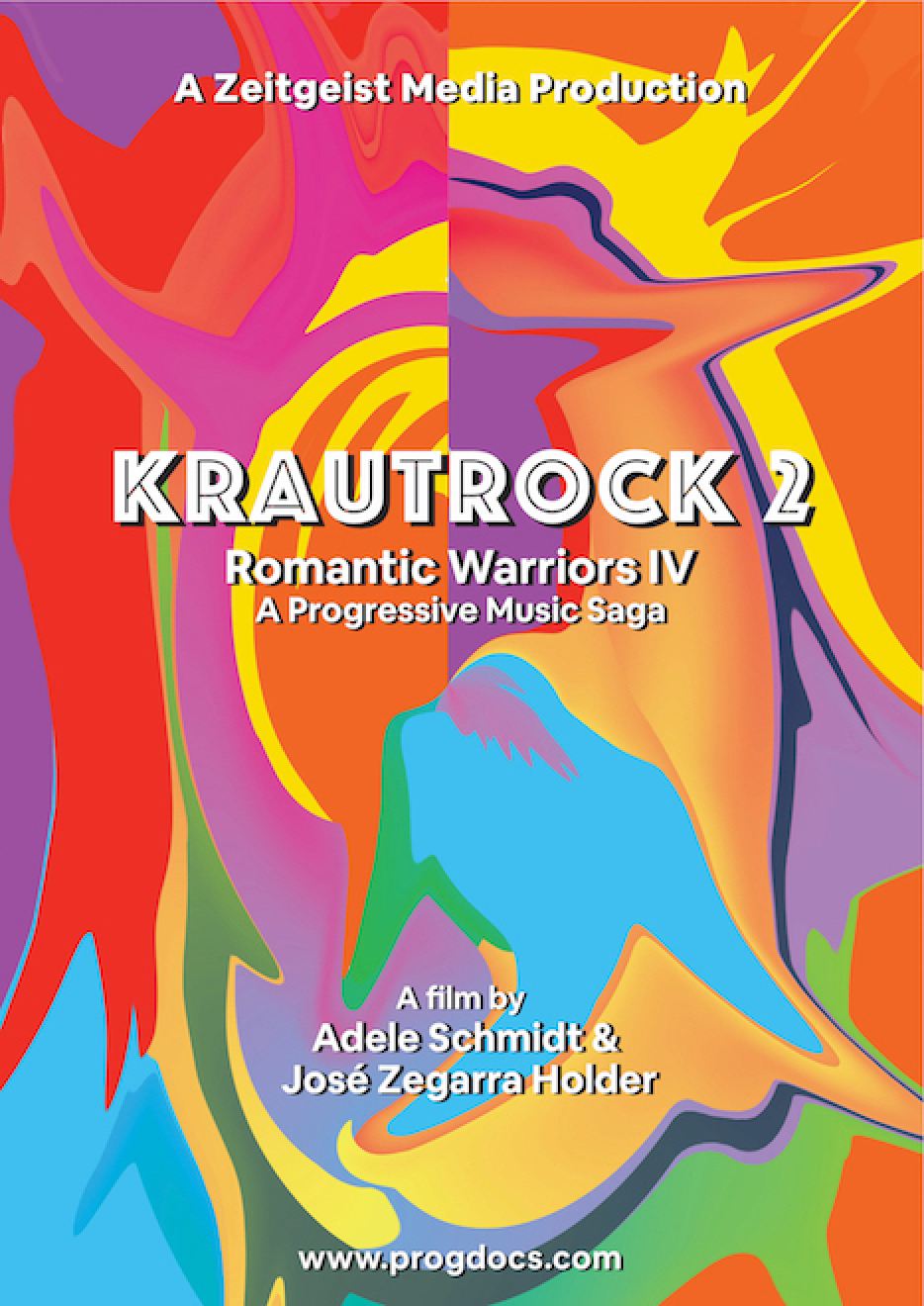
Krautrock 2 cover

A documentary film by José Zegarra Holder and Adele Schmidt
Produced by Zeitgeist Media LLC
Featuring: Amon Düül II, Xhol Caravan Witthüser & Westrupp, Guru Guru, Electric Orange, Popol Vuh, Kraan. Special appearance: Alan and Steve Freeman.
Total time: 123 min.

The early months of 2021 bring the second part of the Krautrock film trilogy – the fourth instalment of the ongoing Romantic Warriors documentary series, crafted with love, dedication and expertise by Washington DC-based filmmakers Adele Schmidt and José Zegarra Holder. Though the film was expected much earlier, its completion was – just like everything else – impacted by the events of 2020, a leap year on steroids if ever there was one.

As already anticipated, the second episode of the trilogy deals with bands and artists from Munich and other parts of southern Germany. While Krautrock 1 focused on the “mind”, Krautrock 2 concentrates on the “body” and the “heart” – the physical and emotional components of the music. Some of these differences jump out right from the opening sequence – an aerial view of the city of Essen, the setting of the legendary festival known as Essener Songtage (Essen Song Days) in September 1968, followed by a skilful collage of archival photos, live footage and interview snippets that gives a brief but tantalizing outline of the film’s main content.  

Compared to its more intellectual predecessor, Krautrock 2 is colourful and almost brash (as reflected in the cover artwork, courtesy of the filmmakers’ daughter, Paloma Zegarra Schmidt), packed with exotic imagery and wild live performances, as well as explicit references to LSD and other mind-altering substances. Plenty of footage from recent shows bears witness to the scene’s enduring vitality, almost 50 years later, as well as the infectious enthusiasm of the musicians involved. In fact, it could be said that Krautrock 2 is dominated by the captivating personalities of its protagonists: many of these artists are still very much active as performers, clearly enjoying every minute of it.

From the trippy, spaced-out offerings of Amon Düül II and Xhol Caravan to the intricate, bass-driven jazz-rock of Kraan, through the weird psych folk of Witthüser & Westrupp, Guru Guru’s forays into free jazz and avant-garde, and Popol Vuh’s haunting, ethnic-tinged mysticism, the film spotlights the stunning diversity of the Krautrock scene. Prolific “neo-Krautrock” outfit Electric Orange (who made a brief appearance in Krautrock 1) represent the continuity between the original scene and its modern followers. All recent performances were filmed in 2016 at the Finkenbach Festival, the “Woodstock of Odenwald”, which in 2021 will celebrate its 39th edition. US viewers will not fail to be reminded of the setting and atmosphere of ProgDay – only with a much larger crowd, and a much greater local involvement.

One of the film’s strengths lies in the interviews, which are as entertaining as they are informative. Renate Knaup, one of progressive rock’s first frontwomen, shines with her warm, vibrant presence and joyful outlook.  As a mature woman, Renate is every bit as charismatic as she was in her dark, smouldering salad days, with her stylish clothes and statement jewellery. In the footage captured at Finkenbach, she commands the stage, interacting with the audience and the rest of the band with genuine relish.  A former, self-described “shy girl”, Germany’s answer to Grace Slick has successfully managed to carve a role for herself in the midst of an all-male ensemble, becoming an indispensable piece of the Amon Düül II mosaic. At the end of the interview, her words about staging a revolution against the negativity that surrounds us demolish the old, tired trope according to which all Baby Boomers have turned complacent or just plain reactionary in their “golden years”.

Indeed, the protagonists of Krautrock 2, rather than just grow old gracefully, seem to have discovered the fountain of youth. Mani Neumeier, who turned 80 on the last day of 2020, looks physically fit, and brimming with enthusiasm. The core trio of Kraan are captured performing with the energy and zest of people half their age. Moreover, all the interviewees in Krautrock 2 seem to gleefully debunk the stereotype (sadly still widespread, especially in Southern Europe) of the dour, humourless German: Hellmut Hattler’s impish mien, Renate Knaup’s infectious love of life, Daniel Fichelscher’s enthusiastic “mad scientist” presence do not only add entertainment value, but project each of these artists as well-rounded, genuine human beings.

Not everything, however, is bright lights, gaudy colours, and freewheeling hippie lifestyle. Some rather disturbing original footage depicts violent clashes between police and demonstrators: in their grainy black-and-white, those images are a stark reminder of the tensions underlying the outpouring of artistic creativity of those years. In the late Sixties, the whole Western world, not just West Germany, was riddled with social and political conflict – as pointed out by the razor-sharp commentary (still valid more than 50 years later) by none other than Frank Zappa, a major influence and icon (as Walter Westrupp puts it, like “the man in the moon”) for many Krautrock artists. Another uncannily prescient link with recent events – though the documentary was filmed before the COVID-19 pandemic turned the whole world upside down – appears in the shape of a song about a deadly plague that “ate the rich and ate the poor”, which bookends the section dedicated to Witthüser & Westrupp.

Rather interestingly, the section about Popol Vuh is sandwiched between two sections heavy on live footage – Electric Orange and Kraan – emphasizing the contrast between this unique musical project’s erudite, somewhat introspective approach (which resulted in very rare live appearances) and the dynamic physicality of the other bands. In a scene packed with outstandingly creative individuals, the late Florian Fricke stands out as a man with all the makings of a Romantic artist –with his striking profile, framed by a head of burnished curls, and dandy-like dress sense. The filmmakers use archival photos, audio and video recordings in which Fricke expounds his view of music and art to great effect. In some ways, the subdued mood of this section reminded me of the third Romantic Warriors film – the one dedicated to the Canterbury scene, many of whose protagonists, like Fricke, died well before their time. Fricke’s personality is maybe best summed up by Renate Knaup’s terse statement about his not wanting to grow old: once Popol Vuh fizzled out, the composer’s own creativity followed suit, and soon it was “game over” for him.

A detailed commentary on the music (and the artwork) featured in the film is offered by Alan and Steve Freeman, the duo of brothers behind Ultima Thule Records and Audion Magazine (thankfully still in operation as online-only concerns). The Freeman brothers hail from a rather different milieu – the somewhat grim-looking city of Leicester, in central England. Compared to the picturesque views of Munich’s bustling streets, Ulm’s quaint medieval architecture, or Finkenbach’s misty hills and green fields, those brief shots of Leicester – with the defunct brick-and-mortar record shop now turned into a convenience store – look somewhat depressing. The brothers’ commitment, however, is definitely uplifting: behind Alan Freeman’s cherubic face and unflappable Britishness lurks a profound, informed knowledge of the whole Krautrock scene.

As a whole, Krautrock 2 comes across as more focused on the personal rather than the technical; a generous helping of entertaining anecdotes helps to paint a vivid picture of those heady years. Some of the stories told in the interviews hint at the sheer ingenuity of the musicians – such as the funny tale about the cricket related by the irrepressible Skip van Wyck, former drummer of Xhol Caravan (and the only non-German artist to appear in the film).  

To wrap up this rather lengthy essay, I cannot but repeat what I wrote at the end of my review of the first film in the trilogy: Krautrock 2 is essential viewing for anyone interested not just in the music, but also the history and culture behind it. It will, however, provide a rewarding viewing experience to everyone – even to committed fans of very different subgenres of progressive rock. On a personal level, both Krautrock films have helped me to gain an appreciation of the music that had previously eluded me. Now we can only steel ourselves to wait patiently for 2023, when Krautrock pt. 3 – dedicated to the Berlin scene – is slated to be released.

Links:

www.progdocs.com

http://www.zeitgeistmedia.tv/

http://www.ultimathulerecords.com/main.html

http://www.ultimathulerecords.com/audion.html

https://finkenbach24.de/index.php/finkenbach-festival.html

Read Full Post »