Feeds:
Posts
Comments

Posts Tagged ‘Guitar’

TRACKLISTING:
1. Disarray (3:02)
2. Faceless (7:57)
3. Wither (9:23)
4. Star Bound (4:43)
5. Numb (4:05)
6. Astral Dream (7:03)
7. Delusion (4:06)
8. Dance of the Elders  (8:18)
9. Takes My Breath Away (2010)  (14:14)
10. Altered State (9:43)
11. Reflections (5:14)

LINEUP:
Jeff Hamel – guitars, keyboards, bass, vocals
Jessica Rasche – vocals
Chris Nathe – drums

With:
Jerry Swan – bass (5)
John Wooten – drums (6, 8)
Gregg Johns – guitars, talkbox (10)
Jeremy Hamel – guitars (11)

When I reviewed Majestic’s album Descension in the summer of 2009, my words reflected my lack of enthusiasm for what I saw as yet another ‘solo pilot’ project by a very skilled multi-istrumentalist (Jeff Hamel, formerly of prog-metal band Osmium), ambitious yet lacking in direction. Things took a definite turn for the better with their following album Arrival – the first recorded with the participation of vocalist Jessica Rasche – though I still expressed some reservations about the compositional aspect. Rasche’s arrival (pardon the pun), however, brought some welcome depth and intensity to Hamel’s lengthy, sometimes rambling compositions, and the added bonus of one of the best female voices heard on CD in the past few years.

With Ataraxia (a philosophical concept meaning ‘freedom from worry’ in Greek) it would not be overstating the case to speak about a quantum leap for the Minneapolis-based outfit – now become a real band, with Rasche’s husband Chris Nathe on drums. With the collaboration of a few guests (including Gregg Johns, Hamel’s partner in Proximal Distance, and leader of Mississippi-based project Slychosis), though resting mainly on Hamel’s talents as a multi-instrumentalist, Majestic have produced an album that is unabashedly ambitious – almost 80 minutes long, offering a wide range of sounds and styles that had already been foreshadowed in the band’s previous efforts, though not as coherently developed. The evident progressive metal bent of Arrival is here kept to a minimum, while the symphonic component emerges with far more authority. Indeed, Majestic seem to have grown out of that fascination with prog-metal that, in my view, caused Arrival to be not as impressive as it might have been.

This time, Majestic decidedly head for more traditional prog territories, with most of the compositions bridging the gap between Pink Floyd-style spacey moods and symphonic textures, solemn and pastoral in turn. The longer, weightier compositions (between 7 and 12 minutes) are interspersed by shorter, more accessible numbers that prevent the album from turning into too onerous a listen on account of its length. Most important, though, the music on Ataraxia keeps melody at the forefront, all the while avoiding any descents into cheesiness. As a matter of fact, the danger of sounding too close to those terminally cheesy, female-fronted symphonic metal bands (whose progressive quotient is often rather flimsy) is thankfully kept at bay by Jessica Rasche’s stunning performance. Her clear yet assertive voice steers clear of the operatic excesses of so many female singers, relying on a near-perfect balance between sweetness and power.

All but two of the tracks on Ataraxia feature vocals – mostly Jessica’s, though Jeff Hamel makes a brief appearance on the last two tracks. Touches of Genesis circa Wind and Wuthering surface in the cascading finale of the wistful, melodious opener “Disarray”; while following number “Faceless” begins very much in the prog-metal vein displayed on Majestic’s previous recording effort, then subsiding in favour of a fuller, more symphonic mood with plenty of tempo changes to add interest. The longest track on the album, the 14-minute “Take My Breath Away”, takes instead a more stately direction, with solemn, march-like passages and a lovely, nostalgic mood, enhanced by Jessica’s pure, heartfelt tones and Hamel’s clear, Gilmourian guitar. Another highlight, “Wither displays all of Jessica’s vocal versatility, with a darker mood and a sense of tension that contrast with the almost pastoral quality of “Faceless“, and more of  Hamel’s excellent guitar work.

As wonderful as Rasche’s vocals are, the two instrumentals can easily be numbered among the album’s highlights. The hard-edged riffing and overall ‘metallic’ touches in “Astral Dream” are never overdone, and do not overwhelm the spacey atmosphere created by the synths and the clear, piercing tone of the guitar; while the aptly-titled “Dance of the Elders” reveals a folksy inspiration in its lilting pace and a classical feel in the guitar parts, as well as reminiscences of the likes of Vangelis or Tangerine Dream in the haunting keyboard passages. As to the shorter tracks, the piano-led, funky workout of “Star Bound” allows Jessica to pay homage to her idol Ann Wilson of Heart, and the equally dynamic “Delusion” reveals a distinct influence of Pink Floyd circa Dark Side of the Moon, with a final section where Jessica’s vocalizing made me think of Clare Torry in the immortal “The Great Gig in the Sky”; while “Numb” and “Reflections” are both subdued, romantic ballads which, in my opinion, do not add a lot to the album – the latter providing a rather anticlimactic, though soothing, conclusion.

While Majestic do not pretend to be reinventing the wheel, Ataraxia is a classy offering, showcasing the work of a band brimming with an enthusiasm and love of their craft that have become increasingly rare in the music world, and whose compositional skills are growing by leaps and bounds. Though, as my faithful readers know, I tend to be rather critical of albums that exceed one hour in length, and believe that Ataraxia would have benefited from a bit of trimming, its refreshing lack of pomposity and ‘cheese factor’ balance its undeniable ambitiousness. Moreover, Jessica Rasche’s delightful vocals alone are worth the price of admission – she is a real find, and living proof of how a female singer does not need to indulge in operatic or cloyingly sweet excesses to offer a credible performance in a prog context.

Links:
http://www.majesticsongs.com

Read Full Post »

TRACKLISTING:
1. I Am The One You Warned Me Of  (5:04)
2. Les Invisibles (5:33)
3. In The Presence Of Another World  (6:26)
4. Del Rio’s Song  (5:31)
5. The Siege And Investiture Of Baron Von Frankenstein’s Castle At Weisseria (6:43)
6. Astronomy  (6:47)
7. Magna Of Illusion  (5:53)
8. Blue Öyster Cult  (7:18)
9. Imaginos  (5:46)

LINEUP:
Eric Bloom –  vocals
Albert Bouchard –  guitar, percussion, vocals
Joe Bouchard –  keyboard, vocals
Allen Lanier –  keyboards
Donald “Buck Dharma” Roeser –  guitars, vocals

With:
Kenny Aaronson – bass
Thommy Price –  drums
Jack Secret –  additional vocals
Tommy Moringiello –  guitars
Jack Rigg –  guitars
Tommy Zvoncheck –  keyboards
Shocking U – backing vocals (3)
Joey Cerisano – additional lead vocal (5)
Jon Rogers – additional lead vocal (9)
Daniel Levitin –  additional backing vocals
Marc Biederman –  guitar
Kevin Carlson –  guitar
Robby Krieger – lead guitar (7,8)
Daniel Levitin –  guitar
Aldo Nova – guitar
Joe Satriani –  lead guitar (5)

Back from my well-deserved vacation, I am quite ready to resume my reviewing duties as regards both new and older material.  Though I have a couple of reviews of recent releases in the works, I would like to devote the first slot of the new year to what is possibly the most intriguing album by the band that brought us the original Fire of Unknown Origin (pun unintended).

Just before Imaginos was released, the mighty Blue Oyster Cult had been in disarray, a shadow of their former powerful selves. With the departure of some key members, the spark seemed gone forever – as witnessed by their previous, rather lacklustre release, 1986’s Club Ninja, held by many as their weakest recording effort. However, the completion of this 20-year-long project (originally conceived by drummer Albert Bouchard and mastermind Sandy Pearlman) brought the original members of the band together for what was destined to be their last great album (in some ways, even their masterpiece), and certainly one of their most progressive offerings.

The very elaborate concept behind Imaginos was at least partly inspired by HP Lovecraft’s Cthulhu Mythos, and crafted in order to provide an ‘alternative’ explanation for the onset of World War One.  The titular character is a ‘modified child’ with supernatural abilities, whose story is told (though not in chronological order) in the nine songs on the album, and foreshadowed on two songs featured on 1974’s Secret Treaties – “Subhuman” and “Astronomy”. Both appear on Imaginos, the latter with a different musical arrangement (in my view inferior to the original, and way too ‘Eighties’ for my tastes), the former rewritten as “Blue Oyster Cult”.

Such an intriguing, grandiose concept needed to be implemented accordingly. Therefore, the five members of the band brought on board a number of other musicians, including the ‘Guitar Orchestra of the State of Imaginos’, an impressive array of lead guitarists that included The Doors’ Robbie Krieger (who had already guested on BOC’s “ET Live”), and six-string wizard Joe Satriani. The result is a rich, majestic sound that fits the storyline like a glove, immediately noticeable from the first strains of opener “I Am the One You Warned Me Of,” which sets things off with a bang. In comparison to the somewhat limp-wristed nature of the band’s previous two efforts, The Revolution by Night and Club Ninja,  an exhilarating sense of energy can be  clearly perceived here. Even the more accessible numbers, like the sax-driven title-track, which closes the album on a somewhat cheerful note, in spite of its rather disturbing lyrics, or the even more upbeat “Del Rio’s Song” (possibly the album’s weakest link) seem to barge in with an assertiveness approached by none of the compositions appearing on either of the above-mentioned releases.

Vocalist Eric Bloom – one of the most distinctive (and underrated) voices in rock – is at the top of his game, belting out the obscure lyrics with self-assured forcefulness. On the rousing “The Siege and Investiture of Baron von Frankenstein’s Castle at Weisseria”, though, Bloom is replaced by guest singer Joey Cerisano; the song climaxes with a haunting chorus of “World without end”, and Joe Satriani’s blistering solo makes it even more memorable. Buck Dharma’s well-mannered voice does the honours on “Les Invisibles” – though the song itself is anything but reassuring, with its sinister synth effects and guitar work, and its insistent, almost obsessive repetition of the word ‘seven’; while “In the Presence of Another World” is a dark-hued mid-tempo, almost ballady at times, with a thundering, yet oddly catchy chorus stating that “Your master is a monster”.

The true highpoint of the album, however, comes  in the second half, with the double whammy of “Magna of Illusion” and “Blue Oyster Cult”. The former, named after the mysterious obsidian mirror that Desdinova (the new name given to Imaginos by his rescuers, the human servants of ‘the Invisible Ones’) finds in a jungle in the Yucatan, and which, kept for twenty years in his attic, poisons the minds of European leaders before the outbreak of WWI, is a triumphal, keyboard- and guitar-laden march related from the point of view of the protagonist’s granddaughter. “Blue Oyster Cult”, on the other hand, is as creepily addictive as its earlier version, “Subhuman”, with an anthemic close celebrating the occult nature of the band’s name as originally conceived by Sandy Pearlman.

Many BOC albums boast outstanding cover artwork, and Imaginos is no exception – the über-Gothic Victorian mansion (a San Francisco landmark burned to the ground in 1907)  poised on a cliff on the background of a stormy sky aptly conveying the sense of mystery and menace implicit in the whole story.  At any rate, despite its Eighties-style production (rather evident, for instance, in the drum sound), this is an album of epic proportions that will appeal to both hard rock and progressive rock fans – a much-needed reminder of the greatness and unique approach of this seminal band.

Read Full Post »

TRACKLISTING:
1. Intro/Dio del Silenzio (1:23)
2. Il Nome del Vento (6:01)
3. Verso il Naufragio (6:35)
4. L’Acquario delle Stelle (6:15)
5. Luci Lontane (4:14)
6. Profeta Senza Profezie (4:20)
7. Ogni Storia (5:02)
8. Note di Tempesta (4:29)
9. Dopo il Vento (9:40)
10. Cuore Sacro (8:49)
11. L’Aurora Boreale (4:26) (bonus track)

Bonus Video:
L’Acquario delle Stelle

LINEUP:
Ettore Vigo – keyboards
Martin Grice – sax, flute, keyboards
Pino Di Santo – drums, vocals
Roberto Solinas – guitars, vocals
Fabio Chighini – bass
Mimmo Di Martino – vocals (2)

String quartet:
Chiara Giacobbe Chiarilla – violin
Diana Tizzani – violin
Simona Merlano – viola
Daniela Caschetto Helmy – cello

With:
Stefano “Lupo” Galifi – vocals (6)
Sophya Baccini – backing vocals (2, 4, 7, 9), piano (9)

After having spent the past few months concentrating on albums from the English-speaking world, now it is time for me to to spotlight some  Italian bands and artists. Though many great albums (in some cases essential for a true prog fan) have come out of my native country from the Seventies onwards, only a part of this vast, exciting output has received the attention it deserves.  Here in the US most of the attention tends to be directed at the likes of  Le Orme, PFM and Banco (also owing to their relatively frequent visits to the New World), to the detriment of other acts who seem to be familiar only to a selected few.

Genoa-based band Delirium hold a special place in my heart, since their debut album, Dolce Acqua, was the first progressive rock album that I bought – at the ripe old age of 11. Among the founders of the original Italian progressive rock scene, in 1972 they experienced mainstream success with  the anthemic single “Jesahel”, which introduced the Italian public to the gritty, bluesy vocal talents of Ivano Fossati.  Soon afterwards Fossati  left the band  to embark on a successful career as  a singer-songwriter, to be replaced by British-born Martin Frederick Grice.  After the release of their third album, released in 1974, Delirium split up, but thankfully got back together in 2001 with most of the original members on board.

When listening to Il Nome del Vento, one might almost be tempted to feel that the 30-year hiatus between  Delirium III and this album has in some way been beneficial to the band – a lengthy yet necessary ‘recharging of the batteries’, so to speak. This is indeed a mature, finely-crafted album, very much in the way of  PFM’s  Stati di Immaginazione – a sumptuous, accomplished effort from seasoned prog veterans that had been forgotten or written off far too soon.

Although Il Nome Del Vento is a concept album of sorts (the wind symbolizing the energies that sweep negativity away and usher positive change), it does not feel as contrived as many similar efforts can be. Shunning the clichés than often plague concept albums, Mauro La Luce’s lyrics opt instead for simplicity and emotion, a perfect complement to the outstanding performances of all the vocalists involved. The latter are nicely balanced by the brilliance of the instrumental sections, where the background of each musician, their individual tastes and preferences, is put to effective use. While Martin Grice’s love of jazz and vintage English prog shines through his flute and sax  work, guitarist/vocalist Roberto Solinas (a true revelation) injects a welcome dose of classic rock energy in what is largely an acoustic effort. The presence of an all-female string quartet contributes an authentically symphonic feel to many of the compositions, infused by that uniquely Italian flair for melody and lyricism.

The continuity between the new and the old incarnation of Delirium is highlighted right from the start, as “Intro/Dio del Silenzio (Reprise)” references one of the songs featured on Delirium III. This brief, intense introduction (complete with sounds of rain and thunder at the beginning) sets the scene for what is to come. The title-track is a magnificent slice of complex yet melodic prog, soulfully interpreted by the band’s former guitarist Mimmo Di Martino, whose deep, bluesy tones find a perfect foil in Sophya Baccini’s ethereal soprano. The following track, “Verso il Naufragio” (one of two instrumentals featured on the album), is an exhilarating rollercoaster ride of slow, majestic keyboard washes and electrifying guitar riffs; it also incorporates a passage from George Martin’s “Theme One” (also covered by Van Der Graaf Generator, Cozy Powell and Osanna). The jaw-dropping duel between sax and organ in the second half of the track displays the band’s jazzier side, a constant of their sound since their debut album, Dolce Acqua.

More jazzy influences surface in the uptempo “Profeta Senza Profezie”, further enriched by a  commanding vocal performance by Stefano ‘Lupo’ Galifi (of Museo Rosenbach fame), somewhat reminiscent of the late Demetrio Stratos’ acrobatics; while the romantic “L’Acquario delle Stelle” (dedicated by Martin Grice to his first grandson) is a gorgeous slice of classic Italian prog, in which flute and keyboards emote over a lush background of strings. However, it is the double whammy of “Dopo il Vento” and “Cuore Sacro” that forms the album’s climactic point. The former alternates jazzy passages with calmer, more melodic ones, the string quartet holding the fabric of the song together; while the latter is markedly darker and rockier, enhanced by rippling piano, dynamic drumming, and assertive flute work that recalls early Jethro Tull.

A truly classy offering, and undoubtedly one of the top releases of 2009, Il Nome Del Vento is the ideal showcase for the unique talents of a band that seem to be finally about to get the recognition they highly deserve. It is also a textbook example of how classic progressive rock can sound modern without jettisoning its glorious past. Hopefully this stunning comeback disc will lead the way for more releases of the same high quality from a band that still has a lot to offer to the discerning prog fan.

Links:
http://www.idelirium.it
http://www.blackwidow.it

Read Full Post »

TRACKLISTING:
1. The Encounter ( 5:03 )
2. The Push ( 3:36 )
3. Out Of The Mist ( 8:25 )
4. Sequence Of Events ( 3:25 )
5. DIP ( 6:56 )
6. The Departure ( 4:40 )
7. Gray Matter ( 6:16 )
8. Orb ( 7:47 )
9. 11th Heaven Blues ( 4:00 )
10. Still (Unsettled ) ( 2:10 )

LINEUP:
Dean Watson – all instruments

While so-called ‘solo-pilot’ instrumental albums seem to be rather ubiquitous these days (with results not always up to scratch), it is far from an everyday occurrence to come across an album as impressive as Unsettled, Dean Watson’s debut release – even more so if we consider that we are dealing with a wholly independent production. An amazingly accomplished disc, structured in a remarkably balanced way, it presents music that is eclectic without being directionless, and complex without being unnecessarily convoluted.

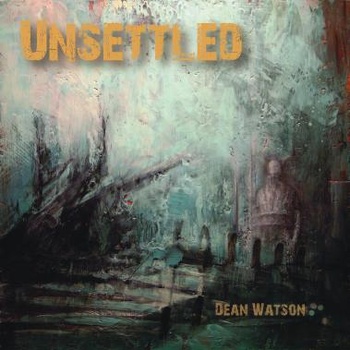
For such a proficient composer and multi-instrumentalist, Toronto-based Dean Watson is a very unassuming character, in spite of his decades-long experience in the music world. Dispensing with the bells and whistles to which so many new acts seem to be addicted, he has embarked on the promotion of his music completely on his own, offering his album for review on progressive rock discussion boards, and eliciting almost unanimously positive feedback. Indeed, though it falls somewhat short of perfection,  Unsettled as a whole is an impressively cohesive effort: inspired by the painting of the same name by Ron Eady (a visual artist also based in Toronto), it is conceived as a sonic rendition of the painting itself, realized with a successful blend of emotion and technical skill that often eludes all-instrumental productions.

Other reviewers have labelled Unsettled as progressive fusion, and, in some ways at least, the description fits the album quite well – especially if we take into account the many diverse sources of inspiration (listed by Watson on his MySpace page) that make up its sound.  the actual jazz-rock component in Unsettled is rather restrained, sharing the stage with spacey touches, progressive metal overtones, and even subtle classic rock influences. Although comparisons have been made with the likes of Planet X and Liquid Tension Experiment – at least as regards those moments on the album where things take a more metallic turn – I feel they limit the scope of Watson’s creative impulse. In fact, while some tracks on the album may bring to mind the aforementioned, hyper-technical instrumental combos, others reveal a vintage jazz-rock feel akin to Jeff Beck’s two seminal mid-Seventies albums, Blow by Blow and Wired, eschewing the feeling of chilly perfection that often plagues the output of metal-fusion acts.

Unsettled’s main flaw lies in the use of programmed drums, though they are nowhere as annoying than on other similar projects. True, their artificial nature occasionally surfaces, marring (albeit slightly) the otherwise warm and engaging sound of the compositions, and making one wonder how the album would sound if Watson had instead gone for the real thing. A couple of tracks also come across as somewhat less cohesive than the others, with abrupt changes in mood and pace that may leave the listener a tad baffled. However, the level of both composition and execution is so consistently high that it amply compensates for these shortcomings.

Running at around 52 minutes, Unsettled is a compact album that strikes the right balance between longer, more complex compositions and shorter numbers with a more direct impact. Watson’s approach definitely helps the listener to concentrate on each number, and appreciate the diversity on offer. Watson always keeps melody at the forefront, opting for power rather than harshness when introducing heavy riffing into the fabric of his songs, so that even the heaviest moments are amazingly tuneful. Opener “The Encounter” is a good example of how Watson merges progressive metal vibes with more sedate moods;  the use of keyboard-based riffs reminded me of Relocator’s self-titled debut (another excellent instrumental album released in 2010), with various electronic effects adding a spacey note, and some remarkable Hammond organ and guitar work. “Sequence of Events”, one of the shortest items on the album at barely over 3 minutes, offers an intense, almost concentrated atmosphere made of brisk keyboard flights and hard-edged riffing reminiscent of classic instrumental metal-fusion; while the brisk, high-energy “Orb” would have been more effective without the overpowering drums and whistling synth sounds.

On the other hand, Watson’s talent emerges most clearly in those tracks where the prog-metal component is kept to a minimum – such as the jazzy, almost funky “The Push”, relying on some fine organ-guitar interplay with a warm, rugged Seventies sound, or the exhilarating “Gray Matter”, propelled by energetic bass and drums and showcasing Watson’s outstanding skills as a guitarist. His soloing here, as well as in the splendid first half of “The Departure”, possesses a clean, melodic feel that evokes  the aforementioned Jeff Beck, as well as another guitar great, Irish legend Gary Moore. While the latter number is somewhat marred by an abrupt change in pace and style towards the end, its slow-burning, wistful first half brought to my mind some of Moore’s more meditative pieces, such as “Sunset”, “The Loner” or “Gary’s Lament”. With “Out of the Mist”, the longest piece on the album (and possibly its highlight), we are presented with a musical version of Ron Eady’s intriguing cover painting, with its romantic, melancholy beginning, backed by strings that add depth to the beautiful strumming of the acoustic and electric guitars, and a second half full of tension and menace, driven by intense riffing and crashing drums.

Though the problem with an album such as Unsettled might lie in its evident metal subtext – which may put off the more conservative jazz-fusion fans – lovers of eclectic instrumental rock will definitely find a lot to enjoy in this finely-crafted effort, an excellent debut from an outstanding musician. In any case, it would be interesting to see Watson branch out and enlist the help of some other musicians, in order to bring his compositions before a live audience.

Links:
http://www.myspace.com/deanwatson2
http://www.roneady.com

Read Full Post »

TRACKLISTING:
1. Clear Air Turbulence  (7:35)
2. Five Moons  (7:30)
3. Money Lender  (5:38)
4. Over the Hill (7:14)
5. Goodhand Liza  (5:24)
7. Angel Manchenio  (5:17)

LINEUP:
Ian Gillan – lead vocals
Colin Towns – keyboards, flutes
John Gustafson – bass, vocals
Ray Fenwick – guitars, vocals
Mark Nauseef – drums, percussion
Martin Firth – baritone saxophone
John Huckridge – trumpets
Derek Healey – trumpets
Malcolm Griffiths – trombone
Phil Kersie – tenor saxophone (2)

It would not be too much of an exaggeration to call  Clear Air Turbulence, the second album released by the sadly short-lived Ian Gillan Band, one of the forgotten masterpieces of Seventies progressive rock. For those who think of Ian Gillan as little more than a hirsute hard rock screamer,  even a casual listen to this record may definitely bring somewhat of a shock – and not just because of the vocals.

Following his return to the world of music after a series of unsuccessful business ventures, Ian surrounded himself with a bunch of seasoned musicians (including bassist John Gustafson, of Quatermass and Roxy Music fame), and proceeded to surprise his fans by slowly but inexorably detaching himself from his Deep Purple past. Unfortunately, though, rock fans are not always as open-minded as we would wish them to be, and the project folded after releasing a total of three studio albums, plus a posthumous live one.

When listening to Clear Air Turbulence,  we cannot but regret the demise of such an exciting outfit, offering an incredibly high level of musicianship as well as  creativity. The six tracks on the album, which all exceed the five-minute mark, feature complex, multi-layered structures, enhanced by the discreet presence of a horn section, and distinguished by an overall sense of  sophistication, a lightness of touch seldom associated with Gillan’s mother band. Even Ian’s vocals, while easily recognizable, never really sound like the original ‘air raid siren’ unleashed on the likes of  Machine Head and  Made in Japan.

However, the ace in the hole on Clear Air Turbulence is undoubtedly keyboardist Colin Towns.  Another of the many unsung heroes of the rock world, now a composer of jazz and soundtrack music, Towns joined the band for the recording of this album (replacing original member Mike Moran), and immediately stamped his mark on their music, as well as on the band’s later incarnation – simply called Gillan, and much more akin to Deep Purple in sound, with excursions into outright heavy metal.

Weird, spaced-out keyboard sounds introduce the title-track, surging into a crescendo that soon gives way to a manic, bass- and drum-driven riff, and a wildly exhilarating, 7-minute-plus ride, powered by Towns’ sweeping synthesizers. In the middle section of the song, guitarist Ray Fenwick (a veteran of the British rock scene, formerly with the Spencer Davis Group) demonstrates his skills with a slow-burning, emotional solo. Towns is  also responsible for the delicate flutes on the dreamy, soulful ballad “Five Moons”; while on the funky “Money Lender” horns take pride of place, with Gillan’s  commanding, even aggressive vocal performance somewhat reminiscent of his hard-rockin’ past.

“Over the Hill” (my personal favourite, together with the title-track) showcases drummer Mark Nauseef’s impressive skills, as well as brilliant piano and synth in the bridge, and more understated yet distinctive guitar work. The atmospheric “Good Hand Liza” follows, punctuated by Latin-style percussion and spacey synths, and driven along by John Gustafson’s meaty, dynamic bass lines. The album ends in style with another intricate, highly structured number, the romantic “Angel Manchenio”, dedicated to a Gypsy who became Gillan’s blood brother (an intriguing tale, as told by both the lyrics and the liner notes). The song, which alternates slower, almost Latin-flavoured moments with full-fledged jazzy flights of instrumental and vocal prowess, is probably the furthest Gillan ever strayed away from his hard rock roots, and a perfect closer for such a distinctive album.

At the time of its release, Clear Air Turbulence was not considered rock enough by Deep Purple fans, and probably not jazzy enough by fusion devotees; moreover,  the competition of the fledgling punk scene did it no favours. Over thirty years later, however, it is high time it was recognized as an adventurous, stimulating effort, at times bordering on masterpiece status. It is a sad fact of the music world that, all too often, musicians are much more ready to try new avenues than their fans…  I would encourage my readers not to make the same mistake:  if you love sophisticated, complex jazz-rock/fusion, do not be put off by the name, and get hold of this album.

Read Full Post »

TRACKLISTING:
1. Save The Yuppie Breeding Grounds (4:12)
2. Ephebus Amoebus (4:55)
3. Nacho Sunset (4:29)
4. $9 Pay-Per-View Lifetime TV Movie (5:51)
5. Manifest Density (3:55)
6. Uncle Tang’s Cabinet of Dr. Caligari (4:01)
7. Disillusioned Avatar (5:15)
8. Kuru (5:02)
9. Revenge Grandmother (5:11)
10. Staggerin’ (4:41)
11. Middlebräu (6:46)

LINEUP:
Dennis Rea – electric guitar
Ruth Davidson – cello
Alicia Allen – violin
Kevin Millard – bass guitar, baliset
Jay Jaskot – drums

The city of Seattle has long been known as a hotbed for innovative music, from Jimi Hendrix to the grunge movement through progressive metal pioneers Queensryche. For several decades, it has also been the home of globe-trotting guitarist and composer Dennis Rea, originally from upstate New York, but now a full-fledged member of the Pacific Northwest artistic community. While Rea, in  his many years of tireless activity in the realms of creative music-making, has gathered an impressive discography (especially in terms of quality), he has never become a household name as he would have amply deserved. Luckily, the release of Moraine’s debut album in 2009, as well as his first solo album proper, View from Chicheng Precipice, and Iron Kim Style’s debut in 2010, have contributed to putting Rea’s name on the sprawling map of the progressive music scene.

Indeed, Moraine were selected for the 2010 edition of NEARfest, where they elicited quite a lot of interest – in spite of having been described as ‘avant-garde’ on the festival’s press material, a definition which (coupled with their placement in the opening Sunday slot, also known as the ‘rude awakening’, and generally reserved for rather idiosyncratic bands) kept the more conservative members of the audience away from their set. The members of the band, and Rea in particular, were somewhat amused at having been lumped together with much more ‘mainstream’ bands under the all-encompassing prog banner. In these times of derivative acts being peddled as the best thing since sliced bread, Moraine were possibly the most genuinely progressive band on the bill – though, as purveyors of hard-to-pinpoint music, they left some of the more label-happy members of the audience a tad baffled.

Although instrumental albums are seemingly a dime a dozen these days, Manifest Density (a brilliant pun on one of the most obnoxious aspects of US history) is not your average cookie-cutter instance of amazing chops unencumbered by soul and emotion. With a total of 11 tracks averaging 5 minutes in length  (the longest running at under 7 minutes),  and all of the five band members but drummer Jay Jaskot contributing to the compositional process, it is very much an ensemble effort, a collection of contemporary chamber rock pieces that comes with a liberal helping of almost Canterbury-like dry wit – though more geared to 21st-century American society. The essential input of the violin may draw comparisons with bands such as King Crimson circa Larks’ Tongue in Aspic or Mahavishnu Orchestra, while the pervasive presence of the cello may bring to mind Swedish Gothic proggers Anekdoten. However, in Moraine’s sound the cello’s unmistakable drone does not create the same kind of claustrophobic atmosphere, but rather adds that kind of depth that is generally supplied by the keyboards in the output of more conventional prog bands.

Since the individual members of Moraine have parallel involvements in a number of very diverse projects, ranging from jazz to stoner rock, it will not come as a surprise that eclecticism is the name of the game on Manifest Density. However, those anticipating a hodge-podge of disparate ideas that ultimately do not coalesce would be making the wrong assumption: the album as a whole impresses for its cohesion, even allowing for the different compositional styles of each band member. While Dennis Rea’s compositions (such as “Kuru” or “Staggerin’”) tend to favour a jazzier, more experimental style, two of the three tracks penned by co-founder Ruth Davidson (“$9 Pay-Per-View Lifetime TV Movie” and “Revenge Grandmother”) possess a wistful, low-key quality, shared by Alicia Allen’s deeply lyrical “Disillusioned Avatar”. On the other hand, album opener “Save the Yuppie Breeding Grounds”, also written by Davidson, is an energetic yet haunting number with a strong Crimsonian vibe; while bassist Kevin Millard’s “Ephebus Amoebus” opens in a slow, atmospheric fashion, then develops into a frenzied workout, with guitar and violin sparring with each other.

The quirky track titles inject a welcome dose of humour into the proceedings – a recurring feature in the work of other modern instrumental bands, but which Moraine (and especially Dennis Rea) seem to have got down to a fine art. Actually, the titles fit the musical content astonishingly well: “Uncle Tang’s Cabinet of Dr Caligari” is suitably dissonant, at times chaotic, with subtle Gothic undertones; while the upbeat “Nacho Sunset”, embellished by stunningly clear, lilting guitar work and gentle violin, has a relaxed, almost Latin feel. Though the album’s sound is mostly driven by the flawlessly intricate interplay between Rea’s distinctive guitar and Allen’s versatile violin lyrical and assertive in turns, none of the other instruments is confined to a mere supporting role, and each of them contributes in keeping the sonic texture tight. An excellent example of this is album closer (and personal favourite) “Middlebräu”: after a funky first half, propelled by magnificent bass and drums (very much in classic jazz-rock vein),  a pause signals an abrupt change of pace, and the beginning of a simply magnificent, almost slo-mo coda featuring an intense, meditative guitar solo (the closest Rea comes to a traditional rock solo).

When Moraine performed at NEARfest, their lineup had changed, with obvious consequences for their sound. Ruth Davidson and Jay Jaskot had moved away from Seattle, and been replaced by  drummer Stephen T Cavit (also an award-winning composer of film and TV scores), and woodwind player Jim DeJoie ( now Alicia Allen’s husband). The switch from cello to woodwinds lent the music a brighter, but also slightly more angular quality, reminiscent of those bands, such as Henry Cow, on the more experimental end of the Canterbury scene. This bodes well for the band’s second album, which is already in the works at the time of writing. In the spring of 2011 Moraine will also embark on a tour of the US East Coast, with dates at the New Jersey Proghouse and the legendary Orion Studios in Baltimore already confirmed. Catch them if you can – they are a very entertaining live act, and Manifest Density qualifies as one of the most promising debut albums of the past decade in the progressive music field.

Links:
http://www.moraineband.com

Read Full Post »

TRACKLISTING:
1. September Song (9.27)
2. Antarctica  (9.05)
3. The Byways  (4.17)
4. Orange Ice  (10.20)
5. Concrete, Glass, Steel  (4.37)
6. Four Faradays in a Cage  (16.25)

LINEUP:
John MacNeill – keyboards
Mike Marando – bass guitar
John Orsi – drumset, percussion
Don Sullivan – guitar, guitar-to-MIDI

Based in Providence, Rhode Island (USA), instrumental quartet Incandescent Sky are part of the roster of fine musicians signed to the label It’s Twilight Time – founded in 1994 by musicians/composers John Orsi and Michael Watson, and home to a number of highly interesting acts. I first came across the label in the late spring of 2009, when I was sent Knitting By Twilight’s album An Evening Out of Town to review – by a fortunate coincidence, that album was to be the very first review I wrote for the site I collaborated with until recently. Because of the almost complete lack of exposure that It’s Twilight Time’s output has received so far – even in terms of specialized press and websites – very few people have had the opportunity to know the beautiful music produced by Orsi and his cohorts, as well as the stunning artwork accompanying each of their releases. As the caption on the label’s website recites, its acts provide ‘works of whimsy, wonder and wistful thinking’ – which is as apt a description as they come.

Four Faradays in a Cage (a pun referring to an electrical device called Faraday cage) is the third CD release by Incandescent Sky, following Glorious Stereo (2003) and Paths and Angles (2005). Originally recorded in September 2007 during a live improvisation session, the album was only committed to CD in 2010. It is therefore alike in conception to a number of other albums I have recently reviewed, seemingly going against the grain of the modern tendency to spend ages in the studio in order to get things ‘right’. These ‘live in the studio’ efforts, while sounding anything but shoddy or haphazard, inject a welcome sense of freshness and spontaneity into today’s often contrived approach to music-making.

Tagged on their own website as ‘an inventive improvisational instrumental ensemble’ (yes, Orsi does like his alliterations!), Incandescent Sky prove true to their definition, as it immediately becomes obvious when listening to Four Faradays in a Cage. In spite of the improvisational nature of the six compositions presented on the album, there is nothing sloppy about them. While there are some similarities in pattern, each track has got its own individuality, which prevents the album as a whole from sounding repetitive. The end result is a disc chock full of music that is in turn hypnotic, invigorating and deeply atmospheric, mainly based on a traditional rock instrumentation though making judicious use of cutting-edge technology. Running at about 53 minutes, it never overstays its welcome, with the two shorter tracks nicely balancing the longer offerings. In spite of the obvious talent and experience of the musicians involved, Four Faradays in a Cage always steers clear of spotlighting any of the band members’ individual chops at the expense of the bigger picture – a fine example of how talent can be effectively put to the service of the music, and not the other way around.

All of the six compositions possess a rich texture, to which all the instruments contribute in a distinctive yet somewhat understated fashion. The music feels spacious, beautifully flowing, yet at times almost seething with intensity. Most importantly, though some occasional references to external sources can be picked out, it sounds original in a way that has become increasingly rare in these days of unashamedly derivative productions. It might be said that describing the individual numbers is simple and at the same time rather demanding. Unlike so many ‘mainstream’ prog recordings, where the complexity is shoved right in the listener’s face – often with the unwelcome result of obliterating any sense of genuine emotion – Four Faradays in a Cage comes across as an extremely emotional album. However, there is also a sense of energy emanating from the music, which is not at odds with the delicate, melancholy nature of some of its parts.

“September Song” sums up the album’s main features, as well as rendering its title quite perfectly in musical terms. Opening with sparse, spacey keyboards and guitar, it develops into an airy, slow-paced composition, with Don Sullivan’s clear, relaxed guitar occasionally bringing to mind Pink Floyd’s David Gilmour, or Pat Metheny when it adopts a lower register in the second half of the track. Propelled by Orsi’s impeccably creative percussion work, the tempo increases, slightly at first, then steadily, until the piece reaches a climax – a pattern that can be noticed in most of the tracks, although with variations. The following number, “Anctartica”, manages to conjure views of the icy, windswept wastes of the titular continent through the ebb and flow of the keyboards and the slow-burning interplay of drums and guitar which, especially towards the end, creates a mesmerizing ambient mood.

While “The Byways”, the shortest track on the album, acts as a laid-back, hypnotic interlude where the guitar seems to follow the pattern laid out by the drums, further enhanced by electronic effects, the intriguingly-titled “Orange Ice” brings the listener into Vangelis territory, with its steadily surging waves of electronic keyboards, and the guitar sounding almost suspended in time and space – though the second half sees the drums and bass take the lead, setting an almost military pace spiked by slashes of electronics. Not surprisingly, seen its title, “Concrete, Glass, Steel” brims with energy reminiscent of the third incarnation of King Crimson (albeit mellowed out by melodic keyboard work), and introduces the tour de force that is the 16-minute title-track – a stunning workout of really epic proportions where all the instruments strive together in order to create a densely textured, somewhat cinematic soundscape that at times feels like King Crimson on steroids. Synthetizers are pushed to the forefront, with keyboardist John MacNeill delivering passages that might comfortably sit in Keith Emerson’s oeuvre. As usual, Orsi’s outstanding drumming, bolstered by Mike Marando’s ever-reliable bass, is the driving force behind the composition, punctuating wild keyboard flights and unleashed guitar exertions, then slowing things down until all the instruments gradually subside.

The above description should make it clear that Four Faradays in a Cage is much more likely to appeal to lovers of instrumental music that combines technical skill with hefty doses of ambiance and emotion, rather than to worshippers of anything fast and flashy. It is, indeed, an album to be savoured slowly and carefully, in order to appreciate its moments of sheer beauty, as well as its moody intensity and the subtle yet flawless interaction between the instruments. Highly recommended to all fans of genuinely progressive music (as well as drum enthusiasts, who should check out John Orsi’s magnificent performance), it will hopefully encourage my readers to get acquainted with the remarkable talents gathered under the It’s Twilight Time banner.

Links:
http://www.incandescentsky.com
http://www.itstwilightmusic.com

Read Full Post »

TRACKLISTING:
1. Cannonball (7:40)
2. Still in Love (4:28)
3. No Inbetween (4:41)
4. Better Days (6:12)
5. Brother Where You Bound (16:34)
6. Every Open Door (3:05)

LINEUP:
Rick Davies – keyboards, vocals
John Helliwell – saxophone, vocals
Bob Siebenberg – drums
Dougie Thompson – bass, Cha Cha, background vocals (2)

With:
David Gilmour – guitar solos (5)
Scott Gorham –  guitar (5)
Scott Page – flute (4, 5)
Marty Walsh – guitar (1, 2, 4, 5)
Doug Wintz – trombone (1)

When Roger Hodgson left the band in 1983, many were ready to write Supertramp off for good. After all, the interplay between his distinctive high-pitched vocals and Rick Davies’ gruff, bluesy tones, as well as their differing songwriting styles, had always been one of the main points of attraction for the many fans of the band. It was therefore quite a shock for the sceptics to be confronted with such a strong release as 1985’s Brother Where You Bound – a still relatively underappreciated album that, however, can easily be put on a par with the band’s renowned Seventies output.

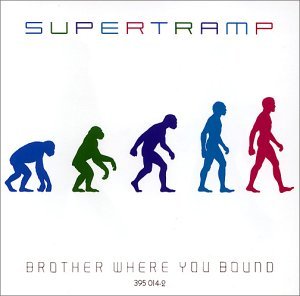
Starting from the elegantly minimalistic cover, depicting the stages of man’s evolution in five different colours on a pristine white background, Brother Where You Bound simply oozes class. Supertramp always had the uncanny knack of marrying catchy hooks with interesting, thought-provoking lyrics, and this album is no exception. Rick Davies, left alone to cope with vocal duties, unleashes a performance that is nothing short of awesome, especially on the album’s pièce de resistance, the 16-minute title-track. Add a couple of prestigious guest musicians to the mix, and you have a near-masterpiece on your hands.

In the best tradition of a band known for strong opening tracks, “Cannonball” does not disappoint the listener. Backed by a steady, almost danceable beat, and introduced by Davies’ scintillating piano, it is one of the vocalist/keyboardist’s many songs about a broken relationship, where you can positively hear the anger in his voice, belying the mock-cheerfulness of the sudden bursts of horns and the almost singalong coda. However, while the horn-heavy “Still in Love” seems to reprise the apparently carefree mood of Breakfast in America, on the whole the songs come across as definitely more somber and less accessible. Both the slow, understated “No Inbetween” (featuring great keyboards and sax) and the relentless “Better Days”, with its frantic pace and splendid flute solo, convey an aura of almost claustrophobic pessimism and disillusion

Interestingly, it is mainly Davies’ voice that makes Brother Where You Bound a markedly darker, less upbeat offering than Supertramp’s 1979 mega-hit, Breakfast in America.The title-track, in particular, is anything but an easy, radio-friendly listen, made up as it is of various parts interspersed by recorded voices, odd noises and sudden silences, underpinning the oppressive atmosphere conjured up by lyrics imbued with all the paranoia of the Cold War years. Davies’ stunning, highly dramatic vocal performance and David Gilmour’s trademark, crystal-clear guitar tones link all the pieces together to create what is possibly the band’s best epic. In comparison with such a wild, exhilarating ride, album closer “Every Open Door”, a slow, moody piece, is a tad anticlimactic, also on account of its decidedly more optimistic message.

If you only know Supertramp for the likes of “Dreamer” and “The Logical Song” (which is as perfect a pop song as they come), you will probably be inclined to dismiss them as little more than ‘prog-lite’ for those who hesitate to delve into the more demanding examples of the genre. Although it is true that the band possess a great feel for melody and memorable hooks, they are also outstanding musicians, and purveyors of above-average lyrics.  While they may represent the ‘easier’ side of prog, they do so with inimitable style and class, displaying songwriting skills that are far from average. Brother Where You Bound is a prime example of ‘crossover’  prog at its very best, and as such highly recommended to anyone but those prog fans who think that ‘pop’ is inevitably a bad word.

Read Full Post »

TRACKLISTING:
1. Simon Magus  (6:23)
2. Diamondized  (6:33)
3. The Night I Killed Steve Shelley  (9:07)
4. Royal Oil Can  (5:15)
5. Out of the Oceans  (7:17)
6. He is Like a Spider  (6:20)
7. Nuclear Density Gauge  (7:21)
8. Tumbleweeds  (4:09)
9. Astro  (11:30)

LINEUP:
Patrick McGowan – vocals, guitar
Dan McGowan – vocals, guitar
Kyle Minnick – drums
Becky Osenenko – bass

With:
Tom Brislin – keyboards

In 2008, New Jersey-based trio The Tea Club’s debut release made waves on the progressive rock scene, and sparked a lot of interest in this youthful new band. A completely self-produced effort, General Winter’s Secret Museum brimmed with freshness, enthusiasm and not inconsiderable chops. Moreover – most important in this age of manufactured, cookie-cutter musical outfits – it sounded original, not sporting its influences too openly. The Tea Club were at the forefront of the new generation of ‘crossover’ progressive rock bands, fuelled by the raw energy of post-punk and indie/alternative rock, with an eye to melody and another to complexity –  a power trio for the new millennium, with enough quirkiness and intricacy to appeal to the old-school set, and contemporary-sounding enough to make headway with the younger fans.

It is no wonder, therefore, that the release of Rabbit, the band’s sophomore effort, was eagerly awaited in prog circles. Due to their ideal location right in the middle of the ‘prog hub’ of the US Northeast (the main subject of the documentary film Romantic Warriors), they have been able to gain a loyal following, as well as the opportunity to increase their visibility by playing relatively frequent live shows. Unlike other bands of recent formation, they have never suffered from overhype, and still retain an endearingly down-to-earth attitude. On the other hand, Rabbit comes across as a clearly more ambitious project that its somewhat stripped-down predecessor. With the basic lineup augmented by bassist Becky Osenenko, longer track times (including a couple of almost epic-length numbers) and the unobtrusive but constant presence of the keyboards (manned by an experienced musician such as Tom Brislin, known for his associations with the likes of Yes and Renaissance), the albums marks a shift away from General Winter’s… immediate, hard-rocking impact into more nuanced modern prog territories.

This time around,The Tea Club are a tad less restrained about letting their sources of inspiration show – though this does by no means spell derivativeness. The band occasionally sound like a toned-down version of The Mars Volta, an impression compounded by the McGowan brothers’ high-pitched vocals – even though they go for a distinctly more melodic approach than Cedric Bixler-Zavala’s occasionally abrasive tones. There actually are some numbers that bring to mind the generally low-key mood of Octahedron, the Volta’s latest release. The first two songs, “Simon Magus” and “Diamondized”, are both sophisticated, well-constructed numbers, the former with a more dramatic edge, the second relying on atmosphere rather than power. Indeed, Rabbit’s most remarkable distinguishing feature is its slower pacing, seemingly light years removed from General Winter’s… exhilarating urgency. Its reflective, somewhat attenuated mood cannot but bring to mind  the haunting atmospheres created by bands like Radiohead and The Pineapple Thief. A song like the 9-minute “The Night I Killed Steve Shelley” (one of the undisputed highlights of the album) seems to bring together the two strains of the band’s creative impulse, alternating understated, almost meditative, moments with bursts of intensity driven by fat bass chords, eerie keyboard effecs and high-energy riffing.

True to their new direction, The Tea Club also throw a couple of slow-burners into the mix – namely the muted, mesmerizing “Royal Oil Can”, with its solemn drumming and tinkling guitars, and the gentle, percussion-less “Tumbleweeds”, reminiscent of Radiohead circa OK Computer. While the closing epic “Astro”, in my view, is not a completely successful endeavour, reproducing in some way the stop-start structure of “…Steve Shelley” (though featuring a nice instrumental section with one of the rare guitar solos on the album, as well as assertive keyboard touches and commanding vocals), Rabbit’s real highlight lies in the powerful “Nuclear Density Gauge”, a kind of mellower yet subtly menacing version of a Mars Volta number spiced by jagged drum patterns, neat bass lines and haunting vocal exchanges.

Although I suspect Rabbit is one of those albums that will slowly but relentlessly grow on me, I also have to admit that, at least on the first couple of listens, it did not grip me in the same way as General Winter’ Secret Museum. As a whole, the album seems to lack the ‘peaks and valleys’ that made its predecessor such a compelling effort, and sometimes the tracks seem to blur into each other. I also found the ubiquitous vocalizing a tad off-putting, as if it deprived the music of some much-needed energy. Personally speaking, I would be glad to see The Tea Club adopt a more ‘back to basics’ approach for their next release, recapturing some of the edginess and vitality of their debut and blending it with their newfound sophistication. However, in spite of these shortcomings, Rabbit is undeniably a lovingly-crafted effort from a band that oozes potential. With a striking cover in gorgeous hues of blue and green (courtesy of  Kendra DeSimone), the McGowan brothers’ own quirky artwork gracing the booklet, and intriguing, thought-provoking lyrics, it offers a complete package in the finest progressive rock tradition.

Links:
http://www.theteaclub.net

Read Full Post »

TRACKLISTING:
1. Leslie Anne Levine    (4:12)
2. Here I Dreamt I Was an Architect (4:31)
3. July, July! (2:51)
4. A Cautionary Song  (3:08)
5. Odalisque (5:20)
6. Cocoon (6:48)
7. Grace Cathedral Hill  (4:28)
8. The Legionnaire’s Lament  (4:44)
9. Clementine (4:07)
10.California One / Youth and Beauty Brigade  (9:50)

LINEUP:
Colin Meloy – lead vocals, guitars, percussion
Chris Funk – guitars, pedal steel, theremin
Jenny Conlee – Hammond organ, Rhodes piano, regular piano, accordion
Nate Query –  upright bass
Ezra Holbrook – drums, percussion, backing vocals

Many of those people who (sometimes in spite of themselves) were won over by The Decemberists’ award-winning 2009 release, the sumptuous rock opera The Hazards of Love, will certainly have felt the impulse to delve into the Portland band’s back catalogue, and thus come across their debut, Castaways and Cutouts. Though the specialized press has often placed the band under the ‘progressive rock’ umbrella (as  was definitely the case with the first article I read about them,  in the autumn of 2006), true-blue prog fans are sharply divided about this issue. While the more conservative set often refuse to acknowledge anything not sounding like the Seventies bands, the more open-minded fans have equally often embraced the band as a firm favourite.

As is the case of all Decemberists releases but The Hazards of Love (and possibly their 2004 EP, The Tain),  Castaways and Cutouts is an effort that can only in part be called progressive. In fact, a good proportion of the songs follow in the footsteps of  the great American folk tradition, influenced by its European counterpart, yet at the same time noticeably different.  It is nevertheless an album that prog fans can definitely find appealing (unless they are of a seriously close-minded disposition), and even features a couple of tracks that might be tagged as ‘epics’. Based on a series of vignettes often focused on the plight of the less fortunate members of society (as the title implies), handled in terms that range from the downright grotesque to the deeply compassionate, the album undeniably possesses a powerful lyrical impact – which has become a constant of the band’s output, making very effective use of Colin Meloy’s fertile, erudite imagination and remarkable skill as a wordsmith.

Meloy’s stories, deeply rooted in the folklore of both the Old and the New World, are not meant to leave the listener cold, even resorting to shock tactics in their stark description of seedy milieus and events. Indeed, some of the situations depicted on  Castaways and Cutouts are not for the faint-hearted, even without resorting to excessively graphic detail. Luckily, not all is not doom and gloom on this album. Meloy approaches his subject matter, no matter how sordid or depressing, from a perspective of poetic realism, presenting the events with a compassionate stance, avoiding the almost masochistic wallowing in misery that, for instance, seems to be almost the rule for progressive metal bands. His voice, with its somewhat nasal twang and precise enunciation, may be an acquired taste for some, but is also quite perfect for the sort of storytelling displayed on the album.

I have always been impressed by The Decemberists’ ability to produce memorable opening tracks – in my view, one of the real strengths of a band in compositional terms – and “Leslie Ann Levine” is no exception. A hard-hitting account of suicide and stillbirth, told from the point of view of a dead baby, it is the follow-up to “We All Go Down Together” (featured on  Picaresque, the band’s third studio release), which, however, does not pack the same punch, either musically or lyrically. While its folksy, accordion-driven tune, with its vague French flavour, is only mildly wistful, the lyrics drip with sadness and regret. Some of the songs are straight-up acoustic folk numbers, where the music seems to take a back seat, and as such might appear too ‘simple’ to those craving the complexity (whether authentic or fake) of ‘mainstream’ progressive rock. The profoundly disturbing, dirge-like “A Cautionary Song” (a tale of prostitution motivated by abject poverty), and the wistfully romantic love songs  “Grace Cathedral Hill” and “Clementine” belong to this group, where the minimalistic musical accompaniment allows the narrative component to emerge, driven along by Meloy’s plaintive, nostalgia-filled vocal style.

On the other hand, the upbeat “July! July!”, whose deceptively optimistic mood conceals another disquieting tale of violent death, and the haunting dreamscapes of “I Dreamed I Was an Architect” display a catchier, more listener-friendly approach, with memorable choruses and a richer instrumental background. The aptly-titled “Cocoon”, a dreamy, almost slow-motion number inspired by the science fiction of the late Kurt Vonnegut, feels almost reassuring in the midst of so much turmoil; while “The Legionnaire’s Lament” is an infectious divertissement sporting some of the wackiest rhymes this side of Lewis Carroll. That leaves the two aforementioned epics, though in terms of running time only album closer “California One/Youth and Beauty Brigade” might be described as such. However, the mesmerizing, Hammond-drenched strains of “Odalisque” – another pitch-black, convoluted tale of sexual perversion, rape and (probably) infanticide – are such a towering achievement as to give the impression of a much longer song. “California One”, on the other hand, celebrates the beauty of nature and youth with a deep vein of nostalgia for a bygone past – its almost 11 minutes, driven by piano, pedal-steel guitar and touches of theremin, evoking a distinct Sixties West Coast feel.

An outstanding debut album, lavishly packaged in a booklet graced by the quirky illustrations of Carson Ellis (Colin Meloy’s then-girlfriend, now his wife, and a professional graphic artist), Castaways and Cutouts is highly recommended to those who are constantly seeking for both lyrical challenges and music that manages to be catchy and thought-provoking at the same time. Though here they will not find the myriad complexities and head-spinning changes of canonical progressive rock, open-minded (and curious) prog fans could do much worse than get acquainted with the wild and wonderful world of Colin Meloy and The Decemberists.

Links:
http://www.decemberists.com

Read Full Post »

« Newer Posts - Older Posts »