Feeds:
Posts
Comments

Posts Tagged ‘Guitar’

TRACKLISTING:
1. Lake of Fire (4:22)
2. Money Speaks (4:40)
3. You’ll Just Have to See It to Believe (5:22)
4. Stars of Sayulita (6:12)
5. Warning (4:20)
6. What Have They Done to the Rain (4:56)
7. Abandoned Mines (5:45)
8. Suicide Train (4:23)
9. Telstar (3:55)
10. Dateless Oblivion & Divine Repose (1:54)

Bonus tracks:
11. Abandoned Mines – Forest Fang Remix (8:26)
12. You’ll Just Have to See It to Believe – Alternate Mix (5:48)
13. Lake of Fire – Evan Schiller Remix (4:21)

LINEUP:
Barry Cleveland – electric & acoustic guitar, electric & acoustic 12-string guitar, Moog guitar, GuitarViol, sampled percussion, sampled Mellotron, voice (8), bass (8)
Robert Powell – pedal-steel guitar (1-5, 7, 9, 11-13), lap-steel guitar (4)
Michael Manring – bass (1-9, 11-13)
Celso Alberti – drums, percussion (1-4, 6-9, 11-13)
Amy X Neuburg – vocals (1, 2, 6, 9, 10 & 13).

With:
Harry Manx – vocals (4)
Deborah Holland – vocals (4)
Artist General – voice (5)
Erdem Helvacioglu – acoustic-electric guitar, electronics (3,13)
Rick Walker – chain-link drums, teapot (5), congas (4), dumbec (7)
Gino Robair – dumbec, kendang (6)

As anticipated in my previous post, here is my third review in a row of an album released in 2010 by MoonJune Records – and, like its predecessors, definitely one of the top releases of the year. Hologramatron, the fifth album credited to the name of San Francisco-based guitarist, composer and journalist Barry Cleveland (currently Associate Editor for Guitar Player magazine), has recently been submitted for the Grammy Award as “Best Alternative Rock Album of 2010” – and deservedly so.  A labour of love, whose recording took several years to complete, Hologramatron (whose title, according to the artist himself, means ‘whatever you need it to mean’) is one of those rare musical efforts that manage to sound like very little else. With derivative acts a dime a dozen on the current music scene, listening to such an album can be an exhilarating experience. Although Barry Cleveland’s name may be the most prominent on the cover, unlike your average ‘solo pilot’ release this is very much a collective effort, in which the input of each member of the band is recognizable, yet at the same time meshes with the others to form an organic whole.

Unabashedly eclectic,  Hologramatron has been called a modern ‘protest album’, and with very good reason – though only part of the songs have an unmistakable socio-political bent. However, it is first and foremost a collection of inspired, thought-provoking compositions performed by a group of amazingly talented, experienced musicians who manage to come across as an extremely tight unit rather than a combination of over-inflated egos. While vocalist Amy X Neuburg (a classically-trained singer, and a truly serendipitous find for Cleveland) may be relatively unknown outside dedicated avant-garde circles – in spite of an impressive curriculum as a composer and ‘avant-cabaret’ artist – the name of bassist Michael Manring is nothing short of legendary among four-string fans, and both drummer Celso Alberti and pedal-steel guitarist Robert Powell can claim a number of prestigious affiliations. When such collective talent is gathered together, the results may often be a tad underwhelming – especially when musicians forget that they are at the service of the music, and not the other way round.

Thankfully, this is not the case with Hologramatron. The impressive cohesion between all the artists involved, band members and guests, results in 10 tracks that display a remarkably original approach, even when external influences can be detected . While listening to the album for the first time, the closest comparison that came into my mind was with the late ‘90s – early 2000’s incarnation of King Crimson – and Robert Fripp is undoubtedly one of Barry Cleveland’s most noticeable sources of inspiration. In contrast with the majority of prog albums released in the past year or so, Hologramatron is based on relatively short compositions, none longer than 6 minutes –  and, indeed, half of the tracks are songs with a more or less ‘conventional’ verse-chorus-verse structure. The album might even be seen as a lesson on how to produce music that does not rely on 30-minute epics or convoluted concept stories in order to be progressive.

As I previously pointed out, eclecticism is the name of the game, with the hard-hitting earnestness of tracks like “Lake of Fire” or “Money Speaks” relieved by the inclusion of two covers of Sixties hit songs (which, in my personal view, do not really fit too well with the rest of the album), or the gentle yet emotional content of “Stars of Sayulita”. The psychedelic-meets-ambient component of Cleveland’s creativity (which was brilliantly showcased in the band’s live performance at ProgDay 2010) is here represented by the instrumental tracks, namely “You’ll Just Have to See It to Believe It” and “Abandoned Mines” – where Cleveland’s array of traditional and electronic guitars, effectively supported by Robert Powell’s pedal-steel guitar, Manring’s stellar bass and understated percussion patterns, weave subtly entrancing, multilayered textures.

On opener “Lake of Fire” (whose firebrand lyrics point a sharp finger at Christian fundamentalism),  Amy X Neuburg adopts two sharply different singing styles in the verse and the chorus – soothing, almost seductive in the former, venomously aggressive in the latter. The splendidly bass-driven “Money Talks” and the haunting “Stars of Sayulita”, graced by the warm, bluesy vocals of Harry Manx and Deborah Holland, follow a similar ‘mainstream’ pattern – as, obviously, do the two covers, “What Have They Done to the Rain” and “Telstar”, whose cheerful nature contrasts almost jarringly with the rest. Two of the tracks with vocals, however, diverge quite sharply: the ominous, electronics-laden avant-rap of the aptly-titled “Warning” (with vocals courtesy of long-time Cleveland collaborator Michael Masley, aka Artist General), and the tense “Suicide Train” (interpreted by Cleveland himself), an effort that borders on metal, featuring a beautiful, hypnotic guitar solo bolstered by crashing drums.

Running at around 64 minutes, Hologramatron is nowhere as cumbersome as many other current releases, though the three bonus tracks tagged at its end do not really add a lot (unless you happen to be a staunch completist) – with the possible exception of the remix of “Abandoned Mines” (nearly three minutes longer than the original), which possesses an eerily cinematic quality.  A masterful blend of mainstream sensibilities, socially-aware lyrics, intriguing atmospheres and stunning instrumental and vocal performances, this is a unique album that is warmly recommended to progressive music fans.

Links:
http://www.barrycleveland.com

Read Full Post »

TRACKLISTING:
1. Three Views From Chicheng Precipice (after Bai Yuyi) (9:52)
2. Tangabata (15:52)
3. Kan Hai De Re Zi  (Days by the Sea) (3:44)
4. Aviariations on “A Hundred Birds Serenade the Phoenix” (6:48)
5. Bagua  (Eight Trigrams) (10:41)

LINEUP:
Dennis Rea electric and resonator guitars, melodica, Naxi jaw harp, kalimba, dan bau (Vietnamese monochord)
Alicia Allenviolin (1, 3)
Greg Campbell drums, percussion (2)
Ruth Davidson cello (1, 3)
James DeJoie bass flute, bamboo flute, bass clarinet (2)
Caterina De Re voice (4)
Stuart Dempster trombone, conch shell (2)
Will Dowd – drums, percussion (1)
Elizabeth Falconer koto (5)
John Falconer shakuhachi (5)
Jay Jaskot drums (3)
Paul Kikuchi percussion (5)
Kevin Millard baliset (3)

In spite of China’s venerable musical tradition, very few people outside the ‘Asian studies’ circles are aware the authentic musical heritage of the Far East, unless it is in the most superficial of terms. Mentions of Chinese music might conjure, at least to the uninitiated, memories of the cheesy (when not downright ghastly) ‘sonic wallpaper’ that will accompany a meal in most Chinese restaurants of the Western world. However, I am happy to report that Views from Chicheng Precipice – the first recording effort solely credited to Seattle-based guitarist and composer Dennis Rea, a true veteran of the progressive music scene of the US Pacific Northwest – is light years removed from any such kitschy scenario.

Those who are familiar with Rea’s current main projects, the eclectic art-rock of Moraine and the improvisational jazz-rock of Iron Kim Style, will probably find themselves somewhat puzzled by this album – which, on the other hand, provides further proof of the guitarist’s broad horizons and dedication to the pursuit of creative musical avenues. While world music may be all the rage in a some circles, it is nevertheless not easy to find artists that approach the tradition of a country as distant (both literally and metaphorically) as China with such rigorously philological spirit as Rea manages to do – informed by his first-hand, in-depth knowledge of the musical and cultural background of both China and Taiwan, where he spent the years between 1989 and 1993.

Recorded between 2006 and 2008, Views from Chicheng Precipice sees the participation of members of both Moraine and Iron Kim Style, as well as other musicians from the Seattle scene, such as Japanese music specialists Elizabeth and John Falconer, and trombone master Stuart Dempster. Running at under 50 minutes, the album features five tracks presenting different facets of the Chinese musical heritage, seen through the eyes of a Western artist in a respectful yet uniquely personal way. Indeed, four out of five numbers (the sole exception being the title-track) are traditional compositions arranged by Rea so as to preserve their spirit even when reinterpreting their form.

Out of those five tracks, the East-West collision of “Days by the Sea” might almost be described as a pop song of sorts (also on account of its markedly shorter running time). Rea’s guitar weaves a tune that, while respectful to the original, incorporates elements of African-American blues, sparring with Alicia Allen’s violin in a stunning dialogue that brought to my mind Rea’s work with Moraine. The title-track, on the other hand, is built around three pentatonic motifs that comprise an original sonic triptych, with a recurring theme and plenty of scope left for improvisations. The composition was performed by Moraine during their performance at NEARfest 2010, though not many members of the audience were able to grasp its sheer elegance and grace in a live setting. Here the triptych comes across in all its understated power, the seamless flow of the music evoking the beauty of the titular mountain landscape (Qingcheng Mountain is the site of a Daoist sanctuary in China’s Sichuan Province). Rea’s guitar converses smoothly with Allen’s violin, while a drum-led improvisation adds a free-jazz touch to the central part of the composition.

The remaining three numbers are of a distinctly more challenging nature, since each of them develops in a fashion that is definitely less attuned to the Western ear. The 15-minute “Tangabata” and the 10-minute “Bagua” both have their roots in ceremonial music, as borne out by their stately, measured pace. The latter makes use of traditional Japanese instruments such as the koto and the shakuhachi (a bamboo flute), supported by solemn yet dramatic percussion work in the creation of a gently meditative mood. “Tangabata”, though a far from accessible piece, might be called the real highlight of the album. While featuring a distinctly Western-flavoured, free-jazz improv section at its very end, most of the composition remains faithful to its ancient origins – a sparse melody of austere beauty, almost suspended in time, made of deep, echoing sounds occasionally brightened by chiming bells. Finally, in “Aviariations on A Hundred Birds Serenade the Phoenix” (whose gently punning title reflects Rea’s ever-present sense of humour) the Chinese oboe traditionally used in the titular piece is replaced by Caterina De Re’s piercing vocal acrobatics, mimicking birdsong in a performance that brings together contemporary Western academic music and Chinese opera. Rea plays guitar and kalimba, whose sounds almost merge with De Re’s impossibly high notes.

Miles away from any tawdrily commercial ‘world music’ recreations, Views from Chicheng Precipice is, as Rea himself puts it, a love letter to the country where he spent four years of his life, an experience that was essential for his development as a musician. A refined, understated listen, it is an album made of subtle contrasts of light and shade, and as such needs to be approached with respect and concentration. The music possesses the delicate, almost brittle beauty of Far Eastern art, in stark contrast with the ‘in-your-face’ nature of much that is fashionable in this day and age. Being such an unabashed labour of love, imbued with profound feelings towards the country and its culture, sets it head and shoulders above the many blatantly contrived releases flooding the current music market. Those who will find themselves intrigued by the album could do much worse than get hold of a copy of Dennis’ book Live at the Forbidden City, a thoroughly enjoyable, extremely well-written account of his years in China and Taiwan – and a perfect companion to this disc. A special mention is also deserved by the stunningly minimalistic cover artwork and detailed liner notes – a simple yet classy package for an album that everyone with an interest in world music should check out.

Link:
http://www.dennisrea.com

Read Full Post »

Tracklisting:
1. Elephant Talk (4:43)
2. Frame by Frame (5:09)
3. Matte Kudasai  (3:47)
4. Indiscipline  (4:33)
5. Thela Hun Ginjeet  (6:26)
6. The Sheltering Sky (8:22)
7. Discipline (5:13)

Lineup:
Adrian Belew – lead vocals, guitars
Robert Fripp – guitars, devices (Frippertronics)
Tony Levin – bass, Chapman stick, backing vocals
Bill Bruford – drums, percussion

After two posts dedicated to recent albums,  now it is time to go back almost thirty years – to the beginning of that decade that, in the eyes of many people, is synonymous with the ‘dark ages’ as far as progressive rock is concerned.  In the eyes of many, the Eighties marked the triumph of style over substance, and therefore offered very little of interest to anyone looking for authentically progressive music. Obviously, this is in many ways a misconception, because during those momentous ten years for the history of the world a lot of great music was  produced – even though it sounded different from anything released by the trailblazing acts of the early Seventies.

One of those bands, King Crimson (whose 1969 masterpiece, the legendary In the Court of the Crimson King, had reputedly marked the official birth of the progressive rock era), had been laid to rest by its mastermind Robert Fripp after the release of the monumental Red in 1974.  Very few people expected them to resurface at the beginning of the new decade, when prog had become all but a four-letter word – not just with the inevitable Fripp at the helm, but also drummer Bill Bruford on board, as well as two newcomers (though with already a sizable amount of experience behind them) – bassist Tony Levin with his Chapman stick, and guitarist/vocalist Adrian Belew.

For those who had known King Crimson during their Seventies glory days, the release of Discipline in 1981 was nothing short of a shock.  No mellotrons (or any keyboards for that matter), no majestic vocal performances, no visionary lyrics – just a rhythm section to die for, two gifted guitarists trying to outdo each other at every opportunity, an incredibly expressive vocalist with an endearingly lazy American twang, and oodles of intriguing ethnic influences – notably Javanese gamelan music.  On the other hand, it would not be correct to say that Discipline has no connection with  the Crims ’70s  output.  Indeed, in some ways it takes up where “Lark’s Tongue in Aspic” left off – there is more than a touch of Jamie Muir’s crazy percussive brilliance in Bruford’s performance on this album.

One very evident influence on  Discipline,  especially as regards the  tracks featuring vocals,  is celebrated New Wave band Talking Heads, easily one of the most ‘progressive’ (in the true sense of the word) representatives of the so-called post-punk era – and no wonder, seen as Adrian Belew collaborated for some time with the New York band before being invited by Fripp to join the new incarnation of King Crimson. Belew’s manic, emotionally charged vocal delivery is noticeably influenced by David Byrne’s, although in my view Belew is by far the better vocalist. Needless to say, his style is light years removed from Greg Lake’s smooth, quintessentially English tones, or John Wetton’s rawer yet powerful delivery: as much of an acquired taste as Belew’s vocals may be, they are a perfect fit for the music showcased on Discipline.

It must be pointed out, however, that the numbers which feature more or less traditional singing amount to just half of the album. The true strength of “Discipline” lies in its magnificent instrumental tracks: the tense electric storm of “Indiscipline”, slashed by almost violent guitar flurries, and featuring a slightly disturbing spoken-word section; the ambient-influenced, African-tinged mood piece of “The Sheltering Sky” (inspired, like The Police’s  “Tea in the Sahara”, by Paul Bowles’ novel of the same title), which provides a welcome respite from the overall intensity of the album; and the title-track, which rounds things off in style with Fripp and Belew’s dueling guitars weaving in and out of Bruford’s and Levin’s thunderous, intricate rhythmic background.

Of the tracks featuring vocals, the laid-back, atmospheric ballad “Matte Kudasai” (Japanese for “please wait”), an alternate version of which is provided as a bonus track in the 2004 edition of the album, is the closest the album gets to the mainstream.  Though it is not a bad song by any means, displaying Belew’s gentler side as a vocalist, it feels somewhat out of place among the other, more exciting and innovative tracks. Conversely, opener “Elephant Talk”, spiked by all sorts of weird noises (courtesy of Belew’s notorious “elephant guitar”), a real vocal tour de force, with Belew half-singing, half-reciting his whimsical lyrics, sets immediately the scene, making it clear what the new Crimson are all about.  In a similar vein are the dynamic, though not as frantic, “Frame by Frame”, and the funky, percussion-driven “Thela Hun Ginjeet” (anagram of “Heat in the Jungle”), in whose central section Belew relates his narrow escape from muggers in NYC.

King Crimson  have always been quite famous for their stunning cover art, and Discipline is no exception, though – almost paralleling the album’s musical content  – the cover is much more minimalistic and streamlined than such baroque masterpieces as ITCOTCK and “Lizard”. Incidentally, the background colour is that shade of dark red commonly known as crimson, framing a spectacularly intricate Celtic knot – deceptively simple, extremely stylish, just like the album it contains.  However, do not be mistaken into thinking that Discipline might be – in true Eighties fashion – a triumph of style over substance. Although it may not everyone’s cup of tea, it is one of the undisputed masterpieces of progressive rock, and an enormously influential effort – as pointed out by Edward Macan, who dedicated a whole chapter of his seminal book Rocking the Classics to King Crimson’s comeback album.

Read Full Post »

Tracklisting:
CD 1:
1. The Bruised Romantic Glee Club
2. Variations on a Theme by Holst
3. Catley’s Ashes
4. When Peggy Came Home
5. Highgate Hill
6. Forgiving
7. No One Left to Lie To
8. The Things We Throw Away
9. Doxy, Dali and Duchamp
10. Srebrenica
11. When We Go Home

CD 2:
1. As Long As He Lies Perfectly Still (incorporating: That Still and Perfect
Summer – Astral Projection in Pinner)
2. Pictures of an Indian City
3. Nirvana for Mice
4. Islands
5. The Citizen King
6. Soon After

Lineup:
Jakko M. Jakszyk – vocals, electric and acoustic guitar, keyboards, mellotron, bass guitar, balalaika, sitar, flute, strings, whistles, sound effects, percussion, programming
Gavin Harrison – drums
Mel Collins – alto and tenor saxes, flute
Dave Stewart – keyboards (CD 1 – 9, CD 2 – 1, 3, 5)
Robert Fripp – soundscapes, electric guitars (CD 1 – 6, 11)
Danny Thompson – double bass (CD 1 – 9, CD 2 – 4)
Mark King – bass guitar (CD 1 -3)
Nathan King – bass guitar (CD 1 – 5)
John Giblin – bass guitar (CD 1 – 6)
Lyndon Connah – piano (CD 1 – 8 )
Ian MacDonald – flute (CD 1 – 2)
Caroline Lavelle – cello (CD 1 – 2)
Helen Kaminga – viola (CD 1 – 2)
Clive Brooks – drums (CD 2 – 1)
Gary Barnacle – alto flute, flute, bass flute and piccolo, tenor and soprano saxes (CD 2 – 1)
Hugh Hopper – bass guitar (CD 1 – 1)
Pandit Dinesh – tabla, vocals (CD 2 – 2)
Ian Wallace – drums (CD 2 – 4)
Suzanne Barbieri – backing vocals (CD 1 – 11)
Django Jakszyk – voice (CD 1 – 11)
Camille Jakszyk – voice (CD 1 – 11)
Chris Baker – Irish priest (CD 1 – 4)

After my review of the groundbreaking yet controversial debut by The Mars Volta, here is another album released during the first decade of the 21st century – though a vastly different one. This is one of the hidden progressive rock gems of recent years, courtesy of a musician who, in spite of his decades-long career and impressive curriculum, is still nowhere close to becoming a household name. In fact, while Jakko M. Jakszyk is in his early fifties, and has shared a stage or a recording studio with many a revered protagonist of the prog scene, most of the bands he has played with over the years are of the positively obscure kind. Before he joined the 21st Schizoid Band in the role that was of Robert Fripp, Jakszyk had been little more than what in my native Italy we would term as an ‘illustrious unknown’, in spite of his short-lived tenure in a relatively high-profile band like Level 42.

Much like its author, “The Bruised Romantic Glee Club” (released in 2006 to a lot of critical acclaim, and become unavailable soon afterwards, due to the record label going under) enjoys cult status among prog fans, though not many people have been able to listen to it. I was lucky to find a copy (at an almost bargain price for a double album) in one of the music stores I used to visit regularly when I lived in Rome. And what a great purchase!  This is an  album that most dedicated prog listeners will appreciate, with all the trademark features of our favourite genre, plus a healthy dose of melody and accessibility. Fans of cover versions will also be absolutely delighted by the contents of CD2 – a splendid collection of classics by the likes of King Crimson, Soft Machine and Henry Cow, performed by some of the stalwarts of the original Canterbury scene.

Right from its cover, a gorgeous, muted snapshot of Jakko walking on Brighton beach at sunset, “The Bruised Romantic Glee Club” is a thoroughly classy package. Everything – the pictures, the detailed liner notes, the graphics, the music – is designed to appeal to listeners of sophisticated tastes, who look upon an album as a complete experience. I would not hesitate to call it a beautiful album in the true sense of the word – not only on account of the very accomplished nature of the music contained within, but also of the stories behind each of the songs.

From even a casual reading of the liner notes, Jakko comes across as a very sensitive, vulnerable human being, consequently bruised by life, but keeping up his optimistic side. Some of the stories attached to individual songs are very moving indeed, especially those related to his family. As many adopted children, he got to meet his real mother much later in life, not long before her untimely death. This part of his life story is the subject of the haunting, Celtic-tinged instrumental “When Peggy Came Home”, dedicated to the burial of his natural mother’s ashes in her birthplace in Ireland; while the following song, “Highgate Hill”, reminisces about Jakko’s own birth in a hospital in the titular area of northern London.

Musically speaking, the first CD features a number of songs and instrumental tracks performed by Jakszyk and a handful of high-profile guest musicians – namely Porcupine Tree drummer Gavin Harrison, Mel Collins, former Level 42 bassist Mark King (a well-respected four-stringer), double bass legend Danny Thompson, and even His Majesty Robert Fripp himself. Canterbury keyboard king Dave Stewart also performs on one track (“Doxy, Dali and Duchamp”), as well as on most of CD2. Comparisons to other bands or artists are anything but easy to draw – I have read one review comparing some of the songs on “The Bruised Romantic Glee Club” to David Sylvian’s output, and I find myself in agreement with such a remark. Though Jakko does not have Sylvian’s distinctive, world-weary voice, I find his vocals are the perfect foil for the album’s elegant, somewhat understated musical mood.

On the other hand, there is a distinctly jazzy feel running through the album. The marvellous “Catley’s Ashes”, driven by Mark King’s pneumatic bass, is richly laced with Mel Collins’ masterful saxophone; while the melancholy “The Things We Throw Away” features Jakko’s long-time friend and former bandmate Lydon Connah, and the majestic “Srebrenica” is based on the traditional music of Serbia. Infused with sadness and loss, the atmospheric, rarefied “When We Go Home” (dedicated to the artist’s adoptive mother, Camille) features Fripp on electric guitar, as well as Camille’s own recorded voice.

All the songs are of consistent high quality, with a particular mention for the title-track and the already mentioned “Highgate Hill”. Admittedly, they sometimes border on pop, though in an adult, well-rounded kind of way, and definitely not an overtly easy or commercial one.  Jakszyk also deserves kudos for his skills as a lyricist, something not precisely common in the prog world. While he lays his soul bare, he hardly ever descends into mawkishness, and occasionally injects some humour in the overall wistfulness of his musings.

There is not much that can be said about CD2, if not that it is quite magnificent. The quality of the  ‘raw material’ alone would guarantee excellent results, but what really makes these versions special is the obvious love lavished on them by both Jakko and his distinguished guests. It would be very hard for me to pick out a highlight, though the cover of Henry Cow’s “The Citizen King” is nothing short of stunning, capturing the blend of  wistful beauty and biting irony of the original to perfection. Jakszyk’s Oriental-tinged take on King Crimson’s “Pictures of a City”, featuring Indian percussionist Pandit Dinesh (another former collaborator of the artist), also wins points for inventiveness; while “Islands”, remarkably faithful to the original, fits  perfectly within the album’s stylishly melancholy atmosphere.

As previously pointed out, up  to a couple of years ago or so, “The Bruised Romantic Glee Club” was, to all intents and purposes, impossible to find.  Now it has been reissued, which is great news with anyone whose curiosity will be whetted by this review – as it can be easily counted as one of the best releases of the past decade, a progressive rock album that pays homage to a glorious past, and at the same time feels thoroughly modern. With its intimate, confessional quality, and lush, sophisticated music, it is highly recommended to most prog fans, especially those who appreciate beautiful melodies coupled with flawless instrumental performances.

Read Full Post »

Tracklisting:
1. Son et Lumiere (1:35)
2. Inertiatic ESP (4:24)
3. Roulette Dares (The Haunt of) (7:31)
4. Tira Me a las Arañas (1:29)
5. Drunkship of Lanterns (6:20)
6. Eriatarka (7:06)
7. Cicatriz ESP (12:29)
8. This Apparatus Must Be Unearthed (4:58)
9. Televators (6:19)
10. Take the Veil Cerpin Taxt (8:42)

Lineup:
Cedric Bixler-Zavala – vocals
Omar Rodriguez-Lopez – guitars
Juan Alderete – bass
Flea – bass
Jon Theodore – drums
Ikey Isaiah Owens – keyboards
Jeremy Michael Ward – sounds

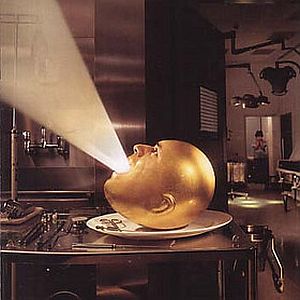
After inaugurating my blog with a series of reviews of classic albums ranging from the late Sixties to the early Eighties, now it is time for me to tackle a modern classic – one of the albums that, in my view, define modern progressive rock, and one of the few really ground-breaking releases of the first decade of the new millennium. Like many masterpieces, it is a divisive effort, and the band itself – the brilliantly-named The Mars Volta, a bunch of extremely gifted musicians led by volcanic guitarist and composer Omar Rodriguez-Lopez – almost a textbook definition of the expression ‘an acquired taste’.  On the other hand, it is undeniable that the release of  De-Loused in the Comatorium set new standards for contemporary prog.

This album was not my first experience with The Mars Volta (TMV for short). On the strength of some very positive reviews, some months before I had bought Frances the Mute, which I immediately loved  in spite of its shortcomings. However, De-loused in the Comatorium, the Hispanic-American band’s first full-length recording, is quite a different story – one of those almost perfect debut albums that it is often impossible (or at least very difficult) for a band to top.

Hate them or love them, it is hard to deny that The Mars Volta are progressive in the true sense of the word. Born from the ashes of post-hardcore band At The Drive-in, they are not afraid to take elements from such disparate genres as prog, punk, metal, jazz and Latin music, and throw them together in a metaphorical blender, stamping their individual seal over the end result. The band’s display of dazzling musicianship, left-field lyrical concepts, stunning cover art (courtesy of legendary graphic artist Storm Thorgerson, better known for his work with Pink Floyd) and no-holds-barred songwriting are the hallmarks of a first-rate outfit that is ready to push prog – that stereotypically earnest, stuck-in-a-time-warp musical genre – right into the 21st century.

Most of the tracks on this album are over the 5-minute mark, with “Cicatriz Esp” clocking in at over 12 minutes. Both band mastermind Omar Rodriguez-Lopez and vocalist/lyricist Cedric Bixler-Zavala wanted to expand their horizons after leaving At the Drive-In, as shown by the clear influence of such giants of progressive rock as King Crimson and Rush. In time-honoured prog tradition, De-Loused… is also a concept album, relating the tale of Cerpin Taxt’s week-long, drug-induced coma and subsequent suicide (a story inspired by the death of former bandmate Julio Venegas).

Even if Omar and Cedric’s original punk roots rear their heads every now and then, they add a measure of spice to the exotic mixture that is TMV’s sound. The musicianship is first-rate throughout, with a special mention for inventive, powerful drummer Jon Theodore, whose rhythmic sparring partner is on this occasion a very special guest, Michael Balzary aka Flea of Red Hot Chilli Peppers fame (one of the best four-stringers on the market, even if you are not too keen on his mother band). The crisp, clear production values further enhance Theodore’s intricate, occasionally explosive drumming, as immediately shown by  killer opener  “Inertiatic ESP” (preceded by the deceptive quiet of “Son and Lumière).

In my personal opinion, though, the real strength of TMV lies in the supercharged vocals of Cedric Bixler-Zavala, whose banshee wail, interspersed with more reflective, almost lyrical moments, provided a textbook example of  really expressive singing. A richer, fuller version of Geddy Lee, he stamps his mark all over the album, perfectly complemented by his partner in crime  Omar Rodriguez Lopez’s wildly atmospheric guitar playing. Unlike on follow-up  Frances the Mute, here the band keep the use of weird, electronic noises to a minimum, with epic “Cicatriz ESP” ‘s middle section being a prime example of how such sounds can be used sparingly to their maximum effect.

With such an overall strong album, it would be difficult for me to pick any standout tracks, apart from those I have already mentioned. Haunting ballad “Televators” is a much better effort in this sense than “The Widow” on Frances the Mute; while “Eriatarka”, “This Apparatus Must Be Unearthed” and album closer “Take the Veil, Cerpin Taxt” brim with energy and freshness, Cedric’s manically brilliant vocals soaring above the band’s unleashed instrumental fury.

A brash, loud, yet sophisticated statement of intent, De-Loused in the Comatorium was clearly not conceived with mass appeal in mind – even if The Mars Volta have become a relatively successful act in their field. This is thoroughly modern progressive rock, and a must-listen for all serious devotees of the genre – weird and wonderful, and a really wild ride, but also one to enjoy to the fullest.

Read Full Post »

Tracklisting:
1. Light Flight (3:19)
2. Once I Had a Sweetheart (4:43)
3. Spring Time Promises (4:09)
4. Lyke-Wake Dirge (3:36)
5. Train Song (4:47)
6. Hunting Song (6:44)
7. Sally Go Round the Roses (3:40)
8. The Cuckoo (4:30)
9. House Carpenter (5:32)

Bonus tracks
10. Sally Go Round the Roses (3:40)
11. Sally Go Round the Roses (3:42)
12. Cold Mountain (2:02)
13. I Saw an Angel (2:52)

Lineup:
Jacqui McShee – vocals
Bert Jansch – guitar, banjo, vocals
John Renbourn – guitar, sitar, vocals
Danny Thompson – double bass
Terry Cox – drums, percussion,  glockenspiel, vocals (4)

There must have been something in the water in Great Britain back in 1969 that inspired musicians to produce such an impressive number of landmark albums. Though best known to progressive rock fans for King Crimson’s seminal debut, the year saw the release of other essential discs for the history of rock in all its forms. Pentangle’s third album, Basket of Light, is one of those, though unfortunately it may easily fly under the radar of most listeners but dedicated folk-rock  enthusiasts – which is a pity, because the album is nothing short of a masterpiece.

Indeed, Basket of Light is everything a lover of progressive folk-rock might expect, and then some. Bert Jansch’s and John Renbourn’s fluid, jangling guitars weave seamless melodies, backed by Danny Thompson’s impeccable double bass work and Terry Cox’s precise, understated drumming, while  Jacqui McShee’s enchantingly crystalline tones soar above  the fray. Though this is the recipe for all of Pentangle’s best output, Basket of Light possesses a cohesive nature that somewhat eludes their other albums, even as good as they are. Though more than half of the material featured here consists of rearrangements of traditional British or American folk songs, the band’s original compositions are shining examples of how those traditions impacted their creative process, allowing them to craft songs that are at the same time accessible and musically complex (though very subtly so,  avoiding the over-the-top  nature of too much canonical prog).

The album’s title comes from a line of “Train Song”, probably the best-known number  in the band’s output, and one of the original compositions previously mentioned. Indeed, the title describes the album quite aptly – it is an overall uplifting slice of music, though not in the quirkily humorous way typical of Canterbury bands. For instance, “Lyke-Wake Dirge” (as the title implies) is based on an ancient Anglo-Saxon funeral chant, and as such might be expected to be quite depressing – which is, however, not the case. With its gorgeous, three-part vocals and a delicate, barely perceptible guitar accompaniment, the song possesses a melancholy kind of beauty, yet is anything but gloomy. On the other hand, album opener “Light Flight” is a deceptively light and airy tune permeated by a faint sense of nostalgia, which follows some interesting rhythm patterns and introduces the listener to the delights of Jacqui’s vocals. Gentler and less assertive than Annie Haslam’s, but powerful in its own way, her voice possesses an authentic sweetness devoid of that saccharine aftertaste so rife in her modern followers.

Interestingly, a good proportion of the album is dedicated to American music, in the shape of two folk songs derived from traditional English ballads (“Once I Had a Sweetheart” and the somewhat disturbing “House Carpenter”), and “Sally Go Round the Roses”, the only hit by New York girl group The Jaynetts, a delightful, feel-good tune (originally written by Phil Spector) showcasing a different side of Jacqui’s singing style.  The latter is also present in two different versions as a bonus track, together with two other songs that, while penned by the band or individual members, are strongly redolent of  the American musical tradition (especially the upbeat “Cold Mountain”). The aforementioned “Train Song”, written as a lament for the passing of the steam train, has a basic blues structure with vocal arrangements that reproduce the sound of a train in motion; while “The Cuckoo” is a traditional folk song from Somerset interpreted by Jacqui in piercingly sweet tones. “Hunting Song”, an original band composition based on traditional materials (namely an episode of the King Arthur cycle involving Morgana Le Fay and a hunting horn), is an almost seven-minute mini-epic sung by Jansch and McShee in their sharply contrasting timbres, and infused with the gently tinkling sound of the glockenspiel. In “House Carpenter”, which closes the original edition of the album,  Renbourn’s and Jansch’s banjo-sitar interplay reinforces the sinister atmosphere of the tale of a young woman lured to perdition by the Devil himself.

Ever since I was a child, I have been deeply fascinated by folklore and mythology, so my attraction to bands like Pentangle should not come as a surprise.  On albums like this one, the music and the lyrics seem to mesh together seamlessly, and the sheer beauty of the vocals lends new intensity to those centuries-old tales of love,  death, magic and treason.  If, according to a popular stereotype, prog fans have an affinity for fantasy literature, then the root of it all is here, in the enthralling yet disquieting ballads interpreted by the exquisite voices of Jacqui McShee and her peers – as the father of modern fantasy, J.R.R. Tolkien, pointed out in many of his writings.

In the previous paragraphs I have often used the word ”progressive’. So, can Basket of Light be really tagged as a prog album?  Of course it can, though you should not expect anything resembling the likes of Yes or Genesis. We are not talking about lengthy epics with a pinch of folksy spicing thrown in for good measure, but rather about a genuinely progressive approach, where folk, blues, jazz, country and medieval/Elizabethan music are blended together with immaculate instrumental proficiency and vocals that achieve the perfect balance between technique and emotion. This is the kind of music whose progressiveness is made of subtle layers of light and shade, rather than a pile-up of flash and bombast. Indeed, many modern bands would have a lot to learn from this album –  a masterpiece of class, expertise and restraint, and a delight from start to finish.

Read Full Post »

Tracklisting: 1. Fire Of Unknown Origin (4:11) 2. Burnin’ For You (4:30) 3. Veteran Of The Psychic Wars (4:50) 4. Sole Survivor (4:04) 5. Heavy Metal: The Black And Silver (3:19) 6. Vengeance (The Pact) (4:41) 7. After Dark (4:25) 8. Joan Crawford (4:54) 9. Don’t Turn Your Back (4:02) Lineup: Eric Bloom – lead vocals, bass (5) Donald “Buck Dharma” Roeser –  lead guitar, vocals, bass (8) Joseph Bouchard – bass, vocals Allen Lanier-  keyboards Albert Bouchard – drums, synthesizer, vocals Though it may not be the peak of originality, I would like to inaugurate my blog by posting a review of the album from which it takes its name. Released almost 30 years ago, the wonderfully-titled Fire of Unknown Origin counts as a firm favourite of mine – strange as it may sound to those who may not find it anything special, or even think it borders too much on AOR territory for comfort. However, it also contains a few songs that I would not hesitate to call masterpieces, as well as superb artwork, and a genuinely progressive vibe (though you should not expect anything resembling Yes or Genesis, of course). Fire of Unknown Origin features a major hit in “Burnin’ for You”, written and interpreted by criminally underrated guitarist Donald “Buck Dharma” Roeser – a catchy little number that got the band a lot of airplay at the time of the album’s release. Though a more straightforward (and also more openly commercial) composition than the legendary  “Don’t Fear the Reaper”,  it is still AOR with a bite, unlike some of the band’s later output. The other songs, however, are a different story – starting with the title-track, its  typically cryptic lyrics penned by punk muse Patti Smith (who was in a long-term relationship with keyboardist Allen Lanier). A fine showcase for Lanier’s skills,  it straddles the line between sophistication and commercial potential. The album’s standout track, however, is the magnificent  “Veteran of the Psychic Wars”, written by vocalist Eric Bloom together with English fantasy writer Michael Moorcock (also known for his collaboration with Hawkwind), who in the previous couple of years had provided lyrics for two other BOC  songs, “Black Blade” and “The Great Sun Jester”.   As good as those two tracks are, “Veteran” is in a different league – definitely one of the band’s classics, and one of those songs that, right from day one, have held a constant appeal for me, especially in some difficult moments of my life: “My energy is spent at last/And my armour is destroyed/And I’ve used up all my weapons/And I’m helpless and bereaved….” A slowly but powerfully surging composition, it features a killer guitar solo by Roeser, and a haunting drum pattern that was probably inspired by Peter Gabriel’s equally riveting “Intruder”. Like most of the album, the song was originally written for the soundtrack of the animated film Heavy Metal, but was the only one to eventually feature in its final version. While “Sole Survivor”, featuring former Meat Loaf vocalist Karla DeVito, and the upbeat but somewhat weak  “After Dark”  follow the AOR-inclined path of “Burning for You”, the eerie, ominous “Vengeance (The Pact)”, and the dramatic “Joan Crawford” present the listener with frequent time changes, lush musical textures and intense, forceful vocals. The album closes with the soothing vocal harmonies, layered bass and keyboard lines of the deceptively catchy “Don’t Turn Your Back”,  whose lyrics  (not surprisingly for the band) deal with the subject of death. Like its predecessor, the excellent Cultosaurus ErectusFire of Unknown Origin was produced by hard-rock icon Martin Birch, who in those years would also revive Black Sabbath’s flagging career – and then proceed to make stars out of Iron Maiden. With great clarity of sound, sterling performances from all the band members, powerfully emotional vocals, and intriguing  lyrics, it ranks undoubtedly as one of BOC’s best offerings. Though not as strongly cohesive as their third release, the stunning Secret Treaties, it is nevertheless highly recommended to all fans of vintage classic rock with a progressive bent.

Read Full Post »

« Newer Posts