Feeds:
Posts
Comments

Posts Tagged ‘Keyboards’

TRACKLISTING:
1. Lucid (1:40)
2. La Bealtaine (7:52)
3. In Orbit (12:30)
4. This Past Presence (6:14)
5. A Faerie’s Play (5:19)
6. The River (10:04)
7. Lucid Dreams (2:19)

LINEUP:
Morten Andreas Eriksen – guitars
Lars Fredrik Frøislie-  keyboards, marxophone, vocals
Kristian Karl Hultgren – bass, saxophone, glockenspiel
Martin Nordrum Kneppen – drums, percussion
Andreas Wettergreen Stromman Prestmo – vocals

With:
Ketil Vestrum Einarsen – flute
Hanne Rekdal – bassoon

This is undoubtedly one of the most difficult reviews I have written in a long time (if not the most difficult), and one that may turn out to be quite controversial. In order to convey my opinion effectively, I will have to make a clear distinction between the actual quality of the music and any considerations relating to originality of content.

Before someone indicts me of being one of those snobs that turn up their noses at anything that might remind them of bygone times, I do enjoy a lot of so-called “retro prog”, and Wobbler’s Afterglow was one of my favourite albums for 2009. Moreover, I am quite aware that the “retro” phenomenon is not only a prerogative of symphonic prog:  a band choosing to imitate Magma or Univers Zéro is no less “retro” than one imitating Yes or Genesis. Like it or not, originality these days is rather thin on the ground, and throughout the 40+ years of prog’s existence as a musical genre there have been countless instances of bands shamelessly cloning more successful and influential acts (one name for all: Starcastle). In more recent years the number of tribute bands has been steadily growing, attracting relatively large audiences (often larger than those commanded by bands or artists that play their own original material). While fans of the more cutting-edge varieties of progressive rock may throw around the “retro” label with a sort of contempt, others wear it as a badge of honour, further widening the gap within the “prog community”.

First emerged on the prog scene in 2005 with their debut Hinterland, Wobbler – led by multi-instrumentalist and vintage keyboard collector Lars Fredrik Frøislie (also the mind  behind experimental metal act In Lingua Mortua) –  quickly established themselves as the darlings of the retro-oriented crowd, especially those who had been mourning the early demise of Änglagård. Even though a sizable portion of the current prog scene consists of acts that might be tagged as “retro”, Wobbler have taken the concept a step further, down to their refusal to use MIDI technology or any post-1975 instruments. Both Hinterland and its follow-up Afterglow (2009) had been based on material originally composed and recorded in demo form immediately after the band’s formation in 1999; Rites at Dawn, on the other hand, comprises entirely new material, the first original music by the band in almost 10 years.

Rites at Dawn is an album of pristine perfection. With its gorgeous, clean-lined artwork (surprisingly modern for a band that has never hidden its worship of all things Seventies) and thorough liner notes, listing the equipment used in loving detail, the centrefold photo depicting them in a rustic period setting reminiscent of Songs from the Wood-era Jethro Tull, it is an unashamed paean to the golden age of prog, tailor-made to send traditionalists into fits of delight, or else to be dismissed by forward-thinkers as a mere nostalgia trip. The truth, as is often the case in life, lies somewhere in between. I believe that the fellow reviewer who compared Wobbler’s music to neoclassical art hit the nail over the head, since Rites at Dawn possesses the smooth, polished beauty of a Canova statue. As such, it has raised the bar for “retro-prog” to almost unattainable levels.

Indeed, speaking in strictly objective terms, the music on Rites at Dawn is beautiful, intricate and flawlessly performed, in spite of the slightly disturbing feeling of déjà vu that grips the listener as soon as the vocals in “La Bealtaine” kick in. Drenched in gorgeous Mellotron, fuelled by the fat, trebly sound of a vintage Rickenbacker bass, embellished by layers of keyboards and soothing vocal harmonies, the whole album is a clear homage to Yes circa Fragile and Close to the Edge, even as regards the lyrical matter, based upon pagan rituals and nature worship. While both their previous efforts showed the imprint of Gentle Giant and Gryphon, as well as legendary early Nineties acts such as Änglagård and Anekdoten,  Rites at Dawn sound less “Scandinavian” and definitely more upbeat. The band’s new singer, Andreas Wettergreen Stromman Prestmo, gets a lot of room to flex his impressive, Jon Anderson-like pipes, as all but the two tracks that bookend the album, “Lucid” and “Lucid Dreams”, feature vocals (unlike the band’s previous albums, which were mostly instrumental). The vocal parts are balanced by the magnificent instrumental interplay, chock full of head-spinning tempo changes, scintillating solo spots and moments of atmospheric, ethereal beauty, enhanced by touches of flute and glockenspiel, with the distinctive drone of the bassoon lending further depth to some of the passages. Clocking in at 45 minutes, the album is longer than Afterglow and shorter than Hinterland, with only two tracks, “In Orbit” and “The River”, running over 10 minutes.

An album of sterling quality from a formal point of view, Rites at Dawn is probably the closest any band has come in recent years to recreating the original sound of the Seventies (though, of course, with modern production values). That said, its often uncomfortably derivative nature leads me to adopt a somewhat schizophrenic attitude towards it. While I do like the music a lot, and will be probably be listening to the album for my personal pleasure in the future, I cannot help questioning the point of reproducing the sounds of a bygone age down to the last detail – as well as wondering if such a move is going to benefit the prog scene in the long run. However, it is undeniable that there is an audience for albums like Rites at Dawn among those listeners who thrive upon nostalgia. Highly recommended to fans of vintage symphonic prog, it is probably best avoided by anyone who expects prog to be actually progressive.

Links:
http://www.wobblermusic.com/

http://www.myspace.com/wobblermusic

http://www.termorecords.com

Read Full Post »

TRACKLISTING:
1. Passion (5:27)
2. Empathy (11:20)
3. Feeding Frenzy (5:47)
4. This Green And Pleasant Land (13:13)
5. It’s Just A Matter Of Not Getting Caught (4:41)
6. Skara Brae (7:31)
7. Your Black Heart (6:46)

 LINEUP:
Nick Barrett – vocals, guitars, keyboard, keyboard programming
Peter Gee  – bass
Clive Nolan – keyboards, backing vocals
Scott Higham – drums, backing vocals

One of the front runners of the Neo-Prog movement (together with Marillion, Pallas and IQ) who in the mid-Eighties brought the genre back into the limelight, Pendragon do not need any introduction to the community of progressive rock fans. Never the most prolific of bands, throughout their 33 years of activity on the music scene the Stroud-based quartet have established themselves as firm favourites with those who privilege the more melodic, song-based side of prog.

Even if I was obviously acquainted with the band’s reputation, I have to admit that, before Passion, I had never listened to any Pendragon album in its entirety. For a number of reasons, mainly related to my personal circumstances, while in the Eighties I had become quite familiar with Marillion, most of the other bands managed to flow almost completely under my radar. In the following years I only heard a handful of scattered tracks that left little or no impression – especially as my tastes evolved in a different direction from “mainstream” symphonic prog and its offshoot Neo.

Passion, Pendragon’s ninth studio album – released in April 2011, and recorded with the same line-up as 2008’s Pure –  like its predecessor may well prove quite divisive as regards the band’s fandom. A masterpiece for some, a borderline sellout for others, it is definitely a bold statement, and therefore bound to rub some people the wrong way. Whatever you may think about the band and the whole Neo-Prog movement, it is undeniable that, with their last couple of releases, Pendragon have taken a big step forward into the 21st century, even at the risk of alienating their more conservative fans. Though some might call it sacrificing to fads, it might also be seen as being willing to take risks – a more than healthy attitude for a progressive rock band.

Neo-Prog often gets a bad rap in some prog circles for being both derivative and not as complex as other subgenres, as well as frequently too  “accessible”. While all of those aspects may be considered true to a certain extent, it is also true that they have earned bands like Pendragon a loyal following among those people who shy away from anything too convoluted, or lacking in melody. Indeeed, in compositional terms, Passion is rather straightforward: the same, however, might be said about highly acclaimed “modern prog” icons Porcupine Tree (incidentally, a clear influence on this album). It is also very balanced in terms of running time (54 minutes), featuring 7 tracks, only two of which longer than 10 minutes, and therefore fulfilling the role of the obligatory “epics”.

The first shock for prog purists comes right at the beginning of the title-track, after the industrial-sounding drum loops and gentle guitar chords – in the shape of heavy riffing and near-growling vocals with a definite Opeth flavour. The song, rather linear in structure, relies on the atmospheric interplay between Nick Barrett’s guitar and Clive Nolan’s keyboards, occasionally slashed by razor-sharp riffs and increased drumming speed, and plenty of electronic effects. The following number,  Empathy (one of the two epics previously mentioned), makes very effective use of cutting-edge technology to create an ominous, claustrophobic atmosphere, with spacey effects, heavily treated guitar and dirge-like vocals (as well as heavy riffing) that reinforce the Porcupine Tree comparisons. This is offset by a clean, melodic guitar solo and solemn church-like organ section towards the end, though not without the further shock of a rap-style vocal interlude. True to its title, “Feeding Frenzy” pursues the same dark, menacing tone, slowly building up to a powerful climax of heavy guitar chords and crashing drums, and ending with some rather scary vocal samples.

Though strategically placed right in the middle of the album, the second epic (and longest track), “This Green and Pleasant Land”,  is, in my view, probably the weakest, most predictable track on Passion, though the heavier, faster second half and the yodeling voices at the end inject some spice in a song that might have used some editing. Moreover, I feel that the lyrics, though undeniably sincere, tend to simplify some rather complicated issues (such as multiculturalism), and possibly reinforce negative stereotypes.  The short “It’s a Matter of Not Getting Caught” has a brief, riff-driven section sandwiched between two slow, meditative ones; while “Skara Brae” (the name of a Neolithic settlement in the Orkney Islands) is one of the highlights of the album, and my personal favourite – with its raw, almost Sabbathian opening, and the successful combination of clean, melodic guitar and vocals and the intense heaviness of chugging riffs perfecting the example put forward by Porcupine Tree in their more recent efforts. The album is wrapped up by the lovely, piano-led ballad “My Black Heart”, soulfully interpreted by Barrett (whose voice is undisputedly an acquired taste, but also very attuned to the music), and reminiscent of the more intimist moments of The Tangent or Big Big Train.

Coming in a sumptuous package complete with striking artwork by German-based Killustrations design studio, a thorough booklet and a 120-minute making-of DVD titled A Handycam Progumentary, Passion may disappoint the more traditional-minded fans, but its bold approach may also win the band a few followers among the ranks of the more modern-oriented prog devotees. Though not everyone’s cup of tea, this is an interesting, well-crafted offering by a highly professional band who – unlike other veterans of the prog scene – refuse to be stuck in a musical time-warp.

Links:
http://www.pendragon.mu/

http://www.killustrations.com/

Read Full Post »

TRACKLISTING:
1. 1969 (14:14)
2. Turn It Up (6:55)
3. The World Is Caving In (9:00)
4. Can’t Take It With You (5:44)
5. There’s Nothing Wrong With the World (7:23)
6. Bite the Grit (4:59)
7. When Fear Came to Town (9:55)

LINEUP:
Jonas Reingold – fretted and fretless bass, backing vocals
Marcus Liliequist – drums
Göran Edman – vocals
Lalle Larsson – keyboards, backing vocals
Nils Erikson – vocals, keyboards
Krister Jonsson – guitars

Even if I tend to be familiar with most of the names circulating around the progressive rock scene, there are quite a few bands or artists whose music will remain an unknown quantity at least until I receive one of their albums for reviewing purposes  Swedish band Karmakanic belong to the group of acts who, in spite of their impressive pedigree and reputation among prog fans, so far had managed to fly under my personal radar. While my ignorance of all things Karmakanic was all set to end at this year’s edition of NEARfest, after the festival’s unfortunate cancellation I welcomed the opportunity to review their latest album, and finally get acquainted with such a highly rated outfit.

Started at the very beginning of the 21st century, Karmakanic is one of the numerous projects in which bassist Jonas Reingold (of Flower Kings fame) is involved. In a Perfect World is their fourth studio release, highly awaited by those fans who lean towards the melodic, traditional end of the prog spectrum. Though I tend to privilege music that is somewhat more challenging, I am open-minded enough to recognize quality, and – while In a Perfect World may not impress the listener overmuch at first – its tightly organized structure and richly varied musical offer gradually unfold with each successive listen.

Karmakanic might be firmly rooted in the great classic progressive tradition, but their musical approach privileges the creation of engaging melodies, striking the right balance between accessibility and complexity, with rather down-to-earth lyrics and songs that, even when long, do not overstay their welcome. From such an album as In a Perfect World you can expect extremely accomplished musicianship, strong vocals,  with a broad spectrum of influences ranging from the golden years of progressive rock to classic rock and even some quality pop (namely The Beatles). Moreover, while some of the songs wear their influences on their sleeve, so to speak, the healthy dose of eclecticism (in some cases responsible for some rather daring combinations), lends the album a freshness often missing from a lot of ‘mainstream’ prog.

For a band created as a side project by one of the most celebrated bassists on the prog scene, Karmakanic’s sound is not as dominated by the ‘bottom end’ as one might expect. In their current configuration as a six-piece, the band present a remarkably balanced picture, with all the instruments contributing to the intricate yet smoothly flowing texture of each individual composition. Lead singer Göran Edman has a confident, often understated voice that is an excellent match for the material, and capable of displays of assertiveness when needed. The two keyboardists, Lalle Larsson and Nils Erikson, provide plenty of those lush textures so prized by fans of vintage prog, accented by the versatility of Krister Jonsson’s guitars, effortlessy shifting from melody to aggressive riffing; while Reingold’s bass, bolstered by Marcus Liliequist’s strong drumming, emerges through the fray without stealing the limelight or overpowering the other instruments.

Out of the album’s 7 tracks (running at a total of 58 minutes), opener “1969” is the closest Karmakanic get to recreating a classic symphonic prog vibe. A 14-minute epic brimming with instrumental brilliance and plenty of tempo and mood changes, occasional touches of atmospheric Pink Floyd inspiration, and a veritable feast of majestic, sweeping keyboards and rippling piano, its Yes influences are particularly evident in Reingold’s full, twangy bass sound and the soaring vocal harmonies. In sharp contrast, “Turn It Up” is a much more linear number, whose Yes references hark back to the much-maligned Rabin era, and whose catchy chorus, powered by keyboard flurries and heavy riffing, would have some serious airplay potential in a more discerning world. “The World Is Caving In” begins instead in a deceptively low-key, almost somber fashion before developing into a pomp-rock behemoth with more than a passing nod to the likes of Styx or Kansas, and Edman channelling Steve Walsh especially in the grandiose, passionate ending.

With “Can’t Take It With You”, undoubtedly the most distinctive track on the album, Karmakanic take a leaf out of their fellow Swedes Diablo Swing Orchestra’s book, juxtaposing an upbeat, Cuban-flavoured rhythm with crushingly heavy riffs and almost atonal vocal lines; while things go back to normal with the dynamic, yet melodic “There’s Nothing Wrong With the World”, influenced by Yes’ more recent output.  “Bite the Grit”, on the other hand,. marries catchy Beatles-inspired melodies with more heavy riffage and whistling synths. The album is then wrapped up by the slow-burning blues of “When Fear Comes to Town”, complete with smoky piano and a smouldering, Gilmour-tinged guitar solo, and featuring a soulful vocal performance by Edman.

Highly recommended to anyone with an interest in symphonic prog with an eclectic attitude, In a Perfect World is not as unabashedly ‘retro’ as other recent releases, though it  may still disappoint those who are looking for cutting-edge music. It is nonetheless a finely crafted effort by a truly  excellent band, and thankfully devoid of that overweening ambitiousness that can be the downfall of many an album.

Links:
http://www.jonasreingold.com/

http://www.reingoldmusic.com/

http://www.insideoutmusic.com/

Read Full Post »

TRACKLISTING:
1. G.B. Evidence (5:19)
2. Arabesque (12:32)
3. Dark Magus (9:00)
4. L’Ombra di un Sogno (6:55)
5. Più Limpida e Chiara di Ogni Impressione Vissuta, Part I (5:08)
6. Battery Park (6:37)

LINEUP:
Giovanni Parmeggiani – Hammond organ, acoustic and electric piano, Arp Odyssey, Minimoog
Cristian Franchi – drums
Daniele Piccinini – bass
Marco Marzo Maracas – guitar, oud

With:
Richard Sinclair – vocals (4)
Antonio “Cooper” Cupertino – percussion (4)

Hailing from the historic Italian city of Bologna, home to the oldest university in the world, Accordo dei Contrari (Italian for “Agreement of the Opposites”) started out their career in as a trio; then, after a number of line-up changes, recorded their debut album, Kinesis (released in 2007) as a quartet. The same line-up is featured on Kublai, their sophomore effort, released in the spring of 2011 – an album that is sure to put them on the map of even the most demanding lovers of progressive rock. Sadly, the band was one of the “innocent victims”, so to speak, of the unfortunate cancellation of the 2011 edition of NEARfest, which deprived American prog fans of the opportunity to witness a number of exciting modern bands.

While the album’s title may bring to mind the fabled character of the Mongolian emperor celebrated by the likes of Marco Polo and S.T. Coleridge, in this case the name Kublai is meant to  represent “the most distant point in an imaginary landscape. It represents ordered chaos, light and dark, the balance between written and improvised music.” A clear statement of intent that accurately sums up the musical content of Accordo dei Contrari’s second album. With its stylishly minimalistic cover artwork, Kublai is a supremely classy package that shows a band whose compositional and instrumental mastery is growing by leaps and bounds.

Running at a compact, perfectly balanced 45 minutes, the album sounds fresh and original even when the band’s main sources of inspiration are referenced. While Accordo dei Contrari do not choose to employ as extensive an array of instruments as other modern bands, they manage to create an impressive volume of sound with a rather restrained instrumentation, dispensing with the violin and saxophone featured on their debut, and therefore perfecting the “electric quartet” format. For an album that might be tagged as jazz-rock, Kublai seems to revolve a lot around Giovanni Parmeggiani’s stunning keyboard work. Indeed, the keyboards are definitely the driving force of the disc, with the distinctive rumble of the Hammond organ lending a touch of unbridled hard rock passion to the overall sound: there are moments on Kublai in which Parmeggiani sounds as if he was channeling Jon Lord.

Opener “G.B. Evidence”, a variation on a Thelonious Monk composition, immediately introduces the listener to the fascinating world of Accordo dei Contrari, with Cristian Franci’s crisp, inventive drumming, bolstered by Daniele Piccinini’s sleek, versatile bass lines, sparring with Marco Marzo’s simmering guitar and Parmeggiani’s subtly layered keyboards. In the second half, guitar and organ engage in a sort of dialogue that conjures images of Deep Purple jamming with Mahavishnu Orchestra. Clocking in at 12 minutes “Arabesque” presents Accordo dei Contrari’s own twist on the obligatory prog ‘epic’, making effective use of a steady electronic drone to create a faintly ominous atmosphere underlying the stately beauty of the Eastern-flavoured acoustic guitar arpeggios in the first part of the track. The overall loose, somewhat rarefied texture, the flow of the music broken by frequent pauses and surges in volume, occasionally gains intensity in bursts of energy that bring to mind the revolutionary sonic melting pot of Area circa Arbeit Macht Frei. Bookended by sonorous gong. “Dark Magus” (a nod to Miles Davis’ 1974 album of the same title) reinforces the impression of classic jazz rock coupled with the intensity of vintage hard rock. Parmeggiani attacks his Hammond with unadulterated abandon, while Franci’s stellar drumming propels the whole of the composition along, with Marco Marzo’s guitar in an invaluable supporting role.

Strategically placed at the opening of the album’s second half, “L’Ombra di un Sogno (Shadow of a Dream)” is the only track with vocals, provided by none other than the ‘voice of Canterbury’, Richard Sinclair, who also wrote the gentle, moving lyrics in memory of his dog. Centred around Sinclair’s subdued yet emotional interpretation, his velvety baritone bending the music to its will, the song – somewhat sparse at first, with a hauntingly insistent guitar line, then taking a jazzier turn towards the end – brings the the sound of iconic Canterbury bands such as Hatfield and the North and National Health into the 21st century. On the other hand, “Piu’ Limpida e Chiara di Ogni Espressione Vissuta, Pt. 1”  steers towards a more symphonic direction, with organ and guitar alternating in the lead role, and an overall solemn, meditative feel even when the pace picks up. The album ends with the “Battery Park” (inspired by a windy, sunny February day by the Hudson River in New York City), a lovely, piano-led  piece based around a main theme developed in a stop-start movement, the various sections climaxing and then subsiding like the natural flow of a water course.

A perfect marriage of formal elegance and emotion, rich with diverse influences but always cohesive, Kublai clearly proves that Accordo dei Contrari are ready to take their rightful place alongside D.F.A. as purveyors of impeccably executed, yet warm and emotional jazz-rock in which keyboards play a prominent role. The band have amply fulfilled the promise shown by their debut, Kinesis, and the compositional and technical maturity shown on their sophomore effort bodes extremely well for their future career. A must for fans of the Canterbury scene and classic jazz-rock in general, Kublai will delight anyone who loves great music – whatever the label attached to it.

Links:
http://www.accordodeicontrari.com/


Read Full Post »

SETLIST:
Black Country
One Last Soul
Crossfire
Save Me
The Battle for Hadrian’s Wall
Beggarman
Faithless
Song of Yesterday
The Outsider
Cold
The Ballad of John Henry
I Can See Your Spirit
Sista Jane

————–

Man In the Middle
Burn

Even though this blog is mostly focused on progressive rock in all its forms, I am, and always have been, a fan of good, old-fashioned hard rock. As much as I love the sophistication and intellectual appeal of prog, there is something about the powerful wail of a cranked-up electric guitar, or the equally powerful roar of an iron-lunged vocalist that appeals to both the physical and the emotional side of my nature. It is no wonder, then, to find an album like Black Sabbath’s Heaven and Hell in my personal Top 10 – and no wonder either that a band like Black Country Communion, in the ten months since the release of their debut album, has immediately become such a firm favourite that both their CDs get almost daily spins in our player.

When the band’s formation was first announced, the presence of Glenn Hughes alone would have been enough to attract my interest, as he has been my favourite vocalist for the past ten years or so, even over such luminaries as Ronnie James Dio and Ian Gillan. The first time I saw him perform live, at London’s Mean Fiddler club in October 2003, as soon as he started to sing my jaw dropped on the floor and stayed there for the whole duration of the concert. I have also been following his career closely, and acquired quite a few of the numerous albums he has released over the years – including the near-legendary Hughes-Thrall album (originally released in 1982), and his collaborations with another rock legend, Black Sabbath guitarist Tony Iommi.

However, nothing could have prepared me for the sheer magnificence that is Black Country Communion.  Even though supergroups can often be rather hit-and-miss affairs that hardly ever last beyond one album, scuppered by ego clashes or by just failing to deliver the musical goods, BCC are all set to become the glaring exception to the rule. While snobs might superciliously label them as a retro or nostalgia act, accusing them of rehashing old modes of musical expression, or cashing in on some members’ erstwhile fame, in my humble view they possess the same classic, timeless quality of those dishes or items of clothing that never go out of fashion. There is something deeply comforting in the knowledge that, on a music scene all too often dominated by fads, where most of the offer seems to be little more than a triumph of style over substance, there are still artists that choose to play the music they want, and use the same strategies as the trailblazers of the late Sixties – writing brilliant material, releasing albums every few months or so (instead of keeping fans waiting for years), and – most importantly – performing their music on stage, where it really belongs.

Indeed, while  probably a good half of current prog releases are studio-only projects (sometimes carried out through the Internet), Black Country Communion’s music begs to be played in front of an audience. While each of the four members could live comfortably for the rest of their lives without having ever to tread the boards of a stage again, seeing them perform on the evening of June 19  confirmed that this is an outfit tailor-made for raising hell in a live setting. The 9.30 Club – a no-frills venue situated in a slightly seedy (though full of character) neighbourhood of Washington DC, with no seating except for a handful of bar stools, a balcony and a stage raised high enough to make it visible even to small people like me – provided the perfect locale for a profoundly satisfying evening of loud, passionate, flawlessly performed, bluesy hard rock – the kind of entertainment that leaves you physically drained because you have been standing up for over three hours in close proximity to other equally excited fans, dancing, yelling, singing along and pumping your fists in the air, while being hit by the full force of the sound blasting out of a stack of Marshall amps. Indeed, quite a change from being comfortably seated in a theatre, listening intently to the elaborate musical concoctions of your average prog band…

The sizable crowd was a mix of the older and the younger generations; some audience members had brought their children with them, as living proof of BCC’s timeless appeal – unlike, I am sorry to say, far too many stuck-in-a-time-warp progressive rock acts. I had noticed the same thing at the Blue Oyster Cult show in Baltimore, back in February – there is a reason why such bands are often  called ‘classic rock’. When we got in, securing a nice position a few feet from the stage, the anticipation was palpable. At 8 p.m., the lights dimmed, and Wagner’s “Ride of the Valkyries” started blaring from the PA, eliciting a round of excited yells from the audience. A bit clichéd maybe, but a fitting introduction to one of the very best concerts I have been fortunate to attend.

The concert was the last date of the band’s first US tour – expected, as Glenn Hughes repeated on several occasions, to ‘build a foundation’ for a band that aims to fill a void in the current music market – judging from the comments gathered around the Web, an unqualified success in spite of its short duration. With no opening act, the audience was allowed to concentrate completely on BCC’s show, introduced by the formidable one-two punch of “Black Country” and “One Last Soul” (from the band’s debut album). As expected, Glenn Hughes totally owned the stage, wielding a nicely battered, vintage red and white bass, and displaying a level of energy that many people half his age (he will turn 60 at the end of August)  would kill for. As soon as he opened his mouth to belt out the first lines of the pulsating anthem “Black Country”, there was no doubt that he amply deserved his nickname of ‘The Voice of Rock”.  Most of those who have been lucky to see him live will wonder how those golden pipes of his can withstand the strain of singing with that kind of intensity night after night. Though some people cannot warm to his voice, and are annoyed by what they perceive as over-the-top vocal acrobatics, I am happy to report that he has toned things down considerably, his voice adapting to the music rather than the other way around.

Indeed, BCC is not a Glenn Hughes vehicle, but very much of a tight unit in which everyone works towards the final result. No one with a large ego would share vocal duties with someone as gifted as Joe Bonamassa (whose voice sounds at times like a higher-pitched version of Paul Rodgers). Glenn is also a fine lyricist, capable of penning standard rock anthems as well as deeply emotional pieces, such as the ones dealing with those dark years when he came very close to self-destruction. For somebody who has stared in the face of death, and lost many a good friend in recent years (including his childhood friend and fellow Trapeze member, Mel Galley), he is in superb shape, and his positive attitude  to life is to be commended in an age when people seem to enjoy wallowing in negativity. He is also one of those rare singers whose voice has actually improved with age, in spite of his struggle with various addictions. While in his Trapeze and Deep Purple days Glenn’s voice had occasionally sounded a tad shrill, now it has acquired a depth and versatility that, coupled with his awesome range, allow him to sing just about anything with stunning results.

Though they have been jokingly called “Purple Led” or “Deep Zeppelin”, BCC actually do not sound anything like Hughes’ former band. On the other hand, the Led Zeppelin comparisons are certainly more appropriate: Joe Bonamassa is the 21st century’s answer to Jimmy Page, and has also stepped into the void left by Gary Moore’s unexpected passing in February 2011. In a scene riddled with shredders, Bonamassa’s brilliantly emotional playing and considerable songwriting skills (as shown by “The Battle of Hadrian’s Wall” and “Song of Yesterday”, the latter possibly the highlight of the whole set) are a breath of fresh air, proving once again that great music does not necessarily have to break new ground each and every time. On stage he employed a nice array of guitars, including a double-necked one for the wistful, folk-tinged “The Battle for Hadrian’s Wall” (stirring memories of the immortal “The Battle of Evermore”), and a Flying V for the two encores – as well as a spot of Theremin towards the end of the set.

Keyboard maestro Derek Sherinian plays an even larger role on stage than he does on record, putting to rest any allegations of BCC being a power trio with just a token helping of keyboards. His maple-encased Hammond B-3 provided that indispensable background rumble (though at times it tended to overwhelm the vocals); he also performed the only solo spot of the evening. Jason Bonham pounded away at his rather understated kit (especially if you are used to the likes of Mike Portnoy) with enthusiasm and precision – clearly a very capable drummer in the no-nonsense mould of his father or Cozy Powell, and perfectly suited to the band’s sound, which does not need fancy flourishes, but rather solid, powerful time-keeping. Until halfway through the set, both him and Sherinian looked dead serious, almost grim – but then both of their faces lit up when Hughes heaped lavish (and clearly heartfelt) praise on his fellow band members. The deep personal bond between the four players is clearly the secret to BCC’s success, and bodes very well for the band’s future endeavours.

Besides 8 out of 11 tracks from the band’s second album (released only a few days before the gig),  the stunning two-hour set featured a selection of songs from their debut, the gorgeous, slow-burning Bonamassa composition “The Ballad of John Henry” (from his 2009 album of the same title), and a blistering rendition of Deep Purple’s “Burn” as a final encore, with its iconic Hammond riff and Hughes screaming his heart out as he did almost 40 years ago at the legendary California Jam. Though I was a bit disappointed about the absence of personal favourites such as “Medusa” or “Down Again”, BCC’s performance was so exhilarating that it left no room for minor quibbles. In spite of the feeling of physical exhaustion and the ringing in our ears, we were left wanting more, and the promise of another US tour next year filled us with joy and anticipation. Clichéd as it may sound, Black Country Communion have really put the “super” back in “supergroup”. Long may they reign!


Read Full Post »

TRACKLISTING:
1. Beginning (1:51)
2. Progressions (4:53)
3. What (2:23)
4. In Memoriam (5:39)
5. Guantanabu 1 (7:07)
6. Guantanabu 2 (1:38)
7. Guantanabu 3 (4:15)
8. Straviko (5:59)
9. Before the End (0:32)
10. Mereditika (7:34)

LINEUP:
Carolina Restuccia – vocals
Pol González – vocals
Paul Torterolo – drums
Fernando Taborda – guitars
Nahuel Tavosnanska – bass
Alan Courtis – guitars
Carlos Lucero – guitars
Fabian Keroglian – vibraphone, percussion
Sebastian Schachtel –  accordion
Sergio Catalán – flutes
Federico Landaburu – clarinet
Will Genz – bassoon, double bassoon
Mauro Rosales – soprano sax
Nolly Rosa – alto and baritone sax
Dana Najlis – clarinet
Mauro Zannoli – electronic processes

Chamber orchestra directed by Marcelo Delgado

Hailing from Buenos Aires, the capital of Argentina (a city generally not associated with progressive music, rock or otherwise, in spite of its venerable musical tradition), Factor Burzaco are the brainchild of composer Abel Gilbert. However, Gilbert is not part of the impressive line-up performing on the band’s second album – while he was directly involved as a musician on Factor Burzaco’s debut, released in 2007 on the homegrown label Viajero Inmóvil.  The album was greeted with lavish praise in RIO/Avant prog circles, and also managed to win over a few of the more conservative fans of ‘mainstream’ prog. Their sophomore effort, simply titled II, was recorded between 2008 and 2010, and released in the first half of 2011.

Calling Factor Burzaco a band in the rock sense of the word would be very limiting, as well as rather inaccurate. With a staggering sixteen musicians credited as playon on the album, the term ‘chamber ensemble’ would definitely sound more appropriate. Additionally, the music showcased on II only bears a slight resemblance to conventiona ‘progressive rock’, even more so than in the case of other RIO/Avant outfits. Though Abel Gilbert mentions bands like King Crimson and Henry Cow among his chief sources of inspiration, while listening to the album I was sharply reminded of the work of classical composers such as Debussy or Stravinsky (also listed by Gilbert as major influences on his writing).

Though the album, at under 40 minutes, is very short for today’s standards, it is definitely not an easy listening experience, not even for  devotees of all things RIO/Avant. The 10 tracks, rather than as individual numbers, are meant to be seen as movements of a single composition, a true chamber piece that commands the utmost attention from the listener, and will not tolerate being relegated to the role of sonic wallpaper. Indeed, II is not for the faint-hearted, and will appeal to those who like music to stimulate the mind rather than the body. As the liner notes illustrate quite clearly, this is a highly intellectual musical effort, and not one for the casual listener.

Factor Burzaco’s most distinctive feature lies in Carolina Restuccia’s acrobatic, unconventional soprano, which has drawn comparisons to Kate Bush and Dagmar Krause. A couple of tracks also brought to mind another intriguing new band in a similar vein, Italian outfit Nichelodeon and their outstanding singer Claudio Milano. While Restuccia’s voice is pivotal to the fabric of the music, it does not dominate it, performing the function of an additional instrument rather than overwhelming the others. In a few tracks she is flanked by male vocalist, Pol González, which creates an intensely dramatic contrast imbued with a sort of skewed operatic quality.

In spite of the sheer number of musicians involved, the music on II comes across as somewhat minimalistic, and eminently sophisticated – the kind that you cannot just let run in the background and more or less ignore. Its complexity does not come from piling up elements, or packing more tempo changes into a single track than anyone can wrap their heard around. Its layers are gossamer thin, its moods a play of light and shade, the music itself forming sharp peaks and valleys of sound, with sudden climaxes and equally sudden pauses, moving from whispers to screams. Some passages are intensely cinematic, their sparse, ominous quality the perfect foil for some movie based on psychological horror rather than in-your-face gore. Though conventional melody may be thin on the ground, the dissonant patterns are expertly handled, so they never feel gratuitously jarring.

With an album of this nature, a detailed track-by-track description would be ineffective, as well as counterproductive. In fact, as previously intimated, II should be approached as a single composition divided into separate movements, the shorter ones intended as interludes or introductory pieces – as in the case of the aptly-titled “Beginning”, in which slowly mounting keyboards and vocals set the tone for the entire album – and making use of electronic effects to evoke a sense of anticipation or sheer tension. Mallet percussion instruments produce cascades of tinkling sounds to fill the pauses, while melancholy reeds paint delicate soundscapes reminiscent of Debussy – especially noticeable in “Straviko” and “Mereditika”, a magnificently atmospheric number that provides a perfect ending for the album. On the other hand, “In Memoriam” relies on the theatrical effect produced by vocal and guitar bursts interspersed by whispers; while “Guantanabu 1” and “Guantanabu 3” revolve around the stunning interplay of Restuccia and González’s voices emoting and chasing each other over a loose, haunting instrumental backdrop.

As the previous paragraphs should make it abundantly clear, Factor Burzaco’s sophomore effort is not recommended for those listeners who find it difficult to step outside their individual comfort zones. Those looking for the rock component in the ‘progressive rock’ definition are also quite likely to be disappointed, as II qualifies more as modern chamber music than conventional rock  (though typical rock instruments such as guitar and bass are featured in the line-up). Open-minded, inquisitive listeners, on the other hand, will find a lot to love in this album, although it may need repeated spins in order to fully sink in. All in all, another excellent release from the ever-reliable AltrOck Productions, and a must for fans of RIO/Avant prog.

Links:
http://www.myspace.com/factorburzaco

http://production.altrock.it/


Read Full Post »

TRACKLISTING:
1. Stone Salad (13:26)
2. Familiarization Results (7:45)
3. Harry Heller Theater (12:11)
4. Perfect Place (1:37)
5. Parallels (20:01)
6. Influence of Time (10:22)
7. Crashmind (9:57)
8. Desert Circle (15:51)
9. Babylon Dreams (9:38)

LINEUP:
Igor Elizov – keyboards, grand piano
Al Khalmurzaev – keyboards, synths, 12-string guitar, flute
Vitaly Popeloff  – acoustic steel & nylon guitars, voice
Ali Izmailov – drums, percussion
Sur’at Kasimov – fretless bass

While quite a few people might consider the Central Asian republic of Uzbekistan little more than a backwater plagued by many of  the same issues as most developing countries, very few would ever associate it with rock, let alone prog. However, the country, situated on the ancient Silk Road, is anything but irrelevant in terms of historical and cultural heritage, and has a surprisingly high literacy rate – higher than many Western countries. Though its contribution to progressive rock (like the majority of Asian countries with the exception of Japan and very few others) is certainly not large in terms of quantity, the few outfits hailing from Uzbekistan have attracted enough attention to put the country on the prog map, and none more effectively than Tashkent-based quintet From.uz.

Formed in 2004 by guitarist Vitaly Popeloff and bassist/producer Andrew Mara-Novik, From.uz proudly declare their origins in their own name, with the dot added on occasion of the release of their third album, Seventh Story, in order to make the meaning “from Uzbekistan” even clearer. The band underwent a line-up change prior to the release of Seventh Story, with only Vitaly Popeloff and Al Khalmurzaev left from the line-up that had recorded their first two albums, and three new musicians joining the ranks. From.uz’s new configuration is the one featured on the aptly-titled Quartus Artifactus, a double CD/DVD set recorded live in June 2009. As the album’s subtitle points out, Quartus Artifactus contains “the best of From.uz in a progressive chamber style”, yhet there is definitely more to it than the usual live album/compilation format.

The live setting seems to be the most natural for a band like From.uz, whose debut, Audio Diplomacy (2007), was a live recording – quite an unusual choice for an album of completely new material. Quartus Artifactus, on the other hand, contains mainly acoustic versions of material taken from the band’s three previous albums. Since practical issues make playing abroad rather difficult for them, the recourse to the DVD format is the band’s chosen way to bring their music out to their growing fanbase. Being signed to US-based label 10T Records has obviously helped them to gain a larger following than if they had kept within their borders, and their music possesses an undeniably exotic appeal. While many other outfits bring ethnic elements to their sound, From.uz are the real thing, bridging the East-West divide with a musical offer that brings together the great Russian classical tradition, centuries of Eastern folk music and the modernity of rock and jazz – as well as other, perhaps less obvious influences.

The members of From.uz are very accomplished musicians, but thankfully they never give the impression of wanting to hit the listener over the head with their technical skill. While their music is undeniably quite complex, and requiring quite a bit of attention, the acoustic dimension lends additional warmth and depth to it, smoothing the occasionally hard edges of its electric counterpart. Furthermore, the accompanying DVD, even in its almost stark simplicity, reveals a genuine sense of enjoyment on the part of the musicians. While the quality of the images may not be as pristine as in other productions, watching the band perform injects new life into the material. Arranged in a semicircle, and seated most of the time, the band members come across as concentrated but never detached from the audience, and the intimate setting of the small theatre reinforces the ‘chamber’ definition mentioned in the album’s subtitle. The extra features allow us a look behind the scenes, showing the crew’s tireless work and the band members’ unassuming yet dedicated attitude.

Running at abour 100 minutes, the 9 tracks featured  on the set offer a well-rounded picture of the band’s output and general approach. As anyone already familiar with From.uz will know, their compositions tend to be rather long, with only the short guitar/vocal interlude “Perfect Place” and “Familiarization Results” clocking in at below 9 minutes. The music’s inherent complexity benefits from the semi-acoustic rendition immensely, retaining its head-spinning intricacy while acquiring more than a hint of endearing softness.  Guitarist Vitaly Popeloff’s is a delight to watch (or even just to hear), his stunningly accomplished acoustic playing, together with Ali Izmailov’s spectacular drumming, the engine behind From.uz’s sound. While he is very much in evidence throughout the set, Popeloff’s showcase spot occurs in the first half of “Desert Circle”, where he runs the gamut of his instrument’s expressive possibilities, ranging from slow, meditative tones to jazzier, Latin-tinged licks. He is also a more than capable vocalist, as proved by his performance on the aforementioned “Perfect Place” and “Parallels”.

Opener “Stone Salad” (from Overlook) introduces the listener to the lush tapestry of From.uz’s music, with its jazz-rock foundation overlaid by many different influences, including the expected Eastern ones. The earlier material from the Audio Diplomacy album (“Familiarization Results”, “Harry Heller Theatre” and “Babylon Dreams”) possesses a more distinct classical flavour, though the latter number takes a sharper, jazzy route. The monumental “Parallels” (taken from Seventh Story, like “Perfect Place”, “Desert Circle” and “Influence of Time”,), at 20 minutes the longest item on the album, blends the symphonic, the atmospheric and the jazzy component of the band’s inspiration in a richly complex, yet deeply emotional creation; while “Crashmind” (also from Overlook) is a dynamic, fusiony number based on variations on a theme that runs through the whole composition. Igor Elizov and Al Khalmurzaev’s keyboards add rich, subtly shaded layers of sound, and Sur’at Kasimov’s fretless bass acts as a discreet but reliable driving force.

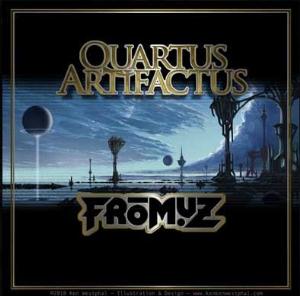
The splendid artwork, courtesy of the band’s official artist and US manager, Ken Westphal, offers an added bonus to both newcomers and fans of the band. Westphal’s style, here rendered in gorgeous shades of blue, green and grey, is subtly reminiscent of Roger Dean, though more streamlined – the dreamlike quality of the  inner gatefold image of water and sky tempered by a life-like touch. All in all, Quartus Artifactus provides a stunningly-packaged introduction to one of the best instrumental progressive rock bands on the current scene, and one that will hopefully get an opportunity to perform in the US in the near future.


Links:
http://www.fromuzband.com/

http://10trecords.com/

http://www.kenwestphal.com/


Read Full Post »

TRACKLISTING:
1. Overture 3.07
2. Il Tredici 11.46
3. Dark Age 6.18
4. The Guillotine 6.00
5. Timepiece 5.30
6. Sobriety 8.19
7. Tema 1.08
8. Steam 9.30

LINEUP:
Gadi Ben Elisha – electric and acoustic guitars, mandolin
Sagi Barness – bass guitar
Aviv Barness – keyboards, saxophone
Igal Baram – drums, percussion
Shem-Tov Levi – flute

With:
Michael Lam – English horn
Elinoy Yogev – bassoon

The name Sanhedrin will not fail to ring a bell with those who are familiar with the Gospels – either because of their religious upbringing or inclination, or for reasons of historical interest – as the name indicates the supreme court of ancient Israel by which Jesus Christ was tried. Though there are also three extreme metal outfits bearing the same name, this particular band (unlike the others, and like the original institution)  hails from Israel, a country whose contribution to the progressive rock scene has been steadily growing – especially in terms of quality – over the past few years.

Originally formed by brothers Sagi and Aviv Barness as a Camel tribute band, Sanhedrin soon started writing their own material, influenced by the golden era of progressive rock. After going through the usual turmoil of line-up changes, in 2006 they started recording their debut album. Four years in the making, Ever After was mixed and mastered by renowned Israeli sound engineer and  producer Udi Koomran, and completed in 2010 – to be released in February 2011 as on the Fading Records division of Italian label AltrOck Productions.

The musical connection between Sanhedrin and Camel will soon become evident even to a first-time listener. Andy Latimer’s crew, even if not as hugely influential on the younger generations of prog bands  as the likes of Genesis, Yes or ELP,  have clearly been a source of inspiration for many outfits who choose a more melodic direction while avoiding the excess of bombast that occasionally characterizes symphonic prog. Even if Camel have sometimes been rather unkindly indicted of being purveyors of ‘elevator prog’, or just a second-tier band lacking the clout of the bigger-name acts, it is undeniable that their restrained elegance has won over a lot of fans.

While Ever After may not be the most original album released in the past few months or so, it is definitely not overtly derivative – at least not as much as other albums which I have recently heard, and which are quite highly rated. Fading Records has been created for albums with a more traditional prog bent than the material usually issued by AltrOck Productions, and their first release, Ciccada’s A Child in the Mirror, was a stunning example of ‘retro-prog’ that managed not to sound like a carbon copy of the great Seventies bands. Ever After is much in the same vein, a classy product performed with impressive technical skill, yet exuding a sense of warmth and pastoral beauty that makes listening a genuinely enjoyable experience. While Camel are obviously the most relevant influence, on numerous occasions Pink Floyd (especially their early Seventies output) spring to mind, and echoes of early Genesis can also be detected. However, Sanhedrin also bring their own signature to the table: the ethnic references subtly scattered throughout the album (not just Middle Eastern, but also Celtic and central European) remind the listener of Israel’s multicultural milieu. Like Camel, the basic combination of guitar-bass-drums-keyboards is enhanced by the exquisitely soothing sound of the flute, with additional woodwinds also employed to add depth and dimension. Unlike the English band, though, Sanhedrin have opted for an exclusively instrumental format, which is quite an interesting choice, and a deviation from the standard symphonic tradition, where vocals play a rather important role.

As Israel is part of the Mediterranean region, it is not surprising to find echoes of vintage Italian prog right from the opening track, appropriately called “Ouverture”, together with a nice pinch of Middle Eastern spicing and jazzy touches. The 3-minute number sets the album’s mood very effectively, with its beautifully clear guitar tone, gentle flute and airy keyboards, the various sections flowing seamlessly into each other. The nearly 12-minute ”Il Tredici”, the longest track on the album (which runs at a very sensible 51 minutes), brings the Camel and Pink Floyd influences together in a majestic slice of gently melancholy symphonic prog, with magnificent Latimer- and Gilmour-inspired guitar leads and layers of keyboards. In spite of its slightly macabre title (suggested by the faint recorded sounds of an angry mob heard throughout the piece), “The Guillotine” alternates atmospheric, almost meditative moments with brisker ones driven along by organ and march-like drumming.

More ethnic influences emerge in the first half of “Dark Age”, possibly the highlight of the whole album, dedicated to fellow Israeli musician Arik Hayat of Sympozion, who committed suicide at the end of 2008. The lively, Celtic-tinged tune, described by lilting mandolin and flute, reminded me of some instances of Italian ‘minstrel’ Angelo Branduardi’s output, while the somber, organ-dominated mood of the middle section lifts towards the end, with a slightly dissonant passage suggestive of King Crimson. “Sobriety”, true to its title, merges the Celtic flavour of its flute-and-drum opening with the spacey yet majestic tone of Pink Floyd circa A Saucerful of Secrets (clearly referenced in a particular organ passage), and an intricate ending that brings martial drums and sharp, clear guitar to the fore. While “Timepiece” adds some almost tentative bouts of heavier riffing to a framework that combines the pastoral feel of Camel with the atmospheric mood of Pink Floyd, closing track “Steam” (introduced by the short acoustic interlude of “Tema”) explores definitely heavier territory, especially in its second half, where the assertive tone of the guitar and the subtle shifts in tempo commanded by bass and drums seem to suggest a running train; the electric piano section in the middle brought instead to my mind Ray Manzarek’s stunning performance in The Doors’ iconic “Riders on the Storm”.

While, as the previous paragraphs make it abundantly clear, Ever After may not be the most innovative proposition on the current prog scene, it is an album whose every note spells class and a deep love of the musical craft. A thoroughly enjoyable listen, highly recommended to fans of classic symphonic prog, especially those who lean more towards the instrumental side of things, it is an excellent debut from an equally excellent new band.

Links:
http://www.myspace.com/sanhedrin1

http://www.reverbnation.com/sanhedrin1

http://production.altrock.it/index.htm

Read Full Post »

TRACKLISTING:
1. Walk On Alone (12:31)
2. Voices (6:24)
3. Weapon (6:52)
4. What I Have Done (5:56)
5. Mind Over Matter (2:38)
6. Prelude (1:48)
7. World in Front of Me (11:19)

LINEUP:
John Baker – lead and backing vocals, guitars, guitar synthesizer, mandolin
Kerry Chicoine – bass, backing vocals
Steve Mauk – keyboards, backing vocals
Jerry Beller – drums, percussion, backing vocals

A quartet of experienced musicians based in Los Angeles, Mars Hollow were brought to the attention of progressive rock fans by the release of their self-titled debut album, almost one year ago. The highly awaited disc did not disappoint, and the band were immediately invited to perform at the 2010 edition of ProgDay, where I had the pleasure to meet them and see them on stage. In spite of the dreaded word ‘hype’ rearing its ugly head, or of those who may point out that Mars Hollow’s music does not really bring anything new to the prog table, and that it is also too poppy for its own good, the band’s dedication to music-making is undeniable, as is their professional attitude.

These days it is certainly not usual for artists to release an album a year, and long waits are often in order for fans of any musical genre. This seems to be even truer in the world of prog, when it is not uncommon for acts to let at least three years pass between releases – mainly due to those practical issues that I have often mentioned in my writing. Mars Hollow, however, chose to buck the trend by going into the studio a mere two months after their successful ProgDay appearance – with a well-respected musician and producer like Billy Sherwood (of Yes, Conspiracy and Circa fame) at the helm, and a strong commitment to delivering the goods in an even more impressive manner than their debut. Needless to say, the band’s sophomore effort – heralded by another prestigious live appearance, this time at the 2011 edition of ROSfest – was even more highly awaited than their debut, though the anticipation was tinged with the kind of anxiety engendered by far too many examples of anything but lucky second times.

While Mars Hollow, with refreshing honesty, have never claimed to be purveyors of daringly cutting-edge music (as is the case with some acts that, in my opinion, are nowhere as consistently good), World in Front of Me rises way above any considerations of innovation, progression, or whatever you choose to call it. Even though their self-titled debut was a hugely enjoyable slice of catchy, melodic prog with modern production values and all-round excellent performances, World in Front of Me is, simply put, pure gold – an album possessed of an almost timeless quality, a flawlessly executed homage to the best that progressive rock has to offer that, in many ways, transcends the very definition of prog. Odd as it may sound, I would compare it with another recent release that has left a lasting impression on me – Black Country Communion’s debut. Now, while the latter are definitely more of a classic hard rock act than a progressive one, their first album is also one of those very rare efforts that manage to reach a very high standard of quality without reinventing the wheel, so to speak.

Clocking in at a perfect 47 minutes, World in Front of Me is bookended by two 10-minute-plus tracks which – like “Dawn of Creation” on their debut album – eschew the tired, worn-out template of the ultra-convoluted (and ultimately patchy) ‘epic’ in favour of an orgy of enchanting melodies, splendid vocal parts, and scintillating instrumental interplay. With consummate sense of balance, the five tracks sandwiched between those two display a variety of moods, from the melancholy, mainly acoustic “Mind Over Matter” to the jagged, somewhat tense “Voices” – shorter, yet no less dense and involved. To use a cliché, Mars Hollow are like a well-oiled machine, their individual skills honed by years of experience and a genuine love of their craft, creating layer upon layer of lovely sounds that, while sustaining that uplifting quality so evident in their debut, are tinged with a hint of gentle sadness suggesting the wisdom that comes with maturity. And mature is probably one of the most effective descriptions for World in Front of Me: though lacking anything as infectious as “Midnight”, it is hard not to find yourself singing along the title-track or “Walk on Alone”, as well as listening raptly to the seamless ebb and flow of the instrumental passages.

As was the case with the band’s debut, World in Front of Me is strongly keyboard-based, with John Baker’s guitar used in a supporting (though indispensable) role rather than as the star of the show. However, Sherwood’s crystal-clear production has given the rhythm section a much more prominent role. Jerry Beller’s dynamic yet sophisticated drumming is not merely propulsive, but adds a lot of dimension to the music, sometimes following the melody laid out by the keyboards and guitar, sometimes playing in a sort of counterpoint; while Kerry Chicoine’s rumbling, pneumatic Rickenbacker bursts out of the densely woven fabric of the sound in a way rarely heard since Chris Squire introduced his ‘lead bass’ approach to the instrument. Indeed, Yes might be mentioned as probably the biggest influence on this album – though, rather than the toweringly unapproachable Yes of Close to the Edge fame, Mars Hollow bring to mind the band that, with their first three albums, gave the music world a textbook-perfect example of contamination between classic pop-rock and the fledgling progressive trend.

Steve Mauk handles his array of keyboards with impressive aplomb, supported by the relentless work of the rhythm section. While the gorgeously wistful, rippling piano piece that is “Prelude” puts him directly in the spotlight, his lush yet sedate contribution to the overall sound perfectly complements John Baker’s understated guitar work and commanding vocal performance. As I stated in my review of Mars Hollow’s debut, Baker’s voice – a soaring, admirably controlled tenor reminiscent of a smoother Geddy Lee, with touches of early Steve Walsh – may not be to everyone’s taste, but his handling of the somewhat downbeat, meditative lyrics (mostly focusing on the end of a relationship) is nothing short of masterful, and the harmony sections suggest the effortless grace of vintage Yes and, occasionally, even Gentle Giant.

As regards the individual tracks, opener “Walk On Alone” and the title-track are classic prog heaven, blending memorable melodies – catchy, though in a very subtle fashion, and dispensing with a conventional verse-chorus-verse structure – with instrumental passages of stunning elegance and understated complexity. While the former number is more airy and relaxed, the latter seems to slowly build up to a climax, with a sense of tension occasionally surfacing. “Voices” and “Weapon”, though shorter, are conceived along similar lines, successfully merging haunting vocal sections with intense instrumental passages; while “What I Have Done”, with its more streamlined approach and catchy harmony vocals, comes closest to the spirit of Mars Hollow’s debut, though without the bold airplay potential of songs like “Midnight” or “Eureka”.

Down to its stylish cover photo, depicting the stark beauty of the Death Valley desert, World in Front of Me is a supremely elegant album that succeeds in the task of combining accessibility with dazzling technical proficiency and a genuine feeling of warmth. Let us forget for a moment about ‘retro-prog’ or any such ultimately pointless labels. Mars Hollow’s intention was never to revolutionize the music world, but rather to produce an album that people will enjoy, cherish, and possibly relate to in terms of their own experience. A pleasure from start to finish, this is definitely a very serious contender for album of the year.

Links:
http://www.marshollow.com/

http://www.10trecords.com/


Read Full Post »

TRACKLISTING:
1. 4378th Day (15:41)
2. No (5:59)
3. War, Act 2 (21:06)

LINEUP:
Rodrigo San Martín – electric and acoustic guitars, bass, mellotron, hammond organ, Moog synthesizer, piano, keyboards, orchestra arragements, synthesized glockenspiel, drum programming
Jelena Perisic – vocals
Craig Kerley – vocals

South America has been a hotbed for progressive rock ever since the beginning of the movement, and Argentina – with its richly diverse musical heritage – is no exception. Even though Argentine prog bands are rarely household names, keen followers of the genre are well aware of the generally excellent level of those outfits. While many of those bands and artists follow in the footsteps of the classic symphonic prog tradition (with some of them displaying Italian prog influences – not surprising in a country where about half of the population is of Italian origin), many of the newer acts have embraced other styles, like progressive metal, and are not afraid of incorporating them into a traditional symphonic fabric.

Rodrigo San Martín is a gifted multi-instrumentalist with a lot of experience on the Argentine music scene as a musician, composer, producer and event organizer, in spite of his young age (he was born in 1988).  He is the lead guitarist of prog band De Rien, as well as the mastermind of the project Souls Ignite. His debut album as a solo artist, simply called 1, was released in April 2010, and featured a 40-minute composition performed solely by San Martín. Conversely, on his sophomore effort, There’s No Way Out (released in November of the same year), San Martín avails himself of the contribution of two guest singers, Jelena Perisic from Serbia and  Craig Kerley from the US.

Clocking in at a mere 42 minutes (a very short running time for today’s standards), There’s No Way Out has a distinctive structure, with two epic-length tracks bookending a more conventional song. The three numbers are different enough from each other to sustain the listener’s interest, and even the two epics are rather nicely balanced, projecting an impression of cohesiveness which is not always the case with long compositions. San Martín handles all the instruments with admirable expertise, though the unmistakably artificial sound of programmed drums is hard to miss, and sometimes clashes with the overall warmth of the music. On the other hand, the vocal performances are consistently good, both singers handling the material authoritatively and stamping their own individual mark on the songs.

Opener “4387th Day” is the closest the album gets to traditional symphonic prog, especially in the first half, dominated by atmospheric keyboards, mellotron and orchestral arrangements with flute and strings, as well as Jelena Parisic’s melodious, yet not sickly sweet voice. Then pace and intensity increase with the introduction of heavy guitar riffs and whistling synth, while towards the end things calm down again. “No”, running slightly over 5 minutes, functions as a sort of interlude between the two ‘main events’, and brings a classic rock note (with touches of AOR) to the ambitious prog context of the album. Distorted guitar, with a distinct Seventies flavour, features prominently here, and Craig Kerley’s gutsy vocal performance is a perfect fit for the overall tone of th song – though the juxtaposition of a more sentimental mood, enhanced by strings and harmony vocals, with harder-edged suggestions occasionally teeters on the brink of cheesiness.

The third and final track, “War, Act2”,  is the undisputed highlight of the album, and – at least in my view –quite superior to both the previous numbers. In spite of its 21-minute running time, it never outstays its welcome, and manages to paint a near-perfect sonic rendition of its title. Here, the contrast between furiously riff-driven sections bordering on extreme metal and dreamy, rarefied passages which, nonetheless, suggest a slow but relentless build up of tension works very well. Jelena Parisic’s voice, while still soothing and well-modulated, reaches for a lower register in order to convey a subtle feeling of menace, and the beautiful guitar solo in the middle brings to mind David Gilmour’s signature style, melodic yet faintly brooding. The frequently occurring changes o mood and pace, unlike what happens in other compositions of comparable scope and length, do not project an impression of patchiness, but rather create an impressively organic whole.

Though not without flaws (mainly lying in the use of programmed drums, whose all too recognizable sound often detracts from the listening experience), There’s No Way Out is a very promising album from an extremely talented young artist, featuring a healthy dose of eclecticism. While the more conservative set of prog fans may be turned off by the strong metal component, particularly evident in the final track, those with a more open-minded disposition are likely to appreciate Rodrigo San Martín’s skill as a composer and multi-instrumentalist. I will be definitely looking forward to hearing the forthcoming De Rien album, to see what he is capable of in a band context.

Links:
http://www.rodrigosanmartin.com.ar/


Read Full Post »

« Newer Posts - Older Posts »