Feeds:
Posts
Comments

Posts Tagged ‘Leonardo Pavkovic’

TRACKLISTING:
1. Baltasaurus (14:18)
2. Flying Trip (7:51)
3. Vietato Generalizzare (6:38)
4. Mosoq Runa (18:58)
5. The Mirror (10:16)
6. La Ballata de s’Isposa ‘e Mannorri (10:16)

LINEUP:
Alberto De Grandis – drums, percussion, vocals (5)
Alberto Bonomi – Hammond A-100 organ with Leslie 760, Fender Rhodes electric piano, Steinway acoustic piano, synthesizers, flute
Silvio Minella – electric guitars
Luca Baldassari – bass guitar

With:
Andhira (Elena Nulchis, Cristina Lanzi, Egidiana Carta) –  vocals (6)
Zoltan Szabo – cello (4, 6)
Maria Vicentini – violin, viola (4, 6)

Hailing from Shakespeare’s own ‘fair Verona’ (one of the most beautiful cities in Italy), where they formed in the mid-Nineties, D.F.A. (acronym of Duty Free Area) are living proof of the old Latin saying that a prophet has no honour in his own country. Hailed as one of the best progressive rock bands of the past decade, they took the NEARfest audience by storm in 2000, and offered a stunning repeat performance in 2009 – when I first saw them, and was floored right from the opening strains of  their set. However, as seems to happen all too frequently, they are barely known in their home country, where their extremely elegant yet punchy brand of Canterbury-tinged jazz-rock starkly contrasts with worship of all things Genesis that is still widespread in Italy. That historic first NEARfest performance was captured on the band’s 2001 live album, Work in Progress, which for over seven years remained the last testimony of the band’s activity.

D.F.A. are nothing but pure class. A quartet reproducing the configuration of bands such as Hatfield and the North and National Health – with both keyboards and guitar in a prominent role,  and the occasional contribution of other instruments – they are one of those rare outfits where each member’s contribution is essential to the band’s overall sound. Even if drummer Alberto De Grandis –  a drummer that, like Christian Vander or Daniel Denis, is much more than a simple timekeeper – gets most of the composing credits, all of the instruments get their chance to shine and create a tightly woven mesh of sound. Alberto Bonomi’s multilayered keyboards lay a lush tapestry for Silvio Minella’s brilliantly expressive guitar work; while Luca Baldassarri’s bass provides ever-reliable bottom end, adding fullness and texture to De Grandis’ propulsive drumming. D.F.A.’s music is effortlessly fluid, yet complex enough to please the most demanding jazz-rock fans – striking a perfect balance between technical skill and genuine emotion, breathless dynamics and captivating atmospheres.

Taking a leaf out of Soft Machine’s book, the album’s title is a simple numeral – not surprising, in the light of their affiliation with Leonardo Pavkovic’s far-sighted MoonJune label. Though it runs at almost 70 minutes, unlike the majority of albums running at over an hour it never outstays its welcome, and always manages to hold the listener’s attention. Most of the six tracks are instrumental, with one notable exception (on which more later). Interestingly, though D.F.A. do not sound as typically ‘Italian’ as those bands who opt for a more traditionally symphonic sound, they possess the inimitable flair for melody that seems to be ingrained in most Italian musicians. Their music is never harsh or needlessly convoluted, yet it also manages to eschew that somewhat overblown theatricality that can turn people off Italian progressive rock. It would be unfair to the band, however, to imply that they are mere Canterbury imitators. While D.F.A have a definitely international appeal (as proved by their choice of giving their composition titles both in Italian and in English), their Mediterranean inspiration – even if thankfully untainted by the overly sentimental excesses of Italian melodic pop – can be often keenly felt. This is one aspect that D.F.A. share with historic jazz-rock outfits such as Area, Il Baricentro and Napoli Centrale.

Chosen to accompany the opening images of the documentary film Romantic Warriors, “Baltasaurus” introduces the album in charmingly subdued mode, a feature shared by most of the tracks. Elegant guitar licks and flawless rhythm section lead the way for a splendid, mid-paced development, in which keyboards and guitar seamlessly interact, bolstered by De Grandis’ stunning drum work – never overwhelming, but very much a protagonist. Gently atmospheric sections alternate with more energetic ones, and the many tempo changes do not break up the smooth flow of the music. The following number, “Flying Trip”,  picks up the Canterbury references with a wistful mid-tempo spiced up by occasional jazzy, Latin-flavoured passages, and featuring some stunningly beautiful organ passages and delicate flute; while the barnstorming “Vietato Generalizzare” (It Is Forbidden to Generalize – the track with which D.F.A. opened their set at NEARfest 2009) barges in, propelled by a vertiginous synth riff and high-energy drumming. Very much guitar-driven, it allows Silvio Minella to display his considerable chops in an intense, expressive solo reminiscent of Gary Moore during his Colosseum II tenure. “The Mirror”, on the other hand, is a classic jazz-rock workout, with the instruments creating a keen, somewhat darker-hued sense of tension – though eased by snippets of muted singing at the beginning and in the middle of the track – and climaxing with an arresting, yet subtle drum ‘solo’.

That leaves the album’s epic, the almost 19-minute “Mosoq Runa” (Quechua for “new human being”), which, not surprisingly, displays a definitely more symphonic bent – thanks also to the presence of strings, as well as a recurring main theme. The amazing interplay between the instruments is nowhere more evident than here, and – in spite of its running time – the track never once feels overlong or overdone; as usual, both the guitar and the keyboards get their chance to shine, with Minella’s soloing at its most soulful. However, 4th’s most distinctive track is strategically placed at the close of the disc. Sung entirely in the ancient Sardinian language (the most archaic of Romance languages) by the heavenly voices of the folk trio Andhira, “La Ballata de s’Isposa ‘e Mannorri” (The Ballad of the Bride of Mannorri) is a tale of love, betrayal and vengeance that would be perfectly at home on a Pentangle album – in spite of the frequent comparisons between Andhira and Canterbury’s own trio of female vocalists, The Northettes. The three Sardinian vocalists, though, are less operatic and more emotional; the resonant contralto timbre of one of them lends even more depth to their performance. The minimalistic instrumental accompaniment does not divert the attention from the sheer beauty of the vocal interplay – though the bridge features a lovely, touching guitar solo that seems to echo the profound sadness of the story.

At the time of writing, D.F.A. are reported to be on indefinite hiatus, due to the all too familiar pressures of ‘real life’ (i.e. family and work) on any non-professional musician. It may even be that the band has reached the end of the road – which would obviously result in a great loss for the whole progressive rock scene. However, even if they indeed decide to call it a day, they will have left a lasting legacy in the history of progressive rock, both for the beauty and power of their music and their genuinely down-to-earth attitude – as captured in the aforementioned Romantic Warriors.. Needless to say, 4th is a must-listen for devotees of the Canterbury scene and classic jazz-rock, and very highly recommended to prog fans of every persuasion. This is one of the landmark albums of the first decade of the 21st century, and one of the very best productions to ever come out of the Italian progressive music scene.

Links:
http://www.myspace.com/dutyfreearea
http://www.moonjune.com/MJR021.htm
http://www.andhira.com
Read Full Post »

TRACKLISTING:
…Rattlin’ All the Time
:
1. Tarabos  (5:10)
2. Chloe And The Pirates  (7:56)
3. All White  (6:24)
4. The Man Who Waved At Trains  (3:54)
5. As If  (4:14)
6. Hibou, Anemone And Bear  (3:28)
7. Out-Bloody-Rageous  (8:36)
8. Pig   (4:28)
9. Esther’s Nose Job   (6:04)
10. Slightly All the Time  (9:32)

…Before the Moon:
11. Leonardo’s E-Mail  (4:11)
12. Moonvision   (2:17)
13. Many Moons, Many Junes  (3:05)

…After the Moon:
14. Lunar Impression  (1:17)
15. Circular Lines In The Air  (2:46
16. Moon Geezers (to Elton and Hugh)  (3:27)

LINEUP:
Beppe Crovella – Mellotron, Wurlitzer E200 electric piano, Fender Rhodes Stage 73 electric piano, Hammond organ M102, Hohner electric piano, Hohner Clavinet D6, Roesler Grand Piano, Farfisa Professional

This is meant as the second instalment in a trio of reviews of albums released by one of the most forward-thinking independent labels on the current music scene  – New York-based MoonJune Records. As a follow-up to View from Chicheng Precipice, here is another album that many listeners may very well see as nearly unapproachable, but whose authentically progressive nature can hardly be denied.

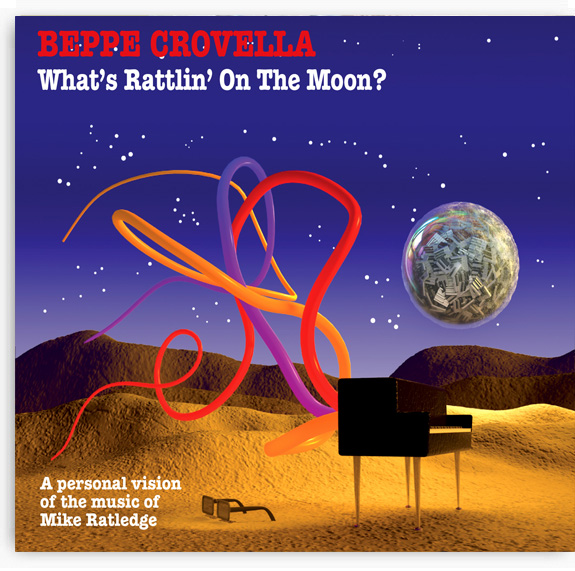
The subtitle to Beppe Crovella’s  What’s Rattlin’ on the Moon? reads “A Personal Vision of the Music of Mike Ratledge” – which alone should put paid to any allegations that this is yet another run-of-the-mill tribute album. An extraordinary musician in his own right, with an impressive career both as a solo artist and the mind behind Italian jazz-rock outfit Arti e Mestieri, Crovella is clearly not interested in faithfully reproducing music that is available elsewhere – but rather in offering his own reinterpretation of some of the legendary Soft Machine keyboardist’s ground-breaking compositions. The result of this daring, enlightened operation (conceived by Crovella and MoonJune Records mainman Leonardo Pavkovic) is a disc that, while anything but easy to approach, and obviously possessing very limited mass appeal, is a fascinating listen, especially for anyone with a keen interest in vintage keyboards.

Since the music of Soft Machine is undeniably an acquired taste in itself, commanding an almost fanatical adoration on the part of its fans, and an equally strong rejection on the part of ‘unbelievers’, an album offering an apparently one-dimensional take on said music is very likely to send a lot of people running for the exits. First of all, it requires quite a bit of patience on the part of the listener, even from those who should be used to the less than easily digestible nature of most progressive rock. Moreover, the distinct lack of the ‘rock’ part of the genre definition can prove a turn off – and the sheer length of the project (close to 80 minutes) is not likely to help sceptics warm to it.  However, those who will stick with the album and give it the attention it deserves will reap their rewards, because  What’s Rattlin’ on the Moon? offers many moments of real interest, and some of sheer delight.

A master of his craft, Crovella recreates the sound of an entire band with his array of vintage keyboards – ruling out the use of those synthesizers and their ilk that have become so indispensable in modern music-making. It is often astonishing to hear those keyboards fulfil the role of the bass or drums, though in most cases they just weave layers of sound in the Softs’ typically free-form style. As the album is divided into three recognizable parts,  the pauses between the individual numbers are almost non-existent – as if each part was meant to be listened to as a single track. This makes for a very distinctive listening experience, the polar opposite of a conventional song-based approach – though equally far removed from the somewhat sterile displays of technical dexterity that are often an integral part of ‘prog’ recordings.

The ten Soft Machine compositions are reinterpreted in such a way as to be nearly unrecognizable. This is especially the case of the two tracks from the band’s iconic Third album, “Out-Bloody-Rageous” and “Slightly All the Time”, the latter being possibly the highlight of the disc with its hypnotic yet melodic line and fascinating use of the Mellotron to provide choral effects. All the compositions share the same rarefied, riveting texture, which is intended to be savoured slowly, possibly not in one take. At every successive listen, different effects will unfold – pulsating,  surging, solemn, sometimes flowing, sometimes choppy, creating subtly shifting layers of sound. It is the kind of music that will fade in the background if left unattended, so to speak – meant to be listened to, not just heard.

The two mini-suites at the end of the album are original Crovella compositions intended, in some ways, to ‘describe’ the creative process behind the album. Both are largely piano-based and less idiosyncratic than the first part of the disc, with a stronger melodic development and some jazzy touches. “Moon Geezers”, dedicated to the sadly deceased former Soft Machine members Elton Dean and Hugh Hopper, closes the album on a suitably measured, melancholy note.

As already intimated, What’s Rattlin’ on the Moon? is not an album that will appeal to everyone, especially not those with short attention spans. It does, however, stand head and shoulders above the many hackneyed tribute albums that flood the progressive rock market. Experimental and very personal (even if a tad overlong), this is a must-listen for Soft Machine fans, and highly recommended to lovers of genuinely personal takes on prog classics.

Links:
http://www.beppecrovella.com/

Read Full Post »

TRACKLISTING:
1. Three Views From Chicheng Precipice (after Bai Yuyi) (9:52)
2. Tangabata (15:52)
3. Kan Hai De Re Zi  (Days by the Sea) (3:44)
4. Aviariations on “A Hundred Birds Serenade the Phoenix” (6:48)
5. Bagua  (Eight Trigrams) (10:41)

LINEUP:
Dennis Rea electric and resonator guitars, melodica, Naxi jaw harp, kalimba, dan bau (Vietnamese monochord)
Alicia Allenviolin (1, 3)
Greg Campbell drums, percussion (2)
Ruth Davidson cello (1, 3)
James DeJoie bass flute, bamboo flute, bass clarinet (2)
Caterina De Re voice (4)
Stuart Dempster trombone, conch shell (2)
Will Dowd – drums, percussion (1)
Elizabeth Falconer koto (5)
John Falconer shakuhachi (5)
Jay Jaskot drums (3)
Paul Kikuchi percussion (5)
Kevin Millard baliset (3)

In spite of China’s venerable musical tradition, very few people outside the ‘Asian studies’ circles are aware the authentic musical heritage of the Far East, unless it is in the most superficial of terms. Mentions of Chinese music might conjure, at least to the uninitiated, memories of the cheesy (when not downright ghastly) ‘sonic wallpaper’ that will accompany a meal in most Chinese restaurants of the Western world. However, I am happy to report that Views from Chicheng Precipice – the first recording effort solely credited to Seattle-based guitarist and composer Dennis Rea, a true veteran of the progressive music scene of the US Pacific Northwest – is light years removed from any such kitschy scenario.

Those who are familiar with Rea’s current main projects, the eclectic art-rock of Moraine and the improvisational jazz-rock of Iron Kim Style, will probably find themselves somewhat puzzled by this album – which, on the other hand, provides further proof of the guitarist’s broad horizons and dedication to the pursuit of creative musical avenues. While world music may be all the rage in a some circles, it is nevertheless not easy to find artists that approach the tradition of a country as distant (both literally and metaphorically) as China with such rigorously philological spirit as Rea manages to do – informed by his first-hand, in-depth knowledge of the musical and cultural background of both China and Taiwan, where he spent the years between 1989 and 1993.

Recorded between 2006 and 2008, Views from Chicheng Precipice sees the participation of members of both Moraine and Iron Kim Style, as well as other musicians from the Seattle scene, such as Japanese music specialists Elizabeth and John Falconer, and trombone master Stuart Dempster. Running at under 50 minutes, the album features five tracks presenting different facets of the Chinese musical heritage, seen through the eyes of a Western artist in a respectful yet uniquely personal way. Indeed, four out of five numbers (the sole exception being the title-track) are traditional compositions arranged by Rea so as to preserve their spirit even when reinterpreting their form.

Out of those five tracks, the East-West collision of “Days by the Sea” might almost be described as a pop song of sorts (also on account of its markedly shorter running time). Rea’s guitar weaves a tune that, while respectful to the original, incorporates elements of African-American blues, sparring with Alicia Allen’s violin in a stunning dialogue that brought to my mind Rea’s work with Moraine. The title-track, on the other hand, is built around three pentatonic motifs that comprise an original sonic triptych, with a recurring theme and plenty of scope left for improvisations. The composition was performed by Moraine during their performance at NEARfest 2010, though not many members of the audience were able to grasp its sheer elegance and grace in a live setting. Here the triptych comes across in all its understated power, the seamless flow of the music evoking the beauty of the titular mountain landscape (Qingcheng Mountain is the site of a Daoist sanctuary in China’s Sichuan Province). Rea’s guitar converses smoothly with Allen’s violin, while a drum-led improvisation adds a free-jazz touch to the central part of the composition.

The remaining three numbers are of a distinctly more challenging nature, since each of them develops in a fashion that is definitely less attuned to the Western ear. The 15-minute “Tangabata” and the 10-minute “Bagua” both have their roots in ceremonial music, as borne out by their stately, measured pace. The latter makes use of traditional Japanese instruments such as the koto and the shakuhachi (a bamboo flute), supported by solemn yet dramatic percussion work in the creation of a gently meditative mood. “Tangabata”, though a far from accessible piece, might be called the real highlight of the album. While featuring a distinctly Western-flavoured, free-jazz improv section at its very end, most of the composition remains faithful to its ancient origins – a sparse melody of austere beauty, almost suspended in time, made of deep, echoing sounds occasionally brightened by chiming bells. Finally, in “Aviariations on A Hundred Birds Serenade the Phoenix” (whose gently punning title reflects Rea’s ever-present sense of humour) the Chinese oboe traditionally used in the titular piece is replaced by Caterina De Re’s piercing vocal acrobatics, mimicking birdsong in a performance that brings together contemporary Western academic music and Chinese opera. Rea plays guitar and kalimba, whose sounds almost merge with De Re’s impossibly high notes.

Miles away from any tawdrily commercial ‘world music’ recreations, Views from Chicheng Precipice is, as Rea himself puts it, a love letter to the country where he spent four years of his life, an experience that was essential for his development as a musician. A refined, understated listen, it is an album made of subtle contrasts of light and shade, and as such needs to be approached with respect and concentration. The music possesses the delicate, almost brittle beauty of Far Eastern art, in stark contrast with the ‘in-your-face’ nature of much that is fashionable in this day and age. Being such an unabashed labour of love, imbued with profound feelings towards the country and its culture, sets it head and shoulders above the many blatantly contrived releases flooding the current music market. Those who will find themselves intrigued by the album could do much worse than get hold of a copy of Dennis’ book Live at the Forbidden City, a thoroughly enjoyable, extremely well-written account of his years in China and Taiwan – and a perfect companion to this disc. A special mention is also deserved by the stunningly minimalistic cover artwork and detailed liner notes – a simple yet classy package for an album that everyone with an interest in world music should check out.

Link:
http://www.dennisrea.com

Read Full Post »

« Newer Posts