Feeds:
Posts
Comments

Posts Tagged ‘MoonJune Records’

TRACKLISTING:
1. Irreducible Complexity (3:39)
2. Manifest Density (3:45)
3. Save the Yuppie Breeding Grounds (4:07)
4. Disillusioned Avatar/Dub Interlude/Ephebus Amoebus (10:25)
5.  Disoriental Suite (11:46):
a) Bagua
b) Kan Hai De Re Zi
c) Views from Chicheng Precipice
6. Kuru (4:31)
7. The Okanogan Lobe (7:36)
8. Uncle Tang’s Cabinet of Dr. Caligari (3:44)
9. Blues for a Bruised Planet (4:35)
10. Waylaid (5:31)
11.  Middlebräu (9:09)

LINEUP:
Dennis Rea – guitar
Alicia DeJoie – violin
James DeJoie – baritone sax, flute, percussion
Kevin Millard – NS/Stick (8-string extended-range bass)
Stephen Cavit – drums, percussion

Two years after the release of their debut album, Manifest Density, Seattle-based quintet Moraine enjoy an impressive reputation as one of the most eclectic outfits on the modern progressive rock scene, purveyors of music that, while constantly dynamic and challenging, is never devoid of atmosphere and melody. In the months between the release of the album and their career-defining performance at NEARfest 2010, the band, led by veteran guitarist and composer Dennis Rea, underwent a lineup change, with the departure of cellist Ruth Davidson and drummer Jay Jaskot that determined a distinct shift in their sound.

For their sophomore effort – bearing the brilliant name of Metamorphic Rock, which, like the band’s own, reflects Dennis Rea’s passion for geology and mountaineering, as well as referring to the metamorphosis undergone by the band – Moraine have chosen a rather unconventional format. Though it is a live album, capturing their NEARfest set in crystal-clear detail, it focuses on new, unreleased material as much as on compositions originally featured on Manifest Density. The latter have been rearranged to accommodate the obvious differences in sound due to the presence of a baritone saxophone instead of a cello, their running time often extended as if to indulge the average prog fan’s preference for longer tracks.

With five members coming from very different musical backgrounds, Moraine are quite unlike conventional prog bands in being much less prone to reproduce their compositions verbatim when on stage, and thrive on freedom of improvisation. This diversity results in a headily eclectic direction, blending rock with jazz, funk, blues, world music and avant-garde, which however never descends into the sprawling “kitchen sink” approach adopted by many acts, with often debatable outcomes. Since its very beginning, Moraine has been a collaborative effort, with every member getting an opportunity to contribute to the songwriting – even if Dennis Rea gets the most credit on this album as a composer. As much as he is the band’s mouthpiece and most experienced member, even a cursory listen to either of Moraine’s albums will reveal a dense, tightly woven structure in which all instruments bring their own distinctive voice, and no one overwhelms the other.

The 11 tracks chosen for the band’s NEARfest set highlight their unique dynamics and the wide range of influences and ideas that characterize their compositional approach. Traces of their beginnings as a “chamber rock” outfit (or, as Rea puts it, a string quartet with drums) emerge occasionally throughout the set, but the definite rock turn taken by the band is hard to miss. In its three minutes, opener “Irreducible Complexity” effectively sums up the “new” Moraine: written by James DeJoie, it emphasizes how seamlessly the saxophone has become part of the whole, replacing the solemn drone of the cello with its more forceful tone, acting both as foundation (together with Stephen Cavit’s understated but subtly propulsive drumming and Kevin Millard’s versatile 8-string bass) and as a protagonist, in combination with the flowing, melodic strains of Alicia DeJoie’s violin and Rea’s clear, almost tinkling guitar.

Interestingly, the majority of Moraine’s compositions seem to make use of a leitmotiv device, a main theme, generally introduced right from the beginning, which crops up in different parts of a song, rendering it more memorable as well as more cohesive. This device is also explored by “Manifest Density”, with its catchy guitar-sax-violin riff, and the more angular “Kuru” – as well as newer material like the hauntingly majestic “The Okanogan Lobe”, and the forceful, slightly chaotic “Waylaid”. Like many of those RIO/Avant bands they have often been compared with, Moraine balance beautifully melodic, lyrical sections, dominated by Alicia DeJoie’s soaring violin, with others where a carefully controlled chaos seems to reign. “Uncle Tang’s Cabinet of Dr. Caligari” represents the band’s noisier side; while in the 10-minute medley of “Disillusioned Avatar/Dub Interlude/ Ephebus Amoebus”, all the different souls of Moraine are given a voice – from the gorgeously melancholy, violin-driven beginning – a masterpiece of careful atmosphere-building with its loose, rarefied texture – to the lazy reggae pace of the “dub interlude” (which allows the rhythm section to step into the limelight), finally climaxing with an effects-drenched, free-jazz workout.

Running at almost 12 minutes, the amusingly-named “Disoriental Suite”, based on Dennis Rea’s solo album Views from Chicheng Precipice illustrates Moraine’s more meditative side, opening with a gentle, lilting melody enhanced by James DeJoie’s flute, and culminating with a sparser, more experimental, violin-led section. As its title implies, the somber mood of “Blues for a Bruised Planet” – a fresh take on the old warhorse of the blues ballad – expressed by the mournful voice of the sax and reinforced by violin and guitar, stems from Dennis Rea’s deep concern with the sorry state of Planet Earth. My personal favourite from the band, the towering “Middlebräu”, closes the album with a bang, its funky intro followed by a short, snappy drum solo, and then culminating with the gorgeous, slow-motion coda in which the interplay between guitar and violin reaches unparalleled heights.

The sheer quality of the recording (mixed by legendary Seattle-based engineer Steve Fisk) and the brilliance of the individual performances more than compensates for the editing of Rea’s unassumingly witty on-stage banter – my only quibble about an otherwise outstanding album. As I pointed out in my review of the 2010 edition of NEARfest, Moraine were by far the most authentically progressive band on the bill. Moreover, their particular brand of “East-meets-West” is quite far removed from cheesy attempts at exoticism for its own sake, but rather motivated by genuine love and interest for different musical modes than ours. Needless to say, Metamorphic Rock is unlikely to be fully appreciated by symphonic prog traditionalists, especially those who object to the absence of keyboards, but it is otherwise highly recommended to all open-minded prog fans. Another contender for my personal Top 10 of 2011 – hoping for a third album some time in 2012.

Links:
http://www.moraineband.com

http://www.moonjune.com

Read Full Post »

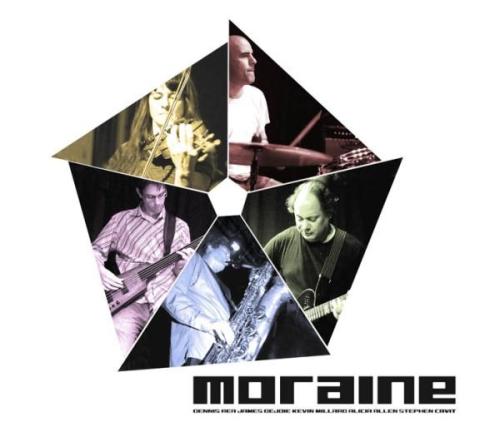
Seattle-based band Moraine, one of the most interesting finds by MoonJune Record’s volcanic mastermind, Leonardo Pavkovic, first came to the attention of the progressive rock scene in 2009, with the release of their debut album Manifest Density. Their reputation as purveyors of complex, intelligent and energetic music with a definitely eclectic bent – chamber rock with an edge – was consolidated by their exhilarating performance at the 2010 edition of NEARfest, and, earlier this year, by a short but successful East Coast tour. With the official release of their second album, Metamorphic Rock (recorded on the occasion of the above-mentioned NEARfest appearance) less than a month away, band members – guitarist Dennis Rea, violinist Alicia DeJoie, saxophonist Jim DeJoie, bassist Kevin Millard and drummer Stephen Cavit – have kindly agreed to share some of their thoughts and experiences on behalf of my readers.

———————————————————————————————————————

Let us start with a rather unoriginal, though obligatory, question. How did the band come into existence, and what was the reason for its inception?

Dennis: Speaking of metamorphosis, Moraine has mutated so thoroughly since its inception that its origins as a free-improvising duo between myself and cellist Ruth Davidson are barely discernable now. The project began as a casual series of get-togethers with no specific agenda; there was certainly no expectation that it would evolve into the type of band it is today. As the musical relationship deepened, both of us brought in some compositions and it soon became apparent that the music would benefit from additional instruments. So we enlisted violinist Alicia DeJoie and drummer Jay Jaskot and named the newly formed band Moraine, a term denoting the debris carried along and deposited by a glacier, very apt for our part of the world. I had worked with Alicia in singer-songwriter Eric Apoe’s group They and knew that she would be perfect for what I had in mind. Jay had been the drummer in my late-90s band Axolotl and we had always been keen to continue our musical partnership.

After briefly trying out a couple of bassists, we found the ideal fit in Kevin Millard, who had played with Ruth back in their native Minnesota; it was an odd coincidence that I met the two of them independently. This lineup persisted for a year or so until Ruth departed for graduate school on the East Coast and Jay relocated to New York City. The drum chair was filled by Stephen Cavit, a longtime musical associate of mine who, in addition to being a phenomenal drummer, is also an Emmy Award–winning film composer and choir director. We considered replacing Ruth with another cellist but didn’t know any in Seattle who had the right temperament for this particular project, so we decided to deploy woodwinds (primarily baritone saxophone) in place of cello. James DeJoie was an easy choice for this role because he is not only one of the finest and most versatile saxophonists in the Pacific Northwest, but also is married to Alicia and thus had already grown familiar with our repertoire. This lineup has been in place for about two years now, and there’s every reason to believe that it will continue indefinitely.

Most of the interviews I have read so far seem to focus on Dennis Rea’s background. However, this time I would rather concentrate on everyone else’s experiences prior to joining the band. What prompted you to join, and how different are Moraine from your previous (or even current) musical experiences?

Alicia: When Dennis Rea approached me about Moraine, I was immediately interested. I had played with Dennis before and had greatly enjoyed it, profoundly impressed by his unique sound and compositional prowess. I had also seen him in the group Axolotl and absolutely loved that band, and was very excited to learn that Moraine would be doing some tunes in common. Moraine is unlike any band I’ve ever been in – our sound is unique, ultra-creative, yet what I like to think of as approachable. In addition to the musical camaraderie shared amongst us in the band, we all get along extraordinarily well as people, which is another aspect of the group I love and appreciate.

Jim: Prior to joining Moraine, I was doing a lot of jazz (well, still do!). I’ve always played in a few large ensembles as well as my own groups. I feel I have a little different take on “jazz” than most, by including “rock” and “pop” elements into the revered jazz world. I have been into using effects on my saxes, flutes, and clarinets for years and really love exploring the sounds created with what are essentially guitar efffects. When Ruth Davidson (Moraine’s cello player) left the band to continue her educational pursuits, Dennis asked if I would be interested in joining. The range of the bari sax and bass clarinet seemed an appropriate replacement for the cello (and they were rehearsing at my wife’s and my house!). I did have some reservations at first, only because I knew my sound would be a completely different thing for the group. I said “yes” with the condition that if it didn’t work out, Dennis could fire me – no hard feelings. Needless to say, I think it’s working out fantastically!

Stephen: When Dennis called me to potentially replace Jay (how is that possible?!?), I was fully engrossed in my composition career — during which time I’ve won an Emmy Award and been named a Sundance Composers Lab Fellow, among other great honors. I had been pretty active in the Seattle music scene before returning to live in Los Angeles for work in early 2000. When I made it back to Seattle a few short years later I found the scene had changed substantially and I didn’t recognize many of the new faces. Which is what made Dennis’ call all the more sweet: I was really jones-ing to perform again!

Kevin: My earliest musical experiences in Seattle (having moved here in ’96) were in the experimental music circles; I met Dennis back then.  He was playing in a band I adored called Axolotl, and my own band at the time (Panopticon, we called ourselves “avant-groove” or “trailer park jazz”) briefly shared a practice space with them.  I also had known Ruth back in Minneapolis; when she moved here, I introduced her to Dennis’ music.  Fast forward several years: imagine my delight to find they had formed an amazing band.  A month after seeing Moraine for the first time, their bassist left town suddenly.  I auditioned, and the fit was very natural.  I love playing music with such good friends.  The band’s music itself is very close to my heart, being a fan of Dr. Nerve, Univers Zero, and 70’s King Crimson.

What is your approach to your respective instruments, and to the compositional process? What about your main musical influences?

Dennis: In a word, I am nondoctrinaire in my approach to playing the guitar; that is, I don’t subscribe to any particular doctrine, ideology, or school of playing. I’m not a jazz guitarist, I’m not a rock guitarist or avant-garde guitarist, but simply a guitarist who is free to exercise any of my many musical interests.

Although I started out taking the standard lessons like everyone else and have periodically studied this or that aspect of music making, I’ve had relatively little formal musical training. I long ago came to the realization that my gift is my ear and that a more intuitive, listening-based approach suits me best. I can read music with a gun to my head but prefer to communicate simply through playing whenever possible. Some people have commented that my playing has a ‘searching’ quality, and that’s because I am literally searching for the right note or phrase rather than following patterns and formulae. As for composing, most of my tunes begin with a single musical motif that gets embedded in my mind; from there I begin crafting variations and complementary parts for my fellow musicians. I typically compose the other players’ parts in my pieces while making sure to leave them ample room for soloing and interpretation. Most of this polyphonic writing actually takes place in my head rather than on paper, when I’m walking down the street or doing something similarly innocuous – I seem to have the ability to hear fully formed pieces in my imagination. I then bring the parts to the other musicians at rehearsal, either in written or recorded form or transmitted using a sort of musical onomatopoeia.

As for my main influences, it’s futile to try to compress them into a baker’s dozen, but some very important influences would have to include John Abercrombie, Art Ensemble of Chicago/AACM, Derek Bailey, Paul Bley, Anthony Braxton, Brotherhood of Breath, John Cage, Eugene Chadbourne, Don Cherry, John Coltrane, Cui Jian, Miles Davis, Stuart Dempster, Eric Dolphy, the ECM catalog in general, Bill Evans, free improvisation, Fred Frith, Stan Getz, Egberto Gismonti, Jimi Hendrix, King Crimson, Gyorgy Ligeti, John McLaughlin, Charles Mingus, Ben Monder, the NYC No Wave movement, William Parker, Harry Partch, Annette Peacock, Jim Pepper, psychedelia, George Russell, Terje Rypdal, Elliott Sharp, Soft Machine, Sun Ra, Toru Takemitsu, Keith Tippett, Ralph Towner, Robert Wyatt, and the music of Brazil, Cambodia, China, Korea, the Naxi people of southwest China, North Africa, Vietnam, and Xinjiang

Alicia: My approach to the violin is to be as present as I can with the instrument while I’m playing, yet free enough to plunge into the unknown, stretching the gamut of sounds the instrument is capable of making. The solid, sonic landscapes laid down by Moraine compositions provide compelling foundations which inspire me to explore myriad melodic and rhythmic elements when soloing. The compositions I’ve brought to Moraine have all started at the piano and migrated to the different instruments from there. I love knowing that when I bring a new piece to rehearsal, the rest of the band will contribute much more with their unique sounds and ideas. Every piece is then honed, enhanced, and ultimately transformed into an expression of the entire band.

Jim: Well, I’ve always approached all my instruments with the mantra “sound first.”  In other words, tone and passion – the effects I use are extensions of my acoustic tone and feel. Compositionally, my ideas generally come from the sax and piano – once an idea starts, I  try to keep fleshing it out until it feels done – I have many, many unfinished pieces! My main influences are wide: John Hollenbeck, Miles Davis, Yusef Lateef, Ornette Coleman, and Tom Waits are some of my personal heroes. Of course there are many others: Eric Dolphy, George Crumb, Morton Feldman, Jim Black, Chris Speed, Portishead, Battles, Anthony Braxton, Dave Douglas, David Bowie… There is so much great music to explore.

Stephen: I haven’t written anything for Moraine, probably because I am not a tune writer and feel more than a little intimidated by the prospect, but I do have a very developed process when it comes to scoring for film…..   I have pretty broad influences and, in regards to drumming, I would cite Paul Motian, Ed Blackwell, Gene Lake, and a few others of that ilk as my favs. When I first joined Moraine the music seemed to have a free-flowing jazz sensibility, more so than the driving rock sound it has today. The music spoke to me in that way and I feel, as a whole, our arrangements became tighter and more dynamic as a result of that shift.  In terms of what I listen to daily, I am mostly a classical music junky. I enjoy Eastern European post-minimalism, in particular, including most of the usual suspects like Arvo Part and Henryk Gorecki and some possibly lesser known composers like Petris Vasks. It’s hard to say how that listening effects my drumming on a conscious level, but I’m certain it does. There’s a much more direct influence on my choral, concert and film work.

Kevin: I am a bit of a “red-headed stepchild” in Moraine, given that I don’t read music and am self-taught on tapping instruments and bass guitar.  (I’m not ashamed to admit that the Violent Femmes and Tones On Tail helped inspire me to take up the bass.)  But when I picked up my first Chapman Stick, it encouraged my dabblings in music theory and into “fancier” music.  My only real ‘bass idol,’ as it were, is Mick Karn (RIP) – a humble, self-taught iconoclast whose lack of formal training helped him develop his own unique tones and voice.  As for composition, I am not much of a tune-writer, having contributed only one tune to Moraine thus far (which was a tune I wrote for Panopticon).  I prefer to take more of a collaborative approach to writing music, probably because I am secretly a lazy man.

How has Moraine’s sound developed since its beginnings, and how did it change with the addition of Stephen and Jim?

Dennis: As mentioned previously, the group began as a free-improvising duo, morphed into a sort of chamber-rock quintet with a ‘string quartet plus drums’ configuration, and then arrived at its current lineup of guitar, violin, woodwinds (including flute), drums, and bass (an eight-string NS/Stick, to be precise). The net result of this transformation is that we are much more of a rock band now, albeit one that is just as likely to make excursions into jazz, world (particularly East Asian) music, and any other musical dialect that interests us.

The addition of Stephen and Jim pretty cemented our current, more forceful approach, for a number of reasons. For one thing, we had often faced challenges making the cello heard in an electric band setting due to issues with amplification, feedback, and overlapping range, whereas Jim’s baritone saxophone, fitted with a microphone, cuts through loud and clear. And unlike his more straightahead jazz gigs, Jim sees in Moraine an opportunity to explore creative sound processing, so his use of various effects such as harmonizers further beefs up the group sound, to the point where it’s almost as though we have a second heavy-duty guitarist on board. Alicia has recently begun incorporating more effects into her sound as well, which opens up a whole other set of possibilities.

Our previous drummer, Jay Jaskot, is a gifted musician whose heart really lies in jazz. With Moraine, he tended to play freely across the bar lines rather than delineate the transitions in our compositions. This approach often produced marvelous results, but as our repertoire grew increasingly intricate, the music called for a more architectural rather than free-flowing style of drumming. While Stephen is also adept at playing jazz, his parallel career as a composer brings a more structural approach to the music, thus enhancing dynamics and lending more drama to the music.

Since I was present at NEARfest 2010, where I had the pleasure to meet all of you for the first time, I am interested in your take  on the whole experience – especially as the future of the festival seems to be hanging by a thread. I also know that most of you had had no involvement with the “prog scene” prior to the release of Manifest Density. What have been your impressions so far?

Dennis: For us, NEARfest was a dream gig in every respect. We were frankly stunned to have been invited, given our exceedingly low profile among progressive rock enthusiasts at the time. Indeed, I saw quite a few “Who?” responses to the announcement in Internet forums. That makes it all the more satisfying that our set was not only well attended but very enthusiastically received.

To put things in perspective, our gigs in Seattle are typically in small dive bars and cafes for about 10-20 people. We’ve landed some decent gigs at local festivals and performance series, but nothing remotely approaching the caliber of NEARfest. It goes without saying that we had never experienced such top-flight sound, lighting, and acoustics as a band, and indeed that’s what made Metamorphic Rock possible. For starters, the warm hospitality and overall good vibe fortunately elicited one of the band’s best performances to date. The recording we obtained from NEARfest was of superb audio fidelity, and subsequent mix work with legendary Northwest producer / sonic genius Steve Fisk and mastering wizard Barry Corliss made it even richer. It’s the best-sounding specimen of my own playing ever.

I was especially blown away to find myself sharing a stage with what was essentially Gentle Giant (Three Friends), one of my towering musical icons. And the experience of connecting with so many like-minded people (yourself included) was priceless.

I was dismayed at the sudden, unexpected cancellation of this year’s NEARfest – since we played on the festival’s last day in 2010, I sometimes quip, ‘Was it something we played?’ Seriously, I really hope that the organizers regroup and come back stronger than ever next year, and some of them have indicated to me that they will. I really don’t want to get caught up in the controversy over why public support for NEARfest dropped off so abruptly this year, though I suspect that part of it is that a certain segment of the once-loyal NEARfest audience doesn’t have the patience for newer bands like ours.

Alicia: We had a fabulous time at NEARfest 2010. I was thrilled at the response we received there, as well as the wonderful contacts we made and have kept since then. Our East Coast tour in the spring of 2011 was a small reunion of sorts with many of the people we met at NEARfest, which makes the release of our upcoming album Metamorphic Rock: Live at NEARfest that much more exciting to us.

Jim: I loved the experience. Usually, I consider myself a “journeyman” in a lot of groups – sort of show up and play and try not to make too many requests. But the NEARfest people were so accommodating and nice, it made the whole time a great experience (and for once I didn’t feel bad asking for more of me in the monitors!). The “prog scene” seemed really cool to me – full of people who truly love and are excited about music, a phenomenon not always associated with the “jazz” crowd. I’m disappointed to hear that the festival may not be happening in the future.

Stephen: If  having two drum techs is any kind of a taste of heaven, then I will be sure to be a good boy! We were so well cared for by people who clearly had a passion for this music. Fortunately, I was the only band member not to have any of the famous, high-octane espresso before the gig (I don’t drink coffee); otherwise, it’s possible Metamorphic Rock would have turned supersonic!!

Kevin: NEARfest was such a fantastic experience.  Having such an accommodating and friendly technical staff was a special pleasure (heck, having *any* technical help at all was a rare treat for us!, but seriously, the NEARfest crew was superb).  The coffee before the show was truly world-class.  And playing through not one but TWO full SVT 8×10 stacks was wish-fulfillment fantasy for me.  If NEARfest is, or was, the prog scene, then I look forward to more!  Such great audience and staff as well.

You recently completed a 4-date tour of the US East Coast. Do you consider it a success, or do you wish you could have done something otherwise?

Dennis: Though it was a modest tour by most measures, we felt that it was an almost complete success, marred only by some problems with borrowed equipment and a rather thin turnout in Philadelphia, but it was after all a Sunday night. Even so, we played very well that night and went down great with the the audience. Overall we received a tremendous response at every tour stop and offers to come back anytime (and we will). It was an almost disorienting contrast to our usual lot in Seattle (more on that below). In several cases people traveled long distances to see us, which was humbling; some had seen us the previous year at NEARfest and wanted more. Audience enthusiasm was palpable, and that fed into the music and charged up the performances. What’s more, we were astonished to actually break even on our travel costs through admissions and merchandise sales, which was wholly unexpected. We’ve also noticed that the touring experience has lifted us up to a new level of confidence and tightness – the Seattle shows we’ve done since then have been very high-energy.

Playing East Coast venues did underline our isolation in faraway Seattle. It was hard not to conclude that there is far more support for progressive rock in the U.S. Northeast than out in the Northwestern Hemisphere; folks back there might not think so, but all things are relative. Naturally, this makes us eager to return for more, but the geographical distance makes it a steep challenge to bring a five-piece band across the country without going deep in the hole. But we’ll be back, one way or another.

How did the new tracks featured  on Metamorphic Rock come about, and what makes them different from the material on Manifest Density?

Dennis: What’s different about our newer material is that it is being written expressly with our current instrumentation and musical personalities in mind, whereas many pieces on the previous two CDs were written before Moraine was formed and then adapted for our specific instrumental resources. Everyone in the band has a stake in the new material, and most of us are writing.

There are also different considerations when writing for woodwinds rather than cello. This will be apparent to those who listen to Metamorphic Rock who’ve also heard Manifest Density. We considered releasing a shorter version of the concert at first, to avoid repeating tracks that appeared on the first album, but found the total listening experience to be so cohesive that the energy would be sompromised by removing any pieces from the set list. We felt that it was excusable to reissue tracks from Manifest Density because with the new lineup, the arrangements are sometimes dramatically different from the previous versions. I’m pretty confident that people will be down with the record’s mix of new and refashioned material.

I know that you have been asked about your name more times than you care to admit, so this time I would rather inquire about the new album’s name, which sounds fantastic. Does it have anything to do with the Pacific Northwest being a heavily volcanic area?

Dennis: Not exactly, as volcanic rock is considered igneous rather than metamorphic rock. Due to the geological nature of our name, I like the idea of threading that theme through our work, not because it has any direct bearing on the music itself but because it’s a perennial area of interest for me. In fact, one of the song titles on Metamorphic Rock, “The Okanogan Lobe,” continues the theme, for the track’s namesake was a feature of the vast ice sheet that once covered parts of Washington State.

Strictly speaking, metamorphic rock isn’t related to moraines, except in an incidental way. Metamorphic Rock occurred to me in a flash of insight as the perfect way of answering that perennial question dreaded by musicians, ‘What type of music do you play?’ In our case we play a variety of rock music that continually seeks to transform itself, hence metamorphosis, hence Metamorphic Rock, which also plays on rock music and underscores that our music-making is a dynamic process.

While Seattle is commonly perceived as a sort of mecca for rock music, I know your experience is rather different, especially as regards getting opportunities for live performances. What are the main strengths (if any) and weaknesses of the Seattle scene?

Dennis: Seattle gets a lot of hype for being a happening music town, but personally I think it’s greatly overrated. As in any city its size, you can find many fabulously gifted musicians working in any genre you can name, but by far the lion’s share of opportunities and attention go to unimaginative indie rock and, lately, the fad for stovepipe-beard neo-Americana. There is no prog scene as such, and while there are a fair number of musicians whose music more or less fits that description, venues that will occasionally present that sort of thing are rare as hen’s teeth, and attention from the local music press scarcer still. Apart from the local jazz publication, where we have allies, Moraine has never received a single mention in any of the Seattle weeklies or arts/music scene rags – and yes, we do send them our CDs and press releases. But if I were to tattoo a middle finger on my forehead, guzzle a flask of Jägermeister, moon the audience, and throw up on the drummer, I can guarantee that there’d be a breathless feature profile of me in the local paper the following week 😉 While Seattle certainly has no monopoly on this sorry state of affairs, the fact remains that for a majority of listeners, physical appearance and attitude trump the music itself.

Lately I’ve seen some signs of a possible resurgence of interest in progressive rock out here, but it seems to be facing resolutely backward. For example, I came across a ‘Seattle Progressive and Art Rock Community’ Facebook group with great interest, but all I ever see discussed there are things like announcements of Kansas and Return to Forever concerts and calls for forming yet another Genesis tribute band. The few postings I’ve seen or submitted about live local progressive music events have been met with total radio silence – most of these folks would apparently rather hole up with their ‘70s records than support a living artform. In fact, I just heard about a local prog nut who passed up seeing a best friend’s first public performance in 10 years in favor of going to listen to old prog LPs at a local bar. There seems to be a persistent perception among many (particularly older) prog fans that local music is somehow always inferior, and that nothing can ever live up to the gold standards set by their ‘70s heroes.

But not to dwell on the negative… Whatever challenges Seattle progressive musicians face in terms of bookings and publicity, we’re blessed with an incredibly rich community of gifted musicians working in the areas of avant-rock, leading-edge jazz and improvised music, noise and experimental forms, world music, and more. Moraine cofounder Ruth Davidson informs me that Seattle has probably the best weird art-metal scene anywhere in the country, and extreme post-rockers like Sunn O))) are having a big impact outside of Seattle. Figures like Bill Frisell, Trey Gunn, and Stuart Dempster are recognized as master innovators around the globe. While many exceptional players end up following the well-worn path to New York or other big-league entrepots in search of more and better opprtunities, those of us who choose to remain here do so for any number of reasons that may or may not have anything to do with music – the inspiring natural surroundings, human-scale urban core, and so on.

Jim: Seattle is a great city with a lot of things happening. Generally, you have to search a bit to find those “happenings,” but there a lot of truly innovative musicians here. The Seattle music scene does tend to move in cliques, with the same group playing the same venues (especially true in the “jazz” scene). In my opinion, Moraine is one of the top jazz bands going. (I know, I know – jazz has such a bad rap these days, and unfortunately deservedly so!) Moraine sure ain’t Ellington, but I feel we exemplify what I consider the best thing about jazz: adventurous explorations into music.

Stephen: The strengths, as with any art scene, lie squarely with the array of great, creative players who make it up. Without a doubt, we have an embarrassment of riches in that regard. When things are good, that creative spirit is accompanied by a supportive, well established, infrastructure of venues and promoters/bookers who care as much for their end of the bargain as us players do for ours. There are some great people involved in booking here and a few great venues to showcase our wares, but for the most part, Seattle is not one of those high-functioning scenes. So far, as a general rule, we find our best opportunities outside of the Northwest.

Kevin:  In my experience, there are a great many Seattle “scenes,” and the town is full of good music, but it seems very clique-ish.  Each genre and sub-genre seems to keep to itself.  Fans of one band rarely seem interested in checking out other bands on the same bill. Also, there are thousands of bands (of all kinds) in the area, but we’re all scrabbling for the same short list of decent clubs.  Consequently, the venues often take the bands for granted – unpaid (or underpaid) and slighted.  But I have a hunch these are very common problems these days – I doubt this is unique to Seattle.

Do you see Moraine as a progressive (rather than “prog”) band? In case you do, how so?

Dennis: Well, I can’t rightly say, since nobody seems to be able to agree on a definition of progressive rock. If by progressive you mean a type of music that privileges instrumental and compositional skill and a spirit of inquiry over recycled forms, personality, fashion, and attitude, I’d say the label fits. But if progressive rock is taken to mean banks of florid keyboards, 20-minute multi-movement suites, and vocalists emoting dramatically about the battle at the end of the world, then no, we’re clearly not. Maybe this gets to the heart of the distinction you drew between ‘progressive’ and ‘prog.’

Based on many reviews and discussions I’ve seen, a lot of people seem to view us as a prog band. That’s valid to some extent, but I’m the only member of Moraine who has a progressive rock background, so we have to factor in the others’ widely varying musical backgrounds as well. One thing’s for sure, we did not consciously set out to become a ‘prog’ band. If anything, I’d say that Moraine has much more in common with the sort of avant-jazz-rock associated with the Downtown NYC scene; it has always puzzled me why more prog rock enthusiasts don’t embrace that music, which more faithfully carries forward the questing spirit of the progressive pioneers than most of the current crop of prog bands if you ask me.

Some reviewers have placed Moraine in the Canterbury or RIO subgenre. I don’t feel that we have much musical affinity to the so-called Canterbury scene since our music tends to be darker, is short on whimsy, and lacks vocals. Not that I’m not a huge fan of several of those groups, particularly Soft Machine. The RIO comparison is much more apt in terms of instrumentation and a somewhat similar compositional approach; I have no problem with that linkage. But in the end, we’re not consciously trying to emulate any models – our influences are going to show through sometimes, but that’s only natural.

Do you have any plans for a third album in the near future? I know you have been writing and performing new material in the past few months, and it would be great if Metamorphic Rock was followed by another studio album relatively soon.

Dennis: We’re getting close to having enough material for our third CD, which will be a studio effort and will probably see release in fall 2012 as MoonJune has many astounding projects to unleash on the world in the interim.

A little bird told me about a possible tour of South America and Europe in the fall or early next year. Any news as to now? Which countries are high on your list?

Dennis: Negotiations are underway for a possible tour of Brazil sometime in 2012, arranged through MoonJune contacts. It goes without saying that we would be absolutely thrilled to visit and play in that country, where we apparently have some fans. Several MoonJune artists were there earlier this year for a gigantic festival in Sao Paolo; they were very well received and had a fabulous time. Brazilian music – particularly bossa nova, tropicalia, and musica popular brasileira – have long been a major influence on me.

We also may have an opportunity to perform in a major jazz festival in Korea, in which case we’d try to set up additional shows in that part of Asia. The opportunity arose through our recent collaboration with Korean master musician Young Sub Lee, a national treasure in the field of Korean traditional music who was integrated into Moraine for a special performance of our East Asian repertoire, a memorable event.

As for Europe, the funding doesn’t appear to be there for that at present. We’d like nothing better than to tour Europe as we’ve gained a lot of fans over there, but realistically it will have to wait until travel funding is forthcoming. We will likely return to the East Coast and make our way farther down the West Coast over the coming year as well.

Thank you very much for your time and patience in answering all these questions! Really looking forward to listening to Metamorphic Rock, and hopefully to another East Coast tour.


Links:
http://www.moraineband.com

http://www.moonjune.com


Read Full Post »

TRACKLISTING:
1. Into the Subatomic (5:21)
2. Free at Last! (5:17)
3. Mud Becomes Mind (5:14)
4. I Don’t Believe (5:53)
5. Matter Is Energy (4:55)
6. Comprehensible (6:38)
7. Infinite Strength (8:05)
8. Where No One Can Win (8:05)
9. Step Out of Your Body (5:12)
10. The Cauldron (15:18)

LINEUP:
Copernicus – poetry, lead vocals, keyboards
Pierce Turner – musical director, piano, Hammond organ, percussion, backing vocals
Larry Kirwan – electric guitar, vocals
Mike Fazio – electric guitar
Bob Hoffnar – steel guitar
Raimundo Penaforte – viola, acoustic guitar, cavaquinho, percussion, vocals
Cesar Aragundi – electric and acoustic guitar
Fred Parcells – trombone
Rob Thomas – violin
Matty Fillou – tenor saxophone, percussion
Marvin Wright – bass guitar, electric guitar, percussion
George Rush – tuba, contrabass, bass guitar
Thomas Hamlin – drums, percussion
Mark Brotter – drums, percussion

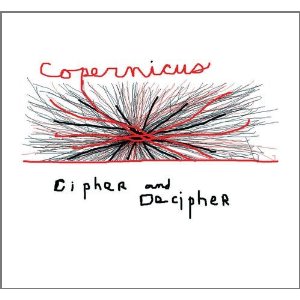
The thirteenth album by New York-based performer-poet Copernicus (aka Joseph Smalkovski), and the third released by MoonJune Records (which is going to reissue the artist’s whole catalogue), Cipher and Decipher is definitely not your average ‘progressive rock’ album, ambitious but ultimately accessible. In fact, is one of those records for which the expression ‘acquired taste’ seems to be tailor-made, and which is at the same time easy and difficult to describe: easy if you want to simplify matters, and say that it is based around a somewhat loopy guy’s ranting and raving over a rather free-form musical background; difficult if you want, instead, to avoid platitudes and offer would-be listeners a more in-depth, nuanced analysis.

Needless to say, even from a quick perusing of the release notes it should be clear that Cipher and Decipher is not for the faint-hearted, or those who like carefully structured music, engaging melodies and conventional singing. This is the archetypal underground production, a marriage of music and poetry steeped in the American beat tradition, dripping with existential ennui and metaphysical musings, in which the music often feels like an afterthought, often sharply diverging from the vocal parts in a sort of schizophrenic effect. Clocking in at slightly under 70 minutes, and barely offering any respite from Copernicus’ over-the-top vocal exertions, it sounds more than a bit daunting (even for a forward-thinking label like MoonJune) and as such quite unlikely to appeal to casual or mainstream-oriented listeners.

And yet, in spite of all these drawbacks, Cipher and Decipher exerts a weird sort of attraction. After a while everything seems to click and, so to speak, begins to make sense. Even as Copernicus’ voice may rub you the wrong way, and make you wish he limited himself to publishing books of poetry like most other people would do, the music perversely sucks you in, and you may find yourself actually enjoying the experience – almost in spite of yourself. At times Copernicus’ secular-preacher recitation blends with the music, at others the two go their separate ways, in a somewhat frustrating fashion. He roars, cajoles, whines, chants, emotes like a Shakespearian actor, leaving very little breathing space to the listener, repeating the key words around which his whole work seems to revolve with a sort of incantatory effect, often augmented by the loose yet oddly mesmerizing nature of the musical accompaniment.

Regarding the concept on which Cipher and Decipher is based, my readers will be able to find all the background information they need in the links I have provided at the end of the review – as well as in the album’s very thorough liner notes. While other reviewers have dedicated at least some space to the album’s lyrical content, I would rather concentrate on the musical aspect, even if I realize it is far from easy to divorce the two. Generally, I do not particularly care for nihilism, and have to admit not being too interested in speculations about the nature of the universe, though neither aspect disturbs me as other kinds of content (i.e. overtly racist lyrics) would. My main interest here is the music, and this is why I would rather avoid launching in any detailed analysis of Copernicus’ message which is much better presented elsewhere.

When listening to Cipher and Decipher, it is important to bear in mind that the music and the vocals often seem to be at odds with each other instead of working together, as would happen in more mainstream recordings. This means that special attention to the musical part is required, and it obviously helps if you like almost completely unscripted music as opposed to the carefully constructed patterns of most conventional progressive rock. Provided by a veritable orchestra of 15 outstanding musicians (including 4 guitarists and almost a full horn section) led by long-time Copernicus associates, expatriate Irishmen Pierce Turner and Larry Kirwan (the latter, together with Thomas Hamlin and Fred Parcells, a member of Celtic-inspired band Black 47), the musical accompaniment to Copernicus’ proclamations is a wildly eclectic mix of influences ranging from experimental free-jazz to early Pink Floyd-style psychedelia.

Organ-drenched opener “Into the Subatomic” immediately sets the scene, both musically and lyrically, followed by the lovely but somber “Free at Last!”, the most genuinely Pinkfloydian number on offer, embellished by some noteworthy acoustic and electric guitar work; while “Mud Becomes Mind” sports a cheery, Afro-Brazilian vibe. The disc’s central section owes quite a lot to free-jazz, rather gloomy in “I Don’t Believe” with its lonesome-sounding trumpet, sparse yet upbeat in “Matter Is Energy”. On the other hand, “Comprehensible” superimposes an overt homage to Pink Floyd, with Larry Kirwan repeating “set the controls further out of the sun” (a paraphrase of the title of one of their most iconic early compositions) to the somewhat chaotic free-jazz template, and “Infinite Strength” (based on Van Morrison’s celebrated “Gloria”) sounds like something out of the Blues Brothers soundtrack – making you want to dance in spite of Copernicus’ weighty proclamations. More Latin influences surface in the funky “Step Out of Your Body”, and the references to Iraq and Afghanistan in “No One Can Win” are aptly punctuated by Middle Eastern echoes conjured by flute and strings. The album climaxes with the sonic and verbal apocalypse of the aptly-titled “The Cauldron”, a 15-minute, voice-driven space jam.

As the previous paragraphs clearly illustrate, Cipher and Decipher is a very peculiar effort, targeted to adventurous listeners, and likely to send the more conservative set of prog fans running for the exits. This is not background music, and is definitely not relaxing – on the contrary, it can easily become a tad wearying, especially on account of Copernicus’ very idiosyncratic vocal delivery and apocalyptic lyrics. The album’s running time can also be an issue, so those who find it hard to concentrate for long might want to avoid tackling it in one go. However, its somewhat sneaky allure may well win over those who are not afraid to get acquainted with less predictable approaches to progressive music.

Links:
http://www.copernicusonline.net

http://www.moonjune.com

http://www.progarchives.com/forum/forum_posts.asp?TID=74511 (interview)

Read Full Post »

TRACKLISTING:
1. Loopy (5.59)
2. A Serious Man (3.49)
3. Mom’s Song (2.05)
4. Bar Stomp (3.04)
5. Outdoor Revolution (3.08)
6. Western Sky (2.12)
7. Burning Match (5.11)
8. Claire’s Indigo (2.11)
9. Snufkin (2.48)
10. Old Silhouette (4.12)
11. Winds of Grace (8.39)

LINEUP:
Dani Rabin – guitar
Danny Markovitch – saxophone
Steve Rodby – bass
Paul Wertico – drums, percussion (1, 8)

With:
Jamey Haddad – percussion (2, 4, 6, 8, 9, 10)
Matt Davidson – vocals (3, 6)
Leslie Beukelman – vocals (3, 6)
Makaya McCraven – drums (4)
Daniel White – lyrics, vocals (11)

Marbin’s eponymous debut came to my attention towards the end of 2009, soon after its release. Even if the duo formed by two young, talented Israeli-born musicians who had recently moved to Chicago was an unknown quantity to me and most other reviewers, the album’s endearingly naïve artwork and intriguing musical offer were enough to warrant closer scrutiny. With a name cleverly fashioned out of the surnames of the two artists (Danny MARkovitch and Dani RaBIN), Marbin made their debut on the US music scene with an album full of intriguing melodies crafted with ony two instruments – Rabin’s guitar and Markovitch’s saxophone – characterised by an ethereal, almost brittle quality, reminiscent of the delicacy of Far Eastern art, complex yet at the same time not too taxing for the listener.

The year 2010 marked a veritable quantum leap for Marbin (very active on the live front in the Chicago area), when they came under the radar of MoonJune Records’ mainman Leonardo Pavkovic, a man with a keen eye for new acts of outstanding quality. Promptly snapped up by the New York-based label, Marbin – who in the meantime had become a real band, with the addition of  Pat Metheny alumni Steve Rodby (bass) and Paul Wertico (drums) – released their second album at the beginning of 2011.

Breaking the Cycle is indeed an impressive effort, which sees the band build upon the foundation laid by their debut, while fine-tuning their sound and adding layers of complexity, though without making things unnecessarily convoluted. Indeed, rather interestingly, a fellow reviewer used the term ‘easy listening’ in connection to the album –  a definition that may conjure images of that openly commercial subgenre known as smooth jazz. However, while Breaking the Cycle does have plenty of smoothness and melody, I would certainly never call it background music. The presence of a full-blown rhythm section has given a boost to the ambient-tinged, chamber-like atmosphere of the debut, and some of the tracks display a more than satisfying level of energy and dynamics, all the while keeping true to the deeper nature of their sound.

Clocking in at slightly over 40 minutes, Breaking the Cycle immediately appears as a supremely sophisticated effort, starting from the striking cover artwork whose mix of the industrial (the bridge on the front cover) and the natural (the elephant on the back cover) seems to reflect the nature of the music itself. While the majority of the tracks lean towards the slower, more atmospheric side of things, delivered in a rather short, somewhat compact format, the album is bookended by two numbers that differ quite sharply from the rest, as well as from each other. Opener “Loopy” is the closest Marbin get to a ‘conventional’ jazz-fusion sound, almost 6 minutes of sax and guitar emoting over an exhilarating jungle beat laid down by Wertico’s drums and percussion that gives a first taste of the seamless interplay between the instruments. On the other hand, the medieval-tinged, acoustic folk ballad “Winds of Grace”, masterfully interpreted by guest singer Daniel White (who also wrote the lyrics), though apparently out of place in the context of the album,  is imbued with a feeling of nostalgia and loss suggested by several other tracks.

Indeed, the three numbers that form the central section of the album might almost be considered as parts of a single suite, since they are characterized by a wistful, romantic (though anything but cheesy) mood. An extended sax solo is the real showstopper in “Outdoor Revolution”, while wordless vocalizing enhances the country-tinged acoustic guitar in “Western Sky”. “Burning Match” seems to reflect its title almost perfectly, its smouldering atmosphere touched with a hint of sadness, the yearning tone of the sax suggesting the end of a love affair. A strong visual element is evoked throughout the album: “Old Silhouette” creates a faintly mysterious picture, yet full of subtle warmth intensified by the slow, deep movement of the percussion; while the sweet, soothing chanting in “Mom’s Song”, combined with the gentleness of the guitar, brought to my mind images of a beach at sunset. In sharp contrast, “Bar Stomp” delivers exactly what the title promises – a bluesy, electrified romp with Rabin’s guitar taking centre stage, bolstered by an imposing percussive apparatus involving the presence of three drummers (Wertico plus guests Makaya McCraven and Jamey Haddad), and spiced up with a hint of cinematic tension.

The final remarks I made in my review of Boris Savoldelli’s Biocosmopolitan may also apply to Breaking the Cycle. Oozing sheer class, with outstanding performances all round, yet plenty of warmth and accessibility (unlike a lot of hyper-technical albums), this is a release that has the potential to appeal to anyone who loves good music and does not care about sticking a label on anything they hear. Judging from the positive reactions to this album, Marbin are definitely going to be another asset for the ever-reliable MoonJune Records.

Links:
http://www.marbinmusic.com

http://www.moonjune.com

Read Full Post »


TRACKLISTING:
1. Aria (2:09)
2. Biocosmopolitan (3:36)
3. Concrete Clima (4:26)
4. The Discordia (3:42)
5. Kerouac in New York City (3:13)
6. Is Difficult to Fly Without Whisky (3:26)
7. Dandy Dog (2:12)
8. Danny Is a Man Now (1:42)
9. Biocosmo (3:39)
10. Lovecity (2:47)
11. Springstorm (3:21)
12. The Miss Kiss (2:57)
13. My Barry Lindon (1:28)
14. Closin’ Theme (2:32)
15. Crosstown Traffic (bonus track) (4:03)
16. Biocosmo (English version – bonus track) (4:14)

Bonus video:
The Miss Kiss

LINEUP:
Boris Savoldelli – all vocals and vocal instruments, piano (9, 16)

With:
Jimmy Haslip – bass (2)
Paolo Fresu – trumpet, flugelhorn (3, 5)

At a first glance, Boris Savoldelli’s second solo album does not spell ‘progressive rock’. With 14 songs (plus two bonus tracks) between 1 and 4 minutes in length, and a rather minimalistic instrumental accompaniment, Biocosmopolitan looks light years away from the lushly orchestrated productions of the flag-bearers of the genre. Moreover, even if the output of New York-based MoonJune Records (one of the few authentically forward-thinking labels in the business) is frequently placed under the used-and-abused ‘prog’ umbrella, this album displays a somewhat different approach to music-making, one that tries to offers something genuinely original rather than a more or less successful replica of Seventies modes.

My first encounter with Boris Savoldelli’s music dates back from 2009, when I reviewed his solo debut, Insanology – an album that impressed me for its unique blend of elegance and uncontrived cheerfulness. It was one of those truly enjoyable discs whose apparent simplicity reveals layers of complexity with every successive listen. It is, however, not the complexity for its own sake that can be sometimes encountered in ‘standard’ progressive rock, but is rather achieved with a lightness of  touch, a kind of consummate subtlety that is all too rare on the modern music scene – all accomplished with one main instrument, Savoldelli’s voice, a veritable one-man-orchestra of stunning versatility that has been compared to luminaries like Bobby McFerrin or Demetrio Stratos.

Indeed, Boris Savoldelli is much more than an ordinary singer – to quote our fellow Italians PFM, he is a real maestro della voce, a master of the art of shaping his voice in ways that would sound impossible to most people, replacing most of the conventional instrumentation used in jazz and rock with an array of awe-inspiring effects whose apparently effortless nature belie the years of hard work behind it all. While most of the songs, which blend traditional and unconventional features, have a similar structure – where two or more vocal lines (both percussive and harmonic) intersect and spar with each other – as a whole Biocosmopolitan does not sound monotonous or repetitive. In my view, his unique handling of the linguistic aspects is probably the single most important factor for the album’s success. English and Italian intermingle with astounding naturalness (while on most other albums a mix of languages would sound contrived) that lends the album a truly cosmopolitan feel – with devices such as alliteration and assonance used to bolster the musical content, creating intriguing rhythms and textures.

In the four years between Insanology and Biocosmopolitan, Boris Savoldelli has been quite busy, though on a more decidedly experimental level – releasing the album Protoplasmic in collaboration with Elliott Sharp, as well as three albums with avant-garde outfit S.A.D.O. While Insanology saw the presence of veteran jazz guitarist Marc Ribot on two tracks, this time Savoldelli avails himself of the collaboration of two outstanding musicians – renowned Italian trumpeter Paolo Fresu, and bassist Jimmy Haslip (of Yellowjackets fame). Haslip’s bass adds depth and interest to the title-track, complementing Savoldelli’s bluesy vocals in a song that is much more complex than it short running time would suggest. Fresu’s wistful-sounding trumpet punctuates the cheery, infectious repetition of the line “the corner is dirty” in the pause-laden “Concrete Clima” (the longest track on the album at slightly over 4 minutes), and its sudden bursts of sounds enrich the fabric of the bright, endearingly nonsensical “Kerouac in New York”.

Most of the songs share the same sunny, upbeat nature and exude a genuine sense of warmth, reminding the listener of exotic vocal styles or of the sensuality of Latin rhythms, combining modernity and a charming retro feel (most evident in the Fifties’ doo-wop style of the hugely entertaining “The Miss Kiss”). Boris’s voice ranges from gritty, passionate blues tones to elegant, jazzy smoothness, infused with a genuine sense of humour and enjoyment. The only number that clearly differs from the rest is the melancholy ballad “Biocosmo”, a slow-burner (also present as a bonus track with English-language vocals) accompanied by piano and ending with solemn, choir-like chanting and distant clinking sounds, which one can almost imagine Savoldelli performing in the semi-darkness of a smoky night club. The album is then wrapped up, in cinematic fashion,  by two humorous complementary pieces, “My Barry Lindon “ – basically a series of ‘thank you’, handclaps and assorted sounds with occasional vocal harmonies thrown in – and “Closin’ Theme”, where a voice recites the album’s credits in English with mock seriousness. The second bonus track, a cover of Jimi Hendrix’s “Crosstown Traffic”(already included on Insanology), is the closest the album goes to traditional rock, with Savoldelli offering a more than credible performance as a hard rock vocalist.

Biocosmopolitan is one of those rare albums that are potentially appealing to all music lovers, regardless of genres and labels – though it might disappoint those who require songs to be over 10 minutes in length, or object to the lack of ‘proper’ instruments, or even shun any kind of music that is not dead serious or just plain depressing. Progressive without necessarily being ‘prog’, entertaining and at times even exhilarating, Biocosmopolitan is an ideal showcase for the amazing vocal and compositional talents of an artist whose work proves that impeccably performed music can also be fun.

Links:
http://www.borisinger.eu

http://www.moonjune.com

Read Full Post »
TRACKLISTING:
1. Baltasaurus (14:18)
2. Flying Trip (7:51)
3. Vietato Generalizzare (6:38)
4. Mosoq Runa (18:58)
5. The Mirror (10:16)
6. La Ballata de s’Isposa ‘e Mannorri (10:16)

LINEUP:
Alberto De Grandis – drums, percussion, vocals (5)
Alberto Bonomi – Hammond A-100 organ with Leslie 760, Fender Rhodes electric piano, Steinway acoustic piano, synthesizers, flute
Silvio Minella – electric guitars
Luca Baldassari – bass guitar

With:
Andhira (Elena Nulchis, Cristina Lanzi, Egidiana Carta) –  vocals (6)
Zoltan Szabo – cello (4, 6)
Maria Vicentini – violin, viola (4, 6)

Hailing from Shakespeare’s own ‘fair Verona’ (one of the most beautiful cities in Italy), where they formed in the mid-Nineties, D.F.A. (acronym of Duty Free Area) are living proof of the old Latin saying that a prophet has no honour in his own country. Hailed as one of the best progressive rock bands of the past decade, they took the NEARfest audience by storm in 2000, and offered a stunning repeat performance in 2009 – when I first saw them, and was floored right from the opening strains of  their set. However, as seems to happen all too frequently, they are barely known in their home country, where their extremely elegant yet punchy brand of Canterbury-tinged jazz-rock starkly contrasts with worship of all things Genesis that is still widespread in Italy. That historic first NEARfest performance was captured on the band’s 2001 live album, Work in Progress, which for over seven years remained the last testimony of the band’s activity.

D.F.A. are nothing but pure class. A quartet reproducing the configuration of bands such as Hatfield and the North and National Health – with both keyboards and guitar in a prominent role,  and the occasional contribution of other instruments – they are one of those rare outfits where each member’s contribution is essential to the band’s overall sound. Even if drummer Alberto De Grandis –  a drummer that, like Christian Vander or Daniel Denis, is much more than a simple timekeeper – gets most of the composing credits, all of the instruments get their chance to shine and create a tightly woven mesh of sound. Alberto Bonomi’s multilayered keyboards lay a lush tapestry for Silvio Minella’s brilliantly expressive guitar work; while Luca Baldassarri’s bass provides ever-reliable bottom end, adding fullness and texture to De Grandis’ propulsive drumming. D.F.A.’s music is effortlessly fluid, yet complex enough to please the most demanding jazz-rock fans – striking a perfect balance between technical skill and genuine emotion, breathless dynamics and captivating atmospheres.

Taking a leaf out of Soft Machine’s book, the album’s title is a simple numeral – not surprising, in the light of their affiliation with Leonardo Pavkovic’s far-sighted MoonJune label. Though it runs at almost 70 minutes, unlike the majority of albums running at over an hour it never outstays its welcome, and always manages to hold the listener’s attention. Most of the six tracks are instrumental, with one notable exception (on which more later). Interestingly, though D.F.A. do not sound as typically ‘Italian’ as those bands who opt for a more traditionally symphonic sound, they possess the inimitable flair for melody that seems to be ingrained in most Italian musicians. Their music is never harsh or needlessly convoluted, yet it also manages to eschew that somewhat overblown theatricality that can turn people off Italian progressive rock. It would be unfair to the band, however, to imply that they are mere Canterbury imitators. While D.F.A have a definitely international appeal (as proved by their choice of giving their composition titles both in Italian and in English), their Mediterranean inspiration – even if thankfully untainted by the overly sentimental excesses of Italian melodic pop – can be often keenly felt. This is one aspect that D.F.A. share with historic jazz-rock outfits such as Area, Il Baricentro and Napoli Centrale.

Chosen to accompany the opening images of the documentary film Romantic Warriors, “Baltasaurus” introduces the album in charmingly subdued mode, a feature shared by most of the tracks. Elegant guitar licks and flawless rhythm section lead the way for a splendid, mid-paced development, in which keyboards and guitar seamlessly interact, bolstered by De Grandis’ stunning drum work – never overwhelming, but very much a protagonist. Gently atmospheric sections alternate with more energetic ones, and the many tempo changes do not break up the smooth flow of the music. The following number, “Flying Trip”,  picks up the Canterbury references with a wistful mid-tempo spiced up by occasional jazzy, Latin-flavoured passages, and featuring some stunningly beautiful organ passages and delicate flute; while the barnstorming “Vietato Generalizzare” (It Is Forbidden to Generalize – the track with which D.F.A. opened their set at NEARfest 2009) barges in, propelled by a vertiginous synth riff and high-energy drumming. Very much guitar-driven, it allows Silvio Minella to display his considerable chops in an intense, expressive solo reminiscent of Gary Moore during his Colosseum II tenure. “The Mirror”, on the other hand, is a classic jazz-rock workout, with the instruments creating a keen, somewhat darker-hued sense of tension – though eased by snippets of muted singing at the beginning and in the middle of the track – and climaxing with an arresting, yet subtle drum ‘solo’.

That leaves the album’s epic, the almost 19-minute “Mosoq Runa” (Quechua for “new human being”), which, not surprisingly, displays a definitely more symphonic bent – thanks also to the presence of strings, as well as a recurring main theme. The amazing interplay between the instruments is nowhere more evident than here, and – in spite of its running time – the track never once feels overlong or overdone; as usual, both the guitar and the keyboards get their chance to shine, with Minella’s soloing at its most soulful. However, 4th’s most distinctive track is strategically placed at the close of the disc. Sung entirely in the ancient Sardinian language (the most archaic of Romance languages) by the heavenly voices of the folk trio Andhira, “La Ballata de s’Isposa ‘e Mannorri” (The Ballad of the Bride of Mannorri) is a tale of love, betrayal and vengeance that would be perfectly at home on a Pentangle album – in spite of the frequent comparisons between Andhira and Canterbury’s own trio of female vocalists, The Northettes. The three Sardinian vocalists, though, are less operatic and more emotional; the resonant contralto timbre of one of them lends even more depth to their performance. The minimalistic instrumental accompaniment does not divert the attention from the sheer beauty of the vocal interplay – though the bridge features a lovely, touching guitar solo that seems to echo the profound sadness of the story.

At the time of writing, D.F.A. are reported to be on indefinite hiatus, due to the all too familiar pressures of ‘real life’ (i.e. family and work) on any non-professional musician. It may even be that the band has reached the end of the road – which would obviously result in a great loss for the whole progressive rock scene. However, even if they indeed decide to call it a day, they will have left a lasting legacy in the history of progressive rock, both for the beauty and power of their music and their genuinely down-to-earth attitude – as captured in the aforementioned Romantic Warriors.. Needless to say, 4th is a must-listen for devotees of the Canterbury scene and classic jazz-rock, and very highly recommended to prog fans of every persuasion. This is one of the landmark albums of the first decade of the 21st century, and one of the very best productions to ever come out of the Italian progressive music scene.

Links:
http://www.myspace.com/dutyfreearea
http://www.moonjune.com/MJR021.htm
http://www.andhira.com

Read Full Post »

TRACKLISTING:
1. Save The Yuppie Breeding Grounds (4:12)
2. Ephebus Amoebus (4:55)
3. Nacho Sunset (4:29)
4. $9 Pay-Per-View Lifetime TV Movie (5:51)
5. Manifest Density (3:55)
6. Uncle Tang’s Cabinet of Dr. Caligari (4:01)
7. Disillusioned Avatar (5:15)
8. Kuru (5:02)
9. Revenge Grandmother (5:11)
10. Staggerin’ (4:41)
11. Middlebräu (6:46)

LINEUP:
Dennis Rea – electric guitar
Ruth Davidson – cello
Alicia Allen – violin
Kevin Millard – bass guitar, baliset
Jay Jaskot – drums

The city of Seattle has long been known as a hotbed for innovative music, from Jimi Hendrix to the grunge movement through progressive metal pioneers Queensryche. For several decades, it has also been the home of globe-trotting guitarist and composer Dennis Rea, originally from upstate New York, but now a full-fledged member of the Pacific Northwest artistic community. While Rea, in  his many years of tireless activity in the realms of creative music-making, has gathered an impressive discography (especially in terms of quality), he has never become a household name as he would have amply deserved. Luckily, the release of Moraine’s debut album in 2009, as well as his first solo album proper, View from Chicheng Precipice, and Iron Kim Style’s debut in 2010, have contributed to putting Rea’s name on the sprawling map of the progressive music scene.

Indeed, Moraine were selected for the 2010 edition of NEARfest, where they elicited quite a lot of interest – in spite of having been described as ‘avant-garde’ on the festival’s press material, a definition which (coupled with their placement in the opening Sunday slot, also known as the ‘rude awakening’, and generally reserved for rather idiosyncratic bands) kept the more conservative members of the audience away from their set. The members of the band, and Rea in particular, were somewhat amused at having been lumped together with much more ‘mainstream’ bands under the all-encompassing prog banner. In these times of derivative acts being peddled as the best thing since sliced bread, Moraine were possibly the most genuinely progressive band on the bill – though, as purveyors of hard-to-pinpoint music, they left some of the more label-happy members of the audience a tad baffled.

Although instrumental albums are seemingly a dime a dozen these days, Manifest Density (a brilliant pun on one of the most obnoxious aspects of US history) is not your average cookie-cutter instance of amazing chops unencumbered by soul and emotion. With a total of 11 tracks averaging 5 minutes in length  (the longest running at under 7 minutes),  and all of the five band members but drummer Jay Jaskot contributing to the compositional process, it is very much an ensemble effort, a collection of contemporary chamber rock pieces that comes with a liberal helping of almost Canterbury-like dry wit – though more geared to 21st-century American society. The essential input of the violin may draw comparisons with bands such as King Crimson circa Larks’ Tongue in Aspic or Mahavishnu Orchestra, while the pervasive presence of the cello may bring to mind Swedish Gothic proggers Anekdoten. However, in Moraine’s sound the cello’s unmistakable drone does not create the same kind of claustrophobic atmosphere, but rather adds that kind of depth that is generally supplied by the keyboards in the output of more conventional prog bands.

Since the individual members of Moraine have parallel involvements in a number of very diverse projects, ranging from jazz to stoner rock, it will not come as a surprise that eclecticism is the name of the game on Manifest Density. However, those anticipating a hodge-podge of disparate ideas that ultimately do not coalesce would be making the wrong assumption: the album as a whole impresses for its cohesion, even allowing for the different compositional styles of each band member. While Dennis Rea’s compositions (such as “Kuru” or “Staggerin’”) tend to favour a jazzier, more experimental style, two of the three tracks penned by co-founder Ruth Davidson (“$9 Pay-Per-View Lifetime TV Movie” and “Revenge Grandmother”) possess a wistful, low-key quality, shared by Alicia Allen’s deeply lyrical “Disillusioned Avatar”. On the other hand, album opener “Save the Yuppie Breeding Grounds”, also written by Davidson, is an energetic yet haunting number with a strong Crimsonian vibe; while bassist Kevin Millard’s “Ephebus Amoebus” opens in a slow, atmospheric fashion, then develops into a frenzied workout, with guitar and violin sparring with each other.

The quirky track titles inject a welcome dose of humour into the proceedings – a recurring feature in the work of other modern instrumental bands, but which Moraine (and especially Dennis Rea) seem to have got down to a fine art. Actually, the titles fit the musical content astonishingly well: “Uncle Tang’s Cabinet of Dr Caligari” is suitably dissonant, at times chaotic, with subtle Gothic undertones; while the upbeat “Nacho Sunset”, embellished by stunningly clear, lilting guitar work and gentle violin, has a relaxed, almost Latin feel. Though the album’s sound is mostly driven by the flawlessly intricate interplay between Rea’s distinctive guitar and Allen’s versatile violin lyrical and assertive in turns, none of the other instruments is confined to a mere supporting role, and each of them contributes in keeping the sonic texture tight. An excellent example of this is album closer (and personal favourite) “Middlebräu”: after a funky first half, propelled by magnificent bass and drums (very much in classic jazz-rock vein),  a pause signals an abrupt change of pace, and the beginning of a simply magnificent, almost slo-mo coda featuring an intense, meditative guitar solo (the closest Rea comes to a traditional rock solo).

When Moraine performed at NEARfest, their lineup had changed, with obvious consequences for their sound. Ruth Davidson and Jay Jaskot had moved away from Seattle, and been replaced by  drummer Stephen T Cavit (also an award-winning composer of film and TV scores), and woodwind player Jim DeJoie ( now Alicia Allen’s husband). The switch from cello to woodwinds lent the music a brighter, but also slightly more angular quality, reminiscent of those bands, such as Henry Cow, on the more experimental end of the Canterbury scene. This bodes well for the band’s second album, which is already in the works at the time of writing. In the spring of 2011 Moraine will also embark on a tour of the US East Coast, with dates at the New Jersey Proghouse and the legendary Orion Studios in Baltimore already confirmed. Catch them if you can – they are a very entertaining live act, and Manifest Density qualifies as one of the most promising debut albums of the past decade in the progressive music field.

Links:
http://www.moraineband.com

Read Full Post »

TRACKLISTING:
…Rattlin’ All the Time
:
1. Tarabos  (5:10)
2. Chloe And The Pirates  (7:56)
3. All White  (6:24)
4. The Man Who Waved At Trains  (3:54)
5. As If  (4:14)
6. Hibou, Anemone And Bear  (3:28)
7. Out-Bloody-Rageous  (8:36)
8. Pig   (4:28)
9. Esther’s Nose Job   (6:04)
10. Slightly All the Time  (9:32)

…Before the Moon:
11. Leonardo’s E-Mail  (4:11)
12. Moonvision   (2:17)
13. Many Moons, Many Junes  (3:05)

…After the Moon:
14. Lunar Impression  (1:17)
15. Circular Lines In The Air  (2:46
16. Moon Geezers (to Elton and Hugh)  (3:27)

LINEUP:
Beppe Crovella – Mellotron, Wurlitzer E200 electric piano, Fender Rhodes Stage 73 electric piano, Hammond organ M102, Hohner electric piano, Hohner Clavinet D6, Roesler Grand Piano, Farfisa Professional

This is meant as the second instalment in a trio of reviews of albums released by one of the most forward-thinking independent labels on the current music scene  – New York-based MoonJune Records. As a follow-up to View from Chicheng Precipice, here is another album that many listeners may very well see as nearly unapproachable, but whose authentically progressive nature can hardly be denied.

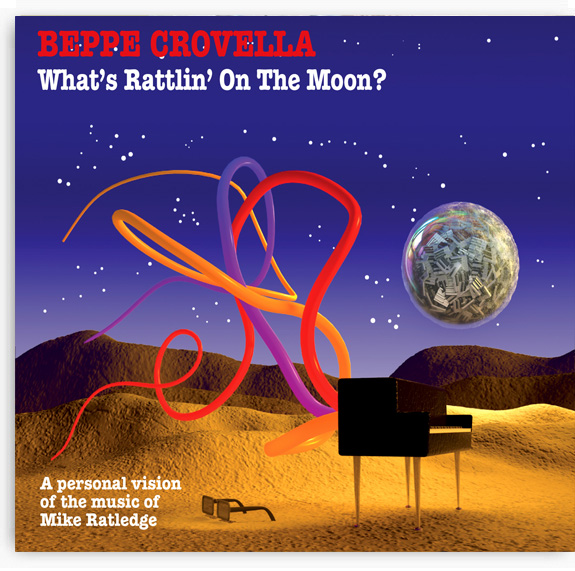
The subtitle to Beppe Crovella’s  What’s Rattlin’ on the Moon? reads “A Personal Vision of the Music of Mike Ratledge” – which alone should put paid to any allegations that this is yet another run-of-the-mill tribute album. An extraordinary musician in his own right, with an impressive career both as a solo artist and the mind behind Italian jazz-rock outfit Arti e Mestieri, Crovella is clearly not interested in faithfully reproducing music that is available elsewhere – but rather in offering his own reinterpretation of some of the legendary Soft Machine keyboardist’s ground-breaking compositions. The result of this daring, enlightened operation (conceived by Crovella and MoonJune Records mainman Leonardo Pavkovic) is a disc that, while anything but easy to approach, and obviously possessing very limited mass appeal, is a fascinating listen, especially for anyone with a keen interest in vintage keyboards.

Since the music of Soft Machine is undeniably an acquired taste in itself, commanding an almost fanatical adoration on the part of its fans, and an equally strong rejection on the part of ‘unbelievers’, an album offering an apparently one-dimensional take on said music is very likely to send a lot of people running for the exits. First of all, it requires quite a bit of patience on the part of the listener, even from those who should be used to the less than easily digestible nature of most progressive rock. Moreover, the distinct lack of the ‘rock’ part of the genre definition can prove a turn off – and the sheer length of the project (close to 80 minutes) is not likely to help sceptics warm to it.  However, those who will stick with the album and give it the attention it deserves will reap their rewards, because  What’s Rattlin’ on the Moon? offers many moments of real interest, and some of sheer delight.

A master of his craft, Crovella recreates the sound of an entire band with his array of vintage keyboards – ruling out the use of those synthesizers and their ilk that have become so indispensable in modern music-making. It is often astonishing to hear those keyboards fulfil the role of the bass or drums, though in most cases they just weave layers of sound in the Softs’ typically free-form style. As the album is divided into three recognizable parts,  the pauses between the individual numbers are almost non-existent – as if each part was meant to be listened to as a single track. This makes for a very distinctive listening experience, the polar opposite of a conventional song-based approach – though equally far removed from the somewhat sterile displays of technical dexterity that are often an integral part of ‘prog’ recordings.

The ten Soft Machine compositions are reinterpreted in such a way as to be nearly unrecognizable. This is especially the case of the two tracks from the band’s iconic Third album, “Out-Bloody-Rageous” and “Slightly All the Time”, the latter being possibly the highlight of the disc with its hypnotic yet melodic line and fascinating use of the Mellotron to provide choral effects. All the compositions share the same rarefied, riveting texture, which is intended to be savoured slowly, possibly not in one take. At every successive listen, different effects will unfold – pulsating,  surging, solemn, sometimes flowing, sometimes choppy, creating subtly shifting layers of sound. It is the kind of music that will fade in the background if left unattended, so to speak – meant to be listened to, not just heard.

The two mini-suites at the end of the album are original Crovella compositions intended, in some ways, to ‘describe’ the creative process behind the album. Both are largely piano-based and less idiosyncratic than the first part of the disc, with a stronger melodic development and some jazzy touches. “Moon Geezers”, dedicated to the sadly deceased former Soft Machine members Elton Dean and Hugh Hopper, closes the album on a suitably measured, melancholy note.

As already intimated, What’s Rattlin’ on the Moon? is not an album that will appeal to everyone, especially not those with short attention spans. It does, however, stand head and shoulders above the many hackneyed tribute albums that flood the progressive rock market. Experimental and very personal (even if a tad overlong), this is a must-listen for Soft Machine fans, and highly recommended to lovers of genuinely personal takes on prog classics.

Links:
http://www.beppecrovella.com/

Read Full Post »

TRACKLISTING:
1. Three Views From Chicheng Precipice (after Bai Yuyi) (9:52)
2. Tangabata (15:52)
3. Kan Hai De Re Zi  (Days by the Sea) (3:44)
4. Aviariations on “A Hundred Birds Serenade the Phoenix” (6:48)
5. Bagua  (Eight Trigrams) (10:41)

LINEUP:
Dennis Rea electric and resonator guitars, melodica, Naxi jaw harp, kalimba, dan bau (Vietnamese monochord)
Alicia Allenviolin (1, 3)
Greg Campbell drums, percussion (2)
Ruth Davidson cello (1, 3)
James DeJoie bass flute, bamboo flute, bass clarinet (2)
Caterina De Re voice (4)
Stuart Dempster trombone, conch shell (2)
Will Dowd – drums, percussion (1)
Elizabeth Falconer koto (5)
John Falconer shakuhachi (5)
Jay Jaskot drums (3)
Paul Kikuchi percussion (5)
Kevin Millard baliset (3)

In spite of China’s venerable musical tradition, very few people outside the ‘Asian studies’ circles are aware the authentic musical heritage of the Far East, unless it is in the most superficial of terms. Mentions of Chinese music might conjure, at least to the uninitiated, memories of the cheesy (when not downright ghastly) ‘sonic wallpaper’ that will accompany a meal in most Chinese restaurants of the Western world. However, I am happy to report that Views from Chicheng Precipice – the first recording effort solely credited to Seattle-based guitarist and composer Dennis Rea, a true veteran of the progressive music scene of the US Pacific Northwest – is light years removed from any such kitschy scenario.

Those who are familiar with Rea’s current main projects, the eclectic art-rock of Moraine and the improvisational jazz-rock of Iron Kim Style, will probably find themselves somewhat puzzled by this album – which, on the other hand, provides further proof of the guitarist’s broad horizons and dedication to the pursuit of creative musical avenues. While world music may be all the rage in a some circles, it is nevertheless not easy to find artists that approach the tradition of a country as distant (both literally and metaphorically) as China with such rigorously philological spirit as Rea manages to do – informed by his first-hand, in-depth knowledge of the musical and cultural background of both China and Taiwan, where he spent the years between 1989 and 1993.

Recorded between 2006 and 2008, Views from Chicheng Precipice sees the participation of members of both Moraine and Iron Kim Style, as well as other musicians from the Seattle scene, such as Japanese music specialists Elizabeth and John Falconer, and trombone master Stuart Dempster. Running at under 50 minutes, the album features five tracks presenting different facets of the Chinese musical heritage, seen through the eyes of a Western artist in a respectful yet uniquely personal way. Indeed, four out of five numbers (the sole exception being the title-track) are traditional compositions arranged by Rea so as to preserve their spirit even when reinterpreting their form.

Out of those five tracks, the East-West collision of “Days by the Sea” might almost be described as a pop song of sorts (also on account of its markedly shorter running time). Rea’s guitar weaves a tune that, while respectful to the original, incorporates elements of African-American blues, sparring with Alicia Allen’s violin in a stunning dialogue that brought to my mind Rea’s work with Moraine. The title-track, on the other hand, is built around three pentatonic motifs that comprise an original sonic triptych, with a recurring theme and plenty of scope left for improvisations. The composition was performed by Moraine during their performance at NEARfest 2010, though not many members of the audience were able to grasp its sheer elegance and grace in a live setting. Here the triptych comes across in all its understated power, the seamless flow of the music evoking the beauty of the titular mountain landscape (Qingcheng Mountain is the site of a Daoist sanctuary in China’s Sichuan Province). Rea’s guitar converses smoothly with Allen’s violin, while a drum-led improvisation adds a free-jazz touch to the central part of the composition.

The remaining three numbers are of a distinctly more challenging nature, since each of them develops in a fashion that is definitely less attuned to the Western ear. The 15-minute “Tangabata” and the 10-minute “Bagua” both have their roots in ceremonial music, as borne out by their stately, measured pace. The latter makes use of traditional Japanese instruments such as the koto and the shakuhachi (a bamboo flute), supported by solemn yet dramatic percussion work in the creation of a gently meditative mood. “Tangabata”, though a far from accessible piece, might be called the real highlight of the album. While featuring a distinctly Western-flavoured, free-jazz improv section at its very end, most of the composition remains faithful to its ancient origins – a sparse melody of austere beauty, almost suspended in time, made of deep, echoing sounds occasionally brightened by chiming bells. Finally, in “Aviariations on A Hundred Birds Serenade the Phoenix” (whose gently punning title reflects Rea’s ever-present sense of humour) the Chinese oboe traditionally used in the titular piece is replaced by Caterina De Re’s piercing vocal acrobatics, mimicking birdsong in a performance that brings together contemporary Western academic music and Chinese opera. Rea plays guitar and kalimba, whose sounds almost merge with De Re’s impossibly high notes.

Miles away from any tawdrily commercial ‘world music’ recreations, Views from Chicheng Precipice is, as Rea himself puts it, a love letter to the country where he spent four years of his life, an experience that was essential for his development as a musician. A refined, understated listen, it is an album made of subtle contrasts of light and shade, and as such needs to be approached with respect and concentration. The music possesses the delicate, almost brittle beauty of Far Eastern art, in stark contrast with the ‘in-your-face’ nature of much that is fashionable in this day and age. Being such an unabashed labour of love, imbued with profound feelings towards the country and its culture, sets it head and shoulders above the many blatantly contrived releases flooding the current music market. Those who will find themselves intrigued by the album could do much worse than get hold of a copy of Dennis’ book Live at the Forbidden City, a thoroughly enjoyable, extremely well-written account of his years in China and Taiwan – and a perfect companion to this disc. A special mention is also deserved by the stunningly minimalistic cover artwork and detailed liner notes – a simple yet classy package for an album that everyone with an interest in world music should check out.

Link:
http://www.dennisrea.com

Read Full Post »

« Newer Posts