Feeds:
Posts
Comments

Archive for the ‘Review’ Category

TRACKLISTING:
1. Achilles (14:51):
a. Troy
b. Achilles To Patroclus
c. Achilles To Hector
d. Achilles To Priam
e. Achilles To Thetis
f. Crossing The River Styx
2. The Quind (9:23)
3. The Eyes Of Age (4:30)
4. Alice’s Eerie Dream (11:50):
a. Searching For Alice
b. A Mad Tea Party From 7 To 11
c. Across The Looking-Glass
5. The Last Oddity (10:17)
6. The Carpet Crawlers (6:06)
7. Alice’s Eerie Dream [Radio Edit] (3:59)

LINEUP:
Franck Carducci –  basses, electric and acoustic guitars, lead and backing vocals, keyboards, mandolin, percussion

With:
Richard Vecchi – keyboards, guitar
Phildas Bhakta  – drums (1)
John Hackett  – flute (1)
Florence Marien – voices (1)
Niko Leroy – Hammond organ, synths (1)
Christophe Obadia – guitar, didgeridoo, vocals (2)
Toff “Crazy Monk” – drums (2, 5)
Vivika Sapori-Sudemäe – violin (3, 6)
Yanne Matis – vocals (3, 6)
Fred Boisson – drums (3, 6)
Gilles Carducci – mandolin (3)
Larry Crockett – drums (4)
Michael Strobel – guitar (4)
Nicolas Gauthier – vocals (2,4), handclaps (4)
Marianne Delphin – vocals (2, 4), handclaps (4)
Chris Morphin – handclaps (4)
Julia – reading from Lewis Carroll’s “Jabberwocky” (4)

Netherlands-based multi-instrumentalist and composer Franck Carducci grew up in a musical family, and learned his first instrument (the Hammond organ) at the age of 5. He then joined his first rock band at 14, and between the ages of 20 and 30 was involved with many different bands and recording projects. The real turning point in his career, however, came in 2010, when he opened for Steve Hackett, one of his heroes, and the legendary guitarist encouraged him to release his own solo material. The result was Oddity, released in the late spring of 2011.

Though the slightly kitschy cover artwork (by Italian graphic artist Manuela Mambretti) might put off some prospective listeners, it is always wise not to judge a book by its cover, because the music showcased in Oddity is surprisingly accomplished. Performed by Carducci with the help of a number of guest artists (who include Steve’s brother, John Hackett, and renowned session drummers Phildas Bhakta and  Larry Crockett), this is not your typical “solo-pilot” project featuring the inevitable programmed drums, but definitely a group effort with a warm,  organic feel. While you will not find anything ground-breaking here, there is plenty to satisfy the cravings of fans of classic progressive rock, served with lashings of melody and brilliant instrumental interplay. Carducci’s voice, though pleasant, may not be the most memorable on the scene, but this is compensated by the presence of backing vocalists such as French folk singer Yanne Matis, with whom Carducci toured and recorded two albums.

In 61 minutes’ running time, Oddity features a neat mix of epic-length tracks and shorter numbers, including a cover of Genesis’ iconic “The Carpet Crawlers” (which, though enhanced by the wistful tone of the violin, suffers in the vocal department from comparisons with Peter Gabriel’s stunning performance). Although the Genesis influence is quite pervasive, by and large the album manages to avoid the blatant derivativeness that mars other similarly “retro-oriented” efforts. The almost 15-minute, 6-part epic “Achilles”, placed at the onset of the album, is a definite attention-catcher for the symphonic prog set, offering a suitable mix of dramatic grandiosity – with soaring guitar, layers upon layers of Mellotron, organ and synth, and solemn drum rolls – and more sedate passages, with rippling piano and pastoral flute (courtesy of John Hackett). On the other hand, “The Quind” (an invented word  meaning “quiet mind”) hinges on rarefied, ambient-like textures enhanced by the use of eerie sound effects and ethnic instruments like the didgeridoo that may bring to mind early Pink Floyd; while the heavily keyboard-based  “The Last Oddity” (inspired by Kubrick’s 2001: A Space Odissey) blends spacey suggestions with classic symphonic ones, while the bluesy Hammond coda adds some bite.

A couple of tracks break (at least in part) the traditional prog mould. “The Eyes of Age”, with its lilting, mandolin- and violin-laced pace, sounds a lot like something out of the repertoire of an Irish folk outfit with hints of American country. Apart from the dramatic, Genesis-like middle section, which includes some excerpts of Lewis Carroll’s nonsense poem “Jabberwocky”, the other multi-part epic, “Alice’s Eerie Dream” (also present as a much shorter radio edit), is a classic hard rock workout whose rather catchy chorus hints at Jimi Hendrix’s legendary “Voodoo Chile”, powered by Carducci’s Hammond organ and Michael Strobel’s fiery lead guitar in a way that made me think of the Allman Brothers Band – though a gutsy, bluesy voice would have served the song better than Carducci’s rather high-pitched vocals.

Even if the artwork may not be to everyone’s taste, Oddity comes very nicely packaged for an independent production, with exhaustive liner notes and lyrics. With plenty of melody, soothingly atmospheric moments and some noteworthy Hammond organ work, they album may firmly entrenched in the “retro” camp, but, very refreshingly, does not pretend to be otherwise. While Oddity is unlikely to find favour with those who are searching for more challenging (or authentically progressive) fare, fans of mainstream prog will find a lot to appreciate.

Links:
http://www.franckcarducci.com/

Read Full Post »

TRACKLISTING:
1. Una Strana Commedia (10:24)
2. L’Occhio del Ciclone (6:39)
3. Corto Circuito (6:26)
4. Bianca Scia (9:25)
5. L’Orgoglio di Arlecchino (12:26)

LINEUP:
Mario Cottarelli – vocals, all instruments

Hailing from the northern Italian city of Cremona,  Mario Cottarelli is a self-taught musician and composer who has been active in the music world since the early Seventies. In spite of his lifelong love of progressive rock, when the music industry’s interest in the genre began to wane towards the end of the decade, Cottarelli had to take a more commercial path in his career as a professional musician. His debut album, Prodigiosa Macchina, released in November 2007, revisited some of the material he had written in 1975, with new lyrics and arrangements.

Even for fans of Italian progressive rock, Mario Cottarelli is anything but a household name, and Prodigiosa Macchina – though it got its fair share of reviews on specialized magazines and websites – seemed to attract more criticism than praise. However, for all its somewhat naïve, rough-around-the-edges nature,  it was an interesting album, oozing a sense of sheer joy and enthusiasm that set it apart from so many prog-by-numbers releases. For Una Strana Commedia, conversely, Cottarelli adopted a more structured, balanced approach in his reworking of material composed in the years 1974-1981. Since those compositions were for the most part rather sketchy, Cottarelli did not only rearrange them, but also added some new parts.

While such operations are quite commonplace on today’s rock scene, the casual listener may often feel that the material has not aged too well. However, odd as it may sound, Una Strana Commedia sounds fresher than the average release by one of those “retro” bands that seem to reap so much praise in prog circles. Though, as was the case with Prodigiosa Macchina,  there are unmistakable references to the greats of prog’s golden age, the album sounds original rather than blatantly derivative – and a lot of this originality lies in Cottarelli’s vocals, with its deep and soothing, yet wryly humorous tone – so unlike the often over-the-top style adopted by many prog singers, Italian and otherwise.

Una Strana Commedia features five compositions, none of them longer than 12 minutes – unlike its predecessor, which had a slightly shorter running time spread over just 3 tracks. Its title (meaning “A Strange Comedy”) refers to life itself, seen from the artist’s point of view as a baffling, somewhat absurdist play, not to be taken too seriously: indeed, the cover photo of a Persian cat (Cottarelli’s own cat Mitzy, who unfortunately passed away some time ago) is meant to contrast the overly complicated way in which humans approach life with the innocence and wisdom of animals. While the intelligent, thought-provoking lyrics are definitely above average, an understanding of Italian is not essential in order to appreciate the album – though it is certainly a bonus.

Entirely performed by Cottarelli, and recorded in his home studio taking full advantage of modern technology, Una Strana Commedia is heavily biased towards keyboards (though the artist started his musical career as a drummer), with guitar and a number of sampled instruments making occasional appearances. The title-track will strike the listener for the upbeat nature of its lilting, dance-like main theme, interspersed by more sedate passages, and spotlighting Cottarelli’s distinctive, almost recited vocals; the stately classical influences mingle with intriguing folk/medieval overtones reminiscent of Jethro Tull or Gentle Giant (especially when the sampled flute kicks in). In contrast, the shorter “L’Occhio del Ciclone” hinges on a dramatic, intense mood conveyed by a combination of synth slashes, atmospheric keyboard washes and orchestral samples that include strings and horns; in a similar vein, the measured mid-tempo of  “Corto Circuito” again highlights Cottarelli’s deep, expressive vocals underpinned by layers of majestic keyboard flourishes. The eerie cinematic allure of the somewhat tense instrumental middle section of “Bianca Scia” brings to mind Goblin (as well as Genesis and ELP), which is not surprising, seen as Cottarelli collaborated with Claudio Simonetti in the Eighties. Album closer “L’Orgoglio di Arlecchino”, the only completely instrumental track, offers a complex, multilayered keyboard feast to which the presence of the guitar in the second half lends a more definite rock flavour.

Though Mario Cottarelli openly pays homage to classic prog modes, and does not claim to be reinventing the proverbial wheel, his second release has a higher originality quotient than the endless slew of albums that sound like outtakes from any of the big Seventies bands. Fans of Italian progressive rock (especially those who have some knowledge of the language) are quite likely to appreciate Una Strana Commedia, but the album is an interesting proposition for anyone who is into keyboard-based prog, and does not mind a healthy dose of quirkily expressive vocals with it.

Links:
http://www.myspace.com/mcottarelli

http://www.progarchives.com/forum/forum_posts.asp?TID=82656

Read Full Post »

TRACKLISTING:
1. Too Much Light (Ionesco’s Theme) (3:48)
2. The Old Woods  (5:46)
3. If Two See A Unicorn  (1:58)
4. What A Night  (4:02)
5. The Conservatives  (1:50)
6. Winter  (3:22)
7. I Could Eat You Up  (3:37)
8. Wordswords  (5:40)
9. Autumn  (3:19)
10. Mitch  (2:57)
11. A Garland Of Miniatures  (2:40)
12. Nightfall  (4:31)

LINEUP:
Dave Willey – accordion, bass, drums, keyboards, percussion, guitar, mailing tubes, piano, bells, zither, whistling, electric guitar, folk guitar, organ, guitarrón, harmonium; vocals (10)
Mike Johnson – guitar, electric guitar (4, 5, 7, 8, 12)
Deborah Perry – vocals (all tracks but 9, 10)
Elaine di Falco – vocals (1, 6, 9), piano (8, 9)
Hugh Hopper – bass, loops (2, 4, 12)
Farrell Lowe – guitar (2)
Wally Scharold – vocals (5)
James Hoskins – cello (6)
Emily Bowman – viola (6)
Mark Harris – clarinet (6)
Bruce Orr – bassoon (6)
Dave Kerman – drums (7)
Hamster Theatre – vocals for loops (12)

Known as a member of avant-rock outfits Hamster Theatre and Thinking Plague (and, more recently, 3 Mice), Colorado-based multi-instrumentalist and composer Dave Willey is someone whose whole career as a musician hinges on an eclectic and broad-minded outlook, informed by the sophistication of Europe’s variegated traditions as much as by the rugged nature of the American West. Even his preferred instrument, the accordion, is an icon of  Old-World folk music (with which Willey became acquainted during his frequent visits to Europe), whose headily nostalgic flavour blends seamlessly with the austerely challenging compositions of Thinking Plague, or underpins the quirky, engaging nature of Hamster Theatre’s sound.

Released on AltrOck Productions almost 20 years after Willey’s recording debut, 1993’s  Songs from the Hamster Theatre, Willey’s second solo album, Immeasurable Currents, is a true labour of love, which, in the words of the artist himself, took him “a million years” to complete.  In a moving, heartfelt homage to his father, the late Dale Willey, the album is based on the poems written by Willey Sr. and collected in The Tin Box and Other Poems (2001). The album also marks the last recording appearance of legendary bassist Hugh Hopper before his untimely passing in 2009.  Besides Hopper, the friends assisting him in this venture include his Hamster Theatre/Thinking  Plague cohorts Mike Johnson and Mark Harris, drummer Dave Kerman, miRthkon guitarist Wally Scharold, and an extraordinary pair of vocalists – current and former Thinking Plague singers Elaine diFalco and Deborah Perry. Mostly recorded at Willey’s Colorado home, the album was then mixed and mastered by renowned sound engineer Udi Koomran in Tel Aviv – a truly international, continent-spanning effort.

The first time I heard Immeasurable Currents, a comparison immediately sprang to my mind with another emotionally charged album, released almost 40 years ago –  Robert Wyatt’s milestone Rock Bottom. The presence of the late Hopper with his signature fuzz bass adds to the sheer poignancy of the album, though – unlike some fellow reviewers – I would not apply the word “sad” to the music. Upbeat moments are scattered throughout the album, and crop up almost unexpectedly, creating a charming contrast of light and shade with the more sober, even somber passages. While Immeasurable Currents is bound to make the listener pause and think rather than get up and dance, its musical and lyrical content is a far cry from the contrived doom and gloom of a lot of progressive metal, or the navel-gazing typical of “alt. prog”.

Following an increasingly (and thankfully) popular trend for shorter albums, Immeasurable Currents runs at a mere 43 minutes, consisting of 12 vignettes (mostly penned by Willey, with some noteworthy contributions from his guests) that, in spite of their short duration and deceptively simple appearance, span a wide range of moods and musical textures. The minimalistic yet exquisite instrumental accompaniment highlights the beauty and power of the words without overwhelming them with layers upon layers of sound; while the magnificent vocal performances bring the lyrics’ vivid imagery to life – never concealing its occasionally disturbing nature, but also throwing its ultimately life-affirming quality and keen observation of nature’s phenomena into sharp relief.

Opener “Too Much Light” spotlights the breathtaking beauty of Perry and diFalco’s intertwining voices – the former higher-pitched, almost child-like, the latter deep and smooth, complementing each other perfectly, in stark contrast with the cloyingly sweet stereotype of the female prog vocalist. The nostalgia-infused sound of the accordion lends a smoky, Old-World feel to the piece, and to the following “The Old Woods”,  somewhat similar in mood.  In a dance-like movement, the songs often temper their initial briskness by noticeably slowing down in the second half – such being the case of the troubling “I Could Eat You Up”, which hints at incest while expanding on the well-known fairy tale of Haensel and Gretel; Dave Kerman’s supercharged drumming, coupled with Willey’s frantic accordion, add to the claustrophobic feel of the piece. The subtle but incisive political criticism of “The Conservatives” is set to surprisingly upbeat music, featuring one of the album’s rare guitar solos; while the solemn, chamber-like “Winter” and the understated piano- and accordion-led ballad “Autumn” render the poignancy of the two “darker” seasons of the year in flawless sonic terms.

With its striking, often harsh images intensified by Perry’s stunningly expressive vocals, “Wordswords”  is one of the highlights of the album,  a skewed Astor Piazzolla tango that gradually builds up to a haunting ending, spiced by a hint of dissonance that anchors it to Thinking Plague’s work. “Mitch” showcases Willey’s idiosyncratic but effective voice in a piece that commands comparisons to the likes of Tom Waits; while “What a Night” oozes a mix of intensity and tenderness, its superbly atmospheric coda a perfect foil to the words. The album is then wrapped up by the arresting “Nightfall”, where Perry’s vocal performance reproduces the peculiar arrangement of the written word, almost suspended in a rarefied backdrop of guitar and bass loops.

An album of subtle, multilayered beauty, Immeasurable Currents seems to embody the very definition of “progressive but not prog” (if by “prog” we mean the myriad acts that are firmly and hopelessly stuck in the Seventies).  Its deeply personal nature, coupled with musical textures ranging from mesmerizingly sparse to engagingly upbeat, will appeal to fans of such diverse artists as David Sylvian or Kate Bush, as well as the RIO/Avant brigade. Indeed, the open-minded, forward-thinking music lover will find much to appreciate in this elegant yet humble tribute to a beloved father’s artistic and human vision, set to music that constantly surprises and delights, and full of intriguing reflections on nature and the human condition.

Links:
http://www.allmusic.com/artist/dave-willey-p367258
http://production.altrock.it/prod2.asp?lang=eng_&id=167&id2=168

Read Full Post »

TRACKLISTING:
1. Ludiche Ecchimosi  (5 Danze Immaginarie) (9:42):
a) Ludiche Ecchimosi # 1 (1:44)
b) Ludiche Ecchimosi # 2 (2:30)
c) Ludiche Ecchimosi # 3 (3:04)
d) Ludiche Ecchimosi # 4 (0:51)
e) Ludiche Ecchimosi # 5 (1:33)
2. Il Folletto di Cera (4:31):
a) Miniatura # 1 (0:28)
b) Il Folletto di Cera (4:03)
3. Inseguito dai Creditori (6:01)
4. Tre Pezzi Brevi (7:46):
a) Flutter (5:50)
b) In Mezzo (0:15)
c) Snappy (1:41)
5. L’Onda Vertebrata (20:08):
a) Ouverture (1:55)
b) … Tra le Gocce Che Verso l’Alto Guardano… (2:03)
c) Tu… Onda Vertebrata (1:57)
d) …di un’Ombra… (1:00)
e) Intermezzo (1:44)
f) In Bilico (2:13)
g) Passaggio (2:00)
h) … Addomestico il Sogno (2:21)
i) Non Credere Più (2:25)
l) Coda con Fanfara (2:30)

Bonus tracks:
6. La Follia del Mimo Azoto (3:41):
a) The Breznev Funk Club
b) La Follia del Mimo Azoto
c) The Breznev Funk Club (Reprise)
7. Il Folletto di Cera (instrumental version) (4:30):
a) Miniatura # 1 (0:29)
b) Il Folletto di Cera (4:01)

LINEUP:
Franco Sciscio – voice, Sprechgesang
Giuliana Di Mitrio – mezzosoprano
Maria Mianulli – flute
Francesco Manfredi – clarinet in B flat
Michele Motola – soprano and alto sax
Gianfranco Menzella – alto, tenor and baritone sax
Francesco Panico – trumpet in B flat
Francesco Tritto – trombone
Tommaso De Vito Francesco – bass guitar, contrabass, oboe
Michele Fracchiolla – drums, percussion, vibraphone, marimba
Pino Manfredi – piano, keyboards
Rocco Lomonaco – classical, acoustic and electric guitar, banjo, mandolin, quatro, harmonica
Duilio Maci – violin
Angela Schiralli – cello

Breznev Fun Club’s cleverly amusing name, which hinges on the common mispronunciation of the words fan and fun on the part of English-speaking Italians, may not be very familiar to most progressive rock listeners, but it is certainly a secret worth learning about.  As the album’s subtitle of Lost and Found implies, L’Onda Vertebrata is a collection of music written in the years 1990-1997 by multi-instrumentalist and composer Rocco Lomonaco (based in Milan, but hailing from the southern Italian region of Basilicata) and singer/lyricist Francesco Sciscio, and performed by an extended line-up of guest musicians, most of them members of chamber and symphonic orchestras. Though Breznev Fun Club was originally born as a trio, the evolution of their music in a more experimental direction required a looser configuration. However, Lomonaco is planning to put together a smaller group in order to perform on stage the music included on this album and its follow-up, titled Il Misantropo Felice, scheduled for a 2012 release on AltrOck Productions.

For an album that can be quite comfortably placed under the capacious RIO/Avant umbrella, L’Onda Vertebrata is a surprisingly melodic and accessible effort, sophisticated yet not needlessly daunting. Indeed, despite the undeniably complex and “highbrow” nature of the music,  the album as a whole never tries to hit the listener over the head with its cleverness and supposed superiority to “mainstream” prog. Even Franco Sciscio’s half-sung, half-recited vocals (a technique called by the German word of Sprechgesang) do not sound as overdone as in other albums that employ a similar style – though obviously they can be much of an acquired taste, and a deterrent for those who prefer a more traditional approach to singing.

L’Onda Vertebrata shares a number of features with contemporary classical and chamber music, and at times– as is the case with other similar outfits, such as Aranis or Factor Burzaco – it may strike the listener as rather far removed from the directness of rock. However, there are also moments in which the whole range of rock instruments is effectively employed, emphasizing the eclecticism of Breznev Fun Club’s approach.  Though, as the liner notes point out, the individual numbers are pieced together from parts composed in different moments of the band’s activity – reflected by their structure of “mini-suites” in various movements – they come across as much more cohesive than one might expect.

As suggested in the previous paragraphs, the music on display on L’Onda Vertebrata offers a lot of variety, though in an elegantly understated way. Echoes of Canterbury (especially Hatfield and the North and National Health) surface in opener “Ludiche Ecchimosi”, introduced by the lovely vocalizing of mezzosoprano Giuliana Di Mitrio, who also appears in the final part of the sparse, Debussy-like “Tre Pezzi Brevi”, accented by the clear, lilting sound of mallet percussion; while the lively “Inseguito dai Creditori”, whose choppy, Hammond-driven first half turns solemn, almost austere towards the end, might be effectively described as “Canterbury with a bite”. “Il Folletto di Cera” is a textbook example of how avant-garde does not necessarily mean noisy or jarring, with Sciscio’s theatrical vocals (reminiscent of Nichelodeon’s Claudio Milano) offset by the gentle, romantic flow of the melodies seamlessly woven by the lush instrumentation.

More than a conventional prog “epic”, the 20-minute title-track is a mini-opera divided in 10 parts that offers a wide range of modes of expression – from the airy, slow-paced opening to heavier, dramatic passages which brought to my mind Italian Seventies cult outfit Pholas Dactylus, from solemn church organ to fluid, jazzy moments enhanced by a rich fabric of horns and reeds. The first of the two bonus tracks, “La Follia del Mimo Azoto”, harks back to the time when Breznev Fun Club were heavily funk-oriented, at times reminding me of New York-based outfit Afroskull with their powerful horn section; while the Canterbury influence emerges again in the instrumental-only version of “Il Folletto di Cera”.

In spite of its rather intellectual vibe, L’Onda Vertebrata is a surprisingly accessible album, which is sure to win over lovers of both “chamber rock” and contemporary academic music, but that may even appeal to those of more mainstream tastes – especially on account of its high melodic quotient (quite revealing of its Italian matrix). An excellent, classy testimony of Rocco Lomonaco’s over two decades of activity as a musician and composer, the album will also whet the appetite of devoted followers of AltrOck Production’s roster in anticipation of the release of Il Misantropo Felice. The very detailed liner notes (unfortunately only in Italian), illustrating the history of the band as well as of each of the tracks, and the striking green hues of the cover artwork also deserve a special mention.

Links:
http://www.myspace.com/roccolomonaco

https://www.facebook.com/pages/Breznev-Fun-Club/122126211199607?sk=wall

Read Full Post »

Even though it comes slightly late in comparison to other blogs and websites, this retrospective of the past year has been in the pipeline for a while. It is a first time for me, though obviously I have participated in quite a few surveys of this kind in my time as a collaborator of various music sites. However, the year 2011 has been uncommonly rich in excellent releases covering the whole of the progressive rock spectrum – similar in this to 2009 rather than the somewhat lackluster 2010.

My activity as a reviewer has also reached an unprecedented level in the past 12 months, and this (as well as other factors) have allowed me to listen to a wider range and number of new albums than in previous years – though not all of the albums I will be mentioning in the following paragraphs have been the object of a review. I have also been actively involved on the prog scene, attending festivals and gigs and keeping up a steady network of contacts with artists, label owners and fellow reviewers and fans. As the end-of-year statistics point out, the total number of views received by this blog in 2011 exceeded any of the expectations I had at the start of this venture, one and a half years ago.

Obviously, I cannot claim to have heard each and every prog (and related) album released in 2011, and quite of few of the big-name releases of the past year will be conspicuously absent from this overview. I will also refrain from using the usual list format, let alone a “Top 10/20/100” one, in spite of its undeniable popularity with music fans. While I am sure that everyone will be very curious to learn about my # 1 album of 2011,  this curiosity will have to remain unsatisfied, because I hardly ever think in terms of “absolute favourites”, and would be hard put to name my favourite band or artist (or literary author, for that matter). Although most “year in review” pieces do contain a measure of narcissism, the main aim of this post is to stimulate people’s curiosity, as well as debate, rather than turning it into a pointless competition of the “my list is better than yours” sort. We are all adult enough to be aware of the mostly subjective nature of lists, overviews, retrospectives and the like, and hopefully no one here is out to change other people’s minds.

In 2011, the prog “revival” reached unparalleled proportions, bolstered by the many opportunities offered by the Internet. In spite of the loud cries of woe about a supposed “death of the CD”, the number of acts that keep releasing their material in physical format is still quite high, and many of them still choose to put extra care in the artwork and liner notes, with often remarkable results. While the oversaturation of what remains very much a niche market cannot be denied, it is also true that high-quality productions are far from scarce, and the advent of legal streaming sites like the excellent Progstreaming has made it possible for everyone to sample an album before taking the plunge. Unfortunately, the wealth of music available either in digital or physical form does not correspond to higher availability of performing opportunities for those acts who still believe in the power of live performances. The shocking announcement of NEARfest 2011’s cancellation, at the end of March, rocked the prog fandom for months, and even the subsequent announcement of NEARfest Apocalypse for June 2012 did not allay many people’s fears concerning the dwindling range of gigging opportunities, especially here in the US (Europe, in spite of the economic crisis, seems to be doing much better in this respect). The prog community is also splintering in a way that, coupled with a worryingly nostalgic attitude and increasing reluctance to leave one’s own comfort zone, might spell disaster for the future.

2011 marked not only the return of a number of high-profile acts, but also some outstanding recording debuts. If I was forced at gunpoint to choose a favourite, this award would probably go to Texas-based trio Herd of Instinct’s self-titled debut, the first album released on Firepool Records, legendary Californian band Djam Karet’s own label. An almost entirely instrumental effort with the exception of one (gorgeous) song, the Herd’s debut shares this format with another of the year’s milestones, Accordo dei Contrari’s Kublai (whose only song features the incomparable vocals of Canterbury legend Richard Sinclair). These two albums, as well as Marbin’s classy Breaking the Cycle and Dialeto’s intriguing Chromatic Freedom, illustrate how the song form can be reinvented in such a way as not to disrupt the flow of the music, incorporating the vocals into a fabric that hinges on complex instrumental interplay.

In the realm of the purely instrumental releases, top marks go to Gösta Berlings Saga’s stunning third album, Glue Works (“Island” alone is worth the price of admission), alongside a trio of AltrOck Productions releases – Ske’s elegant 1000 Autunni (the first solo project by Yugen keyboardist Paolo Botta), Calomito’s intense Cane di Schiena and Camembert’s ebullient Schnörgl Attack – and a couple of outstanding offers from the ever-reliable MoonJune Records, the world-jazz of Slivovitz’s Bani Ahead and the superb testimony of Moraine’s NEARfest 2010 set, Metamorphic Rock. Lovers of creative percussion will surely enjoy Knitting By Twilight’s enchanting Weathering (and possibly check out the Providence collective’s previous releases); while Lunatic Soul’s Impressions (the third solo album by Riverside’s Mariusz Duda) will satisfy those addicted to haunting, ethnic-tinged soundscapes. On a more traditional note, Derek Sherinian’s Oceana presents a solid example of guitar- and keyboard-based progressive fusion, which spotlights ensemble playing rather than individual displays of technical fireworks.

The 2011 releases that feature vocals as an essential part run the gamut from experimental to melody- and song-oriented. Big Block 454’s quirky Bells and Proclamations, and another couple of AltrOck releases – The Nerve Institute’s multifaceted Architect of Flesh-Density, and Dave Willey and Friends’ moving homage to Willey’s father, the beautiful Immeasurable Currents (review forthcoming) – are outstanding instances of the first category. More in a jazz than a rock vein, Boris Savoldelli’s Biocosmopolitan showcases the Italian artist’s superlative vocal technique, all the while offering music that is eminently listenable and upbeat. The ultra-eclectic Zappa homage that is Electric Sorcery’s Believe in Your Own Best Friend throws a lot of diverse influences into its heady mix of outrageous storyline and constantly challenging music. On the other hand, Man On Fire’s Chrysalis is a blueprint for modern “crossover prog”, seamlessly blending the accessibility of Eighties-style quality pop with some seriously intricate instrumental work; while fellow 10T Records band Mars Hollow make a true quantum leap with their second album, World in Front of Me, which follows in the footsteps of early Yes in terms of successfully marrying gorgeous pop melodies with instrumental flights of fancy. However, the crown for 2011 in the realm of “mainstream” progressive rock goes to Phideaux’s magnificent Snowtorch, an incredibly dense concentrate of haunting vocals, memorable tunes and thought-provoking lyrical content.

Some landmark albums released during the past year are at least tangentially related to progressive rock. In all probability, my personal award of most played album of the year should go to Black Country Communion’s 2, a more mature, well-rounded effort than its barnstorming predecessor. Thanks to the Glenn Hughes-led quartet, classic hard rock is undergoing a renaissance, with a recognizable yet subtly updated sound. BCC guitarist Joe Bonamassa’s latest opus, Dust Bowl, while not revolutionary in any sense, features scintillating guitar and soulful vocals in its modern treatment of time-honoured blues modes. In a completely different vein, Kate Bush’s ninth studio album (not counting the rather controversial Director’s Cut, released a few months earlier), 50 Words for Snow, shows an artist that still possesses the ability and the power to surprise her followers. English contemporary classical ensemble North Sea Radio Orchestra’s I A Moon (one of the year’s biggest discoveries for me, thanks to a friend’s recommendation) offer a mesmerizing blend of Old-World folk, avant-garde and academic chamber music that is, in many ways, much more progressive than the slew of cookie-cutter acts so revered in prog circles.

Some other albums, while not quite making the cut, have attracted enough of my interest, and are very much worth checking out: AltrOck releases Sanhedrin’s Ever After, Abrete Gandul’s Enjambre Sismico, Humble Grumble’s Flanders Fields, Factor Burzaco’s II and October EquusSaturnal, Ozric TentaclesPaper Monkeys, CopernicusCipher and Decipher, and From.uz’s Quartus Artifactus; for the more conservatively-minded listeners, The AnabasisBack From Being Gone, La Coscienza di Zeno’s self-titled debut, and TCP’s Fantastic Dreamer also deserve a mention. There have also been a number of albums that, even though heard superficially, and mainly in the final weeks of the year, have left enough of an impression to make me want to write about them at some point – chief among those, Discipline’s To Shatter All Accord.

As I anticipated at the opening of this essay, my readers will be sure to notice some glaring omissions from this overview. The most noticeable ones  are probably Jakszyk Fripp CollinsA Scarcity of Miracles and Steven Wilson’s Grace for Drowning – undoubtedly two of the most highly rated releases of the year. Unfortunately, in spite of repeated listens, neither album has yet clicked with me, even if I clearly perceive their very high standard of quality. Though I hesitate to use the term “disappointment”, The DecemberistsThe King Is Dead did not resonate with me in the same way as its predecessors; its songs, however, acquired a new dimension when performed live.

Some other high-profile 2011 releases have failed to register on my personal meter. Such is the case of Opeth’s Heritage, Karmakanic’s In a Perfect World, and White Willow’s Terminal Twilight – all excellent albums, but lacking in that undefinable “something” that would kindle my enthusiasm. Others (such as Wobbler’s acclaimed Rites at Dawn or Glass Hammer’s Cor Cordium), though in no way displeasing to the ear, are too staunchly, unabashedly retro to truly impress,. As to YesFly from Here (possibly the year’s most eagerly awaited release), I am not ashamed to admit that I have refused to listen to it – even though I own most of the band’s back catalogue, and their earlier albums get regular spins in my player. With up-and-coming acts struggling to get their music across, I believe that spending too much time on the interpersonal dynamics of a band that do not particularly need to be supported is quite detrimental to the scene as a whole.

Some other albums that have been very positively received (at least by part of the fandom) have escaped my attention completely, in some cases for lack of interest (Dream Theater’s A Dramatic Turn of Events), or simply for lack of listening opportunities (Agents of Mercy’s The Black Forest, Mastodon’s The Hunter, Van Der Graaf Generator’s A Grounding in Numbers, The Tangent’s COMM, among others). Hopefully I will manage to hear at least some of those discs in the near future, and possibly write reviews of them. With the overwhelming quantity of music released in the past year, the very concrete danger of getting burned out (and therefore becoming unable to appreciate anything at all) is always lurking around the corner.

2011 has also been an outstanding year for concerts, as witnessed by the live reviews I have published in these pages. Besides seeing my beloved Blue Oyster Cult not once but twice (after a 25-year wait), I was treated to an outstanding edition of ProgDay, a stunning “goodbye” performance by Phideaux at the Orion Studios, the electrifying Two of a Perfect Trio tour, and the highly successful one-off CuneiFest (to name but a few). While the NEARfest cancellation cast a pall on the prog scene for some time, bands and artists are still doing their best to bring their music on stage for the benefits of those fans who still love to attend live shows.

Unlike other sites, I will refrain from mentioning “prog personalities”, or awarding any other such dubious prizes. As I previously stated, the whole point of this piece is to encourage people to delve into the abundant musical output of the past year, especially in regard to those lesser-known acts that deserve more exposure. With a few highly-awaited releases already in the pipeline for the coming months, it remains to be seen if 2012 will be able to keep up with its predecessor. On behalf of the survival of non-mainstream music, we all hope this will be the case.

Read Full Post »

TRACKLISTING:
1. 354 (6:00)
2. Icosahedron (3:13)
3. Island (12:26)
4. Gliese 581g (6:16)
5. Waves (2:45)
6. Geosignal (2:09)
7. Soterargatan 1 (12:45)

LINEUP:
Einar Baldursson –  guitars
David Lundberg-  Fender Rhodes, Mellotron, synthesizers
Alexander Skepp – drums, percussion
Gabriel Hermansson-  bass guitar, Moog Taurus

With:
Mattias Olsson –  additional hidden & lost sounds
Fredrik Carlzon – French horn, trumpet
Cecilia Linné – cello
Leo Svensson – musical saw
Ulf Åkerstedt – bass tuba, bass trumpet, contrabass trumpet, bass harmonica

Hailing from the Swedish town of Vällingby, on the outskirts of Stockholm, and named after one of the masterpieces of their home country’s literature – a Gothic romance about a defrocked priest written in 1891 by Nobel Prize winner Selma Lagerlöf – Gösta Berlings Saga are quite different from the stereotypical retro/symphonic-oriented Scandinavian prog band. Their debut album, Tid Är Ljud, was released in 2006, two years after the band’s formation; however, it took their sophomore effort, 2009’s Detta Här Hänt, to put them on the map of the international prog community, garnering very positive critical attention. Glue Works, the band’s first album for Cuneiform Records , came out a couple of months after the cancellation of the 2011 edition of NEARfest, which would have been Gösta Berlings Saga’s first appearance outside Europe – an appointment that has only been delayed, as the band’s inclusion in the lineup of NEARfest’s final edition (scheduled for June 2012) was announced at the end of October.

Produced by Änglagård/White Willow drummer Mattias Olsson, Glue Works (the first Gösta Berlings Saga album to bear an English title) stands out even in a year characterized by a glut of impressive prog releases. Like the band’s previous releases, it is a completely instrumental effort, comprising 7 tracks running between 2 and 12 minutes, and, at a mere 46 minutes, shorter than either of its predecessors. Even a cursory listen to the album will make it clear that Gösta Berlings Saga do not need to fill a CD to capacity to convey their musical message, which hinges on cohesion, intensity and mood-building rather than copious amounts of padding. Though their sound displays an unmistakable Northern European imprint – blending mellowness and angularity with subtle brushstrokes –  and the presence of Mattias Olsson anchors the album to the Scandinavian prog “renaissance” of the early Nineties,  some distinctly modern features lurk beneath those Mellotron washes.

On a scene where, in spite of the “progressive” name, true originality is very often at a premium, Gösta Berlings Saga’s approach, while not forsaking the complexity that is synonymous with progressive rock, also relies on other factors to make an impact. Rather than hitting the listeners over the head with mind-boggling time signature changes and flashy solo spots, they balance the sheer emotional intensity of their compositions with a remarkably disciplined texture, where each instrument contributes to the whole instead of striving for the spotlight. With a classic configuration of guitar, bass, drums and keyboards augmented by cello, horns and some not so usual presences such as the musical saw and other assorted effects, the band produce an impressive volume of sound while keeping a tight rein on any temptation to overreach themselves.

Opener “354” develops from a main theme repeated in a tense, almost obsessive fashion, intensified by the piercing tone of Einar Baldursson’s guitar and David Lundberg’s sparse electric piano, building up to a climax whose hauntingly cinematic quality is emphasized by the eerie sound of the musical saw. Alexander Skepp’s forceful drumming, coupled with Gabriel Hermansson’s growling bass lines, propels the composition forward with a mesmerizing precision reminiscent of Univers Zéro’s Daniel Denis. This imperious, faintly menacing mood is reprised by the much shorter, but equally hard-hitting “Icosahedron”, whose wistful, autumnal-sounding piano bookends are offset by a jagged, slightly dissonant guitar solo.

It is with “Island”, however, that Glue Works really comes into its own. This towering, 12-minute wild ride – epic in the true sense of the word – packs a punch that is both emotional and intellectual, its relentless, wave-like surge reminiscent of post-rock/post-metal bands like Pelican or Ulver. The track opens with the steady, mournful drone of Cecilia Linné’s cello, bringing to mind Anekdoten and  creating that subdued, intimate mood so typical of “chamber rock”. Then lilting piano and keen-edged guitar add their voices to the heady instrumental stew, driven along by the commanding pace of the drums; the final section blends abrasive sounds with warmer, organic ones in an exhilarating climax. After such unadulterated intensity, the sparse, atmospheric texture of “Gliese 581g” (the name of a small planet in the constellation of the Libra) almost feels like a welcome respite; however, the track’s second half develops in a completely different direction, strongly rhythmic with razor-sharp guitar slashes.

Two short tracks, the atmospheric, synth-driven “Waves” with its solemn, almost tribal beat, and the tense, ominous “Geosignal” introduce the album’s final and longest number, “Sorterargatan 1” (named after a street in the band’s home town of Vällingby, and reprising a track featured on Detta Här Hänt). Though not as viscerally intense as “Island”, it is a dramatic slice of Crimsonian angularity interspersed with the imposing, martial stride of Magma, the powerful surge of the drums and bass bolstering the lead guitar’s unbridled exertions – until, all of a sudden, everything subsides, leaving the stage to sparse piano and gently chiming glockenspiel, later fleshed out by the addition of cello and horns in a poignant, melancholy-drenched coda.

With its minimalistic packaging and boldly eclectic approach, Glue Works manages to sound thoroughly modern without rejecting the influence of the “founding fathers” of prog. Indeed, it successfully marries the no-holds-barred intensity of King Crimson, Van Der Graaf Generator and Univers Zéro with the entrancing, layered textures of post-rock, achieving a nearly perfect mix of melody, atmospherics and aggression. Challenging without being inaccessible, impeccably executed yet devoid of self-indulgence, Glue Works is a must-listen for lovers of instrumental prog, and highly recommended to everyone else. Gösta Berlings Saga have established themselves as one of the bands to watch in this second decade of the 21st century, and their performance at NEARfest 2012 promises to be memorable.

Links:
http://www.gostaberlingssaga.se/

Read Full Post »

After pulling off the remarkable feat of bringing two progressive rock legends such as Magma and Univers Zéro to Washington DC for the 2010 edition of the Sonic Circuits Festival, cult independent label Cuneiform Records has done it again. Even if November is generally not as thriving on the live music front as the spring and summer months, the label has brought excitement to fans of genuinely progressive music (of both the rock and the jazz variety) with two events: Cuneiform Curates the Stone, a series of concerts taking place from November 15 to November 30 at John Zorn’s avant-garde space in NYC’s East Village, and a more concentrated, two-day bash aptly called CuneiFest, organized on November 19-20 at the legendary Orion Studios in Baltimore.

While RIO/Avant-Prog (as the subgenre is often called for ease of reference, though somewhat inaccurately) does have a hard core of dedicated supporters in the US, it lacks the following it enjoys in Europe, where the Rock In Opposition Festival, organized in southern France in September, has now reached its fourth edition. The presence of one or more bands identified with this particular subgenre is guaranteed to send people literally running for the exits at any US prog festival, and even the bigger names like the above-mentioned Magma or Univers Zéro have often proved controversial. No one, therefore, expected crowds of hundreds of people to show up at the Orion on Saturday, November 19. Indeed, Cuneiform mainman Steve Feigenbaum had put a mere 65 tickets on sale, and expected to sell no more than exactly that number. I am happy to report that Rock Day was sold out:  the small, cozy space of the Orion was nicely filled by people convened from various parts of the country, as well as farther afield (like Israel and Norway), comfortably sitting on the chairs provided by the Cuneiform crew. On each chair a bright yellow flyer was draped, containing detailed information not only on the day’s schedule, but also on the surrounding area (as well as the lunch and dinner menu).

For such a small, family-run enterprise, the Cuneiform team (consisting of Steve, his wife Joyce and her right-hand man Javier Diaz, both in charge of the promotional department, plus various interns) did an extremely impressive job in organizing the day. The main stage area was not as cluttered as it usually is when people bring their own chairs and coolers, leaving hardly any room to move around, and the lights festooning the walls created a festive feel in that small, high-ceilinged space. As the Orion is located at the far end of an industrial park, with very few amenities within walking (or even driving) distance, the organizers had contacted a local Italian restaurant in order to make a selection of food, both hot and cold, available to the attendees for a very reasonable price – set up buffet-style in the space opposite the Orion’s main body. The beautiful, relatively mild weather encouraged people to eat their lunch outside, enjoying the sunshine and the community atmosphere already inherent to most Orion events. To me, music and food are a quintessentially perfect pairing, and the convivial aspect was one of the highlights of the event, providing the attendees with the opportunity to chill out and socialize after each intensity-packed set.

The six bands selected for the Rock Day emphasized the amazing diversity within a subgenre that is all too often dismissed as over-intellectual (even within a non-mainstream genre like progressive rock) or just plain noisy. While none of those bands could ever be described as catchy or accessible, and very clearly not everyone’s cup of tea, most of them belied the fearsome reputation of avant-prog as a bunch of  purveyors of jarring, melody-free fare. All of them were also homegrown, hailing from such diverse environments as Colorado, New York, New England and California – a very significant move on the part of Cuneiform, and probably not just motivated by the inevitable financial considerations. In spite of many US prog fans’ obsession with foreign bands, it is easy to forget that in a such a large country, especially in these times of economic strictures, witnessing a performance of any act based on the other side of the country, or even a couple of states away, is anything but a frequent occurrence.

Steve Feigenbaum opened the festival, greeting the audience and introducing the first band, the quaintly-named Alec K. Redfearn and The Eyesores – one of the projects in which Redfearn, a singer-songwriter from the historic New England town of Providence, has been involved for a number of years. The six-piece that graced the Orion stage  had one of the most distinctive configurations I have ever seen in progressive rock, actually featuring almost no typical rock instrumentation. With contrabass, horn, organ, percussion and assorted objects, and the accordion (played by Redfearn himself) used as a pivotal element, the band’s profoundly fascinating sound possessed an unmistakable Old World flavour. Out of the six bands on the lineup, they had the highest melodic quotient, though a subtly skewed kind of melody, with a mournful, hypnotic quality intensified by the drone of Orion Rigel Dommisse’s organ and her plaintive vocals. While the strong folk component of the band’s music reminded me of modern acid-folk outfits like Espers, with hints of The Decemberists (especially as regards the Americana element and the dark lyrical matter), the many different ingredients of such a heady musical mixture made it quite unique. The longish, complex songs were surprisingly easy to follow, with “Wings of the Magpie” coming across as a particular highlight. Alec K. Redfearn and the Eyesores are a band that I would wholeheartedly recommend to anyone willing to dip their toes in the avant-prog waters, but still find the prospect somewhat daunting.

When, after an half-hour break for more socializing and refreshments, Los Angeles quartet Upsilon Acrux took to the stage, the contrast with the previous set could not have been greater. In an evening that presented a number of interesting band configurations, Upsilon Acrux’s minimalistic two-guitar, two-drummer approach easily won first prize – at least in the sheer energy and volume stakes. Having reviewed the band’s most recent album, 2009’s Radian Futura, I knew what to expect – an angular, dissonant aural onslaught, with enough manic energy coming out of the two drummers (Dylan Fuijoka and Mark Kimbrell) to light up a whole town, and a conspicuous absence of melody. In fact, Upsilon Acrux delivered a 30-minute performance that – while riveting to watch, particularly on account of the drummers’ uncanny precision in laying down jaggedly intricate patterns in perfect unison – bordered dangerously close to white-noise territory. The two guitarists, founder (and only constant member in a band known for its revolving-door policy) Paul Lai and his sidekick Noah Guevara, churned out slashing, piercing chords of almost unbearable intensity. It was math-rock in its purest form, so brutally intense to make the likes of Don Caballero sound tame – and, needless to say, it left a sizable part of the audience rather perplexed. Even those who listen to RIO/Avant-Prog as a matter of course found the band’s uncompromising approach a bit hard to take, and almost everyone agreed that a longer set would have discouraged at least some of the attendees. The band’s somewhat dour presence, with little or no interaction with the audience, also seemed to parallel the spiky, bristling nature of their music. On the other hand, Upsilon Acrux were definitely worth watching (albeit in small doses), and an excellent addition to a lineup that showcased the wide-ranging musical offer to be found under the Cuneiform umbrella.

Next on the bill were New York-based quintet Afuche, who had recently released their first album, Highly Publicized Digital Boxing Match. In a way, the title is an accurate representation of the band itself – another high-energy outfit, though imbued with a sheer sense of enthusiasm, as well as a distinct Latin flavour (the band’s name actually refers to a very distinctive percussion instrument used in Latin jazz). Their 30-minute set, while full of sonic clashes and crashes, was also spirited and entertaining, with a charismatic focal point in keyboardist/vocalist/percussionist Ruben Sindo Acosta – a wiry, diminutive dynamo with a rakish mustache and a curtain of black hair, jumping up and down when pounding the keys of his rig, or bashing his drums with unadulterated gusto. His facial expressions were a sight to behold, while his vocal style owed a lot to traditional Afro-Cuban music, though infused with a manic energy all of his own. Saxophonist Andrew Carrico also cut quite an interesting figure – tall and lanky with long hair and an impressive mustache, wielding his blaring baritone sax with a bit of a swagger, while guitarist Zach Ryalls, bassist Denny Tek and drummer Ian Chang (all three looking very young) kept a lower visual profile, though laying down the groundwork for Ruben’s unflagging energy and showmanship. With plenty of groovy, infectious rhythms and a genuinely omnivorous attitude, Afuche were for many the true revelation of the evening.

New York power trio Zevious had been one of the highlights of ProgDay 2011, so I was looking forward to seeing them again – as were those in the audience who had also attended the North Carolina festival in September. Those expecting a repeat of that astonishing Sunday-morning set, however, were in for a treat, because the band’s CuneiFest set felt markedly different – as tight as ever, but with a sense of almost claustrophobic intensity derived by the indoor setting. In the compact, dimly lit space of the Orion, the unrelenting, yet seamlessly flowing stream of music produced by the band’s three members created a veritable wall of sound,  endowed with a mesmerizing quality akin to the best King Crimson instrumentals, with hints of the primeval heaviness of Black Sabbath in the slower passages – always loud and powerful, yet never one-dimensional (unlike Upsilon Acrux no-holds-barred assault). While my playful description of “King Crimson on steroids” might be fitting in some ways, Zevious are definitely much more than that. Possibly taking to heart my criticism about their lack of interaction with the audience at ProgDay (mostly motivated by the early hour and the unfamiliar situation of playing outdoors and in broad daylight), they had gained in terms of both mobility and communication, the triangular shape of the stage perfectly suited to their configuration. Drummer extraordinaire Jeff Eber, the powerhouse at the heart of Zevious’ sound, propelled the music along with a smile on his face, his stunning polyrhythms meshing with Johnny DeBlase’s muscular bottom end and the electric fireworks of Mike Eber’s guitar. All in all, it was an almost career-defining performance, and the festival’s finest hour as far as I am concerned.

After such a scintillating set, dinner break was upon us, giving the audience a much-needed respite and more opportunities for bonding before plates of tasty food. Then, at about 7.20 (almost right on schedule), Hamster Theatre begun their set, enthusiastically introduced by Steve Feigenbaum – who pointed out that the band had only performed three times on the East Coast since their inception, almost 20 years ago. Based in Colorado, the band shares three members with headliners Thinking Plague –  multi-instrumentalist (and founder) Dave Willey, guitarist Mike Johnson and vocalist/reedist Mark Harris – so it is not surprising to hear similarities in their sounds, which share a highly eclectic bent. However, the foundation of Hamster Theatre’s music – mostly instrumental, unlike Thinking Plague’s – lies in folk, as the central role played by Dave Willey’s accordion shows quite clearly. Their set started in a rather subdued, almost soothing fashion, than things became gradually more complex, with jazzy touches creeping in, and then all of a sudden evoking reminiscences of Univers Zéro and their eerily mesmerizing brand chamber-prog. In spite of the problems caused by a dodgy guitar amp, the set flowed on smoothly, each instrument finely detailed, the sharpness of the guitar tempered by the wistful tone of the reeds and. Hamster Theatre’s music sounds big and often upbeat, with a strong Old World flavour and unexpectedly spiky moments. Even if my appreciation of their set was somewhat marred by the sleepiness that inevitably follows a meal (I am also much more of a morning than an evening person), I was impressed by the fine balance of eclecticism and discipline in the band’s music, and also by their warm, engaging stage manner, as befits seasoned performers. While, with the exception of  bassist Brian McDougal, the band members  performed sitting down, the lack of physical dynamics was amply compensated by the agile versatility of the music.

Highly awaited headliners Thinking Plague took the stage almost 20 minutes late on schedule because of soundcheck-related problems. They also had to contend with another emergency situation – the illness of singer Elaine DiFalco (who has been a member of the band for the past four years), who, however, soldiered on, dosing herself with aspirin in order to be able to perform (albeit in a limited capacity), and taking a bottle of water on stage with her in order to keep her vocal chords hydrated. As a teacher, I could relate to her plight quite well, and could not help admiring her mettle. Petite, with a striking, high-cheekboned face, Elaine possesses a surprisingly commanding stage presence, her husky, well-modulated voice oddly seductive though light years removed from the trite clichés that so many female singers feel obliged to follow. Before the festival, I had heard her on Dave Willey and Friends’ stunning Immeasurable Currents, and had been deeply impressed. Though I have some reservations on the way her haunting vocals fit into the multilayered texture of Thinking Plague’s music, I am sure the less than ideal conditions in which she performed contributed to my impression. Never the most prolific of outfits, they are releasing a new studio album (the first since 2003’s A History of Madness), titled Decline and Fall, in the early months of 2012, and the Orion set provided them with a great opportunity to showcase some of their new material, as well as some of their older compositions. Among the über-eclectic, intricate bulk of Thinking Plague’s output, there was also time for the humorously-introduced, never-played-before “The Fountain of All Tears”, a slow-burning ballad in 4/4 that very few would associate with one of the dreaded “Avant” bands. With legendary drummer Dave Kerman having relocated to Switzerland, the drum stool was occupied by Robin Chestnut, introduced by Mike Johnson as the only band member under 40;  he also joked about Robin’s forthcoming Ph.D in Mathematics, which makes him the ideal drummer for a band like Thinking Plague. Keyboardist Kimara Sajn manned his rig with an unobtrusive but engaging mien, his delight in music-making obvious from his body language. I was barely acquainted with the band’s output before the festival, and their set encouraged me to delve into their back catalogue.

By way of a conclusion, I would like to stress that, as good as all of these bands are on CD, the live setting really makes their music come alive, and also gives them a more “human” dimension that helps debunk the myth of their brainy inaccessibility. For all their dedication to the production of challenging music, these are people who, first and foremost, enjoy what they do, and obviously love being on stage as much as any “mainstream” rock band.

All in all, it was a wonderful day of music and social interaction with like-minded people, and the perfect way to spend the third anniversary of my arrival in the US – even though my husband was unable to share it with me because of work commitments, which also prevented us from attending the  festival’s Jazz Day. My sincerest thanks go to Steve, Joyce and their tireless team: though all of them were looking quite exhausted at the end of the day, their happiness and satisfaction was also palpable. The gorgeous (and delicious) layer cake served just before the Thinking Plague set was a very nice touch to celebrate the effort and care that had gone into the organization of the event. Kudos also to Mike Potter and his collaborators for the state-of-the-art sound quality of each performance, and also for getting the Orion premises in tip-top shape.  Even if it will very probably remain a one-off, CuneiFest will be long remembered in the annals of the US progressive rock community as the very embodiment of the old “small is beautiful” adage.

Links:
http://www.cuneiformrecords.com

http://bkrstk.com/alec-k-redfearn-and-the-eyesores/

http://www.myspace.com/upsilonacrux

http://www.myspace.com/afuche

http://zevious.com/

http://www.generalrubric.com/hamster/main.html

http://www.generalrubric.com/thinkingplague/main.html

Read Full Post »

TRACKLISTING:
1. Rome (14:11):
I. Prologue
II. Back To The Future (Part 1)
III. The Sands of Time (Part 1)
IV. The Final Word
V. Playing With Fire
2.  Fly (6:47)
3. Carpe Diem (5:47)
4. Vikings (17:28)
I.  Lindisfarne Abbey 793 AD.
II.Mercia 877 AD
III.Along The Fjords
IV.A Price To Pray
5. Epiphany (5:54)
6. Egypt (23:52):
I.  The Sands of Time
II. The End and The Beginning
III. Along The Nile
IV. Back To The Future
V.  The Sands of Time (Reprise)

LINEUP:
Barry Thompson- guitar, bass guitar, keyboards, lyrics (5)
George Andrade – lyrics, arrangements
Ryo Okumoto – keyboards, arrangements
Per Fredrik “Pellek” Åsly – lead vocals

With
:
Gerald “Mully” Mulligan – drums
Gordon Tittsworth –  lead vocals (5), backing vocals
Plini – lead guitar (1, 4, 5)
Brian Hong – violin (1, 5)
Lee Abraham – bass guitar (2, 3)
Jeroen Hendrix – keyboards (2, 3)
Brick Williams – lead guitar (3)
Christopher James Harrison – lead guitar  (4)
Stefan Artwin  – lead guitar (6)
Josh Sager – lead guitar (6)
Mark Higgins, Nicolette Collard-Andrade, Hannah Andrade, Taylor Andrade, George Andrade – spoken words

In spite of my long-standing relationship with progressive rock, I have never been a huge proponent of concept albums or rock operas. With few exceptions, these ventures are often underwhelming, resulting in overambitious pastiches that do no favours to the career or reputation of any act. For this and other reasons, I could not help approaching The Anabasis’ debut album, Back From Being Gone, with a feeling of trepidation.

Born in 2009 from the collaboration (and personal friendship) between two New England residents – multi-instrumentalist and composer Barry Thompson and professional writer George Andrade – The Anabasis is a project that was conducted and developed almost completely over the Internet. Though neither Thompson nor Andrade may be household names for the majority of prog fans, their extensive network of contacts on the international scene has helped them to gather a sterling team for the realization of their debut album. While the presence of keyboardist extraordinaire Ryo Okumoto (of Spock’s Beard and K2 fame) – as well as the support of 10T Records, one of the leading independent labels on the current scene –  is the most likely to attract the average prog fan, the other musicians on board are all equally talented, though perhaps not as well-known.

The Anabasis’ very name rings familiar to those who, like me and many of my contemporaries, have got years of classical studies under their belt. Meaning “advance”, it is mostly known as the title of Greek historian Xenophon’s most renowned work, concerning the feats of Persian prince Cyrus the Younger  and his army of ten thousand Greek mercenaries. Though Back From Being Gone bears no direct relation to Xenophon’s work, the connection with ancient history is very much in evidence on the album –right from the lush imagery contained in the stylish, very thorough booklet. The artwork superimposes Roman architecture and sculpture, Egyptian pyramids and Viking swords with computers and other trappings of modernity, and the striking cover suggests that our own very advanced civilization may soon go the same way as its predecessors.

The whole album, indeed, is a reflection on modern society and the legacy of the past, with its seemingly endless cycles of ascent, decline and fall – closely intertwined with an intensely personal story of fall and redemption. The six songs are split between three historically-themed epics and three shorter numbers based on the main character’s individual journey. Although such a concept might have turned out into a terminally cheesy, contrived mess, it radiates instead a palpable sense of  genuine emotion that characterizes a true labour of love, but all too often eludes undertakings of a similar nature

For an album entirely recorded over the Internet, Back From Being Gone is a surprisingly cohesive, organic-sounding effort. While the three epics follow very much the traditional, multi-part template, employing a recurring leitmotiv (both musical and lyrical) to emphasize the fil rouge running through them, the three free-standing songs, though obviously connected by topic, are quite distinct from each other in musical terms. “Fly”, with its sprightly, dance-like pace and bright guitar/synth alternation, is followed by the melodic yet riff-heavy texture of “Carpe Diem”; while the dramatic “Epiphany” veers sharply into metal territory, propelled by Gerald Mulligan’s acrobatic drumming and slashed by sharp guitar and whistling synth, Gordon Tittsworth’s ominous growl providing a perfect foil to Pellek Åsly’s melodic, well-modulated high tenor.

At 14 minutes, “Rome” is the shortest of the epic pieces, and also the most cohesive, with a haunting, Middle Eastern-influenced theme developed slowly but steadily by violin, guitar and Okumoto’s tapestry of keyboards – including the unmistakable rumble of the Hammond organ. A series of quotes from ancient and modern historical characters (from Julius Caesar to George W. Bush) anchor the lyrical content to present times, providing ample food for thought; the grandiosity of the piece, appropriate to its topic, never descends into mere pretentiousness, and the instrumental interplay always keeps melody at the forefront. “Vikings”, introduced by Gregorian chant and a narrating voice, takes on a darker, more aggressive tone – culminating with a dramatized account of the attack on a village in Mercia underscored by tense, cinematic riffs and crashing drums. Guest guitarists Plini and Christopher James Harrison contribute blistering fretwork, complementing Pellek’s passionate vocal performance. “Egypt”., at almost 24 minutes, is the longest and most ambitious number on the album, and, in my view, also the one that would have benefited from some editing (especially as regards the last part, catchy and upbeat but also a bit run-of-the-mill). Not surprisingly, it reprises the Eastern influences of “Rome”, though in a heavier key, with plenty of riffing and dramatic tempo changes; guest guitarists Josh Sager and Stefan Artwin (of German outfit Relocator) provide solos that range from shreddy, almost discordant to slow and melodic, with echoes of Pink Floyd’s David Gilmour.

Clocking in at about 74 minutes, Back From Being Gone is a long album, even for today’s standards. As clearly illustrated in the previous paragraphs, it also possesses a solidly traditional vibe that might put off those looking for more left-field listening material. It is, however, a lovingly-crafted effort, full of genuine warmth and enthusiasm, as well as outstanding musicianship – and a cut above the rest in terms of lyrical content, which is genuinely thought-provoking and accurately researched without being overly pretentious. Even if I am generally oriented towards more challenging stuff, I found Back From Being Gone a very enjoyable listen, and I cannot but applaud the effort and vision behind it. It is a pity that we will probably never be able to see this work performed on stage… Then again, who knows?

Links:
http://www.theanabasisproject.com/Home.aspx

http://10trecords.com/


Read Full Post »

TRACKLISTING:
1. Bogus (7:41)
2. Dead Man Walking (6:26)
3. De Rerum Natura (7:42)
4. Follow the Weaver (7:49)
5. Ride the Owl (4:26)
6. Avoid Feelings (6:40)
7. That Night (7:04)
8. Ultraworld (9:45)

LINEUP:
Barbara Rubin – vocals
Francesco Salvadeo – guitars
Giordano Mattiuzzo – bass
Lorenzo Marcenaro – keyboards
Claudio Cavalli – drums

Hailing from Alessandria, in north-western Italy, Loreweaver began their career in 2008, when vocalist Barbara Rubin (a classically-trained violinist) joined  a quartet of musicians that had been playing together for some time – guitarist Francesco Salvadeo, keyboardist Lorenzo Marcenaro, bassist Giordano Mattiuzzo and drummer Andrea Mazza (later replaced by Claudio Cavalli). Imperviae Auditiones (which in English sounds more or less like “difficult listening”) their recording debut, was first released in 2009 by the band themselves; then, in the spring of 2011, after Loreweaver got signed by SG Records (an Italian label specializing in heavy metal, punk and alternative rock), the album finally got an official release.

As my readers may know, I am not a fan of progressive metal, and most of my contacts with this subgenre have been through reviewing rather than personal choice. In particular, anything that might remind me of subgenre icons Dream Theater leaves me quite cold. However, I also pride myself on being as objective as possible, and, even if an album may not be my listening material of choice, I make a point of giving quality its due  – and Loreweaver’s debut, in spite of the almost inevitable rough edges, is quite a remarkable effort.

While Italy is home to an impressive number of progressive metal bands, the genre is somehow perceived as “foreign”, and not only on account of the widespread practice of using English for both lyrics and band names. In the Eighties, a few Italian metal bands adopted their native language, but nowadays this trend seems to have faded almost completely. The choice of English is undoubtedly crucial for all those bands that want to travel outside their home country and make a name for themselves on the international market (as fellow Italians Lacuna Coil did with unqualified success). This strategy certainly helped Loreweaver, whose appearance at the 2011 edition of the Fused Festival in Lydney (UK) drew a lot of attention to this distinctive version of a female-fronted prog-metal band.

Indeed, Loreweaver’s ace in the hole, the single factor that prevents them from sounding just like another of the many Dream Theater disciples, is the presence of Barbara Rubin behind the microphone. My first contact with her came in 2009, when I reviewed her debut solo album, Under the Ice, and was impressed by her voice, a warm, self-assured contralto with enough versatility to tackle both out-and-out rockers and gentler, more intimate pieces. On a music scene overrun with pseudo-operatic wailers or cloyingly sweet, cutesy sopranos, Barbara’s clear, powerful pipes sound refreshingly different – as does her avoidance of either femme-fatale or tough-chick affectations. Her classical training has clearly influenced her singing technique, and her voice sounds perfectly in control, negotiating the often wild shifts in tempo and mood typical of the genre in an almost effortless, authoritative manner. Although her voice is unmistakably feminine, her approach is more masculine, steering well clear of mawkishness and saccharine-sweetness even in the  obligatory, piano-infused power ballad That Night. Indeed, Rubin comes across as a heavier version of Janis Joplin or Grace Slick rather than yet another Tarja Turunen clone, decked in corsets and lace.

The songs, all between 6 and almost 10 minutes (with the exception of the lone instrumental Ride the Own, at barely over 4 minutes the shortest track on the album), blend riff-driven heaviness with synth sweeps, eerie electronics and occasional bouts of mellowness provided by piano and acoustic guitar. Bogus kicks off  with a slice of classic of prog-metal, in which the hissing synthesizers and inevitable spots of rapid-fire drumming  receive a welcome injection of remarkably un-cheesy melody from Rubin’s powerful, yet astonishingly controlled vocals. In Dead Man Walking an atmospheric, slightly sinister component prevails, with Rubin’s voice alternately soothing and shouting, and Francesco Salvadeo’s sharp, clear guitar solo drawing things to a close with just a touch of shredding; while De Rerum Natura is grandiosely dramatic, with so many changes to make the average listener’s head spin, veering from doomy slowness to a more upbeat, dance-like pace. Follow the Weaver, on the other hand, seems to take the contrast between melody and aggression to extremes, with an airy, melodic middle section decidedly at odds with the rest of the track. Avoid Feelings has a similar structure, though more nuanced, and lashings of whistling, wheezing sound effects offset by wistful piano. The album is then wrapped up by the sci-fi-tinged epic Ultraworld, complete with ominous recorded voices and strident electronics, and propelled by Rubin’s sensational vocal performance, whose intensity is paralleled by the smooth guitar-keyboard interplay.

Professionally packaged with suitably disturbing artwork, liner notes and lyrics (which are, however, somewhat difficult to read), Imperviae Auditiones does not stray far from the template, of “traditional” progressive metal, either musically or lyrically. However, Barbara Rubin’s vocals are enough to make a difference, and attract the interest of those fans of the genre that are a bit weary of run-of-the-mill, Gothic/symphonic bands fronted by the token siren-voiced temptress. Loreweaver are a promising band with the potential to develop an even more personal sound in their future releases.

Links:
http://www.myspace.com/loreweaverband

http://www.sgrecords.it


Read Full Post »

TRACKLISTING:
1. Enigma 5 (4:07)
2. We Got It All (6:26)
3. Dialeto (3:50)
4. Está No Ar (4:43)
5. As Pedras Voam (3:29)
6. This Is The World (8:01)
7. Chromatic Freedom (6:26)
8. Eu Me Lembro (6:05)
9. Falsa Valsa (4:28)
10. Rainha Perversa (2:43)
11. Train Of Destruction (4:23)
12. Divided By Zero (3:09)

LINEUP:
Nelson Coelho – guitars, vocals
Andrei Ivanovic – fretless bass
Miguel Angel – drums, backing vocals

With:
Nice Juliano – backing vocals (1, 4, 6)

Hailing from the Brazilian metropolis of São Paulo – one of the largest cities in the world, and no less of a cultural melting pot than its North American equivalents – Dialeto are a modern take on the time-honoured rock stalwart of the power trio. Though they were formed as far back as 1987 by guitarist Nelson Coelho, bassist Andrei Ivanovic and drummer Miguel Angel – three musicians with extensive experience in the underground scene of their home town – and released an album in 1991, they went on hiatus in 1994, and surfaced again almost 15 years later. Will Exist Forever, released in 2008, featured the original content of their debut, including “Existence” (whose chorus line provided the title for the album itself), a composition based on a traditional theme from Pakistan and Afghanistan.

Though the Middle Eastern connection may sound surprising to those who are not acquainted with Brazilian culture, it is deeply rooted in the social and ethnic makeup of the country. In a truly cosmopolitan city like São Paulo, people of Italian, Spanish, Portuguese, northern European, Middle and Far Eastern origin and a myriad others live side by side, and cultural cross-fertilization – even in matters relating to everyday life, like food – is a common occurrence. The members of Dialeto  may have grown up listening to Western progressive rock, but in such an environment the influence of “world music” – as well as Brazil’s own peerless musical heritage – was always present in some way or another. The band’s music, a heady blend of angular, hard-edged prog as developed and perfected by King Crimson, haunting Eastern tunes, a pinch of that inimitably Brazilian sense of wistful melody, and more than a whiff of post-punk/new wave dynamics, seems to reflect their multicultural background.

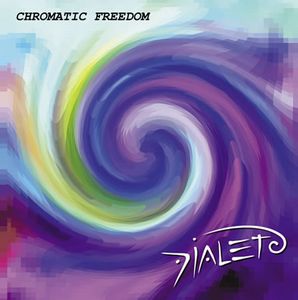
The title of Dialeto’s second album, Chromatic Freedom, refers to a specific concept derived from influential Hungarian composer Béla Bartók, and adapted to rock music – the exploration of the 12-note scale, also known as chromatic scale. The simple yet striking cover artwork reinforces the concept with a sort of visual pun. The essential role of cultural and ethnic integration in Dialeto’s sound is also rooted in Bartok’s artistic vision, as witnessed by the quote that introduces the band’s bio on their website. However, the album, far from being overly pretentious, is surprisingly approachable, its eclecticism realized in a streamlined rather than sprawling manner. Dialeto’s stripped-down format allows the three musicians remarkable freedom, their instruments emoting in synch or adopting a more free-form stance according to the requirements of the composition. They also produce an impressive amount of sound – a characteristic they share with the two King Crimson-related outfits that have been wowing American audiences these past few weeks, Tony Levin’s Stick Men and Adrian Belew’s Power Trio. All of these bands display an almost uncanny ability to produce endlessly intriguing textures using just the basic rock instruments – a markedly different approach to progressive rock than the traditional symphonic one.

Just like King Crimson and its offshoots, Dialeto allow vocals into the equation, often using them as an additional instrument – at times gentle and soothing, at others harsh and assertive. Lyrics are both in English and the band’s native Portuguese – the latter, in my view, a much more interesting choice, especially as the unique phonetic features of Portuguese and its proven effectiveness as a vehicle for music inject a sense of alluringly exotic warmth in the intricate fabric of Dialeto’s sound.

When listening to Chromatic Freedom, I was reminded of Texas-based band Herd of Instinct, another trio that made its recording debut earlier this year – though Dialeto lack the latter’s extensive use of touch guitars and the contribution of keyboards and other instruments to create eerie, ambient-like textures. The bare-bones instrumentation adopted by Dialeto, as well as the insistent, aggressively riff-based nature of many of their compositions, has prompted comparisons with punk and post-punk – reinforced by the vocal style in songs such as “Train of Destruction”. On the other hand, the analogy with Herd of Instinct’s debut (or even some of Trey Gunn’s output) is most evidently borne out by the album’s longest track, the hypnotic “This Is the World”, where the three instruments begin in a subdued tone – paralleled by the muted, almost whispered vocals – then the guitar gains strength towards the end.

Almost in a statement of intent, opener “Enigma”, propelled by Andrei Ivanovic’s pneumatic fretless bass and Miguel Angel’s tribal drum beat, skillfully blends echoes of King Crimson with Eastern-tinged chanting and eerie, drawn-out guitar sounds. The brooding bass line of “We Got It All” echoes the moody monotone of the singing, then the track takes a chaotic turn, with the vocals gaining a punk-like intensity; while the band’s signature tune “Dialeto” wanders into funky territory, with superb bass work throughout. The influence of Brazilian music emerges most clearly in the lovely, melodic “Falsa Valsa”, featuring a clear, piercing guitar solo, and in “Está No Ar” Brazil meets the Orient with a solid injection of abrasive Frippian guitar and towering bass lines. The most distinctly Crimsonian echoes, however, can be found the title-track, with its relentless, guitar-driven build-up, and the hauntingly atmospheric “Eu Me Lembro” – both of them bringing to mind the Wetton-Bruford period.

Although King Crimson have been frequently mentioned in the previous paragraphs, I wish to dispel any impressions that Chromatic Freedom is in any way a derivative effort. Dialeto have a very strong individual imprint, and any influences are reworked and integrated into the fabric of a sound made even more distinctive by the Brazilian and Middle Eastern suggestions. While the presence of vocals may be seen as disruptive by faithful devotees of purely instrumental music, in my view it contributes to making Dialeto an almost unique proposition. With an ideal running time below one hour and a nice balance between shorter, punchier numbers and longer, more atmospheric ones, Chromatic Freedom will appeal to the adventurous listener, and to everyone who still believes that prog can actually be progressive.

Links:
http://www.dialeto.org

Read Full Post »

« Newer Posts - Older Posts »